














By Anandpreet Kaur | Australia |
Satwant Singh Calais did not set out to build an organisation that would span a continent. He set out to ensure that Sikh children growing up in Australia would not do so without structure, guidance and a confident understanding of their identity.
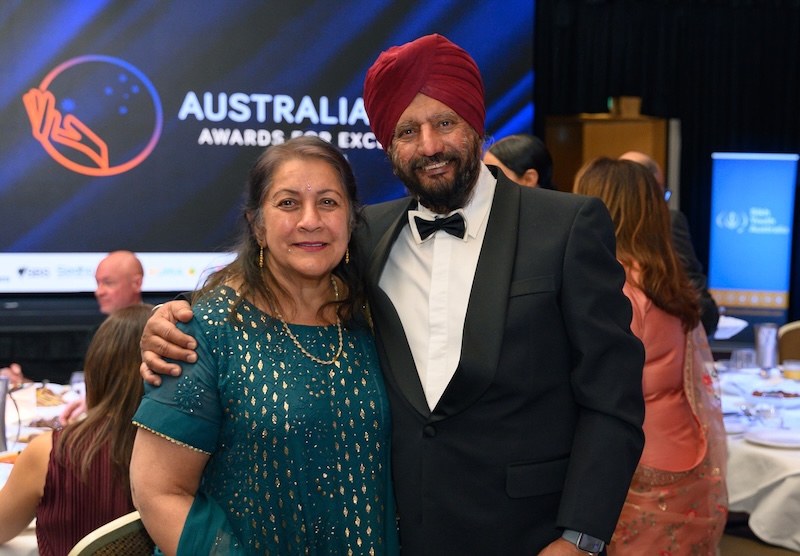
For that sustained and strategic investment in community-building, the co-founder of Sikh Youth Australia (SYA) has been awarded the Medal of the Order of Australia (OAM), recognising more than two decades of service focused on youth leadership development, values-based education and national-level Sikh engagement in a multicultural society.
Drawing from his formative years attending the Sikhs camps organised by the Sikh Naujawan Sabha Malaysia (SNSM) in the late 1960s, Satwant recognised early the transformative impact of structured youth camps.
When he and fellow founders established SYA in 1999, organised platforms for Sikh youth development in Australia were limited. What began as a summer camp model adapted from Malaysia has since evolved into a national organisation delivering more than 80 programmes annually — including leadership development initiatives, women’s retreats, professional mentoring networks, mental health engagement, interfaith collaborations and curriculum-based education outreach.
SEE ALSO: Sikh youth body comes of age in Australia
Under his stewardship as president since 2008, SYA adopted a strategic planning framework grounded in stakeholder consultation, financial sustainability and eight core organisational values. The result has been steady growth, diversified programming and measurable national reach.
On receiving the OAM, Satwant was quick to deflect attention.
“The award, for all intents and purposes, is a recognition of the hard and consistent sewa that has been done by dozens of parents, facilitators, supporters and senior youth to uplift the image and leadership of Sikhs across many sectors,” he told Asia Samachar.
Beyond SYA, he serves as chief patron and benefactor of the Australian Sikh Association at Glenwood Gurdwara and co-founded the Young Sikh Professionals Network (YSPN) in 2012 to mentor emerging leaders.
Professionally, Satwant has built a career in property and consultancy, previously serving as principal of Calais Consultants and currently as managing director of Gregory Hills Development Company.
The OAM forms part of the Australia Day 2026 Honours List, presented by Governor-General Sam Mostyn, recognising Australians for distinguished service to the community.
Experts from the interview.
Question: You co-founded Sikh Youth Australia at a time when organised support for Sikh youth in Australia was limited. Looking back, what personal experience or moment made you realise something like SYA needed to exist?
Answer: Having been a product of the Sikh Naujawan Samelans in Malaysia, which I attended from 1965, when the initial camps were held at Port Dickson Gurdwara, I saw the value of such camps. My last camp was in 1969, after which I left to pursue my Higher School Certificate in Hobart, Tasmania.
Together with our fellow co-founders — the late Ajmer Singh Ji, Sukhvinder Singh, Jaswinder Singh Sidhu, Gurpreet Singh and Dya Singh, along with Giani Sukhdaiv Singh Ji (Gurpuri Foundation) — we decided that a similar model was needed in Australia. We all had young Sikh children who required foundational knowledge in Sikhism, as well as the opportunity to be part of a larger cohort of Australian Sikh boys and girls.
We adopted the Malaysian model in the first two years but soon realised we needed to adapt the delivery style and engagement approach for Australian youth and their parents. These changes ensured sustained and growing participation from both youth and families.
Q: Receiving the OAM is a public recognition, but your work has always been deeply community-driven. What does this honour mean to you on a personal level, beyond the title itself?
The award, for all intents and purposes, recognises the consistent and dedicated sewa of dozens of parents, facilitators, supporters and senior youth who have worked tirelessly to uplift the image and leadership of Sikhs across many sectors.
Q: SYA has grown from a small youth initiative into a national platform over more than two decades. What leadership principles have stayed constant for you, even as the organisation has scaled and evolved?
Unlike gurdwaras, which have a constant stream of income from golak donations, SYA adopted a “user pays” principle from the start.
Unlike Singapore, Malaysia and Thailand, Australia is relatively young in terms of the establishment and recognition of Sikhs. New migrants understandably had to focus on economic survival and consolidation — jobs, skills development, housing and education. Attending camps costing hundreds of dollars was a significant commitment for many families.
We therefore focused on delivering value-for-money programmes, and word of mouth became our strongest marketing tool in the early years.
As our numbers increased, we began engaging stakeholders to better understand their challenges, needs and aspirations.
A strategic plan was subsequently formulated with the support of two external consultants — one Sikh and one non-Sikh. This plan provided a clear vision based on broad community input. We adopted eight key values and principles that underpin our programmes and organisational identity.
This framework enabled us to deliver new and innovative programmes beyond our flagship SYA summer camps, which, with Waheguru’s grace, have been running for 26 years.
Our initiatives include leadership development programmes for future leaders; women’s retreats; the Australian Sikh Awards of Excellence celebrating hidden gems across eight industry sectors; workshops on Artificial Intelligence (AI) and its impact on future generations; and interactive workshops, seminars and art exhibitions celebrating Sikh heritage.
We also run pop-up health clinics across all states to support new migrants and their parents; conduct spiritual sessions, meditation and kirtan tours for two months annually — from Brisbane and the Gold Coast to Perth — with the assistance of Veer Manpreet Ji, Dya Singh Ji, Giani Sukhdaiv Ji and other facilitators from overseas; and deliver over 80 programmes in gurdwaras and homes during this period.
In addition, we operate the Young Sikh Professional Network to mentor young professionals entering the workforce, and undertake charity work in a non-compete spirit, including langar sewa with Turbans 4 Australia and Sikh Volunteers of Victoria, serving women’s shelters and supporting community care following natural disasters.

Q: You’ve balanced long-term community leadership with a demanding career in property and consultancy. How have skills from your professional life shaped the way you approach community building — and vice versa?
As Sikhs, we are all lifelong learners.
A continuous improvement mindset is essential in all aspects of life, regardless of age. There has been mutual benefit — we have learnt immensely from our youth and new parents.
We focus on empowering young people with leadership and community development skills so they can contribute positively to Australia’s economic and social development.
Q: Many of SYA’s initiatives, like Sikh to Give and Divine Steps, centre on engaging with multicultural Australia. What must community organisations do differently today to remain relevant to younger generations while preserving cultural roots?
The diversity of programmes listed above helps engage youth and families. In addition, education — both internal and external — is key to ongoing community development.
Ongoing internal education about our history, heritage and religion, delivered through creative, innovative and self-development approaches, is critical. Simply sharing stories of our Gurus and shaheeds is not enough.
Sri Guru Granth Sahib Ji contains profound wisdom that few fully understand. We must translate and communicate this knowledge in the context of everyday life. For example, many young people face significant mental health challenges. The teachings of our Gurus can offer practical guidance — but we must collaborate with Sikh and non-Sikh professionals to develop programmes that meet this need effectively.
Externally, Australia is a wonderful multicultural country. Beyond food, dance and the Five Ks, we must educate fellow Australians about Sikh values.
We have been fortunate to engage with the Catholic Schools Organisation in Sydney, developing curriculum-based lessons on Sikhism and training their teachers. They now deliver the programme using resources developed by our team of educators and researchers.
This complements initiatives such as the first Divine Steps Festival, where nine different faith groups performed devotional music in an open-air concert that attracted more than 5,000 Australians from diverse backgrounds.
Q: What are some of the most pressing issues faced by the Sikh community in Australia today?
How long is a piece of string?
Q: Is there anything else you would like to share with our readers?
Thank you. We greatly appreciate the opportunity to share our work with the largest online platform serving our community. You are doing commendable work. May Waheguru bless you all. Gurkirpa.\
RELATED STORY:
25 years of nurturing Aussie young Sikh minds (Asia Samachar, 22 Jan 2025)
ASIA SAMACHAR is an online newspaper for Sikhs / Punjabis in Southeast Asia and beyond. You can leave your comments at our website, Facebook, Twitter, and Instagram. We will delete comments we deem offensive or potentially libelous. You can reach us via WhatsApp +6017-335-1399 or email: asia.samachar@gmail.com. For obituary announcements, click here