






















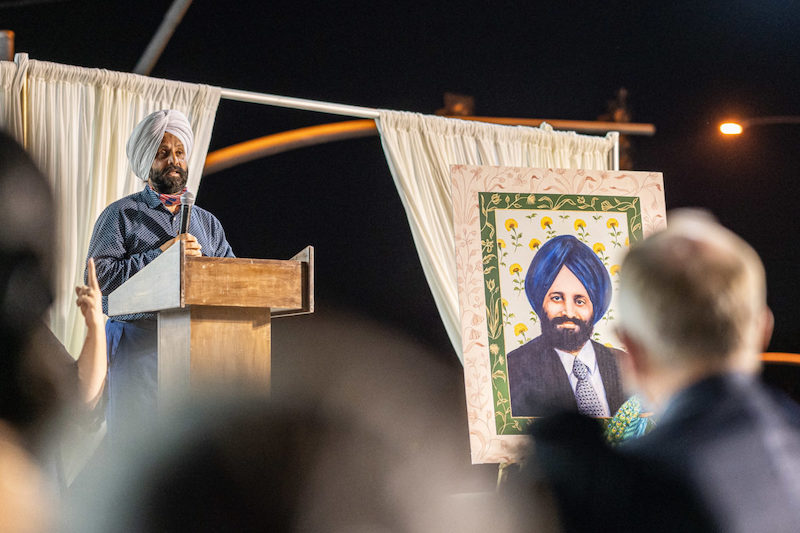
Left: At a memorial event on September 15, 2021, Rana Singh Sodhi speaks about his brother Balbir Singh Sodhi, who was killed four days after 9/11 while planting flowers outside his Mesa, AZ gas station. Photo Credit: Lee Media for the Sikh Coalition
By Frances Kai-Hwa Wang | United States |
After Sept. 11, Vishavjit Singh felt uneasy and unsafe in New York City. His turban and beard, articles of his Sikh faith, drew angry glares from his coworkers almost immediately after the attacks. With the understanding of his boss, he was able to leave Westchester county, where he worked as a software engineer at a telecommunications company, to go back home to Connecticut, where he would stay for a few weeks. In his mind, by then, things would have cooled down and he would no longer be at risk because of his appearance.
“When I went back to work, people in passing cars on highways rolled down their windows to yell at me and flip me off,” Singh said. “Out on the streets, people gave me angry and anxious looks. It was almost everyone. Women, men, white, black, young and old. It was one of the most unsettling times of my life.”
“This is coming from someone who has survived a genocidal massacre as a young boy in India in 1984 that consumed the lives of thousands of Sikhs.”
Sikhism is the fifth-largest religion, with more than 25 million Sikhs around the world. It was founded in the Punjab region in the northern part of India over 550 years ago in 1469. Sikhs have been living in America for over 125 years, and there are about 500,000 Sikh Americans, according to the Sikh Coalition. Important principles of Sikhism include social equality, truthful living, service to humanity, and devotion to God.
Part of the Sikh faith requires Sikhs to not shave or cut their hair to honor what God has given them and for Sikh men to wrap their hair in a turban to represent an outward commitment to their faith. Unfortunately, in America, beards and turbans are often mistakenly associated with stereotypes of terrorists — a dangerous linkage that has been perpetuated for years in popular media. This association has left Sikh Americans, as well as Muslim Americans, Arab Americans, South Asian Americans, and others vulnerable to targeted hate, violence, and discrimination.
Because some Sikh Americans are easily identified by their beards and turbans, they have a long history of being targeted by others looking for a scapegoat, reaching as far back as the 1907 riots in Bellingham, Washington, in which a mob of 600 white men attacked and drove 400 Sikh Americans out of town. However, they also have a long history of helping others and working for social justice. Over the past twenty years, the Sikh American community has come together to advocate, but also to help defend and uplift other marginalized groups.
Read the full story, ‘Sikh Americans push for greater visibility, awareness against years of hate crimes, misunderstanding’ (PBS News Hour, 11 Oct 2021), here.
RELATED STORY:
Anti-Sikh bigotry didn’t start with 9/11. That fact got me through it. (Asia Samachar, 10 Sept 2021)
ASIA SAMACHAR is an online newspaper for Sikhs / Punjabis in Southeast Asia and beyond.Facebook | WhatsApp +6017-335-1399 | Email: editor@asiasamachar.com | Twitter | Instagram | Obituary announcements, click here |