






















By Gurnam Singh | Opinion |
Introduction
At a time when the international order, established after the Second World War, is under significant strain, questions regarding the role and responsibility of political leadership have gained renewed urgency. In particular, the rise of powerful authoritarian leaders, such as Donald Trump and Vladamir Putin, coupled with the significant increases in inequality, conflict and refugee flows, has triggered important debates about the ability of international leaders and institutions to respond appropriately to the challenges facing humanity.
Against this backdrop, this article examines political leadership through a comparative lens that brings Sikh political ethics into a wider debate about leadership in Western political philosophy. By contrasting the leadership style of Maharaja Ranjit Singh with Donald Trump, the article explores competing conceptions of power, legitimacy, and moral responsibility. Drawing on Sikh concepts such as miri–piri, seva, and sarbat da bhala, the article argues that durable political authority is best understood as a form of ethical stewardship rather than control and domination. In doing so, it seeks to demonstrate the relevance of Sikh thought to modern debates on governance, leadership, and global political order.
Leadership, Power and Authority.
Western political philosophy has long wrestled with the tension between moral authority and coercive power. In The Republic, Plato’s ideal ruler is the philosopher king, not because he can command obedience, but because he understands ‘the good’ and governs with reason and knowledge rather than emotion. Leadership grounded purely in desire or ambition, Plato warns, deteriorates into tyranny.
Writing a very different kind of political handbook, the Roman emperor and Stoic philosopher Marcus Aurelius approached leadership from the inside. In the Meditations, composed while ruling his vast and fragile empire, he repeatedly reminds himself that since power is temporary, reputation brittle, ego is a poor basis for making judgments. For Aurelius, an effective ruler governs by self discipline, and by mastery over impulse before. From such a perspective, leadership becomes a form of ethical labour, rather than the wielding of power alone.
In contrast, Machiavelli, a figure who reportedly is idolised by Donald Trump, disrupts this moral standpoint. In The Prince, being an effective leader, he argues, in not predicated on moral virtue, but on clarity and determination to achieve your goals. Indeed, for Machiavelli, this may require deception, fear, or calculated cruelty, and for this reason, rulers cannot be overly restricted by ethical concerns. Yet even Machiavelli’s pragmatism is often misread as being morally blind. His concern was not the kind of spectacle or bravado that is the hallmark of authoritarian leaders like Donald Trump, but resilience. Machiavelli was firmly of the opinion that a leader who relies too heavily on fear invites resistance, decay and ultimately failure.
In the modern era, philosophers such as Hannah Arendt have returned to this question with renewed urgency following her work on totalitarianism, Stalin and Hitler. Arendt, distinguished sharply between power and violence: power, she asserts, arises from collective consent and shared purpose, while violence compensates for its absence. Where power must constantly be asserted, especially through violence and threats, she argued, it is already betraying its inherent weakness.
Contrasting Leadership Approaches
Sikhi is often and mistakenly seen purely as a ‘religious’ ideology only concerned with spiritual matters. This couldn’t be further from the truth! A cursory scan Sikh of scriptural and historical literature uncovers critical insights into the nature of human functioning, ethics, power, conflict and politics.
Sikh political thought begins from the premise that power must be balanced with responsibility and ethics. The doctrine of miri–piri, articulated by the 6 Guru of the Sikhs, Guru Hargobind, asserts that temporal authority (miri) is legitimate only when guided by moral responsibility (piri). Political authority from this perspective is not self validating; it must be measured by approval from the Sangat or general body of people over whom it is exercised. In this regard, one can see this as a middle ground approach between the ethical imperative of Marcus Aurelius and the pragmatism of Machiavelli.
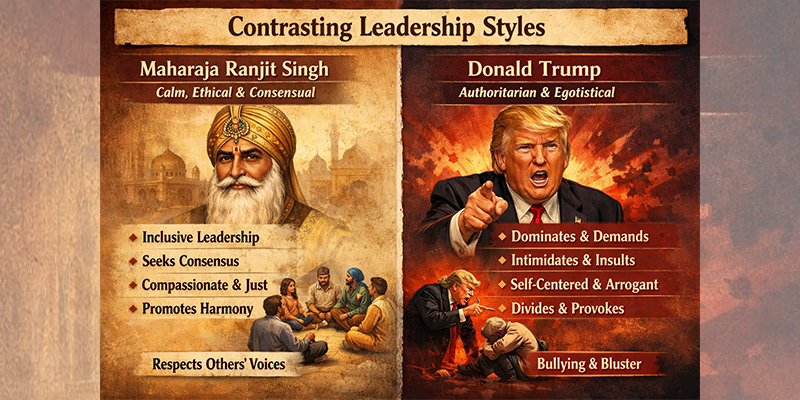
Maharaja Ranjit Singh’s authority reflected this balance. Though an autocrat by constitutional standards, he governed through consultation, religious plurality, and embedded power in institutions. His presence was restrained and his court was administrative rather than theatrical.
Donald Trump’s leadership style, by contrast, has been widely characterised as chaotic, performative and personality driven. Trump seeks to project power through visibility, rhetoric, and confrontation rather than consensus. For authoritarian leaders like him, institutions matter insofar as they serve the leader’s capacity to negotiate and prevail.
As for Trump, one can only speculate, but, his grave blunder to decide to attack Iran, that he may be subject to the 22nd Amendment of the US constitution. This gives Congress the power to remove a sitting president if is he is deemed unable to discharge the powers and duties of the office.
Power, Governance and Moral Responsibility
However they may have gained the leadership position, the moral duty of all rulers and ultimate justification for the power is invested in them is to serve the people and maintain social harmony. From Aurangzeb in Mughal India, to Hitler in Nazi Germany and Stalin in communist Russia, no leader in human history, however brutal their policies may have been, would claim to be motivated by cruelty. Indeed, rulers throughout history that have exercised brutality; tend to justify this as moral necessity and the need to maintain order. As for theocratic leaders, such as the Ayatollah’s of Iran, the justification is often to serve some higher purpose. Tyranny rarely presents itself as cruelty, but as duty!
In Sikh thought, tyrannical rule is not justified on any grounds, and certainly not as the will or mission of God. Legitimacy flows not from victory or mandate, but from ethical conduct in office. Ranjit Singh governed a religiously plural population by institutionalising fairness. Muslims retained their own legal practices; Hindu and Sikh sites received protection; and revenue systems were stabilised to reduce arbitrary extraction. His rule was not neutral, but it was broadly recognised as just, hence its durability.
Largely due to his legacy as the enlightened founder of a unified, tolerant Sikh Empire between 1799 and 1839, in a BBC World Histories Magazine poll in 2020, Maharaja Ranjit Singh was voted the “Greatest Leader” of all time. Riven by conflict and political instability, Ranjit Singh was credited with transforming a region into a prosperous and stable unified state through consensus and inclusivity.
Transactional leadership approaches, such as those characterised by Donald Trump often frame policy programmes as a series of deals, evaluated by immediate gain and loss. For authoritarian leaders, past alliances, norms, treaties and constitutional conventions are treated as obstacles to success, which is often defined in terms of winners and losers.
Diplomacy and Haumai (Ego)
Sikh ethics repeatedly warn against haumai or unbridled ego that can confuse personal will with collective good. Leaders shaped by haumai may succeed tactically in the short term, but destabilise the moral order necessary for lasting authority.
Ranjit Singh demonstrated an acute awareness of the limits of authoritarian rule. Facing the expansion of the British Empire, he resisted both submission and reckless confrontation. Indeed, one of the features of Ranjit Singh’s rule, which only ended after his death, were the numerous treaties, which were used not as a sign of weakness, but as tools for preserving autonomy and peace. Diplomacy was strategic, not emotional. As Khushwant Singh, in his book on the Maharaja notes, “Ranjit Singh was extremely angry with the English, but he had never let anger be his counseller.”
In contrast, Donald Trump’s approach to diplomacy has consistently foregrounded leverage and pressure. Long standing alliances are destabilised and chaos is used as a negotiating tactic. While such methods may yield short‑term concessions, they tend to undermine trust, which is a political asset that is difficult to restore once eroded.
Service Versus Extraction
At the heart of Sikh ethical leadership is the duty to serve rather than engage in self aggrandisement. Applied to leadership, it transforms power from possession into responsibility, with the ruler becoming a benevolent steward rather than a ‘brand’ that demands sycophantic support.
Ranjit Singh’s administration reflected this ethic. Under his rule, infrastructure, cultural life, and military reform were pursued not to enhance his image, but to stabilise the state. Expansion was followed by consolidation; institutions were strengthened to function beyond the ruler’s presence.
The daily Sikh prayer concludes with the slogan ‘sarbat da bhala…’ which literally means, welfare of all humanity. This is not some sentimental universalism or some spiritual escapism. Caring for the whole population is the best way to build cohesion. History tells us that societies endure when prosperity and security are broadly shared.
Ranjit Singh’s legacy rests not on conquest alone, but on the relative stability and confidence his rule brought to Punjab. Though his empire declined after his death, the memory that endures is one of order rather than fear.
By contrast, the transactional leadership associated with Donnad Trump and authoritarian leaders more generally, often externalises costs: disruption is reframed as innovation, and institutional strain treated as collateral damage. Such approaches may benefit individual leaders, but they weaken the systems they leave behind. Its successes may appear vivid, such as enforcing a deal through co-erosion or simple dishonesty, these are often fragile prone to breaking down. And when this occurs, the blame for failure tends to be directed elsewhere.
The comparison between the strength that Ranjit Singh derived through his firm but fair approach and that of Donnald Trump, is not simply a question virtue versus vice, but about different perceptions of strength. One understands power as something to be accumulated through restraint, justice, and service. The other, like the school bully, treats power as something demonstrated through generating fear, pressure and visibility.
Final Thoughts
At a time when strong political leadership is increasingly identified with authoritarianism resulting in growing conflict, humanity needs to unite. Maharaja Ranjit Singh offers an example of an alternative approach grounded in the miri–piri concept underpinned by sarbat da bhalla.
The language may differ – miri piri in nineteenth century Punjab, constitutional norms in the modern West – but the underlying test remains the same: does authority serve the common good, or simply the moment to satisfy their ego? And in this regard, the example of Maharaja Ranjit Singh lends considerable weight to the argument that strength shaped by restraint and benevolence does not need any cheer leaders; It endures because people recognise leaders who display these characteristics as their own.
Join the conversation on this story on Asia Samachar’s Facebook and Instagram pages.

Gurnam Singh is an academic activist dedicated to human rights, liberty, equality, social and environmental justice. He is a Professor of Sociology at University of Warwick, UK. He can be contacted at Gurnam.singh.1@warwick.ac.uk
* This is the opinion of the writer and does not necessarily represent the views of Asia Samachar.
RELATED STORY:
The Demise of the Akali Dal and the Badal Dynasty: What Next for the Panth? (Asia Samachar, 5 Aug 2024)
ASIA SAMACHAR is an online newspaper for Sikhs / Punjabis in Southeast Asia and beyond. You can leave your comments at our website, Facebook, Twitter, and Instagram. We will delete comments we deem offensive or potentially libelous. You can reach us via WhatsApp +6017-335-1399 or email: asia.samachar@gmail.com. For obituary announcements, click here