





















By Dr. Charanjit Kaur | Opinion |
“You Were Not Drunk When You Decided; But You Were When You Drove.”
Road accidents occur for many reasons across different environments. Rural areas face risks such as poor infrastructure, uneven terrain and delayed emergency response. Mountainous regions are exposed to natural hazards like landslides and falling rocks. Urban environments, however, are increasingly dominated by human error such as speeding, traffic violations, congestion and most critically, impaired driving. Among these, drink–driving has emerged as one of the most preventable yet persistent causes of death on the road. It is not simply a traffic offence. It is a moral failure with irreversible consequences. One person’s decision can destroy multiple lives which includes victims, families, spouses, parents and children who are left behind with trauma, financial instability and grief that cannot be repaired.
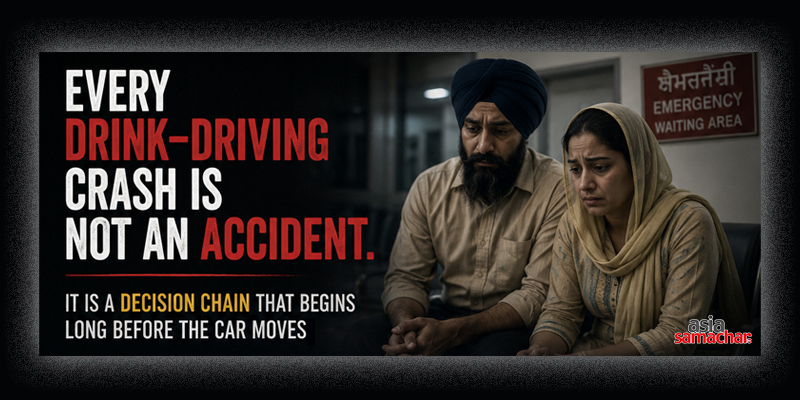
Every drink–driving crash is not an accident. It is a decision chain that begins long before the car moves: a choice to drink, even knowing judgement will be affected; a choice to still take the wheel, even knowing control is no longer certain; and a choice to risk lives that have no warning, no protection and no say in the matter. And then, in a single moment that cannot be reversed that chain becomes death; sudden, violent and irreversible.
From a policy perspective, Malaysia’s Transport Minister Anthony Loke has repeatedly emphasised in public road safety discussions that strengthening enforcement is more critical than continuously introducing new laws. This implies that legal frameworks already exist but the real issue lies in compliance and enforcement. This raises a difficult question: “If the law is sufficient, why do drink–driving deaths continue?”. Drink–driving is not a traffic issue. It is a life-or-death moral boundary violation. Laws exist. Awareness exists. Yet deaths continue. So, the real question is no longer “What is the law?” but “Why is human responsibility still failing?”The answer may lie beyond legislation itself: in enforcement consistency, social tolerance and cultural normalisation of alcohol consumption before driving.
There is a stark contrast between what drivers say and what families later hear. Drivers often convince themselves with phrases such as “I’m fine to drive”, “It’s just a short distance” or “I know my limit”. Yet these statements are later replaced with irreversible messages received by families: “Your son didn’t make it”, “Your spouse is gone” or “We tried to save them”. The gap between perception and consequence is not just wide; it is fatal. The consequences of drink–driving are not abstract statistics but lived realities. Families lose breadwinners overnight, children grow up without parents and survivors carry lifelong psychological trauma. Entire communities absorb collective grief. The impact is not individual but collective and generational which is why drink–driving cannot be reduced to a personal lifestyle choice. Once a vehicle is involved, private decisions become public consequences.
Sikh Ethical Framework: Discipline, Awareness andResponsibility
Sikh teachings approach this issue from a foundational ethical principle: a clear, disciplined and responsible mind is essential for moral living. The Sikh Rehat Maryada clearly instructs initiated Sikhs to abstain from intoxicants including alcohol, tobacco and drugs. This is not about ritual purity. The underlying principle is that intoxicants weaken judgement, discipline and self-control. In ethical terms, this directly connects to road safety: a person who consumes intoxicants and then drives is knowingly compromising their responsibility toward others.
The Guru Granth Sahib does not address modern road transport directly but it repeatedly warns against intoxication that clouds judgement and moral awareness:
“ਮਨ ਤੂੰ ਜੋਤਿ ਸਰੂਪੁ ਹੈ ਆਪਣਾ ਮੂਲੁ ਪਛਾਣੁ” (Guru Granth Sahib, Ang 441)
The mind is light; recognise your true responsibility.
If the mind is meant to be aware and disciplined, then driving under intoxication is not ignorance. It is negligence.
Despite ethical frameworks, alcohol consumption has become socially normalised in many cultural contexts. In certain Panjabi and Malaysian social environments, alcohol is often treated as a symbol of celebration or social bonding. Weddings, celebrations and hospitality settings frequently include alcohol as a marker of enjoyment or status.Justifications are commonly offered, such as “I drink but I don’t disturb others”, “I use Grab or a designated driver” or “It is my personal freedom”. While harm-reduction measures reduce risk, they do not address the deeper issue of normalising impaired judgement in environments where driving may follow. Even when alternatives exist, social expectation continues to shape behaviour. Would you still call it “unfortunate” if the victim was your own family?
Community Silence and Moral Responsibility
A significant obstacle to progress is the pervasive reluctance within certain community spaces to confront the reality of alcohol-related harm. This silence is often maintained by a complex intersection of social sensitivity, cultural pressure and the economic interests tied to grand celebrations. However, the Sikh ethical tradition is rooted in the virtue of Truthful Courage (Sach). From an ethical standpoint, remaining silent in the face of preventable death is deeply problematic, especially when the harm is both predictable and recurring. Field observations and academic interviews reveal a troubling pattern: many individuals attend alcohol-centric events solely out of respect for ‘family expectations’ or ‘social etiquette’ even if they personally abstain. While seemingly harmless, this collective compliance creates a normalization trap. Over time, alcohol’s presence shifts from being a personal choice to a social expectation, effectively enabling a culture of risk.
To break this cycle, our response must be as balanced as it is firm. While emotional pleas for extreme punishment are a natural reflection of the deep pain caused by such losses, sustainable transformation requires a more sophisticated, multi-dimensional strategy. This begins with rigorous enforcement to ensure that legal consequences remain certain and consistent, alongside targeted education that moves beyond simple slogans to address the psychological myths surrounding ‘safe’ drinking limits. Furthermore, we must integrate compassionate rehabilitation to provide support systems for those battling underlying addictions while simultaneously driving cultural reform. By courageously redefining our social gatherings, we can begin to prioritise human life and collective safety over traditional expectations of hospitality or social convenience.
In conclusion, drink–driving is not simply a legal violation. It is a failure of moral responsibility toward human life. Across policy, ethics and Sikh teachings, the principle is consistent: any action that impairs judgement and endangers others cannot be justified as personal freedom. The real challenge is not only law enforcement but cultural transformation. Stronger enforcement, continuous education and ethical awareness must work together to shift society from tolerance of risk to protection of life. Ultimately, the question remains: “If we know our actions can kill innocent people, at what point does ‘personal choice’ become moral negligence?”

Associate Professor Dr. Charanjit Kaur is an expert in cultural anthropology, with a special focus on the Sikh minority community in Malaysia. Her work explores themes such as religious-cultural conflict, gender identity, and social behavior.
RELATED STORY:
Faith, Culture and Clarity: A Sikh Perspective on Diwali in Malaysia (Asia Samachar, 21 Oct 2025)
ASIA SAMACHAR is an online newspaper for Sikhs / Panjabis in Southeast Asia and beyond. You can leave your comments at our website, Facebook, Twitter, and Instagram. We will delete comments we deem offensive or potentially libelous. You can reach us via WhatsApp +6017-335-1399 or email: asia.samachar@gmail.com. For obituary announcements, click here