






















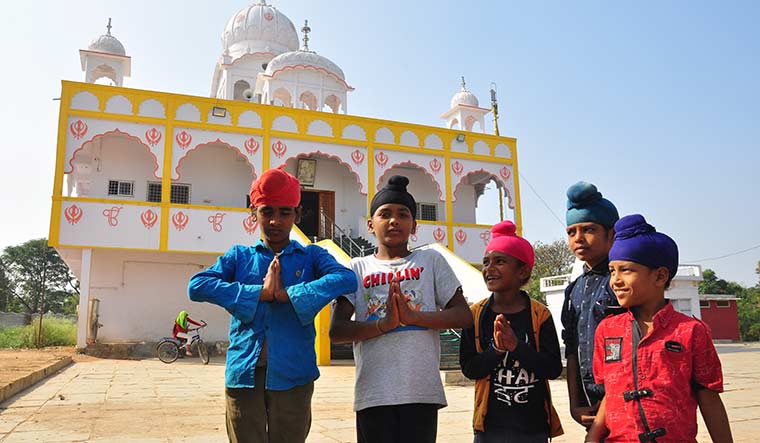
Guiding light: Children in front of the gurdwara in Gachubhai Thanda – Photo: P. Prasad / The Week
By Rahul Devulapalli | The Week | India |
TO REACH GACHUBHAI Thanda, one has to follow the line of sight of a renowned Hindu saint’s statue. The 216ft-tall statue of saint Ramanujacharya, also called the Statue of Equality, will be unveiled by Prime Minister Narendra Modi in February 2022.
The tribal hamlet and its neighbour, a spiritual mascot, lie in Shamshabad, a short drive from Hyderabad. A narrow, dusty lane off the Hyderabad-Bengaluru highway leads to the entrance of the settlement. But for the villagers, Gachubhai Thanda now exists only on paper, as they insist that they live in Guru Gobind Singh Nagar.
It is Sunday morning, and a middle-aged man donning a Patiala shahi pagg—a traditional way for tying the Sikh turban—with a kirpan slung across his chest, guides a heavy vehicle. A little farther away, a youngster in a gol parna (another Sikh turban style) stands outside a small concrete house. And, on reaching the open field, one can see six boys in patka—a smaller under-turban worn by children—playing cricket. One does not need to refer to official records to know that 90 per cent of residents here are Sikhs.
The village has around 500 residents, almost all of whom are Lambadas, listed under the Scheduled Tribes. The conversion to Sikhism happened in the last 20 years or so. The villagers mostly speak Lambadi and a bit of Hindi and Telugu, but no Punjabi. The village has its own gurdwara—Gurdwara Saheb Dashmesh Darbar. The two-storied structure lies on one end of the village, surrounded by farmland.
In its vicinity lives Lakhvinder Singh, who was born Khetawat Deepla. All Sikhs in the village took new names when they embraced the new religion. Lakhvinder, 73, is president of the gurdwara committee. The gurdwara stands on land he donated five years ago. “Life became more meaningful after I converted,”says Lakhvinder, who was among the first converts. He points to a room in the gurdwara premises, and says, “That is where it all started for us.”
Inside the unused room is a two-feet-high tomb. “Our ancestors used to occasionally visit the Nanded Sahib in Maharashtra,”recalls Lakhvinder. “Around 50 years ago, they set a bull free, chanting the name of Guru Gobind Singh. When it died, they buried the animal and constructed a tomb. The elders then placed a picture of Guru Nanak above the tomb and conducted pujas for a long time. In 1996, we raised a roof and turned it into a small temple.”
It was another village elder—Bhagat Singh—who initiated the process of building a gurdwara in the village. Bhagat claims to have visited the Sikh holy sites in Pakistan and also stayed at a gurdwara in Hyderabad for nearly five years to get a deeper understanding of the faith and its tenets.
“In 2001, I consulted Sikh religious leaders on converting our small temple into a gurdwara,”recalls Bhagat, an auto driver. “We were told that it was better to embrace Sikhism if we wished to perform rituals at the gurudwara. Around 70 of us then got initiated into the faith, and we started carrying the five articles mandated by the religion.”
Read the full story, ‘How a tribal village in Telangana turned to Sikhism’, (The Week, Issue @ Jan 2022), here.
RELATED STORY:
A letter to SGPC: Unethical conversion of Sikhs in Punjab (Asia Samachar, 24 Dec 2021)
ASIA SAMACHAR is an online newspaper for Sikhs / Punjabis in Southeast Asia and beyond.Facebook | WhatsApp +6017-335-1399 | Email: editor@asiasamachar.com | Twitter | Instagram | Obituary announcements, click here





They became Sikhs when impressed by mystic life of a Sikh saint of Hazur sahib. Whereas revisionist missionaries who are misleading ignorant Sikhs by creating phoney issues have not been able to get any Sikh from other religions. Time to wake up for the likes of ghagha, dhundha, ghaghriwala.
Comments are closed.