Jasvir Singh is one of the most prominent Sikh voices in British public life. He is also gay – a fact that he has kept mostly private until now. It’s put him at odds with some members of his own community, but he says he now wants to speak up about his sexuality.
Jasvir Singh lays out some photographs on the table in front of him. They are pictures of joyful moments from the day last summer when he married his husband, Nick.
“I know that speaking about this is going to be highly controversial,” he says. “I’m sure there will be lots of people out there who will be upset, annoyed, even angry at me.
“But I’ve got nothing to hide and I know that I have got Waheguru [God] with me, as I have had Waheguru with me all the way.”
Jasvir is a family law barrister and the main Sikh contributor to Radio 4’s Thought For The Day. He has just been awarded a CBE for his work bringing faith communities together and advocating for vulnerable groups.
But through it all, he has lived with a swirl of speculation about his private life – often spilling over into attempts at intimidation – that he now wants to address head-on.
“There is a very small element of the British Sikh community that makes itself loudly heard. From them I have received death threats for being gay, I have been accused on a TV station of being an infidel and I have even had individuals call me up and threaten to expose me.”
Though Jasvir says he has not tried to hide his sexual orientation, it is not something he has talked about publicly.
After a video from his wedding recently started being shared on social media, he felt the time was right to speak up. He wanted to tell his story on his own terms, and also to send a message to gay Sikhs facing difficulties.
“Just as my Sikhism is part of me, so is my sexuality. So is my turban. So is my identity. I can’t divorce any one thing from the rest of me. That is who I am.”
Jasvir Singh chairs London-based City Sikhs and is the vice chair at the Faiths Forum. To read the full story, click here.
ASIA SAMACHAR is an online newspaper for Sikhs / Punjabis in Southeast Asia and beyond. When you leave a comment at the bottom of this article, it takes time to appear as it is moderated by human being. Unless it is offensive or libelous, it should appear. You can also comment at Facebook, Twitter, and Instagram. You can reach us via WhatsApp +6017-335-1399 or email: asia.samachar@gmail.com. For obituary announcements, click here.
Bhawinder Kaur (daughter) / Rajindar Singh (son in law)
Arwindar Singh (Grandson)
Path da Bhog will be held on 12th Feb 2023 (Sunday), from 10am -12.00pm, at Gurdwara Sahib Gunong Rapat, Ipoh. Address: Lorong Gunung Rapat 11, Gunung Rapat, 31350 Ipoh, Perak
A loving and devoted husband, father, father-in-law, and grandfather. He lived a full life and will be missed terribly by his family.
| Entry: 5 Feb 2023 | Source: Family
ASIA SAMACHAR is an online newspaper for Sikhs / Punjabis in Southeast Asia and beyond. When you leave a comment at the bottom of this article, it takes time to appear as it is moderated by human being. Unless it is offensive or libelous, it should appear. You can also comment at Facebook, Twitter, and Instagram. You can reach us via WhatsApp +6017-335-1399 or email: asia.samachar@gmail.com. For obituary announcements, click here.
Sunset at Gurdwara Bangla Sahib in a 2010 – Photo: Rajdeep Matharu
By Rishpal Singh Sidhu | Opinion |
The Sikh community is sometimes confronted with shameful and disturbing news reports of fights taking place in some of our gurdwaras around the world where there is face-to-face confrontation between opposing groups and/or gurdwara management committees. In some instances, where there is physical violence, swords or kirpans are brandished, some antagonists have had their dastars removed (Punjabi: ਦਸਤਾਰ, also known as a ਪੱਗ paga or ਪੱਗੜੀ pagaṛī), and the police have had to be called in to enter the darbar hall to control the melee. It is common knowledge that most if not all of these fights are mainly about the administration and control of the gurdwaras, more specifically the funds received through bheta/offerings to the golak which can amount to a considerable sum of money, depending on the size of the gurdwara and worshipping sangat. This calls into question the pressing and urgent need for greater transparency and accountability on precisely how these collected monies are expended for the benefit, welfare, and greater good of the sangat.
Golak (Sanskrit golak; Persian gholak) or Guru ki Golak (the Guru’s own till) refers to a box or container used for receiving contributions from the sangat, and has a religious as well as a historical meaning in the Sikh tradition.1 It dates back to an early time in Sikh history with the formation of the sangat (holy fellowship) and pangat (commensality), including the establishment of a common kitchen (langar), the upkeep of which needed financial and other resources. “Langar for the Sikhs became, therefore, Guru ka Langar and the golak, Guru ki golak.” 2 “Garib ki rasna, Guru ki Golak” goes a Sikh saying and feeding a poor man is tantamount to the Guru’s golak” 3 This golak is normally placed in front of the sanctum into which cash offerings are placed by the sangat when paying obeisance to the Sri Guru Granth Sahib (SGGS). Other offerings such as bags of rice, atta, fresh milk, ghee, and mithai (ਮਿਠਾਈ, ਮਿਠਆਈ) are often also placed alongside the golak for use in the Guru ka Langar. The Rahitnamas (Manual/Code of Conduct) encourage Sikhs to set aside one tenth of their earnings (dasvandh) towards a common fund for communal or charitable causes. A Sikh guilty of religious misconduct (tankhaiya), if found guilty by the sangat, can, amongst other punishments, be required to pay a penalty such as contributing towards the Guru’s golak. 4
This concern for transparency and accountability in the management and use of offerings to the Guru’s golak is not something new, and dates back to the time of our third Guru, Guru Amar Das, who established the manji system (Punjabi: ਮੰਜੀ, zone or district of religious administration) to better cater to the growing needs of geographically dispersed Sikh sangats. He appointed agents called manjidars who were fully conversant with the doctrines of the (Sikh) faith, to organize worship and collection of offerings for the golak (community chest). 5 Some doubt remains as to exactly when and which Guru established the masand system to replace the manjidars, with some accounts mentioning Guru Amar Das, and still others mentioning Guru Arjan. 6 “The masands played an important role in the further growth and development of Sikhism in successive decades before in-fighting, factionalism, and corruption started to taint this institution.” 7 Like the manjidars before them, the masands were not expected to use or depend on the offerings they received to support their own subsistence. These offerings were to be used primarily in support of the langar and other charitable causes. Over time, there was increasing concern over the growing indulgence and corrupt practices of several of these masands, some of whom had grown increasingly corrupt, dictatorial, grasping power as opportunity offered, and keeping what offerings they had collected in the Guru’s name. Some even “engaged in money lending and trading on the offerings they extorted from the poor peasants.” 8 This growing disaffection with their corrupt practices and behaviour led to Guru Gobind Singh’s announcement and decision to abolish the masand system on Baisahki Day of March 20, 1699.
Fast forward to the 20th century and present times, it would appear that nothing much has really changed, and modern day masands continue to exist albeit in a different guise! The Sikh Review journal of February 1993 featured an editorial by S. Saran Singh aptly titled The Young & the Restless. He noted “that there has been a growing tendency among office bearers of Gurdwara management everywhere to play power politics. Wrangling over control of funds is not uncommon. Entrenched members consider Gurdwara property as their fiefdom and adopt unethical practices to retain control, resulting sometimes, in unseemly civil and criminal legislation.” The editorial of The Sikh Review in December 1999 was even more scathing in commenting that “if Sikhs were angels, Gurdwaras won’t need elections.” “The present day causes of division and disjunction in the Sikh Gurdwaras can, in some instances, be attributed primarily to complex interplay between personal rivalries, caste, sect, and to a certain degree, class.” 9 Chahal (2002) also avers that such fights that have taken place in our gurdwaras are more about power play and control of the huge funds collectively received in the golak from the sangat, which in some of the larger gurdwaras can amount to well over a million dollars each year. 10 Mahatma Gandhi was not wrong in observing that “those believe that religion and politics aren’t connected don’t understand either.” American writer Mark Twain was much more direct and “quite sure now that often, very often, in matters concerning religion and politics, a man’s reasoning powers are not above the monkeys.”
Gurdwaras in the Punjab come under the control of the Shiromani Gurdwara Parbandhak Committee (SGPC). Manjit Singh (2001) noted that “the SGPC ran smoothly between 1925 to 1947. The tone and demeanor of gurdwara management was low-keyed, forthright, and progressive. In general, the SGPC met the expectations of the community and did not entangle itself in politics.” 11 Much has changed since 1947 and “now elections to the SGPC or any other gurdwara committee are no different from the ordinary political elections” 12. Mann (1999) opined that the “SGPC should extract itself from the political arena and devote itself to a management regime which may be a global model for all gurdwaras” 13. “Master Tara Singh, who came into prominence at the time of the Gurudwara Reform Movement, is on record as having said that while the Sikhs had been successful in getting rid of the traditional Mahants, it would not be easy to get rid of the new Mahants that were now climbing into power. History has proved him right, and the situation in regard to the management of the gurdwaras today is much more unsatisfactory and characterized by more corruption than is usually acknowledged.” 14
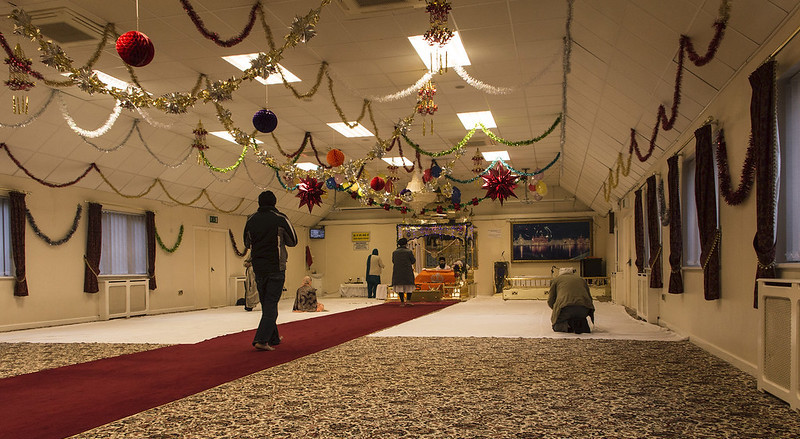
Sunderland gurdwara in 2012 – Photo: Jatinder Dhillon
Irrespective of where they are located around the world, gurdwaras are an integral part of the Sikh way of life, and apart from spiritual upliftment, play an important role in catering to the sociocultural and sociopsychological needs of their Sikh communities. The many tasks they are required to perform include organizing and providing religious services in compliance with the Rehit Maryada, prudent management of income and expenditure, proper and hygienic maintenance of gurdwara premises and facilities, teaching of Gurmukhi, Gurbani, and other Sikh arts. The granthis, raagis, and kathakar all need to be adequately and appropriately paid from the golak. Gurdwara management committees are also expected to conduct their financial management affairs in compliance with the laws of the countries where they are located. This requires submission of audited financial statements appended to reports presented at annual or biannual general meetings. In addition, these management committees also have the potential to actively play a wider role and contribute to their respective country’s economic development and nation-building activities.
The conduct of all these activities does come at a cost and the primary source of income is contributions to the golak and direct donations from the sangat which need to be correctly and scrupulously receipted. How often the golak is emptied and the monies therein accounted for, and in whose presence this accounting takes place are all important questions that need to be rigorously addressed by gurdwara management committees.
There have been several news reports of brazen golak thefts being caught on CCTV. What happens to the surplus income over recurrent operating expenditure? Should it be spent on lavish and unnecessary decoration and embellishment of premises? Should excess income over expenditure be invested in term deposits and stocks and shares? There have been news reports of surplus income over expenditure being used by some gurdwara management committees for investment in real estate. Should the sangat not first be consulted and their views/approval first sought on this and other important large scale capital works expenditures at an extraordinary general meeting/annual general meeting? Should gurdwara management committees have their terms of office limited to no more than two consecutive terms so as to provide opportunities for new and fresh management initiatives and insights? In this context, it is instructive and of particular interest to listen to a lecture given in early 2013 by Professor Harjinder Singh Lallie from Warwick University regarding the financial practices of gurdwaras in the UK, titled “Corruption and pack politics in Gurdwaras; An examination of issues in transparency and governance in Sikh institutions.” Prof. Lallie has done much significant research into the publicly available documentation from Gurdwaras and why such corruption exists. 15
Interestingly, a Gurdwara located in South Shields, United Kingdom, called Khalsa Mero Roop Hai Khaas, was first reported in December 2014 as being the only known Gurdwara in the world which operated just on sewa of sangat. This Gurdwara has no golak, no paid granthis, kirtaniye, committee, or any employee. First opened in 1981, the sangat volunteers collectively manage the Gurdwara, prepare langar, and do kirtan and katha.
Just as it would be wrong to tar or taint all gurdwara management committees with the same brush, it would also be fanciful thinking that the SGPC or some other global organization could be established to provide guidance on both, governance, and sound transparent financial management of our gurdwaras. Models of good and enlightened gurdwara management do exist in many countries around the world, and the Singapore Central Sikh Gurdwara Board’s (CSGB) management of the two gurdwaras under its jurisdiction (Central Sikh Temple and the Gurdwara Sahib Silat Road) is but one of many known examples of good and transparent governance of gurdwaras around the world. There is no shortage of highly skilled Sikh professionals with extensive corporate experience in the business, legal, and financial fields in many countries, ‘waiting in the wings’ and willing to step forward to serve on their gurdwara communities if only some of the entrenched ‘old guard’ are willing to let go of their prejudices and old ways of management and thinking and give them the opportunities to lead the way forward with changing and more progressive times. This is the crucial or essential question! Are the present gurdwara management committees ready and willing to ‘hand over the baton’?
References
1. Singh. H. (2001). Editor-in-Chief. The encyclopedia of Sikhism, vol 2, p.100. Punjabi University Patiala.
2. Ibid., p.101
3. Ibid., p.100
4. Singh. H. (1998). Editor-in-Chief. The encyclopedia of Sikhism, vol 4, p.305. Punjabi University Patiala.
5. Sidhu, R.S. The role of the masands in Sikh history. The Sikh Bulletin, October-December 2019, p.43
6. Ibid., p.44
7. Ibid., p.44
8. Singh, K. (1999). A history of the Sikhs, vol 1; 1469-1839. New Delhi, Oxford University Press, p.82
9. Khaira, G.S. Sikh Gurdwaras: Problems and possible solutions. The Sikh Review. vol 48 no 4, April 2000.
10. Chahal, D.S. Meanings and functioning of gurdwaras. Understanding Sikhism; The research journal, vol 4 no 1, January-June 2002
11. Singh, M. Management of Sikh Gurudwaras. Discussion Paper 1. Presented at the University of Waterloo Conference. Sikhs in the Diaspora: New century, new challenges.
12. Ibid.
13. Mann, K.S. On Gurudwara legislation. Abstracts of Sikh Studies, January 1, 1999.
14. Singh. A. Sikhs at the turn of the new century. In Sikh history and religion in the 20th century.
Rishpal Singh Sidhu is a semi-retired casual academic at the School of Information and Communication Studies, Charles Sturt University, Wagga Wagga, Australia. He has a passion for research, writing, and teaching and is the compiler and editor of the book, Singapore’s early Sikh pioneers; Origins, settlement, contributions, and institutions, published by the Central Sikh Gurdwara Board in Singapore in 2017. He is currently based in Sydney, Australia.The article was first published at Sikh Bulletin (2023 Issue 1, January-March 2023)
* This is the opinion of the writer, organisation or publication and does not necessarily represent the views of Asia Samachar.
ASIA SAMACHAR is an online newspaper for Sikhs / Punjabis in Southeast Asia and beyond. When you leave a comment at the bottom of this article, it takes time to appear as it is moderated by human being. Unless it is offensive or libelous, it should appear. You can also comment at Facebook, Twitter, and Instagram. You can reach us via WhatsApp +6017-335-1399 or email: asia.samachar@gmail.com. For obituary announcements, click here.
Akhand Path begins (arambh) at 8am, 17th February 2023 (Friday) – 19th February 2023 (Sunday) with daily Rehraas & evening kirtan at Darbar Sri Guru Granth Sahib Ji (Address: 10, Lorong 51a/227b, Section 51A, 46100 Petaling Jaya, Selangor)
Sahej Path da Bhog & Antim Ardas
19th February (Sunday) Path da Bhog of Sri Akhand Path Sahib: 8am – 9.30am Kirtan and Katha: 10am Sehaj Path da Bhog & Antim Ardas: 11.30am Thereafter, Guru Ka Langgar will be served.
Please treat this as a personal invitation from the family.
A loving and devoted husband, father, grandfather & great grandfather. He lived a full life & will be missed terribly by his family.
| Entry: 5 Feb 2023; Updated: 8 Feb 2023 | Source: Family
ASIA SAMACHAR is an online newspaper for Sikhs / Punjabis in Southeast Asia and beyond. When you leave a comment at the bottom of this article, it takes time to appear as it is moderated by human being. Unless it is offensive or libelous, it should appear. You can also comment at Facebook, Twitter, and Instagram. You can reach us via WhatsApp +6017-335-1399 or email: asia.samachar@gmail.com. For obituary announcements, click here.
A group of young footballers in Spain and their team officials showed a high degree of understanding of the Sikh way of life when they stoodby their patka-bearing Sikh player.
Patka is a small turban, usually worn by Sikh children to cover their uncut hair. It is even worn by adults when engaging in sports or appearing casual at home.
The incident took place in a cadet match between Arrigorriaga and Arratia C, at the Padura sports facilities, reported by the DEIA newspaper.
Gurpreet Singh, 15, was fielded in the second half of the game. But the referee asked him to remove the patka, badging it as a hat.
The Arratia players interceded to explain that the patka is part of his faith, but the referee did not budge. The teammates then decided to leave the field of play as a sign of solidarity.
But the Vizcaya Football Federation slapped the Basque club with a €300 fine and three points.
The referee justified his decision by alluding to the fact that the 15-year-old was wearing a hat, and explained to the players that it is prohibited according to the regulations. Before this match, however, other referees have avoided that interpretation and have acted with flexibility, according to media reports.
Arratia club president Pedro Ormazabal said Gurpreet has been playing normally for at least four years, both in children and in the first year of cadets, without any problems.
“The kids were the first to support him. The coach did too. Afterwards, he was supported by the players of the rival team and the families who had attended the game,” he added.
“The situation is tough for a cadet kid, although I see him as strong. He is fully integrated into the valley, speaks Basque perfectly, like any other boy from Arratia, and is a boy loved by his classmates. In addition, he is a smart boy, quick-witted, and has clear ideas. Gurpreet has adapted to our culture and society, are we not capable of allowing him to play with a garment linked to his religion and his culture?” he added.
The Biscayan Football Federation has maintained the punishment for Arratia C, for having left the field. It has left it up to the referees to interpret the regulations on which the referee who did not allow Gurpreet to play with his patka has relied.
ASIA SAMACHAR is an online newspaper for Sikhs / Punjabis in Southeast Asia and beyond. When you leave a comment at the bottom of this article, it takes time to appear as it is moderated by human being. Unless it is offensive or libelous, it should appear. You can also comment at Facebook, Twitter, and Instagram. You can reach us via WhatsApp +6017-335-1399 or email: asia.samachar@gmail.com. For obituary announcements, click here.
Sikhism or Sikhi is a faith belief system that emerged in the late 15th century in the Punjab region of India. It arose in a context where religious, caste and gender-based violence was the norm. Its founder, Guru Nanak sought to break free from previous traditions by offering a new paradigm centred on the belief in a transcendent formless divine spirit or ‘Akaal Purakh’, the rejection of religious intolerance, arbitrary social divisions (e.g., class, race, caste and gender), irrationality, and ritualism.
The scripture of Sikhi, the Guru Granth Sahib (GGS), contains writings from Sikh Gurus and is revered as the living Guru. Accordingly, Sikhs regard the GGS as the source of the ultimate source of guidance on spiritual and ethical matters. Sikh ethics are primarily based on the principles laid down in Sikh scripture, which stresses virtuous living, non-discrimination, the pursuit of truth and justice, selfless service of humanity, compassion for all humans and non-humans, critical thinking and reflection, contemplation and meditation on the divine.
Within modern society, whether one is talking about the role of professionals or research involving human subjects, there are rules and legal duties designed to ensure ethical behaviour and actions. Against this backdrop, this paper aims to offer a brief overview of Sikh ethics, which is specifically aimed at professionals and researchers. The paper offers an insight into core values and injunctions that are set out in Sikh scripture, but also in terms of precepts upon which ethical decisions can be arrived at from a Sikh philosophical perspective. This second aspect is particularly important for the contemporary age where, because of momentous social, cultural and technological change, humanity is constantly facing unimaginable new ethical challenges and dilemmas.
LOCATING SIKH ETHICS WITHIN SIKH TRADITIONS
Ethics forms a central plank of Sikh teaching which can be applied to all aspects of life, from the way we treat both human and non-human life to how one might provide care to conducting research. Though Sikh scriptural writing can be dated back to the 12th Century and the writings of the Sufi Saint, Sheik Farid, the consensus is that Sikhism, as a distinct faith tradition, was established by Guru Nanak[1] in the 15th Century in the Punjab.
The noun ‘Sikh’ means ‘seeker of truth’, and the faith advocates social equality, social justice, service to humanity, honest living and tolerance of others. In summary, the purpose of human existence according to Sikh teaching, is to carve out a perfect noble mind to live a life according to ‘hukam’, or ‘divine order’. The process begins with nurturing of spiritual consciousness through tuning the mind to centre itself on ‘Paramatma’ or ‘Universal Divine Soul’, which pervades all things, all places, and all times.
Moral values and ethics from this heightened sense of universal divinity align with Paramatma’s virtues. The challenge is to control ego-centredness and temptations or desires that may lead to unethical behaviour. The ethically aware mind, stabilised in the realm of spiritual truth or exalted grace, is thus best placed to make the right judgements. Whilst recognising there is no complete exalted state, developing divine ethical consciousness is seen as a continuous lifelong learning process. The qualities one needs to nurture to move along this learning path are divinity, critical reflexivity, discerning intellect and reasoning, creativity, patience, love, self-control, self-awareness, kindness, understanding and humility.
LOCATING SIKH ETHICS WITHIN OTHER TRADITIONS
Most discussions on ethics revolve around resolving the tensions between objective and subjective domains. Put another way, between universal rules-based approaches which seek to minimise self-perception or prejudice and contextual approaches, where self-efficacy becomes instrumental to determining right and wrong actions. Characterised as a challenge between the abstraction of experience on the one hand and the messiness of embodied experience on the other, in this sense, Sikh ethics is no different to any other tradition.
A cursory scan of Sikh canonical scriptures contains examples of precepts encompassing the main ethical approaches as set out within most contemporary research literature, namely, ‘utilitarian’, ‘rules-based’, ‘common-good’ and ‘virtue’ ethics. However, it would be wrong to subjugate Sikh ethics completely to the dominant Western tradition for it does also offer a unique perspective, which can only be understood through a deeper dive into Sikh theology.
Though in Sikh scripture there are no prescriptive rules equivalent to ‘Sharia’ in Islam or the 10 Commandments in Christianity, Sikhs have developed the ‘Sikh Rehit Maryada’ [2] or ‘Sikh Code of Conduct’ though this is primarily focussed on personal and ceremonial religious routines for a Sikh as a member of a wider community. However, central to Sikh praxis [3] is the unity of thought, belief and action, which is captured in the idea of living a life of ‘Truth’ or ‘Sat.’ As noted in the primary Sikh scripture, the Guru Granth Sahib (p62), compiled over 400 years ago, “Truth is high, higher still is truthful living.”
Sikhi [4] rejects the idea of a detached benevolent supernatural being, most often referred to as ‘God’, but there is an absolute belief in ‘divinity’ and ‘spirituality.’ For Sikhs, there are essentially two realms of existence, the ‘sargun’ or seen, material, time bound, real, and the ‘nirgun’ or non-material, invisible and timeless realm. And so, from a Sikh perspective, ethics is not just about mental calculations, an intellectual activity, though that is important, it must also cohere with a deeper spiritual significance, which is captured in the idea of ‘hukam’ or the ‘divine will’ which embraces all.
THE TENSION BETWEEN PERSONAL EFFICACY AND EXTERNAL RULES
Herein lies an apparent paradox which, simply put, is between ‘free will’ and ‘divine will’. Without free will, there can be no personal ethical responsibility, so the resolution within the Sikh tradition is to defer to the notion of ‘divine grace/blessing’ or ‘Gurus mehar/kirpa’, precisely in such moments of over-determinism (See Kohli, 1994). Most importantly this is not some intellectual ploy, but rather becomes a critical juncture at which one’s moral imperative to do the right thing becomes elevated to a much more expansive and holistic level, where right actions become infused in a lifestyle of truthful living and divinity. Whereas mental pursuits associated with reason, logic, debate and dialogue are important for engaging in critical enquiry, they are but a means, or if you like a set of tools, that on their own cannot guarantee moral goodness. Why, because such pursuits are centred on the human ego, which, according to Sikh teachings is the ultimate source of bad actions.
Another way to understand this is to see the human mind as a manifestation of intellectual and spiritual power. So, concerning ethics, the challenge is one of harnessing this power of ‘budh bibeik’, or ‘discerning intellect’, to think and act in ethically responsible ways. Critically, according to Sikhi, the purpose of discerning intellect is to develop the capacity to see and appreciate the truth, which is not reducible to logical positivism but infuses it with reason and divine consciousness.
THE CENTRALITY OF THE CONCEPT OF NAAM IN SIKH PRAXIS
The idea of divine consciousness can be found in most if not all the major religious traditions and can be broadly defined as a state of mind that transcends normal human consciousness, that is to say, it is not explainable by mere reference to the mechanical and biological functioning of the human brain. It is, according to Sikhi, self-realisation that is the ultimate purpose of human life i.e. to realise the divine within and hence the possibility of living a truly ethical life.
The question then is, how does one nurture divine consciousness? Here it is necessary to introduce the concept of ‘naam’, a central feature of Sikh praxis. The concept of ‘naam’ has many dimensions but cannot be understood without experience. In this regard, it represents an intensely personal bond between the divine spirit, that pervades the whole universe including all living things. For Sikhs, becoming imbued with ‘naam’ is how one can develop a true realisation of the essence of the divine will and hence one’s purpose in life. Sikhi rejects the idea of a ‘God’ that is detached and sitting in judgement.
According to Sikh teachings, the divine entity or transcendent soul referred to as ‘Paramatma’, has no name or form, but is simply a source of wonderment, which is captured in the onomatopoeic expression ‘Wah-guru’, meaning ‘praise that entity which brings light to darkness’. As one develops an appreciation of this divine existence through nurturing a reflective, meditative mind, he or she gains a better appreciation of this universal divinity.
The 3rd Guru of the Sikhs, Guru Amaradas, in the Guru Granth Sahib (p550) notes, ‘Ego is antithetical to naam; the two do not dwell in the same place’. In egotism, selfless service cannot be performed, and the soul goes unfulfilled. So, the challenge of ethical practice can be understood as an act of ‘selfless service’, which is one of the three key tenants of Sikhi, the other two being ‘honest work/living’ and ‘sharing of material possessions’.
ETHICAL ACTION AND ‘OTHERNESS’
The idea of ‘otherness’ and ‘othering’ has become a key concept within critical and postcolonial theory for making sense of how unethical behaviour on an industrial scale, ranging from dispossession to incarceration, enslavement and genocide, has been justified (See for example the work of Fanon (1961), Spivak, (1988), Said (2014). A cursory scan across the world reveals that in most conflicts, both within and between countries and nations, one or more dimension of group-based othering has a role to play. There are many theories about whether ‘othering’ is a natural human trait, or whether it is the product of modernity over last past 400 years. Whilst forming group identities generally can be seen as a universal phenomenon, based on particular social identities and hierarchies of worth, othering reflects very specific historic contexts. This can result in all kinds of conflict based on what is known as ‘in-group’ and ‘out-group’ thinking. (See for example Taijfel, 1970).
From a Sikh ethical framework, there is a simple way to overcome ‘otherness’ and ‘group think’ and that is to recognise the essential oneness of humanity. The context in which the Sikhi was founded was one of centuries-old prejudice and violence based on religion, caste and gender, and some writers even suggest Sikhi was a system of thought that was directly born out of a reaction to the prevailing exclusionary ideologies and practices associated with ‘othering’. Both through their actions and writings, the Sikhs Gurus launched something of a crusade against all forms of discrimination and prejudice. The following verse by Guru Gobind Singh in his compilation Akaal Ustat captures the essence of this key tenet of the Sikhi:
Someone is Hindu and someone a Muslim, then someone is Shia, and someone a Sunni, Recognize the whole of the human race as one. The temple and the mosque are the same, there is no difference between Hindu worship and Muslim prayer; all human beings are the same, although they may appear to be different.
(Guru Gobind Singh,1691: 85-15-1)
There is a poem by Guru Arjan that offers a profound and direct challenge to ‘othering’ by simply proclaiming that from a Sikhi perspective, there can be no ‘Other’! For Arjan, the vice of jealousy is the root cause of othering, but this can only be erased through participating in an inclusive divine community. And when this happens one begins to realise that ‘there is no enemy, nor a stranger – I have become one with all’ (Guru Arjan, 1705, p1299). He goes on to talk about the divine ‘pervading in all’ which takes us back to the idea of universal divinity. The ethical injunction here becomes crystal clear, to treat others neither as a means, means to end or some abstract entity, but as divine persons. Transcending otherness means disarming the ego state, where the individual identity ‘I/me’ becomes displaced with a collective consciousness of ‘we/us’. It is this merging of self with the other through the divine universal soul that enables one to nurture a unique consciousness which is the best guarantor of ethical living.
CONCLUSION
At its absolute core, ethics is about being and behaving in a virtuous manner. At the common-sense level, this task of differentiation between right and wrong actions may seem like an uncomplicated task. However, as society develops, attitudes change, and new technological advances raise all kinds of ethical challenges that simply didn’t exist before. Whilst we may not have ready-made solutions to new ethical dilemmas, drawing from the major faith and secular philosophical traditions, what we do have is perhaps the most focused attempt to provide a basis for determining ethical actions. Whilst there is a significant overlap between all the traditions, each offers a unique contribution.
In Sikhi, the root of unethical actions and behaviour is the ‘haumei’ or ‘ego-state’, which is considered a disease of the soul. However, if we are cursed by the ego, as human beings, we are also gifted with the potential for appreciating divinity, so there is a possibility of overcoming this. Sikh ethics has its unique contribution, which is based on developing a deep appreciation of the value of all life as being divine as well as our relationship with each other and nature. It is from this basis, more than any other consideration, that all actions are determined. In other words, ethical actions, ethical living and ethical behaviour become synonymous with serving the divine entity.
One of the impacts of modernity has been the ascendency of secular worldviews and the commensurate decline of the role of religion in the affairs of society. This has resulted in a shift from an emphasis on God and religious rules, orders and doctrine, as a basis for determining good actions to more democratic approaches. These are based on a mix of agreed rules-based approaches to ethics, and those that emphasise the minimisation of harm or suffering. Within Sikh ethics, one can see intimations towards both the religious worldview of divine instruction, and the more secular approaches set out above, it also offers a uniquely holistic approach based on universal love, learning, serving and divinity.
References:
Cole and Sambhi, (2017) A Popular Dictionary of Sikhism: Sikh Religion and Philosophy, Routledge
Fanon, F. (1961). The Wretched of the Earth. London, UK: Penguin Books.
Guru Gobind Singh (1691) Akal Ustat, Verse 85-15-1. Available at: https://www.searchgurbani.com/dasam-granth/index/chapter/en
(Accessed 4th Jan 2023)
Freire, P. (1970), Pedagogy of the Oppressed. Bloomsbury Academy.
Said, E. W. (2014). Orientalism reconsidered. In Postcolonial criticism (pp. 126-144). Routledge.
SGPC (1945) Sikh Rehat Maryada, Sikh Code of Conduct and Conventions, Published by Shiromani Gurdwara Parbandhak Committee (SGPC), Amritsar. Available at http://www.gurunanakdarbar.net/sikhrehatmaryada.pdf (Accessed 29th Dec 2022)
Spivak, G. C. (1988). Can the subaltern speak? Reflections on the history of an idea. Cambridge, MA: Harvard University Press.
Taijfel, H. (1970). “Experiments in intergroup discrimination” (PDF). Scientific American. 223 (5): 96–102.
[1] Guru Nanak, was born on April 15, 1469, in a small village called Rai Bhoi di Talvandi, now Nankana Sahib, near Lahore, Punjab. He is known as a traveller, poet, spiritual teacher and the first of 10 Guru of Sikhism. He opposed social divisions based on caste, creed, gender and wealth, and is revered by Muslims, Hindus and Sikhs throughout the Indian Sub-continent. For many Sikhs Nanak was the embodiment of God and that he revealed a new religion, though some sources suggest his teachings represent a continuation of Sufism and the Bhagati tradition associated with radical saints that had emerged in Northern India from the 12th Century. see for example Cole and Sambhi, (2017).
[2] The Sikh Rehit Maryada is a document that was produced by the Shiromani Gurdwara Parbandhak Committee (SGPC), an elected body of Sikhs based in Amritsar, India. After some 15 years of deliberations and drafting, it was officially approved on 3 February 1945. The purpose of the document was to provide a coherent, contemporary interpretation of Sikh religious teachings as they are manifest in the daily life of a Sikh and Sikh institutions. An English version can be downloaded from http://www.gurunanakdarbar.net/sikhrehatmaryada.pdf
[3] The term ‘Sikh praxis’ here is used to denote the unity of acting, thinking and feeling, where each informs the other in a process of learning, spiritual development, and ultimately social transformation. This is very linked to Paulo Freire’s formulation where he defines “reflection and action directed at the structures to be transformed” (1970 p126).
[4] The term Sikhi is increasingly used by contemporary Sikh writers instead of ‘Sikhism’ in reference to the beliefs and lives of Sikhs. The term ‘Sikhism’, implying an ideology or belief system, is seen ‘colonial construct’ and a misreading of Sikh teachings. The word ‘Sikh’ comes from the Punjabi verb ‘sikhana’, meaning ‘to learn’, hence, to be a Sikh is to be a learner, student, and disciple of the teacher/Guru. The term ‘Sikhi’ as opposed to ‘Sikhism’ implies a continuous state of learning and engagement, rather than a box into which people can be placed. Sikhi is not an ‘ism’, it is a way of life (See Singh, 2020).
Gurnam Singh is an academic activist dedicated to human rights, liberty, equality, social and environmental justice. He is an Associate Professor of Sociology at University of Warwick, UK. He can be contacted at Gurnam.singh.1@warwick.ac.uk
* This is the opinion of the writer and does not necessarily represent the views of Asia Samachar.
ASIA SAMACHAR is an online newspaper for Sikhs / Punjabis in Southeast Asia and beyond. When you leave a comment at the bottom of this article, it takes time to appear as it is moderated by human being. Unless it is offensive or libelous, it should appear. You can also comment at Facebook, Twitter, and Instagram. You can reach us via WhatsApp +6017-335-1399 or email: asia.samachar@gmail.com. For obituary announcements, click here.
Children / Spouse: Madam Jaswant Kaur / Late Guthdave Singh Dr. Pritam Singh Doal (Ph.D) / Madam Mahinder Kaur Mr. Praim Singh / Madam Viro Kaur Madam Harjeet Kaur / Mr. Darshan Singh
Nephews, Nieces, Grandchildren, Great Grandchildren, Relatives & Friends
AKHAND PATH 2 February 2023 (Thursday), starting at 9am to 4 February 2023 (Saturday) ending at 12pm at Gurdwara Sahib Sentul, Kuala Lumpur
PATH DA BHOG 4 February 2023 (Saturday), from 9.30am to 12pm
For further details, please contact: Dr P.S. Doal +6012 288 8639 Prem Singh +6012 663 5709
| Entry: 31 Jan 2023 | Source: Family
ASIA SAMACHAR is an online newspaper for Sikhs / Punjabis in Southeast Asia and beyond. When you leave a comment at the bottom of this article, it takes time to appear as it is moderated by human being. Unless it is offensive or libelous, it should appear. You can also comment at Facebook, Twitter, and Instagram. You can reach us via WhatsApp +6017-335-1399 or email: asia.samachar@gmail.com. For obituary announcements, click here.
Khalistan Referendum voting proceeded largely peaceful at the voting site at the Federation Square, Melbourne, on Jan 29, 2023 – Photo: SBS / Supplied
By Asia Samachar | Australia |
The Khalistan Referendum, an unofficial voting exercise to allow Sikhs to express their support for a separate nation-state in India, took place peacefully on Sunday (Jan 29) in Melbourne, with a minor clash towards the end of the whole-day polling.
Tensions flared between Khalistani supporters and a group of people carrying Indian flags in central Melbourne on Sunday, with a fracas breaking out around 4:30 pm, half an hour before voting closed in the Melbourne chapter of the non-binding referendum which organisers say was a largely peaceful event with a big turnout, reportsSBS Punjabi.
Confronting footage shows Khalistani supporters clashing with people waving the Indian tricolour outside Federation Square on 29 January, using flag poles as weapons. Videos shared on social media also show dozens of supporters from both camps fleeing the scene in panic as the police try to disperse the crowd, the report added.
Gurbax Singh Bains, a representative of the Supreme Sikh Council of Australia, who participated in the polling exercise, told the Australian broadcasting station that the fracas broke out after a group of pro-India supporters waving national flags arrived at the polling site.
“I understand that a few members of the pro-India camp protesting near the Botanical Gardens broke away from their group and arrived at the voting site furling the national flags. And as it happens during big youth gatherings, they [Khalistan supporters] took this as a challenge and clashed with the other side,” Mr Bains said.
In a statement to SBS, the Consul General of India in Melbourne, Dr Sushil Kumar, condemned pro-Khalistan activities in Australia, which he said “threaten” the integrity and security of India.
Ahead of the Melbourne event, UK-based Sikh Press Association (SPA) had released the following statement: “After already taking place in Canada, the UK and Italy, the first Khalistan Referendum event in Australia is currently underway in Melbourne. The non-binding democratic Sikhs For Justice [SFJ] campaign to gauge Punjabi diaspora support for a free Sikh homeland in India has seen an estimated 17,000 take part already, with many more expected through the day.
“The campaign, conducted peacefully and legally around the world, was recently endorsed by indigenous groups of Australia, in a show of support for Sikh sovereignty. However, Indian state anti-Sikh propaganda continues to negatively influence coverage of the campaign.”
The referendum is underpinned by the US-based organisation and advocacy group Sikhs for Justice (SFJ). In 2018, it announced the ‘Khalistan referendum’ to establish a consensus among Sikhs to establish a separate homeland within India, which will be known as Khalistan.
The SFJ has proposed that this be achieved by carving out the north Indian state of Punjab, parts of Haryana and Himachal Pradesh, and several districts of Rajasthan and Uttar Pradesh. The voting in the referendum, which began in October 2021, has so far been held in the UK, Switzerland, Italy and Canada.
Whilst the partition of 1947 led to the creation of Hindu-dominated India and Muslim-dominated Pakistan, the Sikhs of Punjab are too often forgotten in this story, argued SFJ general counsel Gurpatwant Singh Pannun.
“Punjab existed as a sovereign state until it was taken over by the British Raj in 1849. Sovereignty of the region existed long before India was given independence when Sikh majority areas were forced under Indian control without seeking the consent of the people. We believe it is now time to right historic wrongs and let Punjab determine how it wants to be governed. The right to self-determination is ingrained in international law, including under Article 1 of the Charter of the United Nations,” he wrote when the referendum kicked-started in London in 2020.
ASIA SAMACHAR is an online newspaper for Sikhs / Punjabis in Southeast Asia and beyond. When you leave a comment at the bottom of this article, it takes time to appear as it is moderated by human being. Unless it is offensive or libelous, it should appear. You can also comment at Facebook, Twitter, and Instagram. You can reach us via WhatsApp +6017-335-1399 or email: asia.samachar@gmail.com. For obituary announcements, click here.
Gurdwara Sahib High Street, Chinatown Kuala Lumpur Date : 5th February 2023. 6.30 am – 8.30 am Asa Di Var. 9.30 am – 11.30 am Kirtan Darbar. 11.30 am Ardaas.
Breakfast & lunch will be served.
Please treat this as a personal invitation from his family
| Entry: 30 Jan 2023 | Source: Family
ASIA SAMACHAR is an online newspaper for Sikhs / Punjabis in Southeast Asia and beyond. When you leave a comment at the bottom of this article, it takes time to appear as it is moderated by human being. Unless it is offensive or libelous, it should appear. You can also comment at Facebook, Twitter, and Instagram. You can reach us via WhatsApp +6017-335-1399 or email: asia.samachar@gmail.com. For obituary announcements, click here.
Amar Singh with PM Anthony Albanese at the Australian of the Year Awards 2023 event
By Asia Samachar | Australia |
Amar Singh plays a critical role in getting essential supplies to people impacted by natural disasters or the recent pandemic-induced lockdowns. It’s a calling they respond to, day or night.
This week, the founder of Turbans 4 Australia was voted as the 2023 Australian Local Hero.
Hailing from New South Wales, Amar oversees the distribution of up to 450 grocery hampers across Western Sydney every week. The charity also delivers hay to farmers experiencing drought; food hampers to vulnerable people isolated during COVID-19 lockdowns; and supplies to people impacted by floods, bushfires and other natural disasters.
Prime Minister Anthony Albanese delivered the award on Jan 25, 2023.
In his acceptance speech, Amar said: “What we want to do is create not just an understanding of our culture but the cultures around us, of every beautiful food, lunch box…Every kid I want them to be proud of their food, their language, their culture and their parents. As a practising member of a religious community, it’s good to see Australians from all faiths and all backgrounds treated I equally.”
He added: “I don’t want somebody judged go for their turban or hijab.”
Amar Singh believes helping others should not be limited by religion, language or cultural background, according to the statement released by the award organiser.
Amar, 41, founded a charity after experiencing racial slurs and insults because of his Sikh turban and beard. He wanted to show people they didn’t need to be afraid and began helping struggling Australians. Every week, Turbans 4 Australia package and distribute up to 450 food and grocery hampers to people experiencing food insecurity in Western Sydney.
They also raise awareness and funds for important causes while promoting multiculturalism and religious tolerance. But the organisation is best known around Australia since its founding in 2015 for transporting emergency goods to those in need.
Turbans 4 Australia has delivered hay to farmers experiencing drought; supplies to flood victims in Lismore and bushfire-impacted people on the South Coast; food hampers to the isolated and vulnerable during COVID-19 lockdowns; and supplies to the Salvation Army in central Queensland in the devastating wake of Cyclone Marcia.
The 2023 Australian of the Year went to body image activist, director, writer and speaker Taryn Brumfitt who leads the Body Image Movement, an Adelaide-based organisation that teaches people to love and appreciate their bodies. Her 2016 documentary Embrace tackled the serious issue of women’s body loathing and Taryn’s path to body acceptance. It was seen by millions of people in 190 countries and is available on Netflix.
ASIA SAMACHAR is an online newspaper for Sikhs / Punjabis in Southeast Asia and beyond. When you leave a comment at the bottom of this article, it takes time to appear as it is moderated by human being. Unless it is offensive or libelous, it should appear. You can also comment at Facebook, Twitter, and Instagram. You can reach us via WhatsApp +6017-335-1399 or email: asia.samachar@gmail.com. For obituary announcements, click here.