At my age, true absolute horror is learning about the death of a young person leaving behind distraught parents and siblings shocked at the sudden loss. Even more horrific if the young person is murdered. Harming another human universally gets a natural reaction from loved ones asking for justice no matter the circumstances. Ending that human’s life forcefully demands for justice by any means possible.
Authorities are investigating and hunting down the perpetrators who murdered this young woman. I have faith justice will prevail and whoever did this will be treated accordingly. At this point, faith and hope is all I have for the authorities to take action, for the sake of her family going through this torturous and hellish time. I cannot imagine anything else worse and I do not wish it even upon anyone I have grievances with.
As a father of 3 girls, news like this has a strong impact on me. Especially when the deceased is of the same age as my eldest. It terrifies me that our girls, our wives, our sisters are not safe in our society today, in this day and age. It makes me paranoid and will somehow inevitably heighten my fears and anxiety whenever they’re not at home safe close to me and my wife. They’re at the age where they will need to be away from home to grow as adults, be it studying abroad or socializing locally.
But how long can we live in fear? I’ve already got a curfew for them, much to their chagrin — with their freedom, being outside ‘lepaking’ with their friends at the local ‘mamak’ — stifled. I mean I used to spend hours late at night out at these shady mamaks when I was their age, so why treat them differently? Yes, I am aware that my sex is different from theirs. But does that even matter nowadays? My better half and I had decided long ago to bring up these girls being treated as equally as possible to the boys. So, I can’t be a hypocrite now and treat them as the weaker fairer sex.
How late is ‘late’ for curfew? What difference does it make if curfew is at 10pm or at 12am or at 1am? I struggle with this especially when horrific news like this murder heightens my paranoia while I try to be fair with my daughters.
There’s only so much we can do to ensure the safety of our girls from the horrors of modern society. You could argue that modern society should really be safer with so many technological advances over the years that enable us to monitor closer and react faster during emergencies. But when news like this breaks out, I realize that our girls are no more safer than when I was their age in the 90s.
My late mother often repeated this to me when I was much younger and was afraid of the dark, my imagination on what lurks in the shadows is strong at work – “Mama isn’t scared of ghosts lah. Mama is more scared of evil humans out there wanting to hurt me”.
At some point, I resigned myself to the fact that we can only continue to teach them about independence just like how we’ve been doing it all their lives. But we also continue to teach them about vigilance, and the harsh reality that it’s a dangerous world out there. Continue to teach them that they cannot let their guard down, that there are people who can be vicious and malicious without any reason they can understand.
I know this is contradictory to the more basic humane lessons that they need as well. Like treating every human with dignity, and trusting that the human nature of not wanting to hurt us should be stronger than to hurt us. I believe we continue the course on par with this, but our girls need to also know that they are going to practise all this while living in a dangerous and perilous world. In my line of work, we call it Risk Management. Trust but verify. Don’t be cynical and doubt everything every time but be careful and vigilant. This balance is very hard to achieve even at my age. We can only hope and pray that our girls strike this balance sooner than later in life.
For now, we pray for this girl’s family to be strong and resilient during this very dark period in their lives. May they get answers to questions that can give them a little peace.
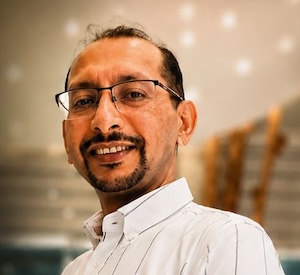
Jagdesh Singh, a Kuala Lumpur-based executive with a US multinational company, is a father of three girls who are as opinionated as their mother
* This is the opinion of the writer, organisation or publication and does not necessarily represent the views of Asia Samachar.
ASIA SAMACHAR is an online newspaper for Sikhs / Punjabis in Southeast Asia and beyond. You can leave your comments at our website, Facebook, Twitter, and Instagram. We will delete comments we deem offensive or potentially libelous. You can reach us via WhatsApp +6017-335-1399 or email: asia.samachar@gmail.com. For obituary announcements, click here
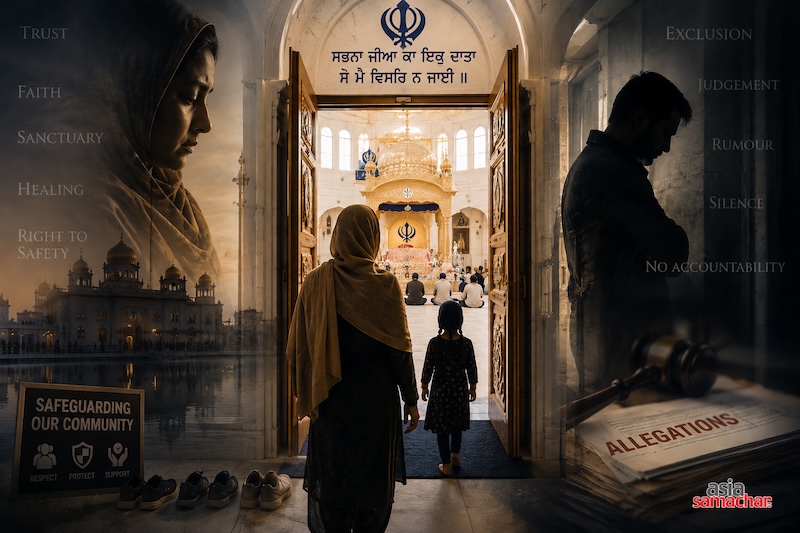
The growing focus on spiritual abuse in faith spaces has led to the introduction of Disclosure and Barring Service (DBS) checks and wider safeguarding measures for vulnerable adults and children. – Graphic: Asia Samachar / AI-aided
By Harjinder Kaur-Aujla | Opinion |
Historically, our Gurdwaras were a place of sanctuary for all – not the privileged, but for the destitute. There is an old saying in Sikhi, “Ghareeb da mooh, Guru di golak.”
Key to disputes on safeguarding is UK legislation, namely the Rehabilitation of Offenders Act, which means that those whose convictions are legally spent have immunity from continued legal sanction. However, community judgement can be lifetime, leading to incarceration for those who wish to repent for even crimes unrelated to vulnerable adults and children. They cannot be barred from praying, and this is the black swan to why faith spaces cannot just bar people as some think. Rather, measures to protect the vulnerable need to recognise that the Gurdwara is a public space for all, including those seeking to move away from their past or who are on a journey of recovery or seeking sanctuary.
The grim conundrum is that not all reports lead to a conviction, and not all victims come forward. Even where reports are made, few result in successful prosecutions due to lack of evidence, while many victims are unwilling to endure a prolonged court process. In this absence of legal resolution, rumour and conjecture can become judge and jury, leading to breaches of confidentiality and defamatory claims online and elsewhere. In other cases, allegations appear to be driven by factional motives with little consideration for the victims themselves, raising false hopes of justice among those already in a vulnerable state.
The growing focus on spiritual abuse in faith spaces has led to the introduction of Disclosure and Barring Service (DBS) checks and wider safeguarding measures for vulnerable adults and children. The DBS is a UK government-run system used to identify individuals with criminal records or those barred from working with vulnerable groups. This is a vital first step in ensuring that those in positions of trust within religious institutions are properly vetted and safe.
However, DBS checks are not foolproof. Public officials can exploit gaps within the system, while some offenders use name-change loopholes to distance themselves from their pasts. True protection therefore requires active oversight and accountability, not just paperwork.
Informal mechanisms often falter when investigations lack independence and become clouded by competing interests. To move from merely “checking boxes” to creating genuine safety, there is a need for a community-led safeguarding model supported by grassroots organisations that possess the cultural literacy and local trust required to manage communal safety. Yet even these groups can face discrimination based on philosophical beliefs or political affiliations.
There is also a double-edged issue around trauma and due process. Parcharaks (preachers) and granthis often lack any form of union representation or institutional support to defend themselves, while at the same time some victims may be encouraged to believe they have a strong case even before a proper police investigation has taken place. Where investigations do occur, they can become entangled in political interests and funding agendas, with vulnerable stories exposed online without proper consideration of capacity, privacy, or informed consent. In cases where victims have died through homicide or suicide, families are often retraumatised with little meaningful outcome or accountability.
1. The “blind spots”: pacharak home visits and tutors
While Gurdwaras are becoming increasingly regulated, the private sphere remains a significant area of risk.
The problem: Predators can operate within the Sangat or exploit the trust and sanctity associated with pacharak home visits and private tutoring.
The solution: A centralised risk-assessment mechanism and a national register of DBS-compliant parcharaks should be established. No home visit should take place without a verified chaperone and a pre-approved safeguarding and management plan.
2. The reality of the “guest list”: violent intrusions
Safeguarding is also about protecting faith spaces from external hate, hostility, and non-Sikh intrusions. These incidents matter because they pose a direct threat to the safety, dignity, and sanctity of places of worship.
Targeted desecration: Attacks on sacred images in Coventry (Dec 2025) and Nuneaton (July 2025). [Link to article]
Physical violence: The weapon attack in Gravesend (July 2024), alongside religiously aggravated assaults in Oldbury and Walsall (late 2025). [Link to article]
The digital threshold: Attention must also be given to the “digital guest list” — addressing the censorship, harassment, and online bullying of Sikhs that can often precede or escalate into physical violence.
3. The RAG risk assessment tool
We propose a Red-Amber-Green (RAG) safeguarding system designed specifically for faith spaces. Under this model, “Green” represents low risk, “Amber” identifies concerns requiring monitoring or intervention, and “Red” signals an immediate threat requiring urgent action.
The purpose of this tool would be to trigger a rapid, multi-agency response linking sewadars, community organisations, safeguarding leads, and relevant state authorities whenever incidents of hate, abuse, or violence are identified.
4. Reclaiming the sanctuary: the 2030 vision
Gurdwaras are places of refuge and sanctuary. Yet a sanctuary cannot truly feel safe if a survivor is expected to pray alongside their alleged perpetrator following separation or disclosure. At the same time, exclusion is not straightforward, given that the Gurdwara is fundamentally a space open to all, particularly the vulnerable, disenfranchised, and those seeking spiritual refuge.
Protected time: Introducing designated hours where girls and women can worship in a guaranteed perpetrator-free environment, recognising that perpetrators are often men.
Women-only spaces: Building on innovations introduced by Gurdwaras such as Central Gurdwara and Seven Sisters (Ilford), there should be a transition from occasional “Women’s Day” events to regular, protected women-only days. Kaur-led groups would likely support such initiatives.
Community policing models: Developing community-led safeguarding models that work alongside the police, such as the approach demonstrated by Injection Singh, who has been active in promoting female allyship on the streets, role-modelling Sikhi and the protection of girls and women without scapegoating communities.
The 50% goal: Many allies, both within and outside the Sikh community, are calling for 50% female representation on all Gurdwara committees. Alongside this, the role of independent investigators — neutral parties who examine safeguarding failures without institutional bias — can provide an objective framework for ensuring accountability for institutions and justice for victims.
Independent oversight and monitoring: Some argue that systems such as independent chauffeurs or video surveillance during home visits and other vulnerable interactions may be among the few ways to ensure maximum protection for all parties, although such measures remain open to debate.
A due diligence register: The Sikh Council and other temporal authorities may wish to establish a due diligence register for approved home visitors, tutors, sports clubs, chauffeurs, and safeguarding personnel who meet recognised standards without compromising community safety. Any such framework would need to balance safeguarding requirements with the right to worship, pacharak employment rights, and protections against decisions driven by conjecture or rumour.
Finally, as the Guru Granth Sahib teaches, “The king and the beggar are both the same, if they both contemplate the Name of God.” The rights and dignity of the vulnerable must therefore be protected within the framework of the law, without hatred and without fear.
(Harjinder Kaur-Aujla is a mental health practitioner, researcher and doctoral candidate whose work focuses on trauma recovery, gender-based violence, grief, and the intersection of faith, law and mental healthcare. She also serves with Sikhs in Academia and the British Association for Behavioural and Cognitive Psychotherapies, while contributing as a reviewer for OMEGA: Journal of Death and Dying.)
ASIA SAMACHAR is an online newspaper for Sikhs / Punjabis in Southeast Asia and beyond. You can leave your comments at our website, Facebook, Twitter, and Instagram. We will delete comments we deem offensive or potentially libelous. You can reach us via WhatsApp +6017-335-1399 or email: asia.samachar@gmail.com. For obituary announcements, click here
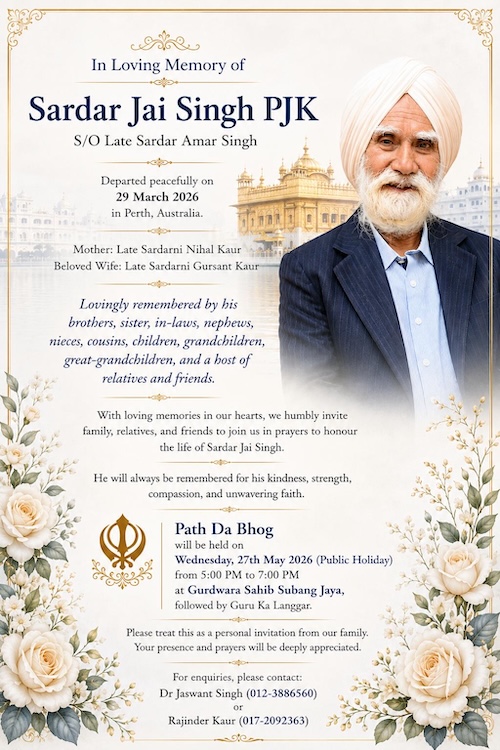
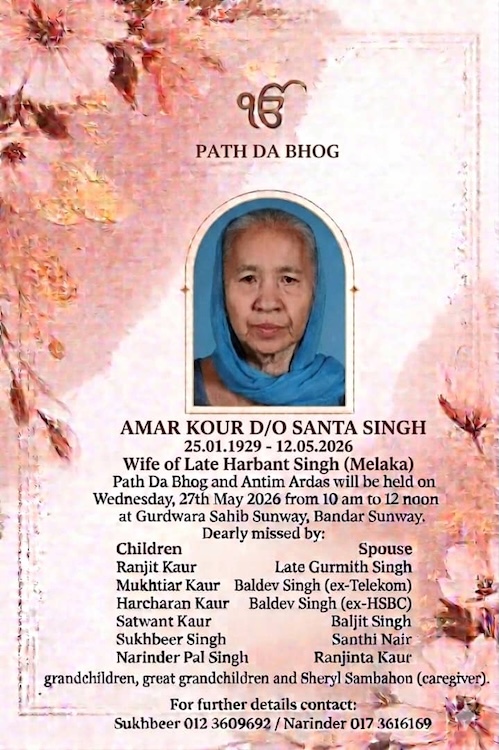
Departed peacefully on 29 March 2026 in Perth, Australia.
Mother: Late Sardarni Nihal Kaur Beloved Wife: Late Sardarni Gursant Kaur
Lovingly remembered by his brothers, sister, in-laws, nephews, nieces, cousins, children, grandchildren, great-grandchildren, and a host of relatives and friends.
With loving memories in our hearts, we humbly invite family, relatives, and friends to join us in prayers to honour the life of Sardar Jai Singh.
He will always be remembered for his kindness, strength, compassion, and unwavering faith.
PATH DA BHOG Wednesday, 27th May 2026 (Public Holiday) from 5:00 PM to 7:00 PM at Gurdwara Sahib Subang Jaya, followed by Guru Ka Langgar.
Please treat this as a personal invitation from our family.
Your presence and prayers will be deeply appreciated.
For enquiries, please contact: Dr Jaswant Singh (012-3886560) Rajinder Kaur (017-2092363)
ASIA SAMACHAR is an online newspaper for Sikhs / Punjabis in Southeast Asia and beyond. You can leave your comments at our website, Facebook, Twitter, and Instagram. We will delete comments we deem offensive or potentially libelous. You can reach us via WhatsApp +6017-335-1399 or email: asia.samachar@gmail.com. For obituary announcements, click here
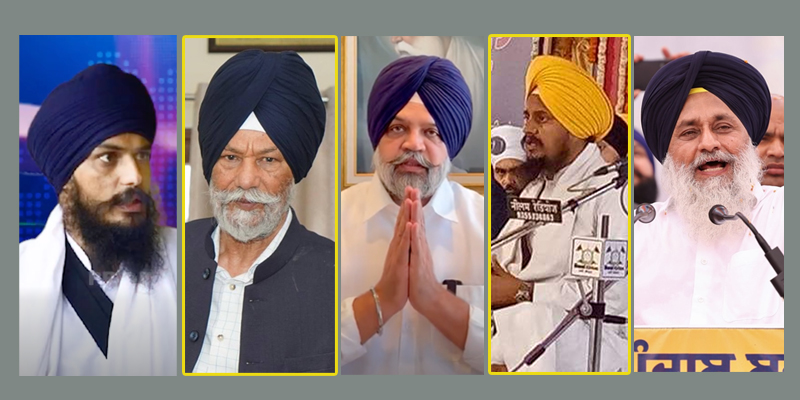
Panjab political leaders, L-R, Amritpal Singh, Surjit Singh Rakhra, Manpreet Singh Ayali, Harpreet Singh and Amritpal Singh
By Asia Samachar | Panjab |
The resignation of Panjab MLA Manpreet Singh Ayali from Shiromani Akali Dal (Punar Surjit) may prove to be more than just another political exit in Panjab’s fluid landscape.
Coming days after former Panjab minister Surjit Singh Rakhra abandoned the party for the ruling Aam Aadmi Party (AAP), Ayali’s departure has intensified questions over whether the fledgling breakaway faction can still emerge as a credible Panthic alternative to the Shiromani Akali Dal (SAD) led by Sukhbir Singh Badal ahead of the 2027 Panjab elections.
The developments are particularly significant because SAD (Punar Surjit) was born out of an unprecedented crisis within the traditional Akali establishment following years of electoral decline, Panthic discontent and the fallout from sacrilege controversies that severely damaged the party’s standing among sections of the Sikh community.
SAD (Punar Surjit) emerged in 2025 as a breakaway faction from the traditional SAD amid growing dissatisfaction over the leadership of Sukhbir Badal and the party’s handling of key Panthic issues.
The term “Punar Surjit” means “revived” or “reorganised”, reflecting efforts to rebuild the Akali movement after the Akal Takht’s intervention against senior SAD leaders in December 2024. The faction became associated with former Akal Takht Jathedar Giani Harpreet Singh, who was seen as a moral and Panthic influence behind attempts to forge a reformed Sikh political platform.
Ayali was among the central figures in that effort.
As reported by The Indian Express, he served as convener of an eight-member “Panthic unity coordination committee” formed jointly by SAD (Punar Surjit) and Akali Dal Waris Punjab De, the outfit associated with jailed Khadoor Sahib MP Amritpal Singh.
The committee was tasked with forging a common political understanding among Panthic forces opposed to the SAD leadership under Sukhbir Badal.
However, those efforts began unravelling in recent weeks.
Waris Punjab De eventually withdrew from the alliance-building process, citing unresolved “fundamental and crucial ideological issues”, according to local media reports.
Ayali’s resignation followed soon after.
In a video statement announcing his decision, Ayali said leaders who had “lost the moral right” to remain associated with Akali politics following the Akal Takht hukamnama were nevertheless accommodated within the new faction.
Without naming individuals, he suggested that some leaders should have temporarily stayed away from party affairs to allow the movement to regain public trust.
The remarks were widely interpreted as reflecting growing dissatisfaction over the direction of the party and its internal leadership choices.
The Indian Express also reported that Ayali was unhappy with what he viewed as sections of the leadership “cozying up” to the Bharatiya Janata Party (BJP), a politically sensitive issue in Punjab after the fallout from the farm laws agitation.
The resignation gains further weight when viewed alongside the recent departure of Rakhra.
Rakhra, a former Punjab minister and longtime Akali heavyweight, had joined SAD (Punar Surjit) after distancing himself from Sukhbir Badal. But earlier this month, he crossed over to AAP after being expelled by the breakaway faction for alleged “anti-party activities”.
His move was seen as a major setback because he represented one of the most recognisable senior leaders to align with the anti-Badal camp.
Another blow came in April when Barjinder Singh Brar, son of former minister Tota Singh, resigned from SAD (Punar Surjit) and later returned to the parent SAD.
Together, the exits point to growing instability within a faction that had initially hoped to consolidate anti-Badal sentiment into a united Panthic political front.
Political observers note that Panjab’s Panthic vote has historically fragmented whenever multiple Sikh-centred political formations compete simultaneously. The inability of SAD (Punar Surjit), Waris Punjab De and other dissident Akali elements to sustain unity may ultimately benefit the traditional SAD, even as the party continues to grapple with its own credibility challenges.
For now, Ayali’s departure appears to symbolise the deepening fragmentation of the very movement that had once promised to reshape Sikh politics in Panjab.
Join the conversation on this story on Asia Samachar’s Facebook and Instagram pages.
ASIA SAMACHAR is an online newspaper for Sikhs / Punjabis in Southeast Asia and beyond. You can leave your comments at our website, Facebook, Twitter, and Instagram. We will delete comments we deem offensive or potentially libelous. You can reach us via WhatsApp +6017-335-1399 or email: asia.samachar@gmail.com. For obituary announcements, click here
Atawar Singh elected president of MSU FT Branch at AGM on May 3, 2026
By Asia Samachar | Malaysia |
Atawar Singh has been elected chairman of the Malaysian Sikh Union (MSU) FT Branch for the next two years, succeeding insurance broker Munijit Singh @ Manjit.
Atawar, who is involved in the security industry, was elected during the state union’s annual general meeting on May 3 and will lead the committee for the 2026–2028 term.
ASIA SAMACHAR is an online newspaper for Sikhs / Punjabis in Southeast Asia and beyond. You can leave your comments at our website, Facebook, Twitter, and Instagram. We will delete comments we deem offensive or potentially libelous. You can reach us via WhatsApp +6017-335-1399 or email: asia.samachar@gmail.com. For obituary announcements, click here
Manpreet Singh Ayali announces his resignation from Shiromani Akali Dal (Punar Surjit) in May 2026 – Photo: Asia Samachar / Ayali Facebook
By Asia Samachar | Panjab |
Panjab legislator Manpreet Singh Ayali has resigned from Shiromani Akali Dal (Punar Surjit), dealing a setback to efforts to forge a united Panthic political front ahead of the 2027 Punjab assembly elections.
Ayali, the MLA for Dakha, announced his resignation amid growing tensions within the breakaway Akali faction and the collapse of its alliance talks with Akali Dal Waris Punjab De, led by jailed MP Amritpal Singh.
The alliance between the two groups fell apart after both sides failed to agree on “fundamental and crucial ideological issues”, reports The Indian Express.
The repot quoted unnamed sources saying the differences centred on organisational and ideological concerns within the Panthic alliance-building exercise.
Ayali was reportedly unhappy with leaders in SAD (Punar Surjit) for allegedly “cozying up” to the Bharatiya Janata Party (BJP), a sensitive issue in Punjab politics following the fallout over the now-repealed farm laws.
In a seven-minute video message announcing his resignation, Ayali said certain leaders who had “lost the moral right” to be associated with the Akali movement, following the Akal Takht hukamnama issued on Dec 2, 2024, were nevertheless given positions in the party.
He argued that such individuals should have stayed away from party affairs temporarily to allow the new faction to gain credibility among the Sikh masses.
Ayali had played a central role in attempts to unite Panthic forces opposed to the Shiromani Akali Dal led by Sukhbir Singh Badal. He served as convener of an eight-member “Panthic unity coordination committee” formed jointly by SAD (Punar Surjit) and Waris Punjab De.
Despite resigning from the party, Ayali said he would not join the Congress, BJP or Aam Aadmi Party, and would also not return to the SAD.
SAD (Punar Surjit) emerged in 2025 as a breakaway faction from the traditional Shiromani Akali Dal (SAD) amid growing discontent over the leadership of Sukhbir Singh Badal and the party’s handling of key Panthic issues.
The term “Punar Surjit” means “revived” or “reorganised”, reflecting efforts to rebuild the Akali movement after the Akal Takht’s intervention against senior SAD leaders in December 2024.
The faction became associated with ousted Akal Takht Jathedar Giani Harpreet Singh, who was seen as a moral and Panthic influence behind attempts to forge a reformed Sikh political platform ahead of Punjab’s 2027 elections.
Join the conversation on this story on Asia Samachar’s Facebook and Instagram pages.
ASIA SAMACHAR is an online newspaper for Sikhs / Punjabis in Southeast Asia and beyond. You can leave your comments at our website, Facebook, Twitter, and Instagram. We will delete comments we deem offensive or potentially libelous. You can reach us via WhatsApp +6017-335-1399 or email: asia.samachar@gmail.com. For obituary announcements, click here
ASIA SAMACHAR is an online newspaper for Sikhs / Punjabis in Southeast Asia and beyond. You can leave your comments at our website, Facebook, Twitter, and Instagram. We will delete comments we deem offensive or potentially libelous. You can reach us via WhatsApp +6017-335-1399 or email: asia.samachar@gmail.com. For obituary announcements, click here
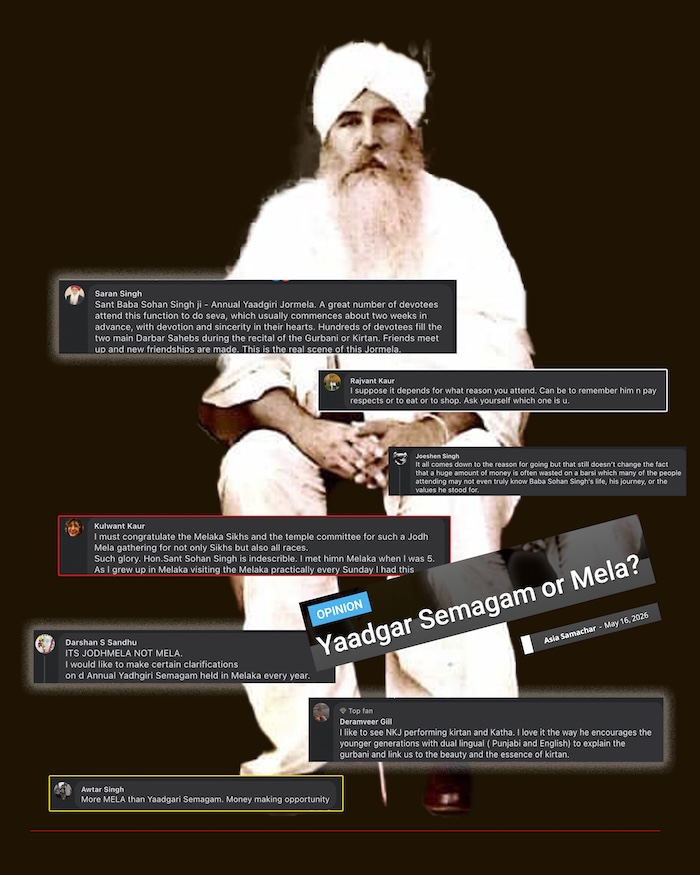
Sant Baba Sohan Singh of Melaka. Some comments at Asia Samachar Facebook – Photo: Asia Samachar
By Amarjeet Singh @ AJ | Opinion |
Following the earlier reflections surrounding the Melaka Yaadgiri Semagam, many responses emerged from different members of the Sikh community. Some agreed with the concerns raised, while others felt the discussion overlooked the deeper spiritual and community value that the gathering continues to hold for thousands of people worldwide.
That itself reflects something important.
This conversation was never truly about choosing sides. It was never about attacking organisers, committees, sewadars, jathas, or the sangat. Rather, it has evolved into something much bigger — a reflection on how Sikh gatherings, institutions, and community spaces are evolving in the modern world.
Community members including Parigeet Singh, Saran Singh, Deramveer Gill, Joeshan Singh, Walveer Singh, Darshan S Sandhu, Tarlochan Singh, and others shared perspectives on Facebook based on the first article and that reflected both the emotional connection and evolving complexity surrounding such gatherings. Their responses showed that while opinions may differ, the underlying concern remains deeply rooted in the Panth, spirituality, sangat, and the future direction of Sikh institutions.
It is important to acknowledge the many valid points raised by those who continue defending the spirit and value of the Melaka Yaadgiri Semagam.
For many individuals, this gathering is deeply personal and spiritual. Thousands attend yearly not because they are forced to, but because they feel spiritually connected to the legacy of Sant Baba Sohan Singh Ji and the atmosphere of seva, sangat, Gurbani, and remembrance that surrounds the programme.
RESPONSES
Many Sanggat members begin seva weeks in advance with sincerity and devotion. Inside the Gurdwara and the Sant Sohan Singh Ji Melaka Memorial Society Malaysia (SSSJMMSM) (commonly referred to as the Vidyala) premises, Akhand Paths, Kirtan, Katha and various forms of seva continue throughout the programme. Hundreds fill the Darbar Sahib to listen to Gurbani wholeheartedly. Old friendships reconnect, new friendships are formed, and many individuals who may otherwise remain distant from Sikh spaces reconnect with the sangat once again. Like people who travel to prepare the sukh prasad and the Santana Biker yearly ride to assist in cleaning and also contribution in meals.
Baba Sohan Singh’s final journey from Malacca gurdwara to the Malacca crematorium on 25 May 1972 – Photos: Gurdwara Sahib Malacca collection in Sant Baba Sohan Singh Ji Of Malacca 1902-1972 – His Life and Times by Saran Singh
As one community member reflected, people connect to the Semagam in different ways — through prayer, Kirtan, seva, reflection, or simply reconnecting with the community. Ultimately, intention remains deeply personal between the individual and Guru Sahib.
These realities should not be dismissed lightly.
It is also fair to acknowledge that many aspects outside the official religious premises are beyond the direct jurisdiction of organising committees. Public stalls, businesses, hotels, social gatherings, and activities occurring elsewhere within the town are often organised independently under approvals from local authorities. No Gurdwara committee realistically possesses the authority to police an entire town, control individual behaviour, or monitor every personal decision made by visitors during a large public gathering.
Several respondents also stressed this point strongly — that organisers cannot realistically control what occurs outside official Gurdwara premises, and that individuals themselves remain responsible for their own actions, intentions, and choices during such gatherings.
That distinction is important.
At the same time, the deeper conversation is not really about jurisdiction or blame at all. It is about recognising how major Sikh gatherings themselves are evolving globally into larger social, cultural, economic, and identity ecosystems.
Because whether openly acknowledged or not, major Sikh programmes today no longer function only as purely religious events. They also become spaces where communities reconnect, businesses operate, social identities strengthen, younger generations meet, families gather, tourism increases, merchandise appears, and social media visibility expands.
BEYOND MELAKA
This is not unique to Melaka alone.
It is part of a wider evolution affecting Sikh gatherings across the world.
Growth itself should not automatically be viewed negatively.
History teaches us that truthful teachings and sincere spiritual legacies often continue growing long after individuals leave this world. During Guru Nanak Sahib Ji’s lifetime, the number of direct followers was relatively small compared to the millions worldwide today who celebrate Gurpurabs, reflect upon Gurbani, and honour his jyoti jot. Teachings rooted in sincerity, humility, compassion, and truth naturally continue expanding because people continue finding guidance and meaning within them across generations.
In many ways, this also explains why large numbers continue gathering today in remembrance of Sant Baba Sohan Singh Ji. His legacy of seva, humility, discipline, and dedication towards the Sikh community left a lasting impact on many lives and institutions. Through programmes organised in his memory, significant funds have also been raised that continue benefiting the wider Sikh community, including contributions towards projects such as KhalsaLand and other community-based initiatives.
Many therefore see the Semagam not merely as an annual gathering, but as a living continuation of Sant Ji’s influence upon the Panth and community.
Others also raised an important point regarding Kirtan Jathas and Pathis.
Some members of the sangat genuinely value renowned jathas because of their ability to explain Gurbani meaningfully, connect with younger generations bilingually, and inspire spiritual reflection through Katha and Kirtan. Many younger Sikhs today understand Gurbani more deeply precisely because certain jathas are making efforts to communicate beyond traditional formats.
One respondent openly shared how bilingual Katha and Gurbani explanations helped younger generations appreciate the beauty and deeper meaning of Sikh teachings in ways that traditional formats sometimes struggled to achieve.
At the same time, concerns raised regarding the welfare and appreciation of Pathis should also not be ignored. The Akhand Path remains the spiritual backbone of the programme itself, and many agree that Pathis deserve equal dignity, respect, and proper care alongside all other contributors involved in the Semagam.
Another thoughtful reflection raised the question of how future Semagams could further expand Sant Ji’s legacy through scholarships, welfare initiatives, educational support, and long-term community development efforts carried out in his name. Such ideas reflect a growing desire among sections of the sangat to see remembrance translated into ongoing social impact and community upliftment.
Some also felt that beyond organising large gatherings, greater emphasis could continuously be placed on educating the sangat about Sant Ji’s life, values, discipline, humility, and spiritual teachings so that remembrance becomes rooted not only in attendance, but also in understanding.
This is where the discussion becomes more balanced and meaningful.
Not one side completely right. Not one side completely wrong.
Rather, it is a community trying to navigate modern realities while preserving spiritual foundations.
Baba Sohan Singh at General Hospital Ipoh, 1972. – Photo: Sant Baba Sohan Singh Ji Of Malacca 1902-1972 – His Life and Times by Saran Singh; Collection of Sardar Gurdial Singh ‘Sagoo’, Ipoh
Some members of the sangat feel strongly that personal intention matters most. If one attends with sincerity, humility, and spiritual focus, then distractions outside should not weaken one’s own connection to Gurbani and Guru Sahib. Others believe that as gatherings grow larger, communities must continuously reflect on whether spirituality remains central amidst increasing scale, visibility, commercial activity, and event culture.
Both perspectives emerge from people who ultimately care about the Panth.
This is why such conversations should not immediately be viewed as attacks, negativity, or attempts to create division.
DIFFICULT QUESTIONS
Sometimes difficult questions emerge precisely because people still care deeply about preserving integrity, maryada, humility, and spiritual purpose within Sikh institutions.
Likewise, organisers, sewadars, and volunteers who sacrifice enormous time and energy behind the scenes also deserve fairness and appreciation. Large-scale gatherings involving thousands of attendees require tremendous commitment, coordination, patience, and resources that often go unseen by the wider sangat.
The Sikh community today does not need more division between “supporters” and “critics.”
It needs more mature conversations about how Sikh institutions and gatherings can continue evolving responsibly in a rapidly changing world shaped by social media, visibility culture, tourism, commercial pressures, and generational shifts.
How do we preserve spirituality while navigating modern public culture? How do we maintain humility within large-scale events? How do we ensure seva remains sincere even when programmes become professionally organised?
How do we continue educating younger generations not only about attending Semagams, but also about understanding the lives, sacrifices, teachings, and values of personalities such as Sant Baba Sohan Singh Ji?
And most importantly: How do we ensure remembrance continues inspiring inner transformation rather than only external expansion?
Because ultimately, large crowds alone do not define spiritual success.
What truly matters is whether Gurmat values — humility, seva, discipline, compassion, integrity, and truthful living — continue remaining alive within the sangat long after the programme itself ends.
And that is the bigger picture worth reflecting upon together as a community.
Join the conversation on this story on Asia Samachar’s Facebook and Instagram pages.
Amarjeet Singh @ AJ is a Malaysia-based business consultant with over 25 years experience
ASIA SAMACHAR is an online newspaper for Sikhs / Punjabis in Southeast Asia and beyond. You can leave your comments at our website, Facebook, Twitter, and Instagram. We will delete comments we deem offensive or potentially libelous. You can reach us via WhatsApp +6017-335-1399 or email: asia.samachar@gmail.com. For obituary announcements, click here
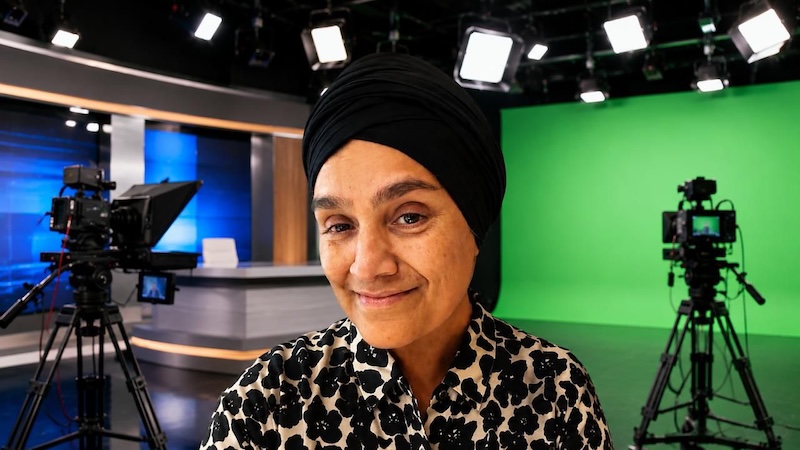
Manjit Kaur: Co-presenter of the 1 Show Live on Panjab Broadcasting Channel (PBC)
By Manjit Kaur | Opinion |
For most of our viewers, the show begins the moment I appear and say, ‘My name is Manjit Kaur’ and my partner says, ‘My name is Gurnam Singh’, we then both say ‘Welcome to 1 Show’. What appears to the viewers on their screens may seem to be polished, composed and effortless. Yet behind every live broadcast lies much preparation, anxiety, responsibility and teamwork that most people never see.
Having served on different Sikh/Panjabi media channels for over 12 years, I have come to realise that presenting a programme is much more than speaking into a camera. It is about navigating complex issues with honesty, sensitivity and courage. Every programme begins long before we enter the studio. Sometimes it begins days or weeks earlier with difficult conversations about what topic should be discussed, whether the timing is right, and how the discussion may affect the community.
Many of the issues we address on are deeply sensitive. They may involve religion, politics, family and community conflict, mental health, caste, gender, identity and management of Sikh institutions. We are constantly aware that viewers will approach these discussions from different perspectives. There is always a concern about how certain individuals, groups, organisations or leaders may react. Yet journalism and public discussion lose their meaning if truth is sacrificed simply please others.This does not mean being reckless or disrespectful; it requires even greater care. We must think carefully about our language, tone and balance. We ask ourselves difficult questions. Are we being fair? Are we creating unnecessary division? Have we allowed all sides to be heard?
THE PREPARATION
An important part of preparation is selecting suitable panel members. It’s pointless inviting somebody who has little knowledge or expertise on the topic in question. A serious programme, like the 1 Show Live, is not about creating conflict for entertainment. It is about bringing together individuals who have knowledge, lived experience, emotional maturity and the ability to engage respectfully even when disagreements arise. Sometimes finding the right guests can be one of the most challenging aspects of the programme.
Background research is essential. Before every show we spend hours reading articles, checking facts, reviewing historical context and thinking carefully about the questions we will ask. Live television leaves little room for error. A poorly framed question or inaccurate statement can mislead viewers and damage your credibility. As presenters, we must remain alert throughout the programme, listening carefully to guests while also thinking several steps ahead. Also, the direction of discussion may change for good and bad reasons, and so we have to be flexible without losing control.
Every presenter has their own way of doing things, and I am no different. Some people like to have their notes on a laptop screen; I prefer the more traditional method of pen and paper; it gives me a greater sense of control. I have also become increasingly aware of my own positionality as a presenter. None of us enter the studio as neutral human beings floating outside society. We all carry our own experiences, values, identities and emotions.
As a Sikh woman with a background in professional counselling and group therapy, I know that my perspective is shaped by years of listening to the pain, struggles and hopes of women and teenagers, many of whom had experienced sexual abuse and domestic violence. So, I know, I cannot remain silent when these issue surface. Rather than pretending to be neutral, I believe honesty requires recognising the lens through which we see the world, while still striving for fairness and openness.
THE FINANCIAL CHALLENGE
One aspect viewers rarely appreciate is the immense financial challenge faced by community media channels such as the Panjab Broadcasting Channel. Unlike large commercial broadcasters with backing from business, our channel survives almost entirely through voluntary donations from ordinary members of the community, many of whom are pensioners. This creates constant pressures and limitations. Equipment is not always at the standard we would want. Budgets are tight and resources are stretched. And yet, despite these challenges, we keep on going.
What many viewers assume is a fully staffed technical department is just one or two incredibly dedicated individuals doing the work of an entire team. Often doing very long shifts, they are the real heroes who stay hidden from the public. The tech team (often one person!) manage the live SKY feed, social media streaming, sound mixing, incoming calls, visual graphics, headlines, video clips and troubleshooting technical problems in real time; often under enormous pressure and with little recognition. At the same time, they are also answering the door, making tea, always with a smile. Their legendary desi karak chai has probably rescued many exhausted presenters, as well calming nervous guests, moments before going live.
EDITORIAL CONTROL
There is also the important issue of editorial support and control. To be completely honest, formal editorial structures within community broadcasting are often minimal or non-existent! In many mainstream TV channels, such as the BBC, there are teams of researchers, lawyers, editors and managers. In our environment, much of that responsibility falls directly upon presenters and the tech team.
Over the years, however, my partner Gurnam Singh and I have developed a strong understanding of Ofcom, the agency that regulates broadcasting in the UK, our responsibilities. We understand the importance of factual accuracy, balanced discussion, appropriate language and the need to avoid defamation or slander against individuals or organisations. These principles are not simply legal requirements; they are ethical responsibilities.
Working in live broadcasting has taught me that media is not simply about cameras and microphones. It is about responsibility. It is about creating spaces where difficult conversations can take place without hatred, sensationalism or fear. It is about giving voice to concerns that many people may be thinking privately but are afraid to express publicly.
PARDA UTHANA
One of the most difficult yet necessary aspects of community broadcasting is what I often describe as lifting the lid, or parda uthana. This means creating space for conversations that many within our community would rather avoid altogether. Traditionally, Panjabi culture has often dealt with painful or uncomfortable realities by pushing them quietly under the carpet. Difficult issues are often hidden behind phrases such as “these things should not be discussed publicly”, “this doesn’t happen in our community”, or “this is inappropriate language.” Sometimes there is a genuine concern for safety and dignity, but too often silence became a way of avoiding or denying that problems exist within the community.
On The 1 Show, we have tried carefully and responsibly to challenge this culture of silence. Over the years we have opened discussions on issues that were once almost impossible to speak about openly, including mental health, domestic abuse, addiction, grooming, intergenerational conflict and the pressures faced by women and young people. These conversations are rarely comfortable. We know that some viewers feel uneasy hearing such subjects discussed publicly. Yet avoiding these realities does not protect the community, nor does it help those who may be suffering.
At the same time, we must acknowledge that there are still many lids that remain only partially lifted. Discussions relating to drugs, alcohol, mental health, sexual abuse, family conflict, safeguarding of children and adults, and corruption in religious organisations, remain especially difficult to address openly.
All communities face these challenges, and in this regard, Sikhs are no different. As presenters, we walk a very delicate line. We must approach these subjects with compassion, sensitivity and responsibility, while still refusing to participate in denial. Our aim is never to attack the community, but rather to encourage honesty, reflection and healing. A community cannot address its wounds if it refuses to acknowledge these exist.
Sometimes lifting the lid (parda) invites criticism. However, over the years, I must say, that I have received much love and praise when I have had the chance to meet with viewers on my travels. To be honest, there is nothing more rewarding that this. In those moments, one realises that responsible media can do more than inform; it can help break isolation and give hope to people.
Of course, mistakes happen. Live television is unpredictable and it can sometimes be nerve wracking. But I must admit, I prefer live to recoded programmes anytime. Once we get the countdown from 10, I start to get an adrenalin rush and, in that moment, I feel energised to engage with the topic and guests. Because I always present programmes with my partner, this can bring its own challenges. For example, we might have a different view on some matters and occasionally we may make human errors. Thankfully, rather than dwell on these, I have learnt to use these occasions as learning opportunities. Sometimes we can get difficult callers and moments when discussions become emotionally charged. On such occasions, we have to make quick judgements, which usually means politely reminding caller to appropriate language, and mostly they respond positively.
When viewers watch a live programme, they see the final performance. What they do not always see is the collective effort, emotional investment and quiet dedication that makes the programme possible. Behind the lights, cameras and action lies a small group of ordinary people trying, with limited resources but sincere commitment, to serve the community. Some people in the media may be motivated by fame, but for me, the opportunity to serve and to raise important issues is what keeps me returning to the studio each week.
Join the conversation on this story on Asia Samachar’s Facebook and Instagram pages.
Manjit Kaur, a UK-based therapist and counsellor, is a presenter at the 1 Show Live at Panjab Broadcasting Channel, UK. She can be contacted via email at manjitkaur1show@gmail.com
ASIA SAMACHAR is an online newspaper for Sikhs / Punjabis in Southeast Asia and beyond. You can leave your comments at our website, Facebook, Twitter, and Instagram. We will delete comments we deem offensive or potentially libelous. You can reach us via WhatsApp +6017-335-1399 or email: asia.samachar@gmail.com. For obituary announcements, click here
ASIA SAMACHAR is an online newspaper for Sikhs / Punjabis in Southeast Asia and beyond. You can leave your comments at our website, Facebook, Twitter, and Instagram. We will delete comments we deem offensive or potentially libelous. You can reach us via WhatsApp +6017-335-1399 or email: asia.samachar@gmail.com. For obituary announcements, click here
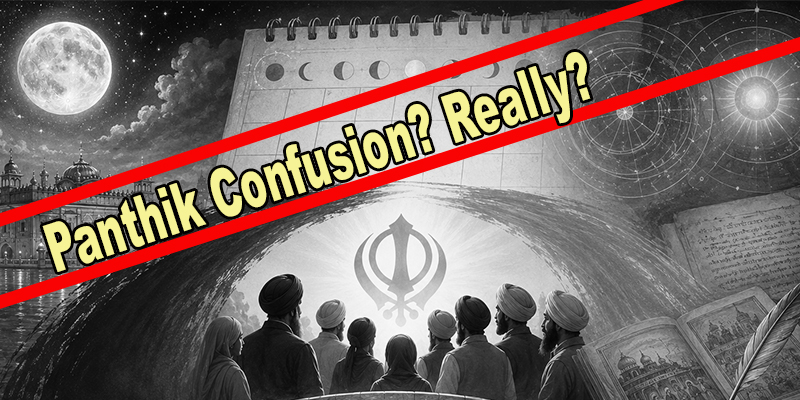
One swallow does not make a summer. And one man’s confusion does not make for “Panthic confusion.”
In arguing that Guru Nanak’s birthday should not revert to its historically correct date of 1st of Vaisakh (April) and instead be maintained in Kathik (November); Dr B.S. Bains, in his opinion titled “This is Panthic confusion, not Panthic awareness” in Asia Samachar (May 14, 2026), has asked:
“Which authority officially shifted the observance of Guru Nanak Sahib’s birth anniversary from April to November? When exactly did this transition take place, and under whose administration or historical circumstances was such a change introduced?”
THE AUTHORITIES
Here are the authorities:
i) Two documents – namely the Sakhi Mehlay Pehlay Ki by Sheehan Upal and Janam Patri Babey Ki by Bhai Boola Pandhay composed in 1570 and 1597, respectively – during the era of the third and fourth Gurus say that Guru Nanak was born in Vaisakh.
ii) Bhai Gurdas writes in Pauree 27 of Vaar 1 that Guru Nanak was born on the 1st of Vaisakh.
iii) Seven prominent Sikh and non-Sikh historians write that Guru Nanak was born in Vaisakh. They are Karam Singh Historian, Bhai Kahn Singh Nabha, Dr Ganda Singh, Principal Satbir Singh Historian, Prof Sahib Singh, Historian Dr Hari Ram Gupta and historian Max Arthur Macauliffe.
iv) The Sikh panth has 6 different Janam Sakhis that narrate the life of Guru Nanak. Five of them state unequivocally that Guru Nanak was born in Vaisakh. The one that says he was born in Kathik November (Balay Valee) also narrates other nonsense such as Guru Nanak married a Muslim lady, belonged to the Tayli (low) caste in his previous life and had to be reborn into a Khatri (high caste) family to redeem himself, and rode the back of whale to cross the ocean to go to Baghdad, Mecca and Medina).
Even if one chose to accept the Balay Valee Janam Sakhi, it still does not entail confusion. It certainly does not amount to “panthic confusion.” At the very least it speaks of an inner desire to want to continue to believe, accept and do what is proven to be historically wrong, and continue to disbelieve, not accept and not do what is right. One cannot be faulted for thinking that even if Guru Nanak comes back to tell us he was born in April, such people will ask him “but which authority officially shifted your birthday from April to November?”
IT IS ALL ABOUT MONEY
The failure and or refusal by the panth to do what is right – revert to celebrating Guru Nanak’s birthday on the 1st of Vaisakh – has nothing to do with confusion – individual or collective. It is all about money, especially on the part of the two groups that stand in opposition to doing the right thing; namely the Gurdwara parbandhaks (management) and our clergy (parcharaks, ragis, kathakars). The Sikh world’s two biggest Gurpurabs (read money earners) are Vaisakhi and Guru Nanak’s birthday. Two separate celebrations mean twice the amount of big chrrawa collections. Combining them would half the income. Why would people who don’t care for the truth want to do that?
That is why we have some Gurdwaras who claim they celebrate Guru Nanak’s birthdaytogether with the Khalsa Birthday on the 1st of Vaisakh. What they don’t tell us is that they will celebrate it a second time in November. Chrrawa does matter.
That is why we have parcharaks, ragis and kathakars who attend the November celebration and sit on the stages and tell the sangats “but sadh sangat ji, Guru Nanak was actually born on Vaisakhi Day (April).” As our religious leaders, they have no real intent of changing things. Their only intent is the stage, big crowds and big shabd bhayt. Why change when two huge packets of Shabd Bhayt are obtainable instead of one?
Dr B.S. Bains says: “Shiromani Gurdwara Parbandhak Committee (SGPC), together with the supreme authority of Akal Takht, may therefore have an important role in bringing clarity and stability to the Panth on this sensitive matter.”
Could Dr. B.S. Bains give us a single example of a single problem that the SGPC and AT has solved for the Sikh Panth in the past 50 years? Ragmala? Paid Akhand Paths? Having langar on chairs? Dasam Granth? Nanakshahi Calendar? Which world are we living in to not know that the very institutions that are supposed to provide solutions are actually part of the problem? In any case, the SGPC website tells us that Guru Nanak was born in Vaisakh. It is ironic that one does not want to accept what the SGPC website says, but then wants the SGPC to resolve this birthdate issue. Hasn’t it already been resolved? Or will we only consider it resolved when SGPC says its own website is wrong and that it is actually inNovember?
Dr. B.S. Bains says “Scholars explain that these differences may have emerged because of varying interpretations of lunar calendars, solar calculations, Bikrami dating systems, historical manuscripts, and later calendar reforms.”
It would be interesting to know which scholar has explained the pushing of Guru Nanak’s birthday from April to November (7 months) through “varying interpretations of lunar calendars, solar calculations, Bikrami dating systems, historical manuscripts, and later calendar reforms.” One can understand that all of these factors can result in a discrepancy of 4 – 5 days or at the most a week. But to blame a 7-month discrepancy on such things (other than historical records) is hogwash.
THE REAL DANGER
Dr. B.S. Bains then writes: The real danger (of Research) begins when discussions become ego-driven battles, when social media reduces sacred matters into entertainment, and when Sikhs begin mocking fellow Sikhs more than outsiders ever could.
Actually, the real danger is when people ignore historical facts derived through research due to their own inner insecurities over handling the truth and their inabilities in dealing with change.
Dr B.S. Bains is correct when he says “Guru Nanak Sahib’s greatness was never confined to a calendar date alone. His eternal message was about the oneness of humanity, remembrance of the Divine, honest living, humility, compassion, and sharing with others.” Yet, the truth cannot be ignored. Sikhs who cannot even get the most basic fact of Guru Nanak’s birthdate correct lose the moral high ground to lecture the rest of us about the Guru’s “eternal messages.”
Everyone should respect Dr. B.S. Bains’ view when he writes “I feel, in the interest of Panthic unity and continuity of long-standing tradition, the Kartik Gurpurab observance that has been followed for centuries should continue to be adhered to with authority and dictatory terms”even if we know that falsehood has no “authority and no dictatory terms” whatsoever. Observing a falsehood over centuries as a long-standing tradition does not turn it into the truth.
Guru Nanak was about the truth. Surely the historical truth of his birthdate matters.
Join the conversation on this story on Asia Samachar’s Facebook and Instagram pages.
ASIA SAMACHAR is an online newspaper for Sikhs / Punjabis in Southeast Asia and beyond. You can leave your comments at our website, Facebook, Twitter, and Instagram. We will delete comments we deem offensive or potentially libelous. You can reach us via WhatsApp +6017-335-1399 or email: asia.samachar@gmail.com. For obituary announcements, click here