



















By Ranveer Singh | Opinion |
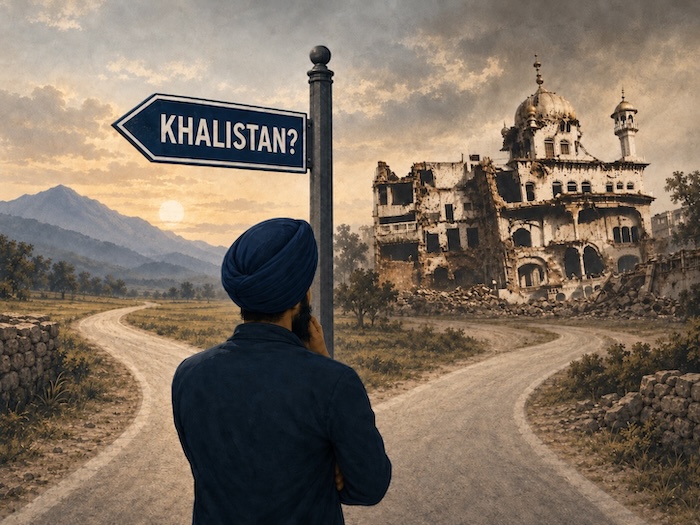
Prof. Gurnam Singh’s recent article, The Feasibility of Khalistan: A Critical Assessment, argues that Khalistan is highly improbable under present conditions. He points to demographics, geopolitics, the absence of international recognition and a decline in political momentum. In place of independence, he proposes a return to federalism, greater fiscal autonomy, stronger Sikh institutions, international human-rights advocacy and possibly Vatican-like status for the Akal Takht. Prof. Singh must be commended for starting the conversation, however, the problem with Prof. Singh’s article is not that he asks whether Khalistan is feasible. It is that the political order against which Khalistan struggles is allowed to define feasibility.
Prof. Singh also describes the contemporary movement as having been “born in 1984”. Whilst June and November 1984 transformed the struggle, Khalistan cannot be understood only as a traumatised response to those events. Such a framing detaches it from the longer Sikh contest over sovereignty, authority and political existence. The contemporary demand has its own historical form, but as I explored in Patshahi Mehima, the Sikh refusal to accept the permanence of another power’s rule did not begin in 1984.
The Modern World Decides What Is Real
With regard to geopolitics, the article notes that India controls the territory, possesses military power, and enjoys international recognition. Open support for Khalistan has been suppressed, and the movement does not presently exercise territorial or institutional authority. These conditions are then gathered together as evidence that Khalistan is politically unattainable, but this tells us little beyond the fact that India is currently the dominant power. A struggle for sovereignty exists precisely because another state possesses the territory, institutions, military force and international recognition being contested. If a movement must possess all of these things before its political objective can be considered realistic, then sovereignty only becomes feasible after it has already been achieved. This circularity needs to be unpacked.
In my recent work on modernity and Kaljug, I have been trying to distinguish between Kaljug as a cosmological condition and modernity as a particular historical order. Modernity is not merely a period of technological advancement; it establishes its own institutions, categories of knowledge and measures of legitimacy. Through colonialism, capitalism, the modern state and the primacy of secular reason, it determines what can be recognised as rational, political and real. Prof. Singh’s assessment remains almost entirely inside this worldview. In essence, a political community becomes real when it is counted by a census, represented through elections, organised within an accepted territory and recognised by other states. There is an assumption that sovereignty belongs to those who already possess the machinery of the modern state. Everyone else is reduced to a minority seeking rights, protections or concessions within it. This is why the Khalistan movement can be acknowledged as emotionally and historically important while being denied political possibility. In other words, emotion and memory are permitted, but sovereignty is reserved for the state.
Furthermore, the categories appear neutral, but they are not. They arise from a particular worldview in which the state is assumed to be the highest political reality and international recognition is the measure of legitimate existence. The Indian state is therefore treated as concrete and permanent, while Khalistan is treated as an aspiration requiring permission from the same order it seeks to challenge. This is connected to the wider argument I am developing in Baghdad & Beyond (my forthcoming book), namely that political disagreements often conceal a deeper clash of worlds. The problem, however, is not simply that two sides reach different conclusions, but rather they may be operating with different accounts of reality, authority, the human being and the purpose of power. If ik oankar is reality and hukam shapes the Sikh way of seeing and inhabiting that reality (as a vishav-drishti), then Sikh political thought cannot begin by accepting the modern state’s account of what is possible. That does not mean ignoring material conditions, it simply means refusing to mistake one historically produced order for reality itself. So the question is not only whether Khalistan fits comfortably into the present world. The question is whether Sikhs are capable of seeing beyond the world as the state has organised it.
What Does the Absence of Support Actually Tell Us?
Prof. Singh places considerable weight on the lack of a clear democratic mandate for Khalistan in Panjab. He argues that people appear more concerned with unemployment, agricultural distress, governance and economic security. But these matters cannot be separated so easily from sovereignty. Who controls Panjab’s water? Who determines its agricultural policy? Who benefits from its resources? Why has a region made central to India’s food security been left with ecological damage, debt, unemployment and an economy from which its young increasingly seek escape? As Prof. Pritam Singh has documented, the policies of the Indian centre have constrained Panjab’s economic development and political autonomy. These are not distractions from the political question. They are among the ways in which Panjab experiences its lack of political power, and they cannot be ignored in this conversation.
The demographic argument also rests upon an assumption that is never properly defended. Prof. Singh cites the 2011 census figures showing Sikhs at 58 per cent and Hindus at 38 per cent as though Panjab’s religious diversity itself presents an obstacle to Khalistan. This only follows if Khalistan is imagined as either a Sikh ethnostate, in which political belonging depends upon ethnicity, or a theocracy, in which Sikhs rule over non-Sikhs through religious law. Neither model necessarily follows from historical formations of Sikh sovereignty, not Sikh teachings espoused within Guru Granth Sahib. Panjab does not need to be uniformly Sikh for a state grounded in Sikh political thought to possess legitimacy. Halemi, which I will return to later, does not propose Indian majoritarianism with the religious identity reversed. It asks what power is for, how it is exercised and whether everyone living under its authority, Sikh or otherwise, is protected from domination. The presence of a substantial non-Sikh population is therefore a political reality that any Khalistan movement must address seriously, but the figure of 58 per cent is not, in itself, an argument against Khalistan.
Nor can support for Khalistan be measured as if Sikhs have spent the past forty years debating it in a free political environment. The movement was met with overwhelming military force, extrajudicial killings, disappearances, torture, mass detentions, censorship and, as the NSYF’s groundbreaking report demonstrated, the criminalisation of its political language. Its supporters were not simply defeated at the ballot box; tens of thousands were killed, imprisoned, displaced or silenced. The state helped produce the political conditions that are now offered as evidence against the movement.
On the topic of mass mobilisation in Panjab, or the lack thereof, I would argue that silence, electoral participation and the prioritisation of immediate economic concerns cannot automatically be interpreted as rejection of the wider political objective of Khalistan, or indeed conclusive evidence of consent to Indian sovereignty. The elections of Amritpal Singh and Sarabjit Singh Khalsa should have complicated Prof. Singh’s conclusion more than they do because both victories showed that Sikh nationalist sentiment remains politically available, particularly when it appears outside the established party structure. They may not amount to a mandate for independence, but neither are they merely signs of general dissatisfaction. A serious assessment would ask what has survived despite four decades of repression, not simply what has disappeared because of it.
Prof. Singh’s claim that “Khalistani elements” attempted to “hijack” the Kisaan Morcha is also revealing. It assumes that agricultural demands constitute the authentic movement while questions of Sikh sovereignty are an external contamination. Yet water, land, agriculture, federal power and the relationship between Panjab and the Delhi Darbar are precisely where economic and political questions meet. Sikh sovereignty was not imported into the farmers’ protest from elsewhere, it belongs to the same unresolved history of power, and this is why Khalistan, or “khudmukhtyari” was spoken of during the Kisaan Morcha.
The Anandpur Sahib Resolution Is Not a New Alternative
The weakest part of the article is the return to the Anandpur Sahib Resolution (ASR) as a basis for federal autonomy. Greater control over water, agriculture, taxation, resources and internal governance is presented as a practical alternative to Khalistan. Yet Sikhs have already pursued this course. These demands are not a new path that has emerged after the first phase of the Khalistan struggle, rather they form part of the political history that led to 1984. Prof. Singh will know that the Akali leadership passed resolutions, contested elections, attempted to negotiate with the Delhi Darbar and mobilised through the Dharam Yudh Morcha (DYM). Sikhs sought constitutional change and greater autonomy within India, and the response was delay, manipulation, mass arrests and escalating state violence. The culmination of that struggle was not federal accommodation, it was the Indian Army entering Sri Darbar Sahib with tanks and artillery and then orchestrating multiple genocidal operations across Panjab. To recommend federal autonomy now requires more than pointing back to the ASR. Prof. Singh must explain why the state that refused those demands then would concede them today. What leverage would compel the Delhi Darbar to surrender control over resources and political authority it has spent decades centralising?
The proposal for fiscal autonomy suffers from the same problem because it was already part of the federal dispute. Describing it as “functional sovereignty” gives it a new name but does not provide a new source of power. Without leverage, federalism remains another petition to the centre, and Sikh history offers little reason to believe that the centre will voluntarily weaken itself because Sikhs have made a reasonable case. More importantly, the historical lesson of the ASR is not that Sikhs demanded too much. It is that the Indian state revealed the limits of what it was prepared to concede.
Sikh Institutions or Sikh Prefixing?
Prof. Singh’s proposal to strengthen Sikh institutions is more useful, but only if we are clear about what an institution is being strengthened to do. Sikhs need independent schools, publishing houses, research centres, think-tanks, legal networks, welfare organisations, financial bodies and political institutions. Such structures can preserve ideals, produce knowledge, train leaders and develop forms of collective capacity that do not depend upon the state. This is where institution-building can become part of sovereignty rather than an alternative to it.
SEE ALSO: The Truth of The Akal Takhat
Yet there is also the danger I have described elsewhere as Sikh prefixing. We add “Sikh” to an organisation, initiative or professional network and assume that its existence strengthens the Panth. It may have Sikh branding, Sikh staff and Sikh representation while its purpose and political imagination remain entirely within the dominant order and its underlying ontology. A Sikh organisation may become highly successful at obtaining recognition, celebrating identity and producing respectable professionals without creating any independent Sikh power. In practice, such an organisation may teach Sikhs how to participate more effectively in existing institutions while never asking whether those institutions are just, sufficient or compatible with the Sikh worldview.
The issue is therefore not how many Sikh organisations exist, but rather what kind of Sikh they produce, whose account of the world they reproduce and what political capacity they place in the hands of the Guru Khalsa Panth. Do they cultivate a people capable of thinking from Gurmat, acting collectively and exercising authority? Or do they simply make Sikh identity more visible within structures controlled by others? The point is that sovereignty is not created by prefix alone. It emerges through the Panth’s collective orientation towards Gurmat, expressed through institutions that place the Panth in epistemological and ontological opposition to political orders such as the Indian state.
The Vatican Is the Wrong Model
The proposal for Vatican-like status for the Akal Takht is also deeply unsatisfactory. The Akal Takht is not the Sikh equivalent of the papacy, and Sikh political authority cannot be understood through a European model in which a religious leader exercises sovereignty over a small territory. The Akal Takht arose as an expression of Miri Piri and the sovereign authority of Guru Hargobind Sahib. Its meaning cannot be separated from the wider political life of Sikhs and compressed into a protected enclave around Sri Darbar Sahib. The Vatican comparison offers the appearance of Sikh sovereignty while leaving Indian sovereignty undisturbed, and perhaps even reinforcing it. Sikhs would receive a symbolic religious centre, while the Indian state retained control over Panjab, its resources, its institutions and its people. It would turn Sikh sovereignty into a matter of religious administration, which again reflects the modern state’s preferred classification of Sikhs. The existence and history of the Shiromani Gurdwara Prabandhak Committee (SGPC) is proof that Sikhs may exist as a religious minority, manage our places of worship and preserve our cultural identity, but what we must not become is a political people with an independent claim to power. So the Akal Takht cannot be honoured by reducing the Panth to a church.
Human Rights Without Political Power
I do believe international human-rights advocacy has value. The work of documenting disappearances, torture, extrajudicial killings, political imprisonment and transnational repression must continue. It preserves evidence and challenges the state’s attempt to control the historical record, but Sikhs have pursued this route for decades. Reports have been submitted, evidence has been compiled, governments, courts and international organisations have been approached. Such work is necessary, but awareness alone has not altered the political relationship between the Sikh Panth and the Indian state. This is because human-rights discourse asks whether the state has treated its citizens or minorities fairly, but the Khalistan question asks whether that state possesses legitimate authority over the Sikh Panth in the first place. These are not the same question. When sovereignty is reduced to minority rights, the state has already won the conceptual argument; Sikhs become a population requiring protection rather than a Panth capable of exercising power. So human-rights advocacy may support a political movement, but it cannot substitute for one.
Halemi and the Measure of Power
In my recent article on Halemi: the Sikh Morality of Power, I argued that Sikh power cannot be judged solely by whether it captures territory, defeats an army or survives as a state. These outcomes matter, but they are not the highest Sikh measure of power because Halemi asks what power is for, how it is exercised and what kind of order it creates. Begumpura similarly provides a moral and political horizon that cannot be reduced to the possession of state machinery. This matters because, notwithstanding the historical limitations of the European nation-state, Prof. Singh’s argument adopts the existing state as both the model and measure of successful power. Put simply, India controls the territory, commands an army and possesses international recognition. Khalistan does not. Therefore, within Prof. Singh’s framework, India is politically real and Khalistan is not. But the Sikh tradition does not teach us to confuse dominance with legitimacy. Guru Arjan Sahib’s shaheedi was not made meaningless because Emperor Jahangir retained his throne. The Battle of Chamkaur did not become a political failure because the Mughal forces held the field, and Banda Singh Bahadur’s Raj is not stripped of significance because it lasted only a few years. Their meaning rests partly in what they revealed, interrupted and brought into being.
This is not an excuse to romanticise defeat or avoid strategic thought. Physical survival and material power do matter. The point, however, is that the oppressor cannot be allowed to define victory merely by surviving the violence it inflicts. A Khalistan movement grounded in Halemi would have to ask more of itself than whether it can reproduce the form of the modern state under a Sikh name. What moral order would it create? How would it treat non-Sikhs? What would it do with power, land, labour and resources? Would it simply place a Sikh prefix before the same structures of domination, or would it bring another political vision into existence? These questions do not weaken the demand for sovereignty; they give it substance.
The Political Imagination We Need
In conclusion, Prof. Singh offers the Panth a familiar menu: federalism, fiscal autonomy, stronger institutions, international advocacy and symbolic recognition of the Akal Takht. None of these ideas are new. In fact, most have been attempted in one form or another, and the article does not adequately explain why they have failed to resolve the Sikh political question.
The problem is not simply a lack of optimism; it is a political imagination confined to the existing order. The more important task is to identify what the Panth must build if it is serious about sovereignty. That includes support within Panjab, political education, credible leadership, independent institutions, economic thinking, engagement with non-Sikh populations, territorial clarity and an understanding of regional and international power.
More crucially, it requires a worldview capable of resisting the categories imposed by modernity. If the Panth sees itself only as a religious minority, it will pursue minority rights. If it sees itself as an ethnic community, it will seek cultural protection. If it accepts the Indian state as the final political reality, it will limit itself to requesting devolution from the Delhi Darbar. But if the Panth understands itself through the Guru, its political horizon cannot be determined entirely by the state under which it presently lives. That does not make Khalistan inevitable or make the obstacles disappear, but it does change the question from “What will India and the international community permit Sikhs to have?” to “What intellectual, institutional, moral and political power must Sikhs develop to shape their own future?”
The map of the world is not static, as Prof. Singh himself acknowledges. Yet his analysis treats current borders, present diplomatic positions and today’s balance of power as though they have already decided the future. Realism must begin with the world as it stands, but a people struggling for sovereignty cannot allow it to end there.
Join the conversation on this story on Asia Samachar’s Facebook and Instagram pages.

Ranveer Singh is an author, translator and editor focused on Sikh history, sovereignty and political thought. He founded Khalis House Publishing and co-founded the UK-based National Sikh Youth Federation. This article, reproduced with permission, was originally published here.
* This is the opinion of the writer and does not necessarily represent the views of Asia Samachar.
RELATED STORY:
The feasibility of Khalistan: A critical assessment (Asia Samachar, 26 Aug 2026)
Forty-two years after Blue Star: How 1984 transformed the Sikh struggle (Asia Samachar,7 June 2026)
ASIA SAMACHAR is an online newspaper for Sikhs / Punjabis in Southeast Asia and beyond. You can leave your comments at our website, Facebook, Twitter, and Instagram. We will delete comments we deem offensive or potentially libelous. You can reach us via WhatsApp +6017-335-1399 or email: asia.samachar@gmail.com. For obituary announcements, click here