






















By Anandpreet Kaur | Pakistan |
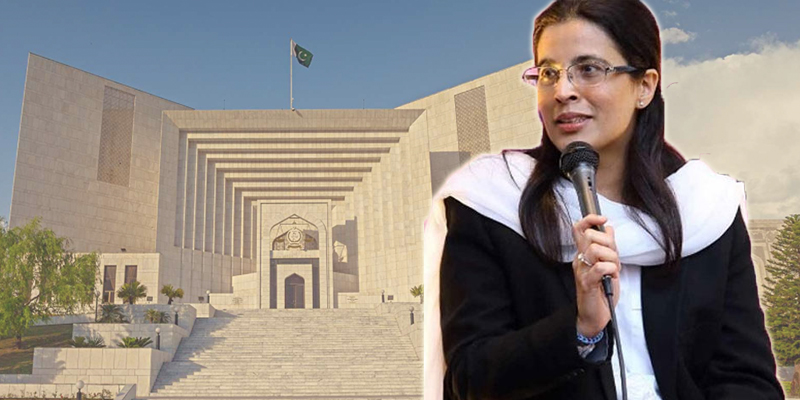
Justice Ayesha A. Malik makes history as the first woman judge at the Supreme Court of Pakistan.
The 55-year judge took her oath administered by Chief Justice Gulzar Ahmed in Islamabad, today (24 January 2022), joining the nation’s apex court consisting of 16 male justices.
In 2012, she made history when she became the first woman to be elevated as a judge to the Lahore High Court (LHC).
She believes her presence in itself would make a difference.
“The biggest way I’ve had an impact is that I’ve become a voice. I’m there to call out the discrimination, call out stereotyping, and bring out the gender perspective. I’m the voice that nudges, reminds, and suggests ways to improve ourselves and make our system more inclusive,” she had said in an interview published at the United Nations Office on Drugs and Crime (UNODC) website.
She added: ” For example, in superior courts, judges generally refer to each other as brother judges since most judges are men. I had to always mention that I’m not a brother judge. That I’m, if at all, a sister judge, and so this would bring on a debate on gender. And even today, at times, I need to make my presence felt and say that you keep me out of the narrative by using brother judge, so please include me by using the brother and sister judge’s terminology.”
At LHC, she heared constitutional petitions on a large variety of issues including tax, environmental, and regulatory matters. She had decided on important issues pertaining to the empowerment of women, the right to vote as well as against maintaining a women quota in government departments and medical colleges, according to her profile at the LHC website.
In January 2021, Justice Malik presided over the landmark ruling abolishing the controversial ‘two-finger’ virginity test for rape survivors. In the case, titled Sadaf Aziz vs The Federation (2021), she declared the two finger test as unconstitutional holding the practice of virginity testing in rape cases as illegal.
As a member of the Board of Punjab Judicial Academy, she helped develop courses on gender sensitization of court processes and training for gender based violence cases.
Born in 1966, she completed her basic education from Schools in Paris and New York and did her Senior Cambridge from the Karachi Grammar School, Karachi. She then did her A’ Level from Francis Holland School for Girls in London.
She completed her B.Com from the Government College of Commerce & Economics, Karachi and studied law at Pakistan College of Law, Lahore. She went on to do her LL.M from Harvard Law School, Cambridge, Massachusetts, U.S.A. where she was named a London H. Gammon Fellow 1998-1999 for outstanding merit.
During 1997-2001, she worked with Fakhruddin G. Ebrahim & Co., Karachi, where she assisted Mr. Fakhurddin G. Ebrahim.
From 2001 to the date of her elevation, she worked with Rizvi, Isa, Afridi & Angell known as RIAA, initially as a Senior Associate and from 2004 as a Partner and was in charge of the firm’s Lahore Office.
She has taught law as a Lecturer of Banking Law, University of Punjab, Department of Masters of Business and Information Technology. She was also a lecturer of Mercantile Law, College of Accounting & Management Sciences, Karachi.
RELATED STORY:
Sikh judge elavated to Malaysia’s top court (Asia Samachar, 17July 2020)
Canada appoints Palbinder Kaur Shergill as Supreme Court judge (Asia Samachar, 24 June 2017)
ASIA SAMACHAR is an online newspaper for Sikhs / Punjabis in Southeast Asia and beyond.Facebook | WhatsApp +6017-335-1399 | Email: editor@asiasamachar.com | Twitter | Instagram | Obituary announcements, click here