









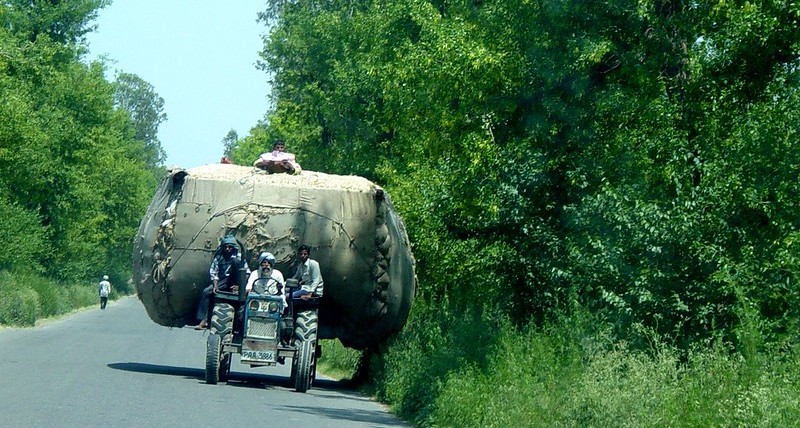
A random shot in Punjab, India, in 2005 – Photo: Kirandeep Singh / Flickr
By Arvinder Kaur | The Outlook | India |
Standing on the boundary of his small field, Harpal Singh stares at the moon as it drifts in the farm stream. There is an air of melancholy about him. When asked about the reason for his pensive demeanour, he says, a bit reluctantly, “This crop that is now ready for harvesting was sown by my father. I was at the Delhi border at that time. After finishing the sowing Bapu joined me there and gave up on life in the bitter cold that followed.” His eyes begin to well up. I look at the farm. A sheet of golden sunshine has spread over it. Late March is the time when the Rabi crop is nearly ripe and the wheat stalks nod happily in a winnowing wind that begins to blow.
Although not much has changed on the ground, there have been forces at work that have torn asunder the soul of its people, the fabric of its society and the vibe in its ambience. The people of Punjab are, however, the hardiest of the lot as historically they have always taken the divisive forces, the invaders, whether from within or without, head on. And they have lived through all this with a broad smile and with a spirit that is by now aptly known as ‘Panjabiyat’. Yes, the indomitable happy spirit that allows them to live the day to the hilt, going by the age old saying “Khada peeta lahe da/te rehnda Ahmad shahe da” (What you eat and drink today is yours, the rest will be pillaged by Ahmad Shah Abdali, who invaded Punjab thrice between 1747-53.)
It is this spirit that has always defined the Punjabi character, making them the people that they are: bold, experimental, not cowing down to authority easily, rebellious and yet deeply sensitive. Some of the things that have been reiterated through the results of the recent elections wherein they have been courageous enough to put their much-loved state in the hands of a party totally new to the soil. All this because they have waited long enough to break the shackles of fiefdom that have brought down the once-prosperous state to the threshold of near poverty. But Punjabis have fought on.
“Hun nahi (not anymore, not now),” says Nirmal Kaur of Mansa who has lost three young sons to the drug menace. She rues the day when her eldest one first took the injection and the malaise took the younger two in its fold quickly. She looks longingly at three pictures perched on a ramshackle sandook, their marigold garlands all dried up. “When I was young this was not the case,” Nirmal goes on. “Hun taan araam naal milan lag gayi si (The damn thing was not so easy to acquire).” Now all you need is money to buy and they squandered away everything before dying of an overdose. “My Punjab back then was not Udta Punjab,” she goes on to say, referring to the Bollywood movie of the same name and based on the drug menace. “My husband and I worked hard in the fields but there was peace and happiness at the end of the day.” She looks wistfully at an old man lying on a broken cot, disinterested in life.
Read the full story, ‘Life, Kingsize: Punjab Has Lost Much But Not Its Spirit’ (17 March 2022, The Outlook), here.
ASIA SAMACHAR is an online newspaper for Sikhs / Punjabis in Southeast Asia and beyond.Facebook | WhatsApp +6017-335-1399 | Email: editor@asiasamachar.com | Twitter | Instagram | Obituary announcements, click here