






















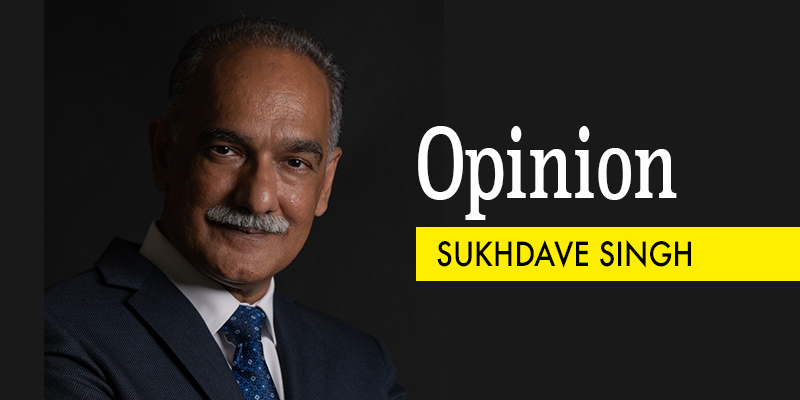
By Sukhdave Singh | Opinion |
Whether in life or leadership, I believe that it is useful to have some form of guidance on what behaviours are appropriate and what are not; guidance on what it is to have a life well lived. Many years ago, while working on an undergraduate assignment, I came across the following quote from the Greek philosopher Socrates: “Are you not ashamed of your eagerness to possess as much wealth, reputation and honours as possible, while you do not care for nor give thought to wisdom and truth, or the best possible state of your soul?” Today, I am again reminded of this quote as I watch individuals and leaders who do not seem to have any behavioural moorings, and appear to be driven solely by the desire to attain, by whatever means, exactly those things that Socrates warns against. Truth and wisdom appear to have no meaning to these individuals.
To me there is no question that values play an important role in the paths we choose in life. The fact that I have spent much of my professional life in a central bank, where a core pillar is gaining public trust and undertaking policies that improve general public welfare, has served to deepen my conviction on the role of values in leadership. The risks to organisations of leaders lacking ethical anchors run beyond the obvious reputational and financial risks of corporate scandals, to include the corrosion of their relationships with their employees, customers and the communities they operate in. If the leaders are themselves lacking an ethical compass, how can they credibly create an organisational climate that encourages the type of ethical behaviour implied by the ESG goals that many organisations profess to uphold?
As leaders, there are skills that we need to manage well whatever business responsibilities we carry – things that one learns through formal learning, in business schools and through experience. But, if that is all we have, our leadership can still be rudderless. We see these in the excesses committed by many people in leadership positions and how easily they are led astray from their responsibilities. Without a sound values system that one is personally committed to, one’s life and leadership will be diminished for lack of that moral compass. Conversely, a proper values system can guide a leader on behaviours that are appropriate and those that should be avoided. It can provide positive meaning and purpose to one’s life and leadership.
Values systems do not need to be complex, although I do remember seeing one with a list of 50 virtues. It is better to keep it simple. Here is an example of a values system that I have personally found useful. It is derived from my faith of Sikhism.
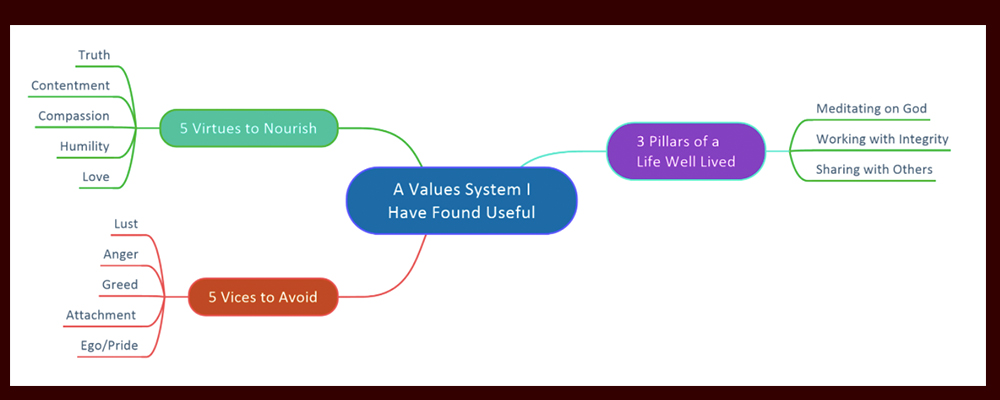
I will describe very briefly my understanding of each component of this values system and how it has a role in life and leadership.
A. 3 PILLARS OF A LIFE WELL LIVED
- MEDITATING ON GOD – Spirituality allows leaders to understand that there is a higher purpose to their leadership than just their personal wants and needs.
- WORKING WITH INTEGRITY – Earning a livelihood through one’s own personal and honest effort and not by trying to find easy and unethical ways to acquire wealth. Not resorting to things like fraud, theft and corruption.
- SHARING WITH OTHERS – Charity towards those who are less fortunate.
B. 5 VIRTUES TO NOURISH
- TRUTH – A core pillar of leadership is trust and integrity. A habitual liar goes against the very core of leadership integrity. Conversely, a leadership based on truth provides a strong moral foundation for its integrity.
- CONTENTMENT – Don’t be so obsessed with what you don’t have that you become blind to what you do have. This is not about being complacent. It is about your outlook to life and how you channel your competitive spirit, and importantly, how you deal with failures. The advantage of contentment is that it allows you to be ambitious without resorting to unethical or illegal means.
- COMPASSION – Empathy and concern for others. Truly compassionate leaders have a transformational effect on organisations and societies they serve.
- HUMILITY – This virtue makes great leaders. It is also a great antidote to the vice of egoism. Having a sense of humility allows you to recognize that your success is based on the contributions of many others.
- LOVE – Love for your institution; love for the people who work for you; love for your customers.
C. 5 VICES TO WATCH OUT FOR AND AVOID
- LUST: With power comes temptation. There are many leaders who have fallen under the charms of this vice, undermining their leadership legacy.
- ANGER: Everyone gets angry sometimes. But as a leader, you have to manage it and be careful about how you express it. An angry rant could make others lose trust in you, and that trust would be hard to rebuild.
- GREED: Seed of unethical behaviour and corruption. Powerful leaders can be a source of great good but that often doesn’t happen because they have fallen prey to this vice. The contentment virtue is an antidote.
- ATTACHMENT: Becoming too attached to your position, power, status and titles can make it difficult to do without them, leading some to resort to unethical means to obtain or retain these.
- EGO/PRIDE: I have seen even accomplished leaders fall prey to this vice. It can be the crack in a leader’s resilience, and open them up to being manipulated by those who know how to play on their ego. Highly egoistic leaders may also not be good to the long-term health of an organisation because they risk being in an echo chamber, hearing only what people think they want to hear, affecting the quality of their judgement and decisions. Their subordinates are also not able to perform at their full potential for fear of clashing with their leader’s ego. Maintaining a sense of humility helps in keeping one’s ego under control.
I realise that there is a risk with making explicit the values system that I have sought guidance from, in that there would be some who would be quick to point out instances where I have failed to live up to those values. However, perfection is not the goal and failure is part of learning and growing. The benefit of having a values system such as the one I have described here is that it provides an anchor for your behaviour and actions. You may at times fail to live up to those values but when you do, you are aware of it, and you know that there is a better you. That self-awareness, over time, guides and strengthens your leadership.
In sharing this, I make no claim to great leadership or having a leadership legacy; only that I have struggled for a substantial part of my professional life with leadership, its responsibilities, and what it takes to be a good leader. I do believe that a good values system can lead to a positive transformation of one’s leadership and allow one to discharge one’s responsibilities with integrity. But for that to happen, these values must not be something that you put on the wall, but rather must be imbedded deep in your mind and conscience through constant reflection. Leadership is not easy but it does not have to be bad.
Sukhdave Singh is a former deputy governor of Central Bank of Malaysia and a former independent director of Malaysian sovereign wealth fund Khazanah Nasional Bhd. The article was published by Sukhdave on his LinkedIn page (link) and is reproduced here with his permission.
* This is the opinion of the writer, organisation or publication and does not necessarily represent the views of Asia Samachar.
RELATED STORY:
Central banker Dr Sukhdave makes a comeback (Asia Samachar, 30th July, 2018)
ASIA SAMACHAR is an online newspaper for Sikhs / Punjabis in Southeast Asia and beyond.Facebook | WhatsApp +6017-335-1399 | Email: editor@asiasamachar.com | Twitter | Instagram | Obituary announcements, click here |





Very true and insightful article.
Many people are willing to sell their soul for the greed of money.Have experienced this from my own personal experience.May karma teach them a good lesson..
Well said Mr. Sukhdev.
Gurbani is a “To-Do BLoCK” that can fit into every aspect of life. Unfortunately the dimension of this Block does not fit well in every Human lifestyle. It’s just like putting a brick into a constructed wall with windows. Either the brick will break or the wall will crack. That powerful “Is this To-Do-BLoCK”… The wisdom in SGGS.
We mortals cannot phantom this advice as humans we keep failing. Even the so- called “religious” or the “pious” fail terribly when they have to catch hold of this “To-Do BLoCK”
Sukhdev is putting this “To-Do BLoCK” on the walls of shackles termed as leaders leaders. It is a very good guide if the leaders can condone truly on every “To-Do BLoCK” illustrated by you sir. The warmth of the seats of the leaders is so comforting that it becomes next to impossible to let go.
Knowing this very fact, our Gurus did not condone to any territories; any kingdom nor indulge into compilation of wealth. They were the only great spiritual Kings who fought for humanity and the rights for us to live in peace and harmony. They taught us to be resilient. They did not condone to any throne; rather placed SGGS to an everlasting throne to the wisdom of which every human will bow in reverence;but ONLY if we are truly exposed to the messages meant to transform us towards “Sach Khand”… Where Nirangkaar Abides
Thank you Dr Sukhdave Singh for taking the time to write this article and sharing it in Asia Samachar.
Hope you will write more and some exclusively for Asia Samachar for the benefit of our young just starting out in their careers.
Kuldip Singh s/o Durbara Singh.
That’s a great article you have written. May Waheguru ji bless you with good health and happiness.
With all good wishes,
Comments are closed.