






















By Dr. Charanjit Kaur | Opinion |
Toxic masculinity is not confined to one society; it is a recurring feature within family institutions across cultures. However, in post-migratory communities such as the Panjabi Sikh diaspora in Malaya (and later Malaysia), it takes on a historically specific form shaped by colonial labour structures, migration patterns and inherited cultural norms. Although Sikh religious teachings emphasize equality and dignity, lived family structures often continue to operate within a Panjabi cultural framework that reproduces hierarchical gender relations. This tension between scripture and social practice becomes particularly visible in domestic spaces.
From a postcolonial perspective, Sikh masculinity in Malaya was not constructed in isolation. During the British colonial period, Sikh men were strategically recruited into roles that emphasised discipline, physical strength and obedience. They were framed as loyal subjects of the colonial order; attributes that reinforced a particular masculine ideal: strong, authoritative and compliant to hierarchy. These colonial constructions did not disappear after migration instead, they were absorbed into community identity and later reproduced within family structures.
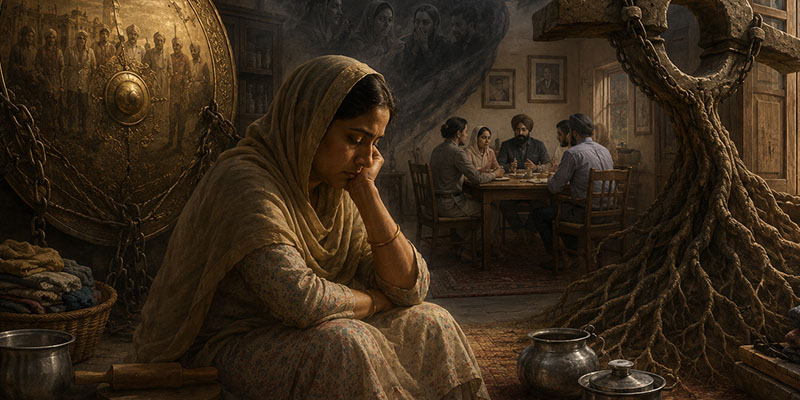
Sikh women, in contrast, were positioned primarily within the domestic sphere. As homemakers, they became the custodians of cultural continuity, language and religious practice in an unfamiliar land. Yet, their labour and emotional experiences remain largely absent from historical narratives. Even in accounts of early Sikh settlement in Malaya, women’s contributions are often marginal or silent. This silence is not accidental. It reflects what can be understood through a triadic framework of social regulation within Panjabipatriarchal structures: izzat (honour), sharam/badnami(shame) and sehna (endurance). These three interlocking forces shape women lived experiences in the domestic sphere.
FAMILY HONOUR
Izzat positions the woman as the bearer of family honour, making her behaviour a reflection of collective reputation.Sharam/badnami operates as a disciplinary mechanism where fear of social disgrace enforces conformity and silence. Sehna normalises endurance as moral duty, framing suffering as an expected feminine virtue. Together, this triad functions as a system of social control that regulates behaviour, suppresses disclosure and legitimises patriarchal authority within the household.
Ethnographic interviews conducted with Sikh families in Malaysia reveal how these structures operate in everyday life. One participant reflected: “Main sab kuch sehndi rahi … par kise nu dasya nahi”. (I endured everything … but I never told anyone). Another stated: “Je main kuch boldi, tan kehnde si ke tu ghar di badnami karni ae”. (If I spoke up, I was told I would disgrace the family).
These narratives illustrate how violence and emotional neglect are not only individual experiences but are mediated through culturally embedded systems of honour and shame. Amid these stories, one pattern was impossible to ignore which is toxic masculinity, not as an abstract concept but as a lived reality within the household. Within this framework, toxic masculinity emerges not simply as individual behaviour but as a structural outcome of intersecting colonial legacies and patriarchal cultural norms. Masculinity becomes associated with authority, emotional suppression and control while femininity becomes associated with endurance, silence and relational sacrifice.
TOXIC MASCULINITY
So, what is toxic masculinity in this context?
It is not masculinity itself. Sikh teachings honour courage and responsibility. But somewhere along the way, these values have been reshaped where authority turns into control, respect turns into fear and silence becomes the measure of strength. Masculinity is no longer about insaaniyat (humanity) but about power. And we must ask: power over whom? What does this do to women especially wives?
For many, marriage did not simply mean partnership; it meant sehna (to endure). Within the four walls of the home, violence (physical, emotional and psychological) became normalised, often hidden behind the idea of ‘ghar di izzat’ (family honour). Speaking out was not just discouraged but it was seen as bringing shame. The impact on women is therefore not only physical or emotional but structural: isolation from natal families, absence of institutional support and cultural discouragement from speaking out all contribute to sustained vulnerability.
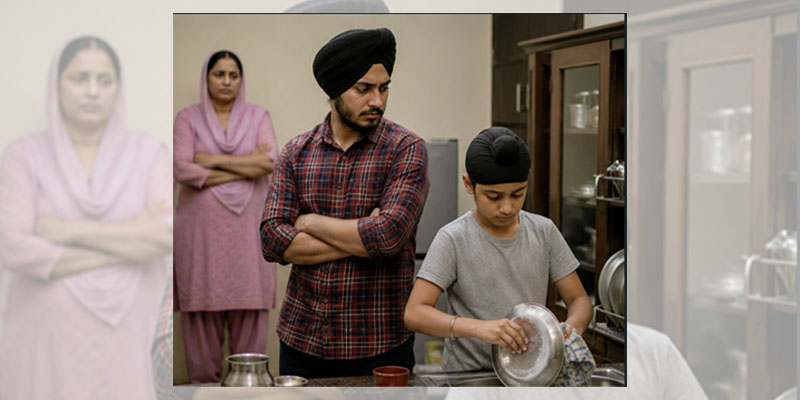
The impact on children is equally significant. Sons often internalise masculinity as dominance and emotional restraint while daughters internalise endurance as relational obligation. In this way, gender roles are reproduced intergenerationally not through explicit instruction but through everyday observation and embodied experience. With no proximity to their own families and often no support from in-laws, these women were left to navigate pain alone. Many were told, “eh hi teri kismat hai” (this is your fate) or “aurat nu sab sehna painda hai” (a woman must endure everything). Their resilience is often praised. But we must ask: kis keemat te? (at what cost?) What does this do to children?
Children are not passive observers. They absorb, they imitate, they internalise. A son who grows up hearing “mard nu dard nahi hunda” (a man does not feel pain) learns to suppress his emotions and equate masculinity with dominance. A daughter who watches her mother endure may come to believe that love means silence, sacrifice and samjhauta (endless compromise).In this way, toxic masculinity does not end; it is quietly reproduced, becoming part of what we call parampara(tradition), even when it contradicts the very values we claim to uphold.
IMPACT ON MEN
And what does this do to the men themselves? This is where the conversation becomes uncomfortable. Men are not only enforcers of this system. They are also shaped and in many ways, constrained by it. A man raised to believe that vulnerability is weakness learns to bury his fears, his grief, his tenderness. He may be called “ghar da mard” (the man of the house) but what does that role allow him to feel? He may provide, protect and command but struggle to connect. He may be respected but not understood. He may appear strongbut feel deeply alone. In protecting an image of strength, he is denied the freedom to be fully human.
However, a postcolonial gender analysis also requires attention to the production of masculinity itself. Men in these communities are not only agents of patriarchal structures; they are also shaped by them. The expectation to embody strength, authority and emotional restraint limits the expression of vulnerability and produces forms of psychological isolation.Thus, masculinity becomes both a position of power and a site of constraint. This reveals a fundamental contradiction: a community that upholds egalitarian spiritual principles (sarbat da bhala, the welfare of all) while simultaneously sustaining domestic hierarchies structured through honour, shame and endurance.
So, we are left with a difficult contradiction. A community that speaks of equality, of sarbat da bhala yet within the home, silence, control and suffering persist. This is not simply culture. This is not just ‘how things are’. This is something we have learned not to question. The real question is not: ki eh sach hai? (is this true?) The real question is: asi isnu badlan di himmat rakhde haan? (do we have the courage to change it?) Because until we do, equality will remain something we recite but not something we truly live.
The conversation does not end here. If masculinity shapes silence then femininity shapes survival and that will be the focus of the next article: toxic femininity in Panjabi Sikh family life.

Associate Professor Dr. Charanjit Kaur is an expert in cultural anthropology, with a special focus on the Sikh minority community in Malaysia. Her work explores themes such as religious-cultural conflict, gender identity, and social behavior.
RELATED STORY:
Bridging faiths, upholding Sikhi: A personal journey in interfaith harmony (Asia Samachar, 26 April 2026)
ASIA SAMACHAR is an online newspaper for Sikhs / Punjabis in Southeast Asia and beyond. You can leave your comments at our website, Facebook, Twitter, and Instagram. We will delete comments we deem offensive or potentially libelous. You can reach us via WhatsApp +6017-335-1399 or email: asia.samachar@gmail.com. For obituary announcements, click here