





















By Gurnam Singh | Opinion |
The need to believe seems to me to be a universal phenomena. Indeed, the absence of belief or faith can be associated with an existential crisis leading to serious mental health problems and worse. It is commonly asserted that those who do not believe are lost souls living pointless lives. To live is to hope and one cannot hope if one doesn’t have some belief!
What somebody believes in can, of course, vary considerably. For some, the focus may be on faith, religion and God; for others their belief/s may be secular in nature. For them, the object may be famous people, heroes, performers, sports clubs, nationalism, science fiction, etc. And yet, for others, beliefs may be both religious and secular.
So it is reasonable to suggest that it is healthy and normal to believe, and in this regard we are all believers, or we should be! However, the problem with faith arrises when we become too rigid or certain in our beliefs. A prime example is religious fundamentalists who have a tendency to reduce the complex and arguably limitless aspects of the divine to a set of rigid actions, rules and rituals. For them, anybody who does not follow their reductive interpretation of the faith is a non-believer and/or sinner!
Of course the same can apply when it comes to secular beliefs. For example, we see nationalists or racists often reducing human diversity to a set of simple stereotypes, racist tropes and binary opposites. Religious fanatics do not have a monopoly on oversimplification. One only needs to see the terrible suffering that secular nationalism and communism has cased to realise that blaming God for the sins of humanity is a little unfair.
Ultimately, belief is about our identity. And just like healthy indentity development requires one to expand and develop one’s sense of self, similarly, we need to do the same when it comes to our beliefs. One of the unique features of the human mind is that we are able to develop a self-concept, an identity and a sense of time and space. This is what makes us quite different from all living beings. Our beliefs are ultimately psychological constructs that enable us to develop a sense of belonging and navigate the social world.
And in this regard, it’s worth thinking about our beliefs as being determined and not determined. That is as relatively fixed in the sense that we may be able to identify with a belief, such as believing in a scripture, prophet or holy person, but also fluid in that we are constantly discovering deeper insights into those beliefs and our existence.
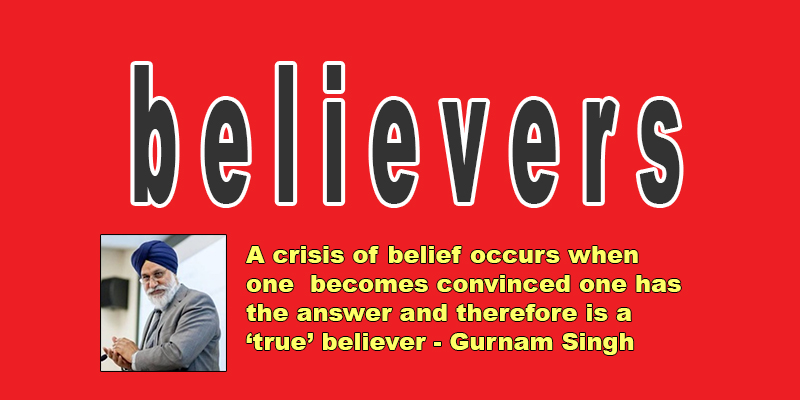
A crisis of belief does not occur when one is developing or expanding one’s understanding of self, but when one becomes convinced one has the answer and therefore is a ‘true’ believer. Life is about ‘being’, which requires a limited degree of certainty, but also ‘becoming ‘, which requires a willingness to engage with the world, learn and expand one’s horizons.
Unsurprisingly, one of the central features of Sikh teaching is to engage in lifelong learning, after all the word Sikh roughly translates as a ‘learner’ or ‘student’. More precisely, it refers to somebody who learns from the Guru, which in this case would be Guru Granth Sahib and Gurbani. And when one does engage in such learning one quickly realises, because it is a living thing, there are no simple understandings of Gurbani. For sure the words are the same, but overtime, because nothing stands still, the meanings and insights can change.
Certainty about belief may provide comfort in the short term, but in the long term it is a road to nowhere! Though this seems counter intuitive, as we question, discover and learn, our beliefs and faith get stronger. Our appreciation of what we believe and the value those beliefs have for our lives becomes richer.
How do I know this to be true? Because I have experienced it in my life. Though I am much less certain what it means to be a Sikh nowadays, this was not the case when I adopted Sikhi over 40 years ago. Then, practicing Sikhi was a kind of self inflicted suffering designed to secure a place in heaven and also to experience some magical spiritual revelation.
Today, though I am much less certain about what meeting God might be, what God is, and whether or not there is an after life, I feel much stronger in my beliefs. The more I question, the stronger my love for Gurbani becomes. I am sure my 20-year-old self would have condemned me as a weak Sikh or worse. Yes, we can lead by example, but we cannot tell another how to live their life. We all have to travel our own journey and find our own meaning of life. I am still searching and I am enjoying every minute in my quest.

Gurnam Singh is an academic activist dedicated to human rights, liberty, equality, social and environmental justice. He is an Associate Professor of Sociology at University of Warwick, UK. He can be contacted at Gurnam.singh.1@warwick.ac.uk
* This is the opinion of the writer and does not necessarily represent the views of Asia Samachar.
RELATED STORY:
BJP all out celebrating Sikh occasions. What’s up? (Asia Samachar, 21 April 2022)
ASIA SAMACHAR is an online newspaper for Sikhs / Punjabis in Southeast Asia and beyond.Facebook | WhatsApp +6017-335-1399 | Email: editor@asiasamachar.com | Twitter | Instagram | Obituary announcements, click here |