




















By Asia Samachar | Sikhi |
Human errors, printing processes, evolution of Gurbani presentation and clergy self-interest are among the causes that led to the numerous errors in prevailing printed versions of the Sri Guru Granth Sahib (SGGS).
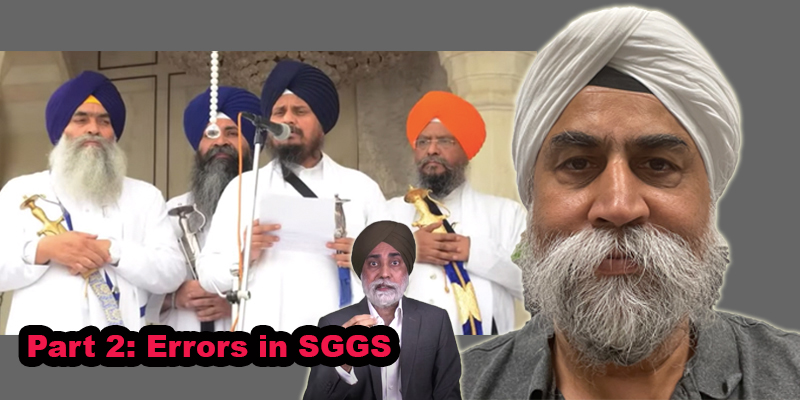
These are among the reasons outlined by , Sikh author Dr Karminder Singh Dhillon in the second video on the topic.
In a second part of the video, Karminder ponted out that the errors within the SGGS is the result of duplication.
The early copies of the scripture were handwritten, a ‘process that is a definite source of errors’.
“A great deal of the hand copying was undertaken by the clergy, the Nirmalas, in particular, who were trained in Hindi and not Punjabi. So the propensity of errors was multiplied,” he said in the video entitled ‘Errors in the Sri Guru Granth Sahib – Part 2′.
Panjabi version: ਸ੍ਰੀ ਗੁਰੂ ਗ੍ਰੰਥ ਸਾਹਿਬ ਵਿਚ ਅਸ਼ੁਧੀਆਂ – ਭਾਗ ਦੂਜਾ ।.
Next, printing. The process of printing, typesetting and proof reading were equally subject to human errors. This is all the more so if the critical processes were neglected, done unprofessionally, overlooked or ignored.
FOR PART ONE OF THIS STORY, GO HERE
The printing brought about possibilities of technical errors. In the type set print era, individual letters had to be picked up and arranged in reverse to print form one page. Potential areas for errors: Letters frequently dropped out, wrongly placed or the printers simply ran short of them, he argued.
The evolution in the process of presenting Gurbani had also led to errors. There are two aspects here. There is the change from the continuous to the separated style of Gurbani presentation (jurdvi to pad-shed).
“The process of separating words can, and does, result in errors,” he argued. Then there is the evolution of the printing technology, from stone press to typeset and then to plate printing. “Each time this happened, old errors got preserved, and new one got added on,” he noted.
Third, advent of clergyism in Sikhi. Here, Karminder pointed out three ways how the class came into being in Sikhi.
“We need to keep in mind that there is always a contradiction between the original religous narrative – the one espoused by the founding fathers, or, prophets, if you like – and the narrative created by the clergy. This contradiction arises because the objectives of the founder and the clergy class are in contradictions,” he said.
He shared a shabad by Bhagat Namdev. He argued that it lays down a critical and foundational basic principal, exposing the clergy’s role in spiritual distortion and corruption. “The message [in the shabad] is to expose the decadent role of the clergy and to prevent us, Sikhs, from falling prey into the rot in spirituality that the clergy inflicts upon the original belief system, all in the name of serving his own interest, and that of his clergy class,” he said.
Karminder then examines the position of the clergy in Guru Nanak’s Sikhi (begins at 13:45). He also examines stories that Sikhs have been constantly fed – including that Guru Arjan (5th Sikh Guru) supposedly sang a shabad in praise of Bhai Mohan to get him to share the collection of shabads of the first four Guru.
He also outlined seven step in the advent of the clergyism that is supposed to have brought Sikhs to their present predicament with the SGGS (37:30). Here, he touches on the question if the original Pothis written by the Gurus exist today, and about the position of the Baba Mohan Pothis, Bhai Bano Vali Beerr and the Kartarpuri Beerr.
In concluding remarks (1:00.00), he noted that the accepted prevailing view is that only the Shiromani Gurdwara Parbhandak Committee (SGPC) has the authority to make the corrections to the errors in the SGGS. He makes some strong remarks on this point of view.
The videos (see here for the first video) were in response to moves by the Amritsar-based Sikh bodies to take to task a United States based Sikh volunteer who had recently highlighted the issue of errors with in the SGGS.
In May, Sikhs around the globe were jolted with news that Thaminder Singh had made unilateral changes to the SGGS. On May 3, Akal Takht acting jathedar Giani Harpreet Singh pronounced US-based Thaminder Singh as “tankhaiya” (guilty of religious misconduct) for allegedly publishing online the GGS with the changes, including adding extra “lagan-matravan” (suprasegmental symbols of Gurmukhi).
RELATED STORY:
Printing errors in Guru Granth: This issue is not about to go away (Asia Samachar, 24 June 2022)
Grappling with Guru Granth printing errors. Thaminder takes the hit (Asia Samachar, 7 May 2022)
ASIA SAMACHAR is an online newspaper for Sikhs / Punjabis in Southeast Asia and beyond.Facebook | WhatsApp +6017-335-1399 | Email: asia.samachar@gmail.com | Twitter | Instagram | Obituary announcements, click here