

























By Gurnam Singh | Opinion |
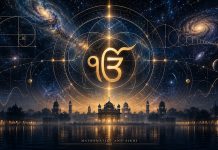
Have you ever felt a state of emptiness, or looked up into the Cosmos and wondered what all the dark space in-between the stars actually represents? For sure, in basic physics, we have learnt about the vacuum of space, but, this leaves one wondering, what does it mean to set eyes on the vastness of ‘empty space’ and see nothing? In fact even the phrase ‘seeing nothing’ is an oxymoron. And given that all seeing is really not happening ‘out there’ but in our minds, what does emptiness mean in the inner world?
The concept of emptiness can have different meanings depending on the context in which it is used and the perspective one is seeking to express. In general, emptiness refers to a state or condition of being empty or vacant, devoid of content, or lacking substance or essence. This condition can relate to the external physical world incorporating the whole cosmos, or the inner world of human consciousness.
In physics, emptiness can refer to a vacuum, which is a space that is devoid of matter or particles. A vacuum however, as modern science has revealed, is not truly empty, as it can contain energy or virtual particles, but it is a state of very low or zero density.
In cosmology, the concept of emptiness is a physical phenomena often associated with a vacuum in space. This related to the idea of the vacuum state in quantum field theory, which is a state of lowest possible energy in a field, and is often associated with empty space. This vacuum state is not truly empty but contains fluctuations in energy, or virtual particles, that can arise from the uncertainty principle of quantum mechanics.
The idea of emptiness is also relevant in the study of dark energy, which is a mysterious force that is thought to be responsible for the accelerated expansion of the universe. In this regard, emptiness can be related to the study of the ongoing expansion of the universe from the Big Bang some 13 billion years ago. During this period of inflation, in the very beginning, the universe was filled with a quantum field that was in a state of emptiness and it is fluctuations in this field are thought to be the seeds for the formation of galaxies and other large-scale structures in the universe.
If we turn from the cosmos to the inner world, then emptiness takes on a wholly different set of meanings. In the general sense inner emptiness relates to particular psychological states, emotions and thoughts. Emptiness here is associated with feelings of separation, confusion, and loss of purpose. This can be a temporary fleeting emotion or more a substantial serious issue than can lead to mental illness and even suicidal tendencies.
Associated with psychopathology, emptiness can lead to extreme emotional states where one enters a state of meaninglessness and/or a moral vacuum. This feeling of emptiness, can be related to a sense of disconnection or detachment from one’s self, others, or the world. Here emptiness can be associated with an existential crises or a search for deeper meaning and purpose in life. And often this search for meaning can lead a person to religion.
Whilst each religion has its own way of conceptualising emptiness, there is remarkable similarity with most traditions associated around the human ego, self, will and desire.
In Christianity, the concept of emptiness is related to the idea of self-emptying (kenosis), which refers to the voluntary relinquishment of one’s own will and ego to serve others and the divine. It is seen as a way of imitating the humility and sacrificial love of Jesus Christ.
Emptiness in Islam is associated with the idea of ‘fanaa’, which refers to the annihilation of the ego or self in the presence of God. It is a mystical concept that is often associated with Sufism, a spiritual tradition within Islam. In Sufism, the goal of spiritual practice is to achieve a state of fanaa, where the individual becomes empty of ego and self and becomes united with the divine. This is also linked to the idea of detachment from material possessions and the world. This is expressed in various forms, such as the emphasis on the temporary hence empty nature of worldly things and the importance of focusing on the hereafter.
Within the Indic tradition, emptiness is closely related to the Sanskrit term ‘sunyata’ referring to “devoidness”, “emptiness”, or “hollowness”. The Punjabi word ‘sunn’ derived from ’sunyata’ is related to a zero point of emptiness from which expansion and a state of ‘non-emptiness’ emerges.
In Hinduism, the idea of emptiness is closely related to the idea of maya meaning illusion or dream. In simple, Hinduism asserts that life is illusory and in this regard empty. In the Advaita Vedanta school of Hindu philosophy, the concept of emptiness is known as shunyata or sunyata, and is considered to be a means of realizing the true nature of Brahman. The philosophy of Advaita Vedanta emphasizes that all phenomena are ultimately empty and lacking in inherent existence, and that the true nature of reality is non-dual and beyond all distinctions.
In Buddhism, the concept of emptiness (also known as shunyata) is a central philosophical concept. It refers to the idea that all phenomena, including objects, people, and even thoughts, have no inherent or fixed existence or nature. According to this view, everything is interdependent and arises in dependence upon other factors and conditions. Therefore, nothing has an independent existence or essence, and all things are ultimately empty of any intrinsic nature or self.
In Sikhi, the concept of emptiness is closely related to the idea of unity and oneness with the divine. The term often used to describe this concept is “shunn”, which is derived from the Sanskrit word “shunya” and is similar to the Buddhist concept of shunyata. The word sunn declares that the Truth is beyond limitations and determinations. Emptiness of Buddhism means ‘no doctrine about Truth’; sunn in Sikhism means ‘no conception about the Inconceivable.’ In his dialogues with the Yogis, Guru Nanak, states that contrary to yogic practices, it is only through cultivating the mind that one can become enlightened. Then mind appears empty like an un-struck chord, which once struck vibrates and resounds. ਨਉ ਸਰ ਸੁਭਰ ਦਸਵੈ ਪੂਰੇ ॥ ਤਹ ਅਨਹਤ ਸੁੰਨ ਵਜਾਵਹਿ ਤੂਰੇ ॥ (Guru Nanak Dev Ji in Raag Raamkalee – SGGS p943)
An important feature of the conception of the ‘void’ in Sikhi is that it can be realized through divine wisdom or naam. It follows in Sikhi, emptiness is not a state of nothingness or absence, but rather a state of transcendence beyond duality and separation. It refers to the idea that the true nature, or the outer world or inner reality are not separate entities but rather part of an interconnected whole. This interconnectedness is reflected in the concept of “Ik Onkar“, which means “All is one” and emphasizes the unity and oneness of all of existence.
Emptiness is one of those concepts that appear to be straight forward, but on closer scrutiny become more and more mysterious. Whilst human beings, by virtue of our immense intelligence have managed to develop a language to engage in some kind of explanation of this concept, my feeling is that ultimately all attempts at making sense of something that in essence does not exist will remain incomplete. And here, I think the council of Guru Nanak is very useful when he says, ‘Where you are bound to lose by speaking, there, you out to remain silent’
ਜਿਥੈ ਬੋਲਣਿ ਹਾਰੀਐ ਤਿਥੈ ਚੰਗੀ ਚੁਪ ॥੨॥
(Guru Nanak Dev Ji in Raag Maajh – SGGS p149)

Gurnam Singh is an academic activist dedicated to human rights, liberty, equality, social and environmental justice. He is an Associate Professor of Sociology at University of Warwick, UK. He can be contacted at Gurnam.singh.1@warwick.ac.uk
* This is the opinion of the writer and does not necessarily represent the views of Asia Samachar.
RELATED STORY:
Miracles and Godmen (Asia Samachar, 31 July 2020)
ASIA SAMACHAR is an online newspaper for Sikhs / Punjabis in Southeast Asia and beyond. When you leave a comment at the bottom of this article, it takes time to appear as it is moderated by human being. Unless it is offensive or libelous, it should appear. You can also comment at Facebook, Twitter, and Instagram. You can reach us via WhatsApp +6017-335-1399 or email: asia.samachar@gmail.com. For obituary announcements, click here.





Dr. Gurnam Singh ji,
You have written and published excellent article on “Emptiness” in this esteemed newspaper based on the discussions started by me in ‘Save Panjab’ WhatsApp group. I have forwarded this question on ‘Emptiness’ to many Sikh scholars and hope a few more may respond with their views in near future. Kind regards
Gurdeep Singh Kundan
founding member nd former Secretary
Global Sikh Council
Executive Member of IRAS COTIS,
Inter fFaith Swiss National organisation
Founder Centre 4 Sikh Studies
Switzerland
Comments are closed.