





















By Rishpal Singh Sidhu | Opinion |
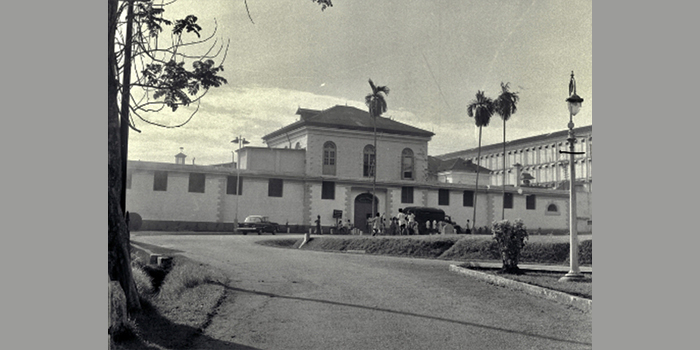
Much has been written and also a documentary produced in 2019 about Punjab’s revolutionary and freedom fighter Bhai Maharaj Singh and his subsequent incarceration at the Outram Road Jail in Singapore in 1850, and his present commemoration at the Bhai Maharaj Singh Memorial, Silat Road Gurdwara in Singapore.1,2,3. He arrived in Singapore on board the ship Mohamed Shah on 9 May 1850, together with his tehlia (personal attendant) Khurruck Singh, also spelt as Kharak Singh. Bhai Maharaj Singh died in prison on 5 July 1856. Khurruck Singh has been depicted in colonial documents as Bhai Maharaj Singh’s servant and little else has been known and written about him. This article seeks to elucidate his background and affiliation with Bhai Maharaj Singh, and, more importantly, his time in Singapore.
Malaysian historian Dr. Ranjit Singh Malhi disputes this arrival date, and his research on British records reveals that Bhai Maharaj Singh and Khurruck Singh instead landed in Singapore on 9 June 1850. This fact is confirmed in a despatch dated 21 June 1850 from the Governor of the Straits Settlements to the Secretary to the Government of India.
Khurruck Singh has been variously described as Bhai Maharaj Singh’s chela. Chela is a Sanskrit word that literally means servant or slave. It also loosely means disciple, follower, or devotee. Ahluwalia (1972) states that “Kharak Singh was to Maharaj Singh, as the latter was to his master Bhai Bir Singh. Nothing is known about this man beyond the fact that he was a Jat by caste and preferred to remain with his guru even beyond the high seas where he served him faithfully till his last breath.”4 He has also been described as one of Bhai Maharaj Singh’s closest advisers and personal attendant.5 When the Government decided to banish Bhai Maharaj Singh to Singapore, Khurruck Singh offered to go with him, and the colonial authorities in India would have been only too glad to get rid of one more trouble maker in the name of Khurruck Singh.
While there were a considerable number of Sikh convicts present at the Outram Road Jail in Singapore, it must be remembered that Bhai Maharaj Singh and Khurruck Singh were considered and treated as political prisoners. “The special status of the Singhs also came with tangible benefits, notably access to better rations. Their diet consisted of rice, flour, ghee (clarified butter), dal (lentils), sugar, salt, coffee, curry spices, onions, chillies, vegetables, dry dates, dry milk, and firewood, many more items than allocated to rank-and-file convicts, as the senior administrator in Singapore noted in characterising their allowance as liberal.”6 However, the Singhs did not consider these allowances as sufficient and in asking for more, they requested and received a small stipend to hire a cook because Khurruck Singh did not wish to fulfil this role any longer. Less successful was Khirruck Singh’s attempt to add a small quantity of bhang (marijuana) to his list of dietary needs.7
While Bhai Maharaj Singh remained quiet and silent throughout most of his time in jail, seldom speaking when spoken to or questioned by his visiting officer, Khurruck Singh by contrast was rarely bashful about speaking up and even frequently lashing out at his jailors. Bhai Maharaj Singh would have been witness to Khurruck Singh’s behaviour, but it is not clearly known “whether he (Khurruck Singh) played this part because he was the mouthpiece for both men cannot be ascertained from the Colonial archives.”8 It is reported that a senior administrator did speak to Khurruck Singh about his behaviour in January 1851, almost a year into their exile. Two years into the harsh and dismal conditions of their captivity, Bhai Maharaj Singh was already described as being in failing health, whereas Khurruck Singh was a picture of “good health, somewhat better behaved, but occasionally verging on disrespect.”9
While it is not clearly known whether it was in direct response to their request, Bhai Maharaj Singh and Khurruck Singh were given the opportunity in June/July 1853 to send messages to their dera at Naurangabad. It is reported that while these letters were in transit, Khurruck Singh expressed a desire to become a Christian. Apparently, he had earlier had conversations and discussions with his jailor John William Ganno about the similarities between the Christian and Sikh faiths. This news was treated with scepticism by Governor-General Lord Dalhousie who considered this as “a very shallow desire’’ to seek a release and made it known “that if he is playing a part and hopes to obtain liberty by adopting Christianity, is deluding himself and that, Christian or Sikh, he will equally remain in Singapore gaol.”10
By early 1854 Bhai Maharaj Singh was literally going blind from his cataracts, and it is not clearly known on when and who made a request to the authorities for reading materials. In January 1855, they received a “Bible Hindoo in 2 volumes, New Testament in one volume’’, and other items, for example a 115 years old manuscript copy of the Guru Granth Sahib that was procured in Lahore and then conveyed by bullock train to Calcutta from where it was shipped.11 It is reported that the then Governor-General of the Straits Settlements, Lord Butterworth, arranged for this manuscript to be brought to Singapore at his own expense. Though currently untraceable, it is believed to be the first copy of the Guru Granth Sahib that was brought to Singapore.12
Bhai Maharaj Singh passed away on 5 July 1856. “Most probably, Khurruck Singh, his disciple, must have been allowed to perform the last rites of his Guru, the Ardas, and recitation of the Sohila.”13 Khurruck Singh was released from jail in January 1857 and was given permission to live wherever he pleased in Singapore, but remained under the surveillance of the Singapore Police Force. When the Indian Mutiny broke out in May 1857, he applied for permission to return to India to help the British authorities, and this request was denied.14 In August 1857, he was alleged to have hatched a plot with fellow Sikhs to attract and massacre the European community in Singapore while they were at church. He pleaded innocence.15
Contrary to earlier reports that “Khurruck Singh also died in prison in Singapore sometime later, but there is no record of the date of his death.”16 As Bhai Maharaj Singh’s disciple, he was held in high regard by the local Sikh community in Singapore,and it was decided that he be deported and would be less of a threat and unable to create any mischief should he feel so inclined.17 He was deported after this alleged plot on board the steamer HMS Hoogly to Fort Cornwallis in Penang.18 It is reported that in 1861 he petitioned the authorities for his family to join him in Penang, and this request was denied.19 There is no colonial record of the date of his death in Penang.
The present whereabouts of the 115 years old manuscript copy of the Guru Granth Sahib remain a puzzle. While some of Bhai Maharaj Singh’s scarce personal possessions have been preserved at the British Library, was this manuscript also one of them? Or was Khurruck Singh allowed to take this manuscript with him to Penang? If so, where is it now? This remains a mystery waiting to be solved!
References
- Sidhu, C.S. (n.d.). Bhai Maharaj Singh; Saint-Soldier, Martyr of the Sikh Faith. Singapore, Central Sikh Gurdwara Board.
- Bhai Maharaj Singh Ji & Gurdwara Sahib Silat Road; A historical journey. (2006). Singapore, Central Sikh Gurdwara Board.
- Usma, G. S. & Singh, D. (2015). Compilers and editors. Bhai Maharaj Singh Ji & Gurdwara Sahib Silat Road; A historical journey. 2nd rev. ed. Singapore, Central Sikh Gurdwara Board.
- Ahluwalia, M.H. (1972). Sant Nihal Singh, alias Bhai Maharaj Singh: A saint revolutionary of the 19th century Punjab. Patiala, Punjabi University, p.98
- Ibid, p.49
- Ricci, R., Anand, A., & Matteson, K. (2016). Exile in colonial Asia. University of Hawaii Press, p. 80
- Ibid
- Ibid, p.81
- Ibid, p.82
- Ibid, p.85
- Ibid, p.86
- Bhai Maharaj Singh: The man, the legend. The Tribune, December 21, 2019.
- Usma, G. S. & Singh, D. (2016). Compilers and editors. Bhai Maharaj Singh Ji & Gurdwara Sahib Silat Road; A historical journey. 2nd rev. ed. Singapore, Central Sikh Gurdwara Board, p.23
- Turnbull, C.M. (1970). Convicts in the Straits Settlements, 1826-1867. Journal of the Malaysian Branch of the Royal Asiatic Society, 43 (1), p.93
- Ricci, R., Anand, A., & Matteson, K. (2016). Exile in colonial Asia. University of Hawaii Press, p.85
- Usma, G. S. & Singh, D. (2015). Compilers and editors. Bhai Maharaj Singh Ji & Gurdwara Sahib Silat Road; A historical journey. 2nd rev. ed. Singapore, Central Sikh Gurdwara Board, p.23
- Ricci, R., Anand, A., & Matteson, K. (2016). Exile in colonial Asia. University of Hawaii Press, p.87
- Pieris, A. (2011). The “other” side of labour reform: Accounts of incarceration and resistance in the Straits Settlements penal system,1825-1873. Journal of social history, 45 (2), p.466
- Ricci, R., Anand, A., & Matteson, K. (2016). Exile in colonial Asia. University of Hawaii Press, p.87

Rishpal Singh Sidhu is a semi-retired casual academic at the School of Information and Communication Studies, Charles Sturt University, Wagga Wagga, Australia. He has a passion for research, writing, and teaching and is the compiler and editor of the book, Singapore’s early Sikh pioneers; Origins, settlement, contributions, and institutions, published by the Central Sikh Gurdwara Board in Singapore in 2017. He is currently based in Sydney, Australia.
* This is the opinion of the writer, organisation or publication and does not necessarily represent the views of Asia Samachar.
RELATED STORIES:
Bhai Maharaj Singh: Freedom Fighter for Panjab (Asia Samachar, 31 Jan 2018)
ASIA SAMACHAR is an online newspaper for Sikhs / Punjabis in Southeast Asia and beyond. When you leave a comment at the bottom of this article, it takes time to appear as it is moderated by human being. Unless it is offensive or libelous, it should appear. You can also comment at Facebook, Twitter, and Instagram. You can reach us via WhatsApp +6017-335-1399 or email: asia.samachar@gmail.com. For obituary announcements, click here.