






















By Gurnam Singh | Opinion |
Because of my outward appearance, a beard and a turban (dastar), most people assume I am a follower of Sikhism, and therefore a religious person and a believer in God. Yet over the years, I have come to realise that questions of faith, belief and even the intensity of belief, are far more complex than the simple binaries of “believer” and “non-believer” might suggest.
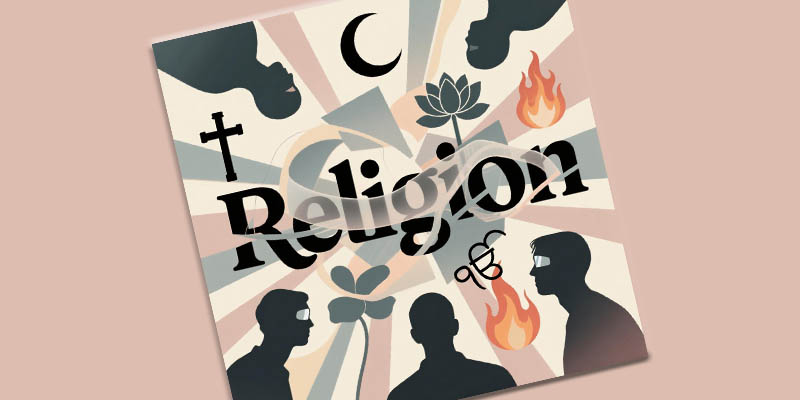
A common dictionary definition of religion describes it as “a set of beliefs concerning the cause, nature and purpose of the universe, often involving a superhuman agency or deity, usually referred to as God.” In the Abrahamic traditions, God is often anthropomorphised — given human-like attributes and personal characteristics. Such definitions, however, present religion as a neutral, universal category, ignoring its contested history and cultural specificity.
The etymology of the term reveals important nuances. From the Latin religare, meaning “to bind,” religion is framed as the reuniting of estranged humanity with God through divine grace and human devotion. An alternative root, relegere, meaning “to re-read” or “to reflect upon,” suggests a process of learning, critical engagement, and attention to the proper performance of worship. While both roots offer valuable perspectives, neither fully accounts for the complexity and diversity of the phenomena to which the word religion has been applied.
The category of religion as we understand it today is not an eternal or universal concept. Scholars such as Wilfred Cantwell Smith have argued that religion is a modern Western invention, emerging out of post-Reformation Europe and the Enlightenment (Smith, 1962). For Smith, the problem is that the term objectifies complex lived traditions into static “things,” obscuring the personal and dynamic nature of faith.
The Saudi-British anthropologist, Talal Asad (1993), has shown that religion is deeply embedded in Western, and specifically Christian, historical contexts. The Protestant Reformation’s emphasis on inner belief, rather than public ritual, shaped the modern notion of religion as primarily a matter of personal conviction; a notion then exported globally through European colonialism. In this process, vastly different ways of understanding the world were reclassified to fit the European model, often distorting indigenous categories and practices.
Professor of Comparative Literature and History of Religion, Tomoko Masuzawa (2005), further critiques the idea of world religions as a universal taxonomy. She argues that 19th century European scholars codified a list of “major religions , in ways that reflected colonial hierarchies and Christian theological assumptions. This excluded or marginalised many traditions, while forcing those, including Sikhi, into a framework alien to our own self-understanding. The term ‘Sikhism’ which has no reference in Sikh scripture or history, is a good example of the ways in which western theological frameworks were deployed to redefine other traditions.
RELIGION ACROSS THE GLOBE
From the 16th century onwards, European expansion and cultural imperialism spread the category of religion across the globe. The extraordinary diversity of human epistemologies (ways of knowing) and ontologies (ways of being) was flattened into a single, universalising label. Complex traditions, such as dharma in the Indian subcontinent or din in Islamic contexts, were translated as “religion,” even though their conceptual scope and philosophical assumptions differed radically from the European model.
The consequence is that today’s debates about religion, whether in academia, politics or the media are framed within categories shaped by Western secularisation, scientific materialism and the dominance of the Judeo-Christian worldview.
PROBLEMATIC LABELS
Recognising the imprecision and hegemonic nature of the term, I have increasingly distanced myself from it. The labels “believer” and “non-believer” are equally problematic. Without clarifying what is meant by “God” and what it means “to believe,” such labels lack meaning. Indeed, when reasonably educated people are asked whether they believe in God, they often hesitate, replying: “It depends on what you mean by ‘God’.”
Cultural stereotyping compounds the problem. We associate belief with outward symbols, making snap judgements about a person’s religiosity based on their attire. This applies both between and within traditions. Among Jewish communities, for example, distinctions are often drawn between so-called ‘secular’ and ‘orthodox’ Jews. Orthodox Jewish men are often recognised by their kippah, black wide-brimmed hat, dark suit, white shirt, full beard and curled sidelocks (payot).
Similarly, Sikh men also have distinctive markers, such as turban, beard, and, for initiated Sikhs, the five Ks. Yet here the operative term is identity. For many, association with a tradition may be driven more by cultural, ethnic, linguistic or historical affiliation than by doctrinal commitment. Religion, in this sense, is woven into the broader tapestry of identity, alongside class, caste, and nationality.
One cannot deny the cultural relevance of dress and attire, but, there when one begins to make value judgements based on appearance, this becomes problematic. There are many Shabads in Guru Granth Sahib that are critical of the externalising of belief, where the inner being is full of deceit and corruption.
Indeed, ironically – since long hair is a symbol of Sikhi – Bhagat Kabir is particularly scathing the external practices of keeping long hair and shaving one’s head. As he says, Guru Granth Sahib (Ang 1366):
ਕਬੀਰ ਪ੍ਰੀਤਿ ਇਕ ਸਿਉ ਕੀਏ ਆਨ ਦੁਬਿਧਾ ਜਾਇ ॥
ਭਾਵੈ ਲਾਂਬੇ ਕੇਸ ਕਰੁ ਭਾਵੈ ਘਰਰਿ ਮੁਡਾਇ ॥੨੫॥
“Kabeer, when you are in love with the One, duality and alienation depart.
Whether you have long hair, or you shave your head bald, it is all the same.”
Here, Kabir emphasises that the true spiritual goal is to overcome the “duality” (dubidha) of the mind, which is achieved through love for the One divine (preeti ik siou kie), not through outward displays of piety.
When we assume a person’s “religious belief” from appearance, we ignore the fact that we are engaging with a complex psychosocial phenomenon, not a simple matter of belief or unbelief. The binary framing of belief versus non-belief is, in my view, untenable. All human beings believe in something. Each one of us has a set of values, principles, ideals, but this is very different from the narrow, often crude ways in which religion is popularly understood.
In our increasingly interconnected and fluid world, perhaps the term religion has outlived its usefulness. As someone who identifies as a Sikh, I find it inaccurate and unhelpful to reduce Sikhi to a “religion” in the Western sense of the term. To do so is to misunderstand its essence and to ignore the richer, more nuanced realities of human identity and meaning-making.
References
• Asad, T. (1993). Genealogies of Religion: Discipline and Reasons of Power in Christianity and Islam. Baltimore: Johns Hopkins University Press.
• Masuzawa, T. (2005). The Invention of World Religions: Or, How European Universalism Was Preserved in the Language of Pluralism. Chicago: University of Chicago Press.
• Smith, W. C. (1962). The Meaning and End of Religion. New York: Macmillan.

Gurnam Singh is an academic activist dedicated to human rights, liberty, equality, social and environmental justice. He is an Associate Professor of Sociology at University of Warwick, UK. He can be contacted at Gurnam.singh.1@warwick.ac.uk
* This is the opinion of the writer and does not necessarily represent the views of Asia Samachar.
RELATED STORY:
The Demise of the Akali Dal and the Badal Dynasty: What Next for the Panth? (Asia Samachar, 5 Aug 2024)
ASIA SAMACHAR is an online newspaper for Sikhs / Punjabis in Southeast Asia and beyond. You can leave your comments at our website, Facebook, Twitter, and Instagram. We will delete comments we deem offensive or potentially libelous. You can reach us via WhatsApp +6017-335-1399 or email: asia.samachar@gmail.com. For obituary announcements, click here


