





















By Dr. B. S. Bains | Opinion |
In the early days after Merdeka, the Jalur Gemilang was not just a flag — it was a unifying spirit. Streets were lined with its colors, homes flew it proudly, and children waved it with uncontainable joy. It symbolizes dignity, sacrifice, and togetherness. The flag was not merely fabric; it was our soul as a nation, stitched with pride and respect.
Yet today, the same flag has become a point of dispute and controversy. Where once the Jalur Gemilang was displayed with reverence, now it is often mounted casually, distorted in design, or even flown incorrectly. Worse still, recent cases show individuals punished harshly for unintended mistakes while larger institutions escape without consequence.
The issue of flag respect is not about stirring division. It is about restoring the dignity of our national symbol — and ensuring that patriotism, which once came so naturally, does not fade further into indifference.
ISSUE ONE: INCONSISTENT TREATMENT OF MISTAKES
In northern Malaysia, a citizen of Chinese descent was recently arrested for unintentionally displaying the flag upside down. He claimed no personal intent, yet he faced harsh action. By contrast, similar errors by government offices, schools, or even during Merdeka parades have not invited any disciplinary measures.
This inconsistency creates mistrust. If ordinary citizens are punished for accidents, while public institutions escape scrutiny, it breeds resentment instead of unity. A flag is a symbol of justice and equality — yet unequal enforcement undermines that very principle.
In other countries, the distinction between careless error and deliberate insult is carefully weighed. For example, in the United States, while the Supreme Court allows flag desecration as free speech, public institutions still correct errors swiftly to maintain respect. Singapore, by contrast, has strict flag laws but provides education campaigns to guide citizens.
Malaysia must follow a balanced approach:
- Mistakes → corrected through awareness, guidance, and education.
- Deliberate insult → addressed with clear, firm legal consequences.
ISSUE TWO: ONE FLAG, ONE DESIGN
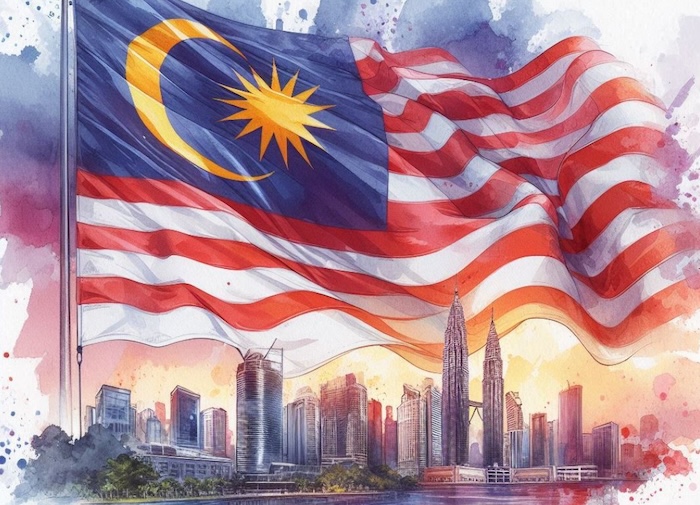
The Jalur Gemilang is officially recognised under a 1:2 rectangular ratio, with 14 alternating red and white stripes, a blue canton, a yellow crescent, and a 14-point star. This is the only authentic design gazetted at independence.
Yet in practice, elongated versions, vertical stretches, and distorted formats are widely used, especially during parades or street decorations. These variations confuse the public and dilute the symbolism. The position of the crescent and star — are sometimes pushed off-centre, changed direction and this reducing their dignity.
Malaysia should learn from India, which legislated strict standards for its Tricolour under the Flag Code of India 2002, specifying size, ratio, and correct display. Likewise, Singapore mandates a fixed design with no variation permitted.
To preserve the integrity of our symbol, we too must legislate:
- One standard design only — 1:2 ratio, no elongation, distortion, or alteration.
- Uniform manufacturing standards — so all flags sold to Malaysians follow the official format.
ISSUE THREE: FLAG BURNING AND INTERNATIONAL RESPECT
Flag burning in public demonstrations has long been used as a tool of anger. Malaysia is not immune. We have seen foreign protestors burn the Jalur Gemilang in Indonesia (2005, 2009, 2017) and the Philippines (2019). Each time, Malaysians felt insulted and the government rightly condemned the acts as an affront to sovereignty.
Yet at home, there have also been instances of Malaysian groups burning the flags of other nations, such as Indonesia, Singapore, and the United States. These acts undermine Malaysia’s moral authority. If we demand respect abroad, we must first uphold it at home.
Currently, Malaysian law does not have a dedicated “flag desecration act.” Offenders are instead charged under general laws — for example:
- Penal Code Section 504 (intentional insult to provoke breach of peace),
- Section 505 (statements conducing to public mischief), or
- Sedition Act 1948 if the act threatens harmony.
But these laws do not specifically address the symbolic insult of flag burning. This gap must be addressed.
A future Flag Respect & Protocol Act 2025 could provide:
- Public burning, trampling, or desecration of any national flag (Malaysian or foreign) = punishable offence.
- Respectful disposal of old or damaged flags = permissible through private burning or burial.
- Demonstrations against other countries = allowed under free speech, but without desecrating flags.
Such provisions would make Malaysia a model of responsible citizenship and international dignity.
ISSUE FOUR: DISPLAY OF FOREIGN FLAGS IN MALAYSIA
The public display of foreign flags in Malaysia is regulated but inconsistently enforced. Embassies, consulates, and cultural bodies may display their national flags, as may organisations with special approval. However, protests and political rallies have seen foreign flags used irresponsibly — either to provoke or to signal allegiance.
This raises confusion: when is it legal, when is it not? The lack of clarity weakens respect for our own national symbols.
We must adopt a firm stance:
- Only embassies, consulates, international organisations, or cultural events with approval may display foreign flags.
- Public protests must not use foreign flags as tools of provocation.
By regulating this clearly, we ensure that foreign flags are displayed only in dignified, respectful contexts.
By enforcing this, we will gain internation respect and be considered as dignified International Citizens.
ENCOURAGING CREATIVE PATRIOTISM
Respect does not mean rigidity. Malaysians should be encouraged to express patriotism through art and creativity — murals, rock paintings, coloured bottle displays, or decorative installations of the Jalur Gemilang. These cultural expressions should not be criminalised, provided they follow the correct design.
Similarly, flags displayed on buildings should be permitted, as long as they conform to the gazetted standards. This balances respect with citizen engagement, keeping the Jalur Gemilang alive in daily life.
PROPOSAL: THE FLAG RESPECT & PROTOCOL ACT 2025
To resolve these issues comprehensively, I propose the Flag Respect & Protocol Act 2025, anchored on five principles:
- One Standard Flag — enforce the 1:2 ratio as the only legal design, with penalties for distortion.
- Proper Display — require flags to be mounted on dignified poles (steel, iron, or approved materials), not broomsticks or plastic pipes.
- Creative Patriotism — allow decorative and artistic expressions, provided they respect the design.
- No Desecration — prohibit public burning, trampling, or mocking of any national flag, while allowing respectful private disposal.
- Regulated Foreign Flags — limit display to embassies, approved cultural events, and authorised institutions.
This Act would align Malaysia with best practices internationally while strengthening patriotism at home.
CONCLUSION: RESTORING DIGNITY TO THE JALUR GEMILANG
The Jalur Gemilang was once a unifying force, proudly flown in the spirit of Merdeka. But in recent years, it has been caught in disputes, misused, and even forgotten. The controversies we face today are a call to act.
If we do not clarify standards now, respect for the flag will erode further, and patriotism will weaken. By legislating a clear Flag Respect & Protocol Act 2025, Malaysia can restore dignity to its national symbol, ensure fair enforcement, and set an example as a responsible member of the global community.
Symbols unite us when treated with dignity. Let us ensure that the Jalur Gemilang remains forever a proud emblem of unity — for today, for tomorrow, and for generations to come.
I would urge The Minister of Unity, Political Parties and the Prime Minister to take this issue seriously and act to ensure the spirit of patriotism is kept alive across the country to all United Malaysia.

Dr Balwant Singh Bains is a Malaysia-based kirtan enthusiast and a practicing physiotherapist with a chain of physiotherapy clinics.
RELATED STORY:
Significance of Chaur Sahib (Asia Samachar, 22 Feb 2025)
ASIA SAMACHAR is an online newspaper for Sikhs / Punjabis in Southeast Asia and beyond. You can leave your comments at our website, Facebook, Twitter, and Instagram. We will delete comments we deem offensive or potentially libelous. You can reach us via WhatsApp +6017-335-1399 or email: asia.samachar@gmail.com.