























By Harmeet Shah Singh | Opinion |
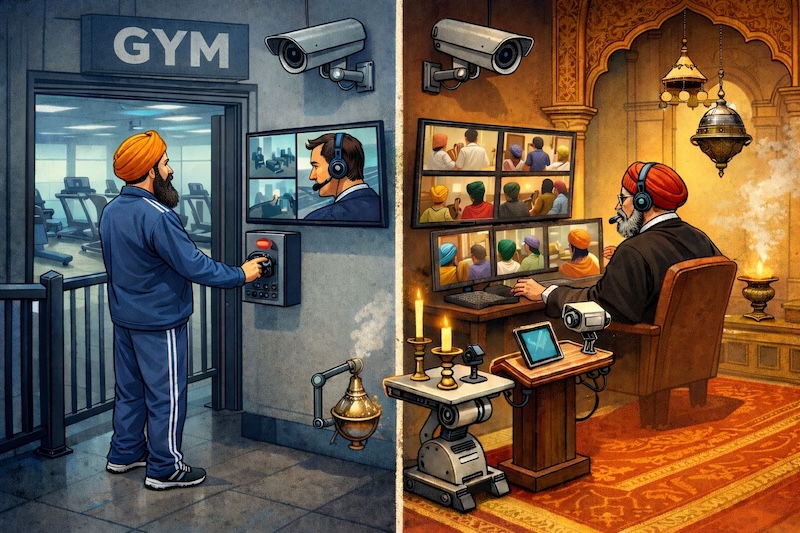
I went to a gym in London to ask about membership. At the entrance stood a buzz phone. Above it, a sign promised that pressing the bell would bring someone to attend. I pressed it and waited. No one came. I returned the next day and tried again. The response did not change.
Later I learned the gym was monitored remotely and that visits were arranged online. The bell remained in place, offering the appearance of access while shifting responsibility elsewhere.
A gym depends on guidance. Bodies adjust through correction offered at the moment strain appears. Walking through the space matters because effort, safety and capacity are understood physically.
A human presence allows questions to form naturally. A website, on the other hand, assumes prior knowledge. And physical fitness overseen from a distance carries a contradiction. Strength develops through supervision that is present, not abstract.
That contradiction mirrors a wider managerial habit. Systems increasingly replace people. Monitoring replaces engagement. Efficiency becomes the organising principle. Entry turns procedural. Care thins into administration.
This same habit is now visible in houses of worship. Surveillance cameras line corridors, halls, sanctuaries, kitchens. Security is the stated reason and the concern is legitimate. Still, management cannot outsource presence. A sacred space is not sustained by observation alone. It requires custodians who are seen, accessible and accountable within it.
Managers of houses of worship are not expected to provide spiritual instruction. That responsibility belongs elsewhere. Their role is more basic and more influential. They set standards of conduct. They model what attention looks like. When they remain largely absent and rely on remote monitoring, they normalise distance. They teach, without saying so, that stewardship does not require regular presence.
Leadership in such spaces is demonstrated through arrival. Showing up during ordinary hours signals responsibility. Appearing mainly during crowded services sends a different message. It frames management as ceremonial. It suggests that attention is warranted only when numbers justify it.
Over time, this reshapes the character of the space. Daily prayer times lose priority. Familiarity erodes. The environment begins to feel supervised instead of cared for. A place meant to be held across the week starts to resemble a venue activated on demand.
Accountability follows the same trajectory. A manager on site can be approached, questioned, challenged. Their presence allows correction in both directions. Remote supervision offers control without conversation. Decision making drifts toward reports and metrics. What can be measured gains authority over what must be tended.
The gym gate made this logic plain. A bell that summons no one trains visitors to expect absence. It conditions people to accept distance as normal. In a gym, this risks misuse and injury. In houses of worship, it risks disengagement. Ritual continues, but relationship thins.
Technology is not the issue. Tools can support stewardship when used properly. Cameras can enhance safety. Systems can assist organisation. Problems arise when tools replace the very presence they are meant to support. A bell should bring someone forward. A camera should supplement those already there.
Management committees often defend remote arrangements through efficiency. Fewer people on site reduces costs and simplifies scheduling. These benefits appear convincing in administrative terms. They feel hollow to those who inhabit the space daily. A building senses when it is maintained instead of cared for. Communities sense the same distinction.
The locked gym gate and the monitored spiritual sanctuary point to a shared failure. Presence has been treated as optional. Responsibility has been diluted. What remains are spaces that function operationally while losing the human attentiveness that once justified their existence.
Managers of houses of worship cannot create faith. They can, unfortunately, erode the conditions in which it is sustained. Leadership in sacred spaces is not exercised through surveillance or speeches. It begins with showing up, consistently, when no one is watching.

Harmeet Shah Singh is a career journalist currently serving as Communications and Advocacy Director at UNITED SIKHS (UK), a charity registered in England and Wales.
* This is the opinion of the writer and does not necessarily represent the views of Asia Samachar.
RELATED STORY:
Gurdwaras are Sangat institutions not commercial businesses (Asia Samachar, 21 Oct 2021)
ASIA SAMACHAR is an online newspaper for Sikhs / Punjabis in Southeast Asia and beyond. You can leave your comments at our website, Facebook, Twitter, and Instagram. We will delete comments we deem offensive or potentially libelous. You can reach us via WhatsApp +6017-335-1399 or email: asia.samachar@gmail.com. For obituary announcements, click here



Is the writer attending the Gurdwara for Darshan of committee members or the Guru?
Comments are closed.