




















By Gurnam Singh | Opinion |
Imagine walking into a gurdwara where dialogue feels like debate and learning feels like loyalty to a single viewpoint. A closed mind, like a closed umbrella, offers no shelter from the storm of ideas. It was perhaps this situation that Guru Nanak had in mind when he declared that “The seeker “comes forth” or flourishes. The debater or the argumentative person “perishes” or “fades away”, “I am a sacrifice to the Guru, the Creative Force.” (ਖੋਜੀ ਉਪਜੈ ਬਾਦੀ ਬਿਨਸੈ ਹਉ ਬਲਿ ਬਲਿ ਗੁਰ ਕਰਤਾਰਾ. GGS p1255). This article argues that fostering dialogue among Sikh scholars and preachers is essential for unity without uniformity.
Defined literally as a ‘community of learners/scholars’, one might have thought that dialogue and an open and enquiring mind would come naturally to Sikhs, but sadly these important virtues appear to be a scarce commodity when it comes to contemporary Sikh scholars and parcharaks. Evidence suggests that allegiance to fixed position or a particular seminary/Dera/Jatha, takes precedent over a genuine desire on the part of Parcharaks to expand our collective understanding of Sikh philosophy, practice, history and traditions. And for precisely this reason, most Sikhs appear to be unwilling or incapable of achieving any kind of consensus.
Doctrinal Divisions and Faith Traditions
Today, within Sikh scholarly circles, we increasingly see divisions along ideological lines. Scholars, preachers and institutions sometimes appear more concerned with defending their own interpretive positions than with listening deeply to others. Alternative viewpoints are dismissed not on the strength of their reasoning, but because they are associated with a particular school, tradition or lineage. This narrowing of vision is deeply at odds with the spirit of Sikhi.
Like all faith traditions, Sikhi has developed multiple schools of thought. What distinguishes the Sikh experience, however, is that these differences have not historically erupted into the violent doctrinal conflicts seen elsewhere, such as the Sunni–Shia divide in Islam, the Catholic–Protestant schism in Christianity, or the deep fractures between secular and orthodox Jews. Other than the odd skirmish in Gurdwara’s, Sikh’s remain united, though, especially around the issue of the relative importance of secondary texts, there is cause for concern that we may be headed in that direction.
Points of Convergence and Divergence in Sikhi
Visit most Gurdwaras and, aside from minor variations in décor or local custom, you will encounter a familiar rhythm of kirtan, ardas and langar. However, beneath this apparent uniformity lie significant differences in interpretation, emphasis and method; particularly in what is being preached, how Gurbani is explained, and which aspects of Sikhi are foregrounded.
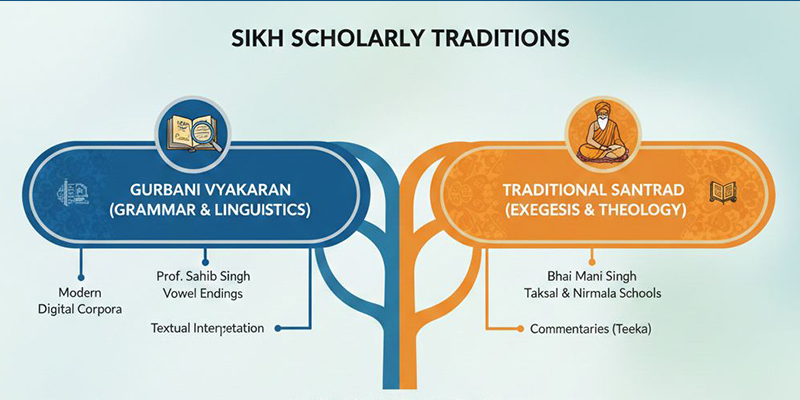
To help make sense of these differences, I created a graphic that illustrates what I see as the four primary pillars of Sikh scholarly traditions. Visualised as branches of a single tree, this model highlights both diversity and unity. Each branch draws nourishment from the same roots, namely, the teachings of the Guru Sahiban and the Guru Granth Sahib, yet each bears a different kind of intellectual fruit. Together, they demonstrate how Sikhi balances ancient spiritual wisdom with modern academic rigour.
Gurbani Vyakaran (Grammar and Linguistics)
The first pillar focuses on the structure and mechanics of the Guru’s revealed word. At its foundation lies the groundbreaking work of Professor Sahib Singh, whose meticulous study demonstrated that Gurbani follows consistent grammatical rules. His work fundamentally transformed Sikh scholarship by showing that the Guru Granth Sahib must be read as a precise and intentional linguistic composition, not as a loose collection of poetic expressions.
In its modern evolution, this tradition has expanded into the use of digital and computational tools. Scholars now employ methods from linguistics and computer science to analyse syntax, verb endings, semantic patterns, and the historical development of Gurmukhi. This approach safeguards the integrity of Gurbani by ensuring that interpretation begins with technical precision and fidelity to the text itself.
Traditional Samprada (Exegesis and Theology)
The second pillar represents the living lineage of interpretation passed down through established schools such as the Damdami Taksal and the Nirmala tradition. This approach is rooted in hermeneutics. In its simplest form this represents the art of explaining not only what Gurbani says, but why it says it and how it transforms the seeker’s inner life.

Rather than focusing solely on grammar, the samprada tradition emphasises spiritual pedagogy, experiential wisdom, and continuity with the lived practices of the Panth. Figures such as Bhai Vir Singh played a pivotal role in bridging traditional exegesis (teeka) with modern literary forms, making the mystical depth of Sikh theology accessible to contemporary readers without diluting its spiritual power.
Sikh Itihaas (History and Chronicles)
The third pillar documents the historical and temporal journey of the Sikh Panth. Foundational works such as the various Janam Sakhis, Bhai Santokh Singh’s Suraj Prakash, offer rich, poetic narratives of the Guru Sahiban and the formative periods of Sikh history. These chronicles have shaped Sikh collective memory, identity, and moral imagination. In recent decades, Sikh historiography has expanded into the realms post-colonial studies, archival research, and architectural history, examining how Sikh identity has been shaped by imperialism, migration, and global political forces. This body of work also shows and how Sikhs, in turn, have shaped the societies in which they lived. This field grounds Sikhi in lived experience and historical reality.
Comparative Religion and Philosophy
The fourth pillar looks both outward and inward, placing Sikh thought in conversation with global intellectual traditions. Through comparative religion and philosophy, scholars engage Sikh concepts alongside Vedantic, Sufi, Aristotelian, and even existentialist frameworks. A notable example is cotemporary scholar, Arvinder Pal Mandair, and his groundbreaking work on work on Sikh philosophy thought through postcolonial and continental philosophy.
This approach fosters comparative exploration and demonstrates that Sikh philosophy is neither insular nor static. Instead, it is a dynamic, universal worldview capable of addressing contemporary ethical dilemmas, such as social justice, environmental responsibility, and human dignity, through the lens of Gurmat. In this way, though rooted in long established wisdom, this body of work shows how Sikhi speaks meaningfully to the challenges of the 21st century.
Unity Without Uniformity
Proponents of each of these traditions often claim exclusive correctness, viewing other approaches as flawed or even dangerous. Yet such absolutism undermines the very richness of Sikh intellectual life. Each of these branches serves a distinct purpose, and none can fully replace the others. Grammar without theology becomes dry; theology without textual discipline risks subjectivity; history without philosophy lacks relevance; philosophy without relevance to the present drifts into abstraction and irrelevance.
There is a telling irony here. At the leadership level, Sikh scholars and institutions frequently maintain respectful and cordial relationships. They come together under the authority of the Akal Takht to address Panthic concerns, following a tradition that stretches back to the Sikh Misl period of in 18th century in Punjab and the institution of the Sarbat Khalsa. Indeed, in this regard, the principle of collective deliberation is deeply embedded in Sikh praxis, but it seems todays Sikhs have forsaken their own traditions in this regard, passed down from the Gurus themselves.
The real problem often lies in a combination of status-seeking, power-hungry, or simply desperate scholars and preachers. Given the precarious lives many priests and scholars lead, they often seek institutional patronage to secure their financial and professional interests. Such dependence, as in many other fields, can result in self-imposed limits on what they feel able to say. There is also the problem of uncritical followers, often individuals who lack either the knowledge or the confidence to engage thoughtfully with differing views. In place of inquiry emerges defensiveness, in place of dialogue one often finds dogma.
All is not lost and, in some senses, there is real scope for optimism since we live an age of unprecedented opportunity when it comes to learning. Sikhs today enjoy access to vast resources, global scholarship, and higher levels of education than ever before. There has never been a better moment to agree to disagree, to agree where we can, and to celebrate the diversity of traditions that together form the mosaic of Sikhi.
Conclusion
At its core, Sikhi is rooted in a love of gian, that is, the desire for knowledge and understanding that enlightens, liberates, and transforms. And when we engage in healthy dialogue, we nurture every branch, the tree of Sikhi grows stronger. To honour this heritage requires more than intellectual openness alone. It requires open hearts and humility. Only then can we truly live up to the name and claim that we are true Sikhs!

Gurnam Singh is an academic activist dedicated to human rights, liberty, equality, social and environmental justice. He is an Associate Professor of Sociology at University of Warwick, UK. He can be contacted at Gurnam.singh.1@warwick.ac.uk
* This is the opinion of the writer and does not necessarily represent the views of Asia Samachar.
RELATED STORY:
The Demise of the Akali Dal and the Badal Dynasty: What Next for the Panth? (Asia Samachar, 5 Aug 2024)
ASIA SAMACHAR is an online newspaper for Sikhs / Punjabis in Southeast Asia and beyond. You can leave your comments at our website, Facebook, Twitter, and Instagram. We will delete comments we deem offensive or potentially libelous. You can reach us via WhatsApp +6017-335-1399 or email: asia.samachar@gmail.com. For obituary announcements, click here





Dum dummi taksal is a rouge and fake organisation
it was unknown until 1977
what Guru ji said was that damdama sahib will b a centre of excellence
zthe current dam dami taksal has hijacked and used that to claim they are established by Guru ji
Tell me where is this name ever in history untill 1977?
Comments are closed.