























By Karminder Singh Dhillon | Opinion |
Nagar Kirtan (literally: neighborhood kirtan) has over the past few decades become standard fare for Gurpurabs. As more and more gurdwaras rush to jump on the bandwagon of taking the Sri Guru Granth Sahib (SGGS) and accompanying kirtaneas on a display-ride on the streets of their townships, and as more and more sangats compete to make their processions larger, longer, grander, and more entertaining, it may be worth weighing this concept from the point of view of Gurmat and Gurbani.
What are we trying to achieve? What, if any, are the tangible benefits of the investment of time, money and energy into this moving exhibition of our Guru, the broadcasting of kirtan onto the streets of the city’s commercial districts, and the display of our accompanying sangat. Most important, what, if any is the spiritual basis of this practice?
Have Sikhs in general and gurdwara parbhandaks in particular become so debased in Gurmat that all that matters is to latch on to the latest trend, satisfy the entertainment needs of their sangats, and contribute to their local council’s hunger to create events for their tourists?
THE TREND.
There is no doubt that Nagar Kirtans are in fashion. They take place all over Europe, North America and Asia. What started off as annual Vesakhi affairs have spilled over into just about any Gurpurab.
But that is not the only metamorphosis. While the front portion of the procession may have some resemblance of it being a Sikhi related function (panj pyares, SGGS and kirtanias), the real action is elsewhere – in the gaudy floats, the blaring music, the bhangra dances, the gatka performances and everything related that makes the whole affair into a thoroughbred social event.
To what extent a Nagar Kirtan of a particular community has become a full blown social mela depends very much on whether the event is in its infant stage (meaning the local sangat just got latched on) or has matured over the years (meaning the organizers have steadily increased its entertainment content). It further depends on how much competition exists from neighboring gurdwaras.
In other words, how far down the slippery slope towards a full blown Mauj Mela (entertainment event) a particular Nagar Kirtan situation has become depends very much on how many years the Nagar Kirtan has been organized.
EXPLAINING THE TREND.
Three explanations can be advanced to explain this trend towards Nagar Kirtans. The first is global and has its roots in the Inter-faith movement and the catastrophic 9/11 incident. The movement and the event do not have anything in common. Yet, the underlying philosophy of both is the same: namely the need for faiths to understand other faiths. The 9/11 event added an urgency to this philosophy. Due to Sikhs being mistaken as being part of the group that orchestrated 9/11, Sikhs felt a need to educate others about our faith – even if forcefully.
SEE ALSO: Nagar Kirtan Beyond India: Faith in Motion or a Misplaced Idea?
Because some Kesadhari turbaned Sikhs – mistaken for Osama-Taliban types – became victims of the aftermath of 9/11, a demand came to reside in the Sikh psyche: we have to educate non-Sikhs about our faith, our beliefs etc. Sikhs were being murdered, singled out for airport checks, ordered off airplanes and trains, and discriminated in their workplaces. Such lack of understanding about Sikhs needed correcting. Our leaders and gurdwara parbhandaks took up this clarion call without blinking an eyelid. That we have to take Sikhi to everyone out there became the mantra of Sikh leaders.
A large number of Sikhs, parbhandaks, organizers and supporters of the Nagar Kirtan “movement” based their justification for the need of this event on this principle. “We need to go out there, to show others, to educate others about what we are, who we are, what we do etc. We need to get rid of stereotypes and ignorance about Sikhs. How will the others know about our solemn practices, our great Scripture, our fantastic Kirtan and our superb culture if we kept it confined to within our Gurdwaras? We are thus doing the Sikhs and the panth a great service.”
There were core difference between the objectives of the Interfaith advocates and the demands of the post 9/11 period. The first is that the Interfaith movement stresses voluntarily acquiring an understanding of other faiths, but the post 9/11 demand wanted to force its understanding on others. The former can only be done with genuine desire, while the latter is done with a sort of vengeance: we will bring it to you whether you like it or not. It does not matter if the non-Sikhs want to know about us or not – we will just take our thing to them. The Interfaith movement invites others to come together to understand each other, while the post 9/11 demand wanted to compel others to be witness to its own beliefs and practices.
The second difference is that the Interfaith movement allows for gradual, steady and genuine learning. The learning is incremental – one learns more and more as one goes along. The post 9/11 demand wanted to take Sikh culture and beliefs to others in a one big bang way – once or twice a year loud and long dhmaka type procession. The third difference is that the Interfaith objective is humble and thus genuine. The post 9/11 demand was an arrogant one, and thus dubious (can you see how good and great my beliefs are!).
The questions one thus has for these Nagar Kirtan die-hards are as follows: Can anyone (Sikh and non-Sikh included) be “educated” about the SGGS, Kirtan, panj pyare, Sikh religion or culture etc. through a procession? Can stereotypes and ignorance be removed through parades? Is it not the case that even if the issues and concerns were justified, the method chosen (processions) was wrong? What about the wrong messages that get sent out – both to Sikhs and non-Sikhs about wastages and a seemingly unending desire amongst Sikhs to undertake a one-way street type of forced “education” approach? What sort of panthic service is achieved by putting great amounts of time, energy, money and attention into such an unproductive ritual.
But a more important question is this. Have our parbhandaks educated themselves and their sangats so thoroughly through parchar within their gurdwaras that they must now educate the others out in the city streets? The truth is that our sangats and Sikh youngsters especially are in dire need of the most basic of gurbanee and gurmat knowledge and on the verge of declaring their faith as outdated and irrelevant to their lives. One major reason for this is that our gurdwaras and their parbhandaks have failed us wretchedly. The major reason for this miserable failure is that the parchar within our gurdwaras has been reduced to piteously boring repetition of unbelievable tales called “sakhis.”
The second explanation for this trend of Nagar Kirtans in grand ways rests on the notion that form is easier than substance. It is easier to be seen doing something, rather than doing what is really required which happens to be difficult. Teaching our youngsters and sangats how to read the 1429 pages of the SGGS, to understand its core messages and to bring its spiritual meaning into our daily lives is a tough exercise. Putting the SGGS on a two-ton truck lit by 1429 bulbs and driving it through the streets is easy. Decorate it with 35 flags – representing the 35 contributors within the SGGS.
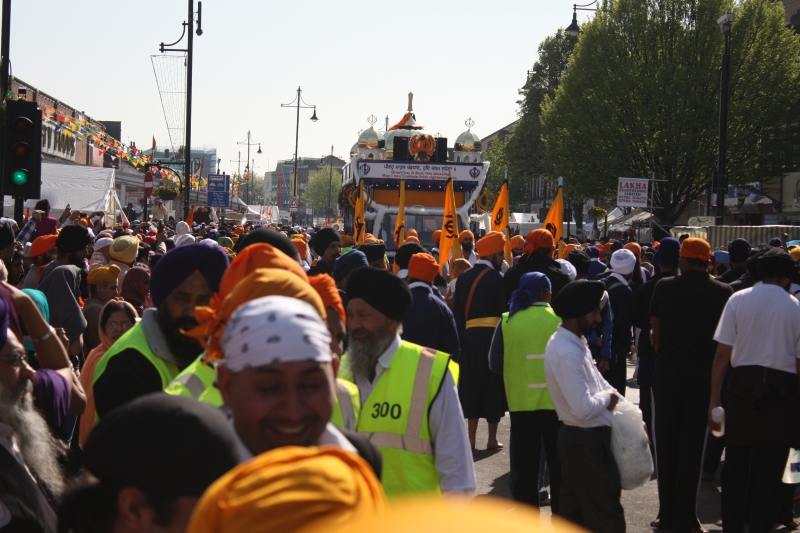
Inspiring our sangats, our youths and even non-Sikhs to learn kirtan, to appreciate the intricate rag and taal system of gurbani classical music and to mesmerize their souls through the stirrings of the spiritually elevating mix of shabad and raag is very difficult. Hiring a group of ragees, loading them onto a 2-ton truck complete with a powerful sound system and parading them around town is the easy part. No one even has to listen to them.
Organizing Punjabi and gurmukhi classes, gurmat sessions, running kindergartens and libraries in gurdwaras, etc. – the substance of gurdwara sewa and leadership is difficult; and parbhandaks always have a ready laundry list of reasons – ranging from not enough of qualified trainers and poor response from the sangat – as to why this cannot be done and will not ever be done.
But organizing the Nagar Kirtan requires no ability that is worth discussing. Above all, there is overwhelming response from the sangat (who does not want to have fun?).
The result is an exercise in deception. We deceive ourselves into believing that Sikhi is being taken to the masses through our Nagar Kirtan sham. We deceive ourselves that our parchar amongst Sikhs is so complete that we have taken it to “others.” We deceive ourselves that we are doing the panth a service when in fact, it may be nothing more than a mockery. We deceive ourselves that we are celebrating a gurpurab when in reality we are celebrating our own inadequacies. We deceive ourselves that the Guru’s blessings are with us in this elaborate mela (event), when the only blessing we have is the pat we give ourselves on our own backs for a great Nagar Kirtan. What can possibly qualify for a bigger fraud?
The third explanation lies in band wagoning. The Punjabi version is bhed chaal (literally sheep follower-ship, or sheep being led by sheep). No gurdwara wants to miss being on the wagon. No parbhandak wants to be left out. No one wants to be told that last year’s Nagar Kirtan was better, or that the one organized by the other gurdwara down the street was bigger, or that the one organized by the just voted out parbhandak committee was more entertaining.
THE BENEFITS.
There is no denying that Nagar Kirtans create joyous occasions and raise awareness of the existence of Sikhs within a local community. It gives those participating a good feeling especially when non-Sikhs capture the procession on film or camera. The participants get a sense of pride. It is not every day that policemen stop traffic to give priority to us. The organizers feel good when newspapers and televisions report the procession. It is nice to see our names in print, hear our voices on television and our activities reported.
But the reality is that these short-term benefits are not worth the investments of time, energy and money – all of which are limited for a community as small as ours. Nagar Kirtan is not a smart choice by any measure.
If Sikhs in a local community need to depend on Nagar Kirtan to raise awareness of their existence, then something is not right about these Sikhs. Such awareness would be more meaningful if achieved by regular and benevolent contribution to the community. Open a free medical clinic in the local gurdwara and get noticed in a meaningful and permanent sort of way. We know that newspapers and televisions report just about anything out of the ordinary. Amongst the first things a journalism student is taught is that while a dog biting a man is not news, it is indeed newsworthy if a man bites a dog.
Are Nagar Kirtans in the news for the good they bring or for their notoriety to cause traffic chaos and disturb the peace of neighborhoods? If publicity is desired, then parbhandaks should strive to get into the news by contributing to worthy causes or by getting their gurdwaras involved in local community activities in some extraordinary manner. That would be a real service to the panth. Run a community kitchen and feed the homeless, adopt an orphanage, sponsor a old folks home patient, visit the local nursing home regularly – the list is long. The gurdwara will get into the news and there will be no reason to be embarrassed about it.
NAGAR KIRTAN IS BECOMING BIG BUSINESS.
There are three reasons why Nagar Kirtan is set to become a permanent (albeit a generally useless) feature of the Sikh way of life. Two of these – our penchant for form over substance and bhed chaal mentality – have been described above. The third reason has to do with the “commercialization” of this event. Stalls selling stuff are fast becoming a part of the Nagar Kirtan. Business people go where the crowds are. Nagar Kirtans are sponsored by these business groups. They provide all that is necessary; such as talking to local officials on behalf of gurdwara parbhandaks to decide on routes and times for the procession. The gurdwara parbhandaks are pleased because it reduces their work load. In return these business people ask for advertising and publicity rights – effectively turning the Nagar Kirtan into a large and moving advertising screen.
WHAT ABOUT THE SANCTITY OF THE GURU?
This is a question that is uppermost in the minds of Sikhs who are concerned about the right and wrong of Nagar Kirtan. Is there honor in parading the Guru in the streets? What is the Maryada of taking the Guru out on to places where the sanctity is always in doubt? What about disrespect, disregard or plain contempt amongst viewers who chose to light up a cigarette, take a sip from a beer can as the Guru passes by?
What exactly is served by taking the Guru on this unmanageable journey to nowhere? What is the objective? What is the benefit? What do we want to achieve? Has anyone come to know that there are 1429 pages or 48 raags in the SGGS as a result of witnessing a Nagar Kirtan. Or that the language of the SGGS is such and such, or that so many Gurus and so many Bhagats have written it. Or that xyz is one of the messages of the 5,867 shabads therein?

If a Nagar Kirtan must be held at all costs – can the Guru be left to reign with pride and dignity intact in the gurdwara? Can the Guru be left out of this raucous mela, this ego feeding event, and this commercialized and adulterated affair called Nagar Kirtan. Can we keep the Guru out of our self-aggrandizing and self-gratifying episode that is on fast track to get even more disrespectful? Or are we as participating sangats all prepared to share the blame, carry the burden and pay the price for the disrespect and disregard of our Guru?
WHAT ABOUT THE MARYADA OF KIRTAN?
What does the maryada say about the sanctity of kirtan? What about the inviolability, the purity and the sacredness of the environment in which kirtan is to be recited and listened to? Are the messages of Gurbani (being sung as kirtan) suitable for loudspeaker blaring on the streets where people are generally expected to shout, scream, yell and shriek while attempting to listen to this kirtan? How exactly does one enjoy the benefits of kirtan except in an environment of silence, serenity, tranquility and quietude that we aspire to have in our gurdwaras or homes whenever kirtan is sung?
Gurbani says: ਰਾਜ ਲੀਲਾ ਤੇਰੈ ਨਾਮਿ ਬਨਾਈ ॥ਜੋਗੁ ਬਨਿਆ ਤੇਰਾ ਕੀਰਤਨੁ ਗਾਈ ॥੧॥ Raaj Leela Teray Naam Banaee, Jog Baneya Tera Keertan Gayee (SGGS, Page 385) Meaning Your Kirtan creates a beautiful situation and that unites me with You. Is the Nagar Kirtan atmosphere of disarray conducive for such unity? Gurbani further says Kalyug Meh Keertan Pardhaana, Gurmukh Japeeay Laye Dhiyana (SGGS Page 1075) Meaning: In present times, Keertan is the primary method of spirituality, to be sung with complete focus. How would one focus in the frenzy of a Nagar Kirtan? These sprinkling of verses talk about the atmosphere, the state of mind and the environment that must exist for Kirtan to be considered Kirtan.
Or have we equated kirtan to folk songs or just about any other pop music that can be blared anywhere, to anyone in any sort of condition. People can eat corn, talk on the cell phone, shout across the street, and smoke a pipe or even pot while listening to folk songs from a passing float in a procession. But are we prepared to let this happen to Kirtan?
IS NAGAR KIRTAN A SIKH PRACTICE?
Or are we just copy cats? The Hindu gods and goddesses are depicted in statue form. A statue can only be at one place at any one time. So the darshan of the deity is normally done by people coming directly face to face with the statue. One way of maximizing this darshan is to occasionally take the statue to the devotees. So the deity is loaded on a beautifully decorated chariot and taken to them. These devotees wait eagerly outside their houses for the chariot to come, pay obeisance one after another and make offerings. Within such a context there is great benefit in taking the statue to the people.
The SGGS is the embodiment of the shabad Guru. This Guru can be in multiple places at any given time. He is where the shabad resides – which is in the hearts and minds of believers. There is no concept of physical darshan of the Guru Granth Sahib – the book structure, the paper or the rumala and palki. These are mainly containers for the shabad to reside – just like a thumb drive that contains a digitized copy.
So this taking of the Guru for a round of darshan for the people is out of context in Sikhi. But to whom is the Guru being taken to for darshan? Save for some thinking Sikhs who will not take part in the charade, almost all the Sikhs in the community are already in the procession. The Nagar Kirtan takes a route that is commercial and tourist connected. Are we expecting these non-Sikhs to do a darshan of the shabad?
In this sense then, Nagar Kirtan is a copy of a ritual that belongs to people of another faith. This copying of the Hindu processions of their devi-devtas is dull and unimaginative to the core. We substituted everything of theirs with our physical things – the SGGS replaces the deity, our ragees replace their high priests who ride the chariot with the statue and our sangats with their hard-core believers who walk the entire path of the chariot. We could not even come up with an original name for this plagiarism! If theirs is a chariot, ours is plainly a charade.
I am reminded of someone who described the Nagar Kirtan he had witnessed: Eh Sikho(n) ki devi nikel rahee hai! (The Sikh Devi is on her rounds).
ABOUT BEING A NUISANCE.
As Nagar Kirtans get bigger, longer, more crowded, more commercialized and more frequent they have increasingly become a nuisance for the local communities. Traffic comes to a standstill, people’s schedules get disrupted, homes and businesses get blocked and inevitably the local communities will ask their leaders to speak up against it.
On Saturday, December 20, 2025, in the Manurewa suburb of Auckland, New Zealand, and again in Tauranga on January 11, 2026, a group of locals disrupted the Nagar Kirtans that were passing through the suburbs. The disruptors blocked the path of the Nagar Kirtan, performed a Haka (a traditional Māori ceremonial dance), and chanted their protest against what they termed a “foreign religion invasion,” with banners reading “This is New Zealand, not India”. The Police had to be called.
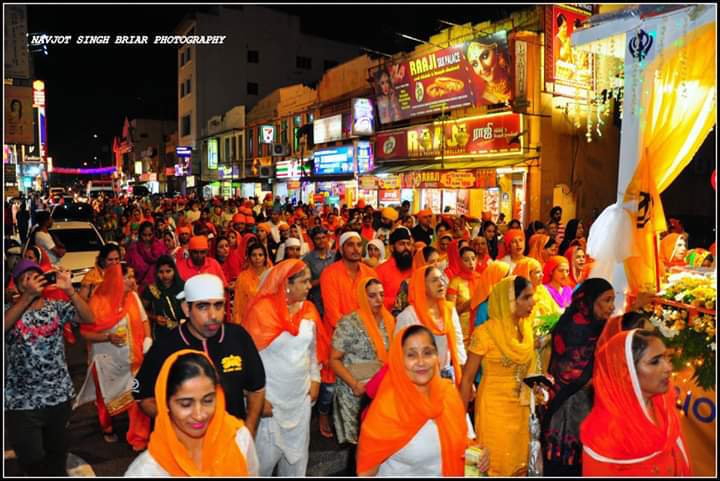
This ugliness was a long time coming. There is only so much chaos that neighborhoods can put up with. And the truth is that chaos has always been part of Nagar Kirtans. The Indian Express of – as far back as March 8 2008 – has this report in its Chandigarh edition: Nagar Kirtan leaves behind a trail of traffic chaos. What else can a parade of 750 vehicles, 32 horses and 11 camels achieve if not utter chaos. (1)
At one Nagar Kirtan, in Malaysia, trees had to be trimmed to enable a Nagar Kirtan to pass through. This action offended the neighbors who vowed not to let the parade pass that way again.
IS THERE ANY BENEFIT IN A NAGAR KIRTAN?
If one does a google search on Nagar Kirtan, one comes up with one web report after another extolling the tremendous success, the huge support, the great impact, and sensational triumphs of each and every parade. One gets the impression that a Nagar Kirtan gets boring fairly quickly and parbhandaks have to add new attractions – in the form of camels, horses, motor cycle outriders, elephants, peacocks etc. – every year. Any and every such addition is an achievement!
Some web reports even (mis)quote Gurbani verses to entice their sangats to attend. One had Guru Amardas ji’s verse “Jhakhar Jhangee Meeh Varsey, Bhee Gur Dekhan Jae. Samund Sagar Hove Bahu Khara, Gursikh Langh Guru Peh Jayee (Meaning, come rain, storm, or hailstones, I will go see my Guru. Even though the ocean is vast and salty, a Gursikh will cross it to go to his Guru). What connection this verse has with Nagar Kirtan is beyond me. Unless the web master wishes to suggest that the third Nanak attended Nagar Kirtans. As matter of fact, he did attend those of the chariot deity type regularly, but that was before he came to meet with Guru Angad.
Cast aside the rubble of the tremendous success, impact and triumph that we have heaped in self-praise and the question relating to the substantive benefit stands in its place like a sore thumb. Blow away the smoke screen of how many thousand attended, and how many witnessed it, the question of tangible benefits stands like a solitary tree in the vast desert – calling for the attention of those who are concerned.
SO WHAT IS NAGAR KIRTAN REALLY ABOUT?
Overall it is about missing the point all together. Nagar Kirtan is about finding short cuts and taking the easy ways out of parchar. Real and substantive parchar required innovative solutions, hard work, dedication, and selfless commitment both from the parbahandaks and the sangat. Nagar Kirtans are easy to organize, and all sangats got to do is simply attend, walk along and enjoy the ride. Nagar Kirtan is also about doing business. There is a ready clientele for people who want to sell all sorts of stuff. Nagar Kirtan is about having a real big mela. It is further a reflection of our laziness in the spiritual and leadership realms. It is also about form over substance.
Nagar Kirtan is further about letting the world see some of our ugliness. We don’t care if the traffic is turned chaotic by our actions. We could not care if an ambulance or fire engine does not get to its destination because of our chaos. Nagar Kirtan shows a haughty and arrogant side of Sikhs – when it is our time and place, we are Kings in an inconsiderate sort of way. As Kings for that one day, we park anywhere, throw rubbish everywhere, act loud, walk on anybody’s lawn and disregard all rules.
Finally Nagar Kirtan is about making merry at the expense of the honor & dignity of the Guru, Kirtan and the Nagar.
WHAT IS IT NOT ABOUT?
Nagar Kirtan is certainly not about Kirtan. Kirtan is to be done, listened and enjoyed within the serenity, dignity and solace of a diwan, a gurdwara, home or any other place with such qualities. Kirtan cannot be done in a “farmer’s market” or sabjee-mandee like atmosphere commonly found in the procession.
Nagar Kirtan is not about the Nagar either. Nagar translates as village, pind or community. By definition, a nagar has to be residential, centered on homes or areas around the homes of believers, who for some reason or other cannot come to the deity, so the deity has to be brought to them. They wait eagerly for the arrival of the deity and make way for it voluntarily. They don’t complain about traffic chaos and other disturbances. They don’t have to wait for others to trim their trees to make way for their chariot. This is because they are devotees.
Our Nagar Kirtan takes to the streets passing commercial areas, places frequented by tourists or other parade grounds. The local authorities, police, government etc. support the Nagar Kirtan (even if reluctantly) because of its tourism potential, because it adds color and life to the city, county or town or simply because to turn down the request would invite allegations of discrimination against Sikhs.
Similarly the people who turn up to see the parade are looking at it from an entertainment point of view. Sure enough our Nagar Kirtan folk never fail to entertain. Panj pyare with swords unsheathed, colorful brightly lit palkis, ragees singing ballads, gatka performers, sangats dressed in traditional garb and in some cases bhangra dancers are, from the point of view of non-Sikhs providing fairly good entertainment. The spectators have nothing to complain about because it is free. But the number of locals who sees the Nagar Kirtan as a nuisance is on the rise – as the two events in Southern Auckland prove.
WHAT CAN I DO ABOUT IT.
Sikhs and gurdwara parbhandaks have a propensity for bhed chaal particularly when it comes to ritualistic and un-gurmat practices. No question about it. Getting our gurdwaras, leaders and sangats as a whole to stop this wasteful and bipran kee reet rooted practice will prove to be a daunting task. No question about that too.
Those looking for guidance from the Akaal Takhat or other historical gurdwaras in India will be equally disappointed. The parbhandaks of these places do not have a genetic make-up that is different from our local parbhandaks.
One of the largest Nagar Kirtans in the world is undertaken at Nankana Sahib during Nirangkari Gurpurab under the auspices of SGPC. There are no Sikhs in this area save for a handful of SGPC sewadars who stay within the Nankana premises to keep the premises open. Tens of thousands of Sikhs come from Europe, America and Asia to take the Guru and groups of Ragees on parade to the neighboring Muslim communities.
The Pakistani villagers make good money selling food, drinks, accommodation and other stuff to this money laden Sikhs. Some of them spin tales of Guru Nanak having given their ancestors all sorts of artifacts during the Nagar Kirtan beginning 1469 and charge the gullible modern-day Nagar Kiten-ites money to do a darshan of (pay homage to) these artifacts. These artifacts are as fake as the notion that the Nagar Kirtan is a Sikh-practice.
Decades of Nagar Kirtan has not created a single Sikh out there in the Nagars of Nankana, but the Sikhs never fail to pat themselves for a Nagar Kirtan well done.
Nevertheless, realization – if it does happen, and change – if it eventually comes, will emanate from thinking Sikhs for whom the sanctity and dignity of the Guru and Kirtan; and real Sikhi parchar are of paramount importance. It will come from blessed Sikhs who will stand up and boldly say no to the senseless parading of our Guru in the streets of downtown, to the equally futile performance of our divine kirtan to entertainment seeking crowds, and to irrational expenditure of time money and energy to undertake an event which has no basis in gurmat and maryada.
Every thinking Sikh understands that we need to invest in our youth and future generations and that such investment must be in the form of substantive, real and meaningful parchar. Gurpurabs are opportunities for the imparting of such education (which must take place 365 days). Gurpurabs are not pretexts to waste money on futile parades and ego feeding processions. Our gurdwaras and parbhandaks continue to fail us desolately in this regard. If we cannot stop this down slide, at the very least, we must not be part of it.
SEE MORE COMMENTS ON THIS ARTICLE AT ASIA SAMACHAR FACEBOOK & INSTAGRAM
NOTES
- Some sentences of this report are reproduced as follows: Most of the city’s busiest routes were choked as the Nagar Kirtan procession progressed on Sunday. Apart from hundreds of devotees, the procession included more than 750 vehicles, 32 horses and 11 camels. The procession is likely to cause traffic chaos on Monday morning in southern parts of Chandigarh and Mohali. Chandigarh and Mohali Police have requested commuters to avoid certain routes. Despite it being a Sunday, there were impossible traffic jams on the roads. There was utter chaos on the roads, particularly in Sector 36 and 37. And with the intersection between Sector 34-35 closed, the procession caused major traffic disruptions in this area. Mohali Police said the road from YPS roundabout to Amb Sahib Gurdwara will remain closed for general traffic from 10 am to 12.30 pm. “We have tied up with the organizers of the rally and instructed them not to disrupt traffic. We have asked them to let emergency vehicles and school buses overtake the procession,” said a senior police officer. The Indian Express, Chandigarh dateline March 2, 2008.

Sikh thinker, writer and parcharak Karminder Singh Dhillon, PhD (Boston), is a retired Malaysian civil servant. He is the joint-editor of The Sikh Bulletin and author of The Hijacking of Sikhi. Click here to retrieve archived copies of the bulletin. The author can be contacted at dhillon99@gmail.com.
RELATED STORY:
The Nishan Sahib is finally ours, or is it? (Asia Samachar, 28 Nov 2024)
ASIA SAMACHAR is an online newspaper for Sikhs / Punjabis in Southeast Asia and beyond. You can leave your comments at our website, Facebook, Twitter, and Instagram. We will delete comments we deem offensive or potentially libelous. You can reach us via WhatsApp +6017-335-1399 or email: asia.samachar@gmail.com. For obituary announcements, click here





Dr. Karminder Singh Ji, your views are spot on! Irrational expenditue that could be channelled
elsewhere for the betterment of the less fortunate in our community.
I agree with Dr Karminder Singh Ji Dhillon… ..
There are other fruitful and banificial ways to promote Sikhism… Provide useful sewa to the needy……the single mothers, the parentless . children , the disaster victims , old age neglects,, free medical services to the poor…..food to the hungry……the money spent on Nagar kirtans could be visibly spent …
Comments are closed.