




















By Gurnam Singh | Opinion |
I have always been curious about the origin of the Dumalla or double decorated turban mostly associated with the Nihang Sect within the Sikh family. Actually, following some quick research, what I found is that the Dumalla has much deeper cultural and historical significance.
In the literal sense Dumalla can be broken down into Du (Two) and Malla (Cloth/Level). It refers to the “Double Turban” method—an inner base (Keski) and an outer wrap. In some dialects, Maala refers to a floor or level of a building. A Dumalla was figuratively a “two-story” turban, referencing its distinctive height and layered volume.
The Nihang Association
Perhap more than any other association, the Dumalla is a hallmark of the Nihang Sikhs, the traditional warrior order of the Sikh Panth. Its origin is a blend of spiritual significance, battlefield utility – both practical and psychological – and a direct link to the lineage of the Sikh Gurus.
One of the most distinctive forms of the Dumalla is that worn by the Akali Nihang, often shaped like a bunga or ‘tower’, rising in some cases over eighteen inches in height. A notable example can be seen on display in the collection of the Victoria and Albert Museum in London. According to popular tradition, such imposing turbans were not merely symbolic but strategic: when viewed from a distance, they would have made Sikh warriors appear extraordinarily tall — perhaps seven or eight feet in stature — thereby conferring a psychological advantage on the battlefield. The dramatic silhouette could intimidate opponents, unsettle their ranks, and diminish morale even before physical engagement began.
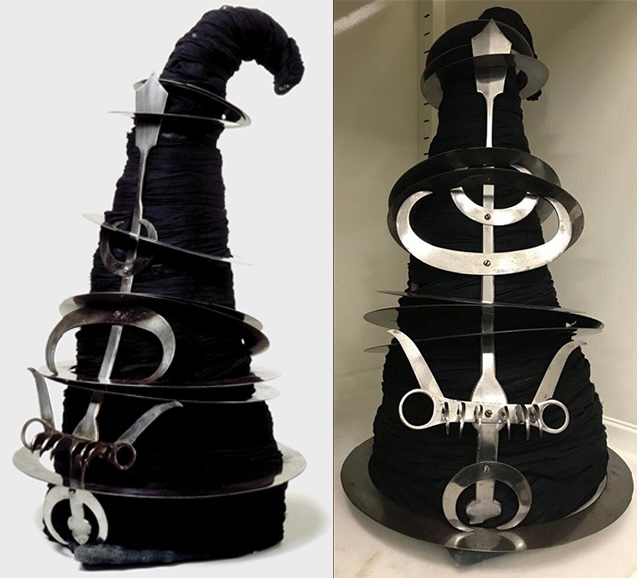
British colonial observers, despite frequently resorting to pejorative terms such as “fanatics” or “zealots”, were nonetheless captivated by the imposing presence of the Akali Nihangs and their towering Dastar Bunga. In The Court and Camp of Runjeet Sing, Osborn described the Akalis as “armed to the teeth”, noting that multiple pairs of steel quoits (chakrams) were fastened around their turbans, effectively transforming the Dumalla into a mobile armoury. Similarly, Cunningham in A History of the Sikhs referred to their “tall blue turbans” and steel bracelets, recognising that this distinctive attire was not mere ornamentation.
Other British records provide technical and visual corroboration of the Dumalla’s dramatic structure and symbolism. In Notes on the Religion of the Sikhs, Major Robert Leech detailed how the turban’s height was achieved by inserting a knife at the centre and winding an iron chain around it—evidence of an internal framework designed to maintain its formidable stature. Earlier still, John Malcolm in Sketch of the Sikhs observed the Akalis’ “high-peaked turbans” and unwavering commitment to their blue dress, demonstrating that the style was firmly established by the early nineteenth century. Complementing these textual sources, Emily Eden in Portraits of the Princes and People of India visually captured the dramatic height, deep blue hue and steel quoits of the “Akalees”, reinforcing the psychological impact and intimidating silhouette that so struck British observers.
The most cherished tradition amongst the Nihangs regarding the Dumalla’s origin dates back to the time of Guru Gobind Singh Ji, the tenth Guru. According to Sikh history, the Guru’s youngest son, Baba Fateh Singh Ji (then a small child), once appeared before his father wearing a very large, high-peaked blue turban with a Farla (a loose piece of cloth fluttering from the top).
When asked why he was dressed this way, the young Sahibzada explained he wanted to look like a formidable warrior. Guru Gobind Singh Ji was so pleased by his son’s warrior spirit that he declared this style would become the distinct identity of the Akali Nihangs, the “Army of the Immortal.”
Secular context
Before and during the early Sikh period, the “double-wrap” or peaked turban also appear in several secular and non-Sikh religious contexts. The “Victory Turban” of Wrestlers in traditional Punjabi culture, the word Malla is also related to wrestlers (Mal).
When a wrestler won a major competition, the prize money (the Maalee) was often tied into a cloth. The winner would tie this prize cloth over their existing turban as a trophy. If the prize was large, it became a Dumaalee or Dumalla (a double-prize/double-turban), serving as a visible badge of victory.
Persian Roots
Though the Dumalla is today almost exclusively associated with Sikh, its roots, like much of Punjabi and Sikh culture, can be found in Persia or modern day Iran.
The word Dumalla (or Dumaala) has two primary linguistic paths, both pointing to its structure and style rather than a specific religious identity
Early references used the term to describe any turban with this specific “tail” feature, common among Afghan and Persian nobility.
Historically, the word is linked to the Persian word Dumbaalah (or Dum), which means “tail.” In the context of headwear, this referred to the Shamla, which is the loose, flowing end of a turban that hangs down the back like a tail.
Mughal and Rajput Influence
While the Sikh Dumalla evolved into a specific warrior shape, the concept of a high, conical, or layered turban was a mark of sovereignty across the Mughal Empire and Rajput kingdoms.
Because Islamic law often restricted the wearing of crowns to the Emperor, noblemen used elaborate, high-peaked turbans to signal high rank.
The Peaked Cap (Kulah): Many Persian and Afghan styles involved wrapping long cloths around a hard, conical cap. The silhouette of the Nihang Dumalla mirrors this ancient Central Asian warrior aesthetic, though the Nihangs replaced the hard cap with a “base” of hair and cloth.

The Vedic Sanskrit tradition
Ancient Sanskrit texts refer to a voluminous headdress called the Ushnisha. While not a “Dumalla” by name, it was a complex, multi-layered wrap used by royalty and spiritually enlightened figures to protect the “tenth gate” (the crown of the head).
Reference in Gurbani
Interestingly, the word Dumalla appears in the Guru Granth Sahib (the Sikh scripture) in a context that reflects the “wrestler” etymology mentioned above.
ਹਉ ਗੋਸਾਈ ਦਾ ਪਹਿਲਵਾਨੜਾ ॥
ਮੈ ਗੁਰ ਮਿਲਿ ਉਚ ਦੁਮਾਲੜਾ ॥ (GGS p73)
“I am a wrestler of the the Divne; having met the Guru, I have tied a tall Dumalla (Victory Turban).” — Guru Arjan Dev Ji (Page 73)
The “wrestler” here symbolises disciplined engagement in the inner struggle against ego and vice, while the Dumalla functions metaphorically as a sign of elevated consciousness and moral responsibility bestowed through encounter with the Guru. The Dumalla hence becomes a visible emblem of inner victory and disciplined identity.
The implication for anybody who chooses to wear the Dumalla is clear; you will start out and be judged for your actions and behaviour. For this reason, the right to wear a Dumalla comes with immense responsibility to be in control of one’s base emotions and be totally committed to ethical actions.
REFERENCE
- Scriptural & Theological Sources
- Sri Guru Granth Sahib: Page 73, Raag Sri Raag. Author: Guru Arjan Dev Ji. (Primary source for the “Wrestler/Victory Turban” metaphor).
- Mahan Kosh (Encyclopedia of Sikh Literature): Bhai Kanh Singh Nabha (1930). (The definitive source for the etymology of Du-Malla and the Persian Dumbālah connection).
- Dasam Granth Sahib: Guru Gobind Singh Ji. (Context for the martial identity and the “Army of the Immortal”).
Historical & Martial Records - Prachin Panth Prakash: Rattan Singh Bhangu (early 19th Century). (Details the origin of the Nihang sect and their unique dress code).
- Bansavalinama Dasan Patshahian Ka: Kesar Singh Chhibber (1769). (Early record of the Khalsa’s physical appearance and lineage).
- Gur Bilas Patshahi 10: Kuier Singh (1751). (Early historical account of Guru Gobind Singh Ji’s life and the traditions of his court).
Academic & Museum References - Victoria and Albert Museum, London: Accession Number 112-1852. Description: “Turban (Dastar Bungga) of a Sikh Akali.” (Evidence for the 18-inch height and the “Tower” structure).
- Warrior Saints: Three Centuries of the Sikh Military Tradition: Amandeep Singh Madra & Parmjit Singh (1999). (Visual and historical analysis of Nihang attire vs. Mughal/Rajput styles).
- The Sikhs: Patwant Singh (1999). (Explores the psychological impact of the Sikh warrior silhouette on the battlefield).
Linguistic & Cultural Sources - A Comprehensive Persian-English Dictionary: Francis Joseph Steingass (1892). (Definitions of Dumbālah as the “tail” or “after-part” of a garment).
- Ancient Indian Costume: Roshen Alkazi (1983). (Historical background on the Ushnisha and early Indian headwraps).
- A Dictionary of the Panjabi Language: Ludhiana Mission (1854). (Archival definitions of Malla and Maalee in the context of Punjabi wrestling/prizes).
Osborne, W.G. (1840). The Court and Camp of Runjeet Sing. London: Henry Colburn. - Cunningham, J.D. (1849). A History of the Sikhs. London: John Murray.
- Leech, R. (1845). Notes on the Religion of the Sikhs. (Journal of the Asiatic Society of Bengal).
- Malcolm, J. (1812). Sketch of the Sikhs. London: John Murray.
- Eden, E. (1844). Portraits of the Princes and People of India. (Visual record).

Gurnam Singh is an academic activist dedicated to human rights, liberty, equality, social and environmental justice. He is a Professor of Sociology at University of Warwick, UK. He can be contacted at Gurnam.singh.1@warwick.ac.uk
* This is the opinion of the writer and does not necessarily represent the views of Asia Samachar.
RELATED STORY:
The Demise of the Akali Dal and the Badal Dynasty: What Next for the Panth? (Asia Samachar, 5 Aug 2024)
ASIA SAMACHAR is an online newspaper for Sikhs / Punjabis in Southeast Asia and beyond. You can leave your comments at our website, Facebook, Twitter, and Instagram. We will delete comments we deem offensive or potentially libelous. You can reach us via WhatsApp +6017-335-1399 or email: asia.samachar@gmail.com. For obituary announcements, click here