
























By Gurjit Singh Sandhu | Opinion |
In many Sikh families, the pressure does not arrive wearing the name of ritualism. It arrives more gently.
A wedding is being planned, and someone says the date should be checked properly. A funeral takes place, and someone quietly insists that a few extra things should be done “just in case.” A child is born, and old ideas about impurity, restriction, or prescribed waiting periods begin to shape the house. A family wants to understand Gurbani, but instead of being invited into it, they are left standing at a distance while others perform religion on their behalf.
None of this is usually presented as a rejection of Sikhi. It comes wrapped as respect, tradition, culture, or caution. But the effect can be the same: ordinary Sikhs begin to feel that access to religion depends on specialists, correct procedures, inherited customs, or invisible rules that must be managed for them.
That is exactly the kind of drift the Sikh Gurus challenged.
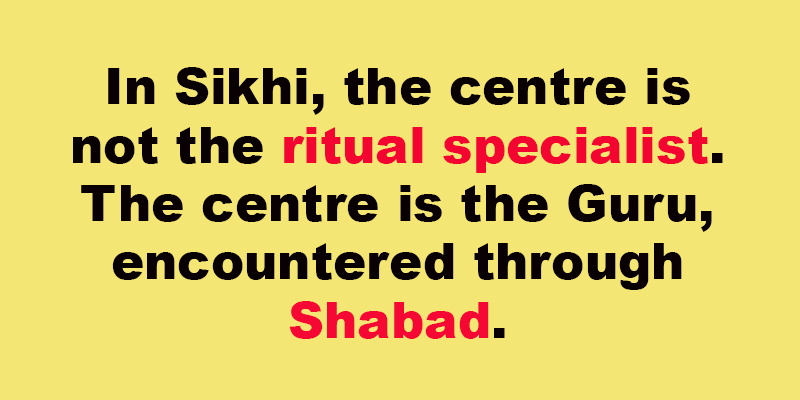
One of the most radical moves in Sikhi was not only theological but social. It broke the idea that spiritual life must be mediated by a hereditary priestly class. It challenged the assumption that ritual expertise, caste status, or ceremonial control could place one human being between another and the Divine. In Sikhi, the centre is not the ritual specialist. The centre is the Guru, encountered through Shabad.
That is why Sikhi’s understanding of Guru matters so much. When Sikhs say that Guru is found in Bani, this is not a poetic slogan. It is a governing principle of Sikh religious life. The authority that forms, corrects, and guides the Sikh is not a family priest, astrologer, ritual broker, or passing personality. It is the Guru’s revealed teaching, received through listening, reflection, and lived practice.
This is not a call for private, self-invented Sikhi. Guidance matters. But in Sikhi, guidance should bring people closer to the Guru, not make them permanently dependent on a middleman.
Gurbani makes this clear. It locates all human beings in the One Light (SGGS, 1349). It recasts the sacred thread in ethical rather than ritual terms, making compassion, contentment, restraint, and truth the marks of spiritual discipline (SGGS, 471). It rejects sootak thinking by shifting impurity from childbirth or contact to greed, falsehood, lust, and slander (SGGS, 472). And it states the principle of authority with striking clarity: Bani is Guru, Guru is Bani (SGGS, 982). Again and again, Gurbani turns the question from outer performance to inner condition: what is happening to the mind? Is ego loosening? Is greed reducing? Is truth becoming visible in conduct?
That remains deeply relevant in the diaspora.
Today, the old priestly structure often returns in altered form: auspicious timing practices entering wedding decisions, funeral expectations inherited from surrounding custom, caste operating beneath the language of respectability, or gurdwara life in which the sangat becomes passive while religion is handled by a few functionaries. It also appears in the outsourcing of understanding itself: people know how to book an Akhand Paath, but not how to sit with one shabad and let it interrogate their life.
This is not a criticism of granthis, raagis, or sevadars as such. Sikh communities need learned people who can read, teach, explain, and serve. The problem begins when such roles harden into something more than seva. A granthi is not a priest in the old hereditary sense. But if the community starts treating him as the only legitimate mediator of religion, the effect becomes priest-like even if the vocabulary remains Sikh.
A community can reject Brahminism in theory and still reproduce priestly habits in practice. The external form may change while the logic stays the same. Religion is no longer something the Sikh receives from the Guru through Shabad and Sangat; it becomes something administered by others, performed at a distance, and guarded by custom.
That drift has consequences. Ordinary Sikhs lose confidence in approaching Gurbani directly. Family ceremonies become heavier but not deeper. Children learn that religion is mostly about compliance, not understanding. Caste and status regain influence because people start looking for socially authorised interpreters of what is proper, pure, or respectable. A community can remain visibly religious while its inner architecture shifts away from what the Gurus were building.
This is why Shabad-Guru should not be treated as abstraction. It has everyday consequences. It means no one can monopolise access to the Guru. It means the path cannot be sold back to the sangat as a package of compulsory extras. It means ceremonies should remain simple, intelligible, and accountable to Gurmat. And it means authority in Sikh life must always be tested against Gurbani, not merely inherited custom or social pressure.
For diaspora Sikhs, this also has a liberating side. Many younger Sikhs are not rejecting Sikhi itself. They are rejecting opacity, performance, and inherited confusion. They do not want religion as theatre. They want to know what it means, what it asks of them, and whether it can still speak truthfully in modern conditions. If Sikh institutions answer that hunger only with more noise, ritual layering, or authority claims, they will fail the very people still trying to come closer.
The answer is not to become thinner, flatter, or more secular in order to seem relevant. It is to become more recognisably Sikh at the point of principle: to return people to the Guru through understanding, practice, and participation.
That can begin in small ways. Families can ask whether a practice is actually Gurmat-based or merely habitual. Gurdwaras can teach meanings, not only organise events. Ceremonies can increase understanding rather than spectator dependence. Children can be introduced to key Sikh words not as slogans but as living categories: Naam, Hukam, Haumai, Seva, Shabad. Sangat can recover the confidence to ask whether an added practice is deepening Sikh life or just burdening it.
None of this requires hostility to culture. Punjabi culture can carry warmth, memory, language, music, kinship, and beauty. But culture cannot outrank Gurmat. The question is not whether a custom is old. The question is whether it trains the mind toward truth or away from it.
That is why the struggle against priestly control in Sikhi is never only about a priestly class. It is about a deeper temptation that returns in every age: the temptation to replace transformation with management, understanding with procedure, and Guru with gatekeeper.
The Sikh response remains both demanding and liberating. Go to the Guru. Hear the Shabad. Let it correct you. Let it simplify what society has made heavy. Let it expose what habit has made respectable. And do not hand over your spiritual agency so easily.
A real Sikh revival in the diaspora will not come only from louder identity claims, better branding, or a busier calendar of events. It will come when more Sikhs recover a direct, disciplined, living relationship with the Guru through Shabad. That recovery would not weaken Sikh institutions. It would renew them from the inside.
And it would remind us of something the Gurus made startlingly clear from the beginning: there is no priest between you and the Guru.

Gurjit Singh Sandhu is an independent Sikh researcher and the founder of PanthSeva (panthseva.com), a publication on Sikh thought, governance, and practice.
Join the conversation on this story on Asia Samachar’s Facebook and Instagram pages.
Gurjit Singh Sandhu, who is based in London, is an independent Sikh researcher and the founder of PanthSeva (panthseva.com), a publication on Sikh thought, governance, and practice.
* This is the opinion of the writer and does not necessarily represent the views of Asia Samachar.
RELATED STORY:
The Demise of the Akali Dal and the Badal Dynasty: What Next for the Panth? (Asia Samachar, 5 Aug 2024)
ASIA SAMACHAR is an online newspaper for Sikhs / Punjabis in Southeast Asia and beyond. You can leave your comments at our website, Facebook, Twitter, and Instagram. We will delete comments we deem offensive or potentially libelous. You can reach us via WhatsApp +6017-335-1399 or email: asia.samachar@gmail.com. For obituary announcements, click here





Thank you all for the thoughtful and generous comments.
I am especially grateful that some of you understood the spirit of the piece. I was not arguing against granthis, raagis, sevadars, or maryada as such. Sikhi does need learned people who can read, teach, explain, and serve. The problem begins when service hardens into mediation, and the sangat starts feeling that access to the Guru must be managed for them.
To answer Dr Davinderpal Singh’s helpful question more directly: by rituals and cultural habits that creep back in, I had in mind things like checking auspicious dates as though Gurmat needs a lucky hour; treating birth or death through sootak/patak-type thinking; adding funeral or family practices “just in case”; caste quietly shaping marriage and respectability under polite language; outsourcing understanding so that people know how to book a paath but not how to sit with one shabad; and assuming that only certain people can properly do ardas, take Hukam, or explain Gurbani.
That is also why I appreciated Dya Singh Ji’s caution about not “throwing the baby out with the bathwater.” I agree. This is not a call for no procedure, no guidance, and no institutions. Quite the opposite. The question is whether our guidance brings people closer to Bani, or leaves them permanently dependent on intermediaries.
Bahadar Singh Ji is also right to point to our own reluctance to learn. Very often we want religion performed on our behalf because understanding takes time, humility, and effort. It is easier to outsource than to sit before the Guru and let Shabad question us.
On the Malaysia point, I agree there is a real shortage of plain-language Gurbani teaching. Where granthis or visiting teachers are serving well, they should be valued. But the long-term answer cannot be endless dependence on temporary visitors. Gurdwaras need regular explanation in ordinary language, small study circles, family learning, and local youth who can grow into teaching roles themselves. Online learning can help, but it should support local Gurbani literacy, not replace it.
My concern, then, is not with teachers. It is with gatekeeping. A granthi who opens Gurbani to the sangat is doing seva. A system that leaves the sangat feeling spiritually helpless without specialists is moving in the wrong direction.
That is why I ended where I did. A Sikh revival in diaspora will not come from more noise, more events, or stronger gatekeepers. It will come when more Sikhs regain a direct, disciplined, living relationship with the Guru through Shabad. If our institutions help that happen, they are doing true seva. If they block it, even gently, something has gone wrong.
With thanks and respect to all for reading so carefully.
If someone could state in broad terms what are the rituals and cultural practices that insinuate into daily Sikhi life yet are obstacles that allow Sikhs to reach the direct understanding of the essence of Gurbani, it would be enlightening!
Let us perhaps start here.
In Malaysia,the priest plays an important role in Sikhi teaching and practice.
We do not have enough of our own learned academicians of Sikh teachings who can go around expounding in easy language for the benefit of the Sangat.
We rely heavily on teachers aka priests aka granthis coming from India on temporary visits.
Perhaps online well versed Gursikhs can be recommended for general learning.
Thanks Gurjit Singh ji, very well presented. Unfortunately, we are heading the same way our Guru’s challenged. We don’t want to learn anything ourselves. We want others to perform such ceremonies on our behalf. Thanks
Refreshing! Thank you Gurjit Ji. I will be sharing this with others. There are those who have a tendency of ‘throwing the baby out with the bathwater’ when it comes to criticising and condemning rituals, procedures granthis etc. But you have forwarded views which are refreshing, and accommodating especially the younger generation to ‘sikh’, learn as we go along.
Thank you, Bai Ji. That you have followed the Japji work so closely means a great deal. Your own lifelong commitment to grounding Sikhi in Gurmat is something I hold in the highest regard.
With deep respect,
Gurjit Singh Sandhu
Gurjit Ji writes:
>>>A real Sikh revival in the diaspora will not come only from louder identity claims, better branding, or a busier calendar of events. It will come when more Sikhs recover a direct, disciplined, living relationship with the Guru through Shabad. That recovery would not weaken Sikh institutions. It would renew them from the inside.<<<
Well balanced Sikhi approach. PanthSeva is a most welcome initiative – have followed Japji interpretation with much satisfaction.
Thank you Gurjit Ji.
Comments are closed.