
















By Gurnam Singh | Opinion |
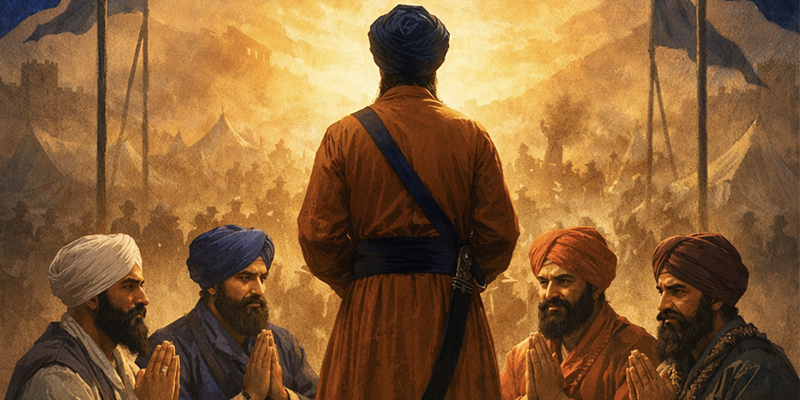
In a world increasingly shaken by hateful ideologies and violence, Vaisakhi offers not only celebration but a moment to ask a deeper question: What is the enduring purpose of the Khalsa today? Vaisakhi commemorates the founding of the Khalsa by Guru Gobind Singh in 1699. But let us not forget the context. Though not the only factor, the martyrdom of his father, the ninth Guru, Guru Tegh Bahadur (1675), is widely recognized by historians as a foundational catalyst for the militant and protective identity that Guru Gobind Singh later formalized through the the creation of the Khalsa in 1699.
At its core therefore, the creation of the Khalsa order of saint soldiers, represents much more than a ‘religious festival’; It was a profound intervention that changed the course of human history. The establishment of the Khalsa Panth (meaning path, movement, force, community), sought not only to question the legitimacy of imperial rule and tyranny, but to organise liberation movements to confront these forces.
To appreciate this, one must situate the Khalsa within the longer arc that begins with Guru Nanak’s vision of the Nirmal Panth (literally meaning the ‘pure path’), which was civilisational rather than merely devotional. It was a challenge to the whole of society in relation to ethical clarity, truthful living, and human dignity. In many ways, this resonates with strands of Enlightenment thought, particularly the insistence, found in thinkers such as Immanuel Kant, that moral worth lies not in intention alone but in action guided by universal principles.
The Khalsa Panth can be seen as the historical crystallisation of this vision: a community of sovereign individuals who internalise moral responsibility and act upon it. Sovereignty here is not merely political; it is ethical. It is the capacity to act without fear and without hatred, guided by a commitment to justice that transcends self-interest.
A TENSION WITHIN CONTEMPORARY SIKH PRACTICE
Yet, if Vaisakhi invites reflection, it also reveals a tension within contemporary Sikh practice. Across the world, Nagar Kirtans will take place, vibrant processions that bring the Sikh presence into public space. They are important expressions of identity and collective joy. The sounds of kirtan, the energy of dhol, the colour of bhangra, the discipline of gatka, and the sharing of food all form an integral part of the Vaisakhi tradition.
However, one may ask whether these public expressions always translate into deeper engagement with the ethical and political meanings of the Khalsa. Too often, participation risks becoming experiential rather than reflective. The consumption of food, the celebration of culture, and the performance of identity can overshadow the more demanding questions that Vaisakhi poses. What does it mean to defend Dharam today? What does it mean to stand against oppression in concrete terms? What responsibilities follow from identifying with the Khalsa ideal?
This is not a critique of celebration itself, but a call to complete it with reflection.
It is in this light that the martyrdom of Guru Tegh Bahadur, commemorated globally in 2025, assumes enduring significance. His execution under Aurangzeb was not simply an act of resistance, but an assertion of a universal moral principle: that the freedom of conscience must be defended, even at the cost of one’s life. In defending the rights of Kashmiri Pandits, he articulated a vision of justice that refuses to be confined within the boundaries of one’s own identity.
This moment is captured in the following lines for Bachittar Narak attributed to Guru Gobind Singh: ਤਿਲਕੁ ਜੰਜੂ ਰਾਖਾ ਪ੍ਰਭ ਤਾਕਾ ॥ ਕੀਨੋ ਬਡੋ ਕਲੂ ਮਹਿ ਸਾਕਾ ॥ “He protected the sacred mark and thread of others’ faith; he performed a great and noble deed in this age of darkness.”
What is striking here is not only the act itself, but the philosophical clarity it embodies. It echoes, in a distinct idiom, later arguments in political philosophy, such as those of John Stuart Mill, who argued that liberty must extend even to views we disagree with, for it is only through such openness that truth and justice can be sustained.
Once can also draw parallels with the sacrifice of Guru Ji, with the sentiments of the French enlightenment scholar, Voltaire who, was a staunch defender of freedom of thought and conscience, and a relentless critic of the Catholic Church and French monarchy.
ACTIVE RESPONSIBILITY
Yet Sikh thought goes further. It does not stop at toleration. It demands active responsibility. This is where the tension between speech and action becomes central. Gurbani offers a stark reminder: ਗਲੀ ਅਸੀ ਚੰਗੀਆ ਆਚਾਰੀ ਬੁਰੀਆ ॥ “We speak good words, but our actions are bad.” The ethical challenge here is that it not enough to take a moral stance; one needs to put this into practice. These tensions are not confined to the past. Our world today is marked by similar contradictions related expanding human rights frameworks alongside wars, structural violence, and deepening social polarisation.
On the one hand, there is an unprecedented articulation of human rights as universal norms and the semblance of a global world order presided over by global institutions such as the UN, NATO and the International Court of Justice (ICJ) and International Criminal Court (ICC). On the other, there is the persistence of violent behaviour of politicians, such as Donnald Trump, Vladimir Putin, Benjamin Netanyahu and the Ayatollah’s of Iran, Today we see wars in Ukraine, escalating conflicts involving Iran and Lebanon, and the humanitarian catastrophe in Gaza, widely described by many as a genocide. Alongside these are less visible, but equally enduring, forms of structural violence affecting minorities, women, children, landless labourers, peasant farmers, and Indigenous communities across the world.
In such a context, the question is not whether we possess moral frameworks, but whether we are willing to act upon them. The Khalsa ideal speaks directly to this dilemma. It calls for a form of moral courage that refuses both fear and hatred. This is articulated succinctly by Guru Tegh Bahadur in Gurbani: ਭੈ ਕਾਹੂ ਕੋ ਦੇਤ ਨਹਿ ਭੈ ਮਾਨਤ ਆਨ ॥
“Do not frighten anyone, and do not be afraid of anyone.” This formulation rejects both domination and submission, proposing instead an ethic of mutual dignity.
REFLECTING THE MEANING
As Vaisakhi is celebrated by millions across the world, almost as a ritual, my appeal to everyone is to reflect on its true meaning. The creation of the Khalsa must not be reduced to as a historical event or festival where people, but as an ongoing ethical challenge. In an increasingly polarised increasingly becoming divided into two camps – one that promotes intolerance and hateful right-wing nationalism and those that question and challenge these – the Khalsa, individually and collectively needs to decide where it stands.
Vaisakhi, then, is not only a remembrance of 1699 but a call to conscience. The Khalsa ideal challenges each of us to cultivate moral courage, defend human dignity, and stand against oppression wherever it appears. Its relevance today lies not in ceremony alone, but in our willingness to become a living force for good.
Join the conversation on this story on Asia Samachar’s Facebook and Instagram pages.
Gurnam Singh is an academic activist dedicated to human rights, liberty, equality, social and environmental justice. He is a Professor of Sociology at University of Warwick, UK. He can be contacted at Gurnam.singh.1@warwick.ac.uk
* This is the opinion of the writer and does not necessarily represent the views of Asia Samachar.
RELATED STORY:
Guru Gobind Singh: The Man Non-Pareil (Asia Samachar, 6 Jan 2017)
ASIA SAMACHAR is an online newspaper for Sikhs / Punjabis in Southeast Asia and beyond. You can leave your comments at our website, Facebook, Twitter, and Instagram. We will delete comments we deem offensive or potentially libelous. You can reach us via WhatsApp +6017-335-1399 or email: asia.samachar@gmail.com. For obituary announcements, click here