




















By Concerned Sikh
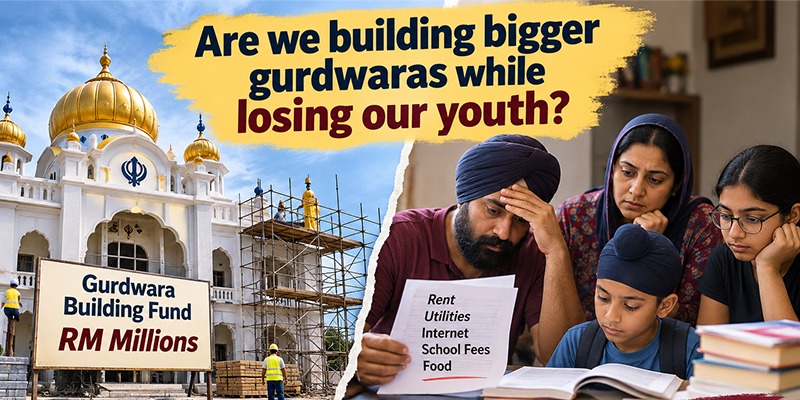
It is always about the biggest, tallest, longest and widest Gurdwaras. But are we investing enough in our people?
We have approximately 150,000 Sikhs in Malaysia and an estimated 150 Darbars and other places of Sikh worship, working out to be 1,000 Sikhs per Gurdwara or Darbar. Remember, this includes everyone: adults, children, senior citizens and babies.
Here is a simple question: Can each of our Gurdwaras regularly accommodate 1,000 people during an ordinary religious programme? How many actually do?
If many existing Gurdwaras are already underutilised, why are we continuing to raise millions to construct bigger buildings or build new ones?
More importantly, is our Sikh population growing sufficiently to justify these additional buildings, or are we building more places of worship while our younger generation leaves the country or drifts away from Sikhi?
A family needs RM500 a month. A building needs millions.
Imagine a struggling Punjabi Sikh family approaching a Gurdwara for RM500 a month to pay rent, utility bills, internet bills, school expenses or daily food costs for their children.
How many Gurdwaras would provide that assistance consistently, month after month?
The same Gurdwara may appeal to the public to donate millions of ringgit towards a building fund. Donations come in, construction proceeds, and eventually the community celebrates a bigger and grander building.
If that family subsequently receives assistance from a church or a mosque, and eventually converts to another religion, do we then blame them for leaving Sikhi?
Before blaming the family, perhaps we should examine whether we, as a community, fulfilled our responsibility towards them.
Langgar is one of the most beautiful expressions of Sikh principles. It brings people together, removes distinctions of caste and status, and ensures that people can eat regardless of their background.
However, we must ask ourselves whether Sewa has become too narrowly defined by what happens within the four walls of a Gurdwara.
Feeding someone today is Sewa. Helping that person build a better future is also Sewa.
We ask for Daswandh. How much do we give back?
Gurdwaras encourage Sikhs to practise Daswandh, traditionally understood as contributing a portion of one’s earnings towards charitable and community purposes.
How much of the Gurdwara’s own income is channelled towards supporting disadvantaged families, children’s education and the long-term development of our youth?
Every five to eight years, some communities begin fundraising for building extensions, renovations or new construction. Some projects may cost millions of ringgit.
Meanwhile, a child from a low-income Sikh family may struggle to secure RM30,000 to complete a university education. Why is it often easier to raise millions for a building than RM30,000 for a student’s future?
We must also be fair: not every Gurdwara has surplus funds, and not every building project is unnecessary. Some existing buildings need essential repairs, accessibility improvements or facilities that meet genuine community needs.
The issue is not whether we should build anything. The issue is whether our spending priorities adequately reflect the needs of our people.
Mobilising our community’s resources
Imagine what could be achieved if Gurdwaras collectively supported:
-
Education: University tuition, vocational training, professional qualifications and scholarships.
-
School welfare: Daily meals, school supplies, transport, examination fees and internet access.
-
Family assistance: Rental support, utilities and emergency financial aid for families in genuine need.
-
Career development: Mentoring, internships, job placement, entrepreneurship and financial literacy.
-
Mental health and wellbeing: Accessible counselling, emotional support and professional guidance for young people facing difficulties.
-
Health services: Community health screenings, preventive care and assistance for families unable to afford necessary treatment.
Malaysia has Sikh doctors, lawyers, accountants, engineers, business owners and other professionals. But can we also mobilise these professionals to serve our community beyond the Gurdwara?
We do not necessarily need to build a hospital before we can provide meaningful healthcare assistance. We can begin by organising existing professionals and resources to serve those who need help. Our community’s greatest resource is not its buildings. It is its people and the knowledge, skills, compassion and opportunities they can share.
A common education and welfare fund
Imagine if 150 Gurdwaras each contributed RM1,000 a month towards a common Sikh education and welfare fund. That would generate RM150,000 every month, or RM1.8 million a year. Even if only 100 participating Gurdwaras contributed RM1,000 a month, the fund would receive RM1.2 million annually.
These are illustrations, not assumptions that every Gurdwara can afford such contributions. The actual amounts would need to reflect each institution’s finances and commitments.
With proper governance, transparent accounts, clear eligibility criteria and independent oversight, we could help students complete their education, support families in crisis and give young people opportunities they might otherwise never have had.
Every ringgit should be properly accounted for. Every beneficiary should be treated with dignity. And every contribution should make a measurable difference.
My final question to the Malaysian Sikh community
We should not assume that every young person who leaves Sikhi does so because of financial hardship. People’s beliefs and decisions are personal and complex.
Religious identity cannot be sustained by buildings alone. It must also be supported by lived values, belonging, compassion and meaningful opportunities.
Let us stop measuring our community’s success only by the size, height or grandeur of our buildings. Let us measure it by the number of lives we improve, the children we educate, the families we support and the opportunities we create.
Because ultimately, the future of Sikhi in Malaysia will not be determined by how many buildings we construct. It will be determined by how faithfully we practise the values we teach.
Wand Ke Shakna. Sarbat da Bhala. Sewa.
Let us invest in our people.
(This article has been abridged and rewritten from an original article that was widely shared on various social media platforms in Malaysia recently.)
CHECK OUT MORE FEEDBACKS FOR THIS REPORT AT FACEBOOK AND INSTAGRAM
RELATED STORY:
10 practical ways to revitalise smaller Malaysian gurdwaras (Asia Samachar, 17 Nov 2026)
ASIA SAMACHAR is an online newspaper for Sikhs / Punjabis in Southeast Asia and beyond. You can leave your comments at our website, Facebook, Twitter, and Instagram. We will delete comments we deem offensive or potentially libelous. You can reach us via WhatsApp +6017-335-1399 or email: asia.samachar@gmail.com. For obituary announcements, click here