






















By Gurnam Singh | Opinion |
There is a Panjabi saying “jeysa ann, teysa man” meaning, “your mind is a reflection of what you eat”. Similarly, in the West we often hear the proverb, “you are what you eat”.
In today’s junk/processed food culture, most of us have become remote from the source of our basic nutrition. If you ask a child where the milk comes from, they are more likely to say Tesco’s rather than cow’s! And because we seemingly have no time to properly cook food, cooking has been reduced to moving frozen/precooked food from the fridge to the microwave.
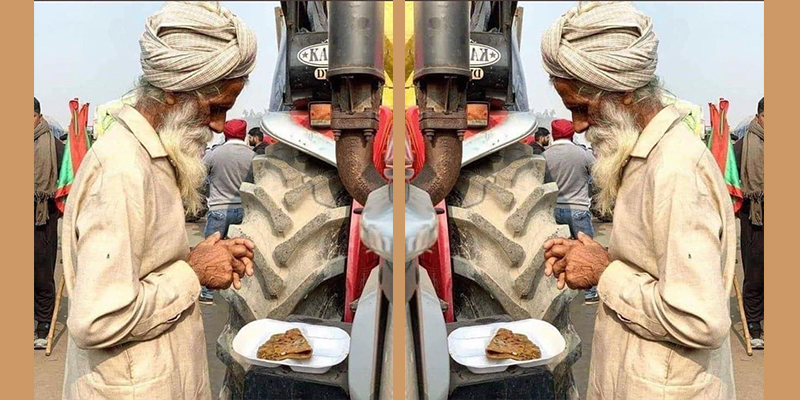
The above picture of an elderly Paniabi farmer/kirsan offering his prayers before eating his pharautha is revealing and humbling in a number of ways. On the surface, one sees a simple poor farmer consuming a simple meal. In making such a judgment, one could not be further from the truth. In reality, this picture highlights a deep relationship between food and food production. In this case, one sees a beautiful, almost divine, and inseparable relationship between the produce and consumer. As Prof Pooran Singh proclaimed, “naam da suad hei ana da suad” or “the taste of the divine name is the same as the taste of wheat”.
There is something real, honest and divine in growing food, preparing it, and then eating it without any middlemen. The more you separate the process of procurement, production, and consumption, the more you convert a basic human process into a dehumanised system of commoditisation. And in the process, you not only destroy lives and livelihoods, but through sheer greed and instant gratification, you also become blind to the long-term damaging impact on the planet’s natural ecology. And sadly today, though we deceive ourselves into believing we are sophisticated, intelligent people, in truth, in our mindless patterns of consumption, our relationships with ourselves and others have come to embody the junk food that we routinely consume.
And so what this picture really reminds us is that the struggle of the Indian farmers is not just about their livelihoods, but ultimately the future of our planet. Today, mass corporate farming has led to the demise of the livelihoods of millions of ordinary people attached to small-scale farming, from farmers to labourers to small traders. The winners are the makers of seeds and agrochemicals and corporates who determine what is grown, how it is grown, whom it is sold to, and what price will be charged.
The real heroes are farmers like the one in the picture. The farmers are not, as the government propaganda suggests, obstacles to progress! For sure one cannot ignore technology, but given the devastation that corporate chemically driven farming is causing, surely there has to be a more ecologically sensitive humane approach.
Rather than trying to break the morale of the farmers, the government should be working with them to develop new organic cooperative systems of farming, where they can re-purpose and re-tool their land as regenerative farms and ranches in order to create more employment for local people, whilst also healing the land. In truth, the government should be outlawing farms that produce food in ways that are unsustainable, namely those that require large inputs of fossil fuels and water, which we know drive soil erosion, climate change, and loss of biodiversity.
So I say, we should see the Panjabi and wider Indian farmers movement as a wake-up call for us all, wherever we live in the world. Their success is ultimately our success and that means divesting in junk farming, junk food, junk macroeconomics and junk lifestyles. And it means rejecting the corporate industrial model that is for sure leading to poverty, inequity, and ecological devastation.
It is often proclaimed that the ordinary farmer is ‘ann-daata’ or ‘one who provides subsistence’. One of the slogans of the Indian farmers movement is “no farmers, no food’! Their struggle is not only about their survival but our survival and ultimately the survival our planet, mother Earth.

Gurnam Singh is an academic activist dedicated to human rights, liberty, equality, social and environmental justice. He is an Associate Professor of Sociology at University of Warwick, UK. He can be contacted at Gurnam.singh.1@warwick.ac.uk
* This is the opinion of the writer and does not necessarily represent the views of Asia Samachar.
RELATED STORY:
Miracles and Godmen (Asia Samachar, 31 July 2020)
Towards a more loving, sharing and caring world in 2021 (Asia Samachar, 22 Dec 2020)
ASIA SAMACHAR is an online newspaper for Sikhs / Punjabis in Southeast Asia and beyond.Facebook | WhatsApp +6017-335-1399 | Email: editor@asiasamachar.com | Twitter | Instagram | Obituary announcements, click here |