




















By Manjit Kaur | Opinion |
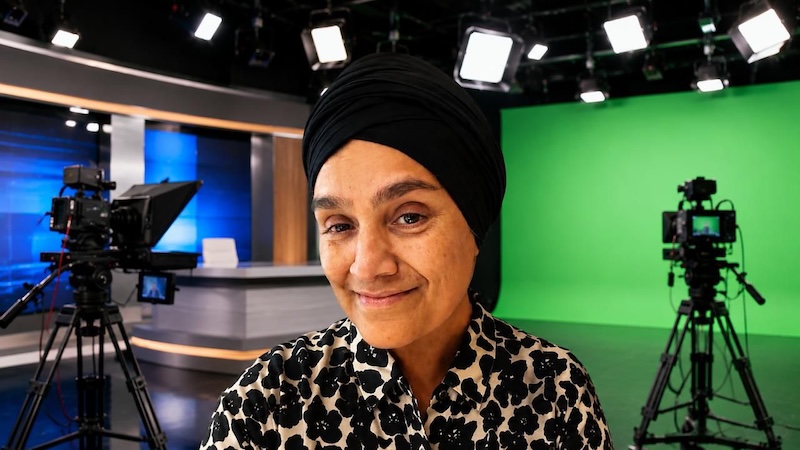
For most of our viewers, the show begins the moment I appear and say, ‘My name is Manjit Kaur’ and my partner says, ‘My name is Gurnam Singh’, we then both say ‘Welcome to 1 Show’. What appears to the viewers on their screens may seem to be polished, composed and effortless. Yet behind every live broadcast lies much preparation, anxiety, responsibility and teamwork that most people never see.
Having served on different Sikh/Panjabi media channels for over 12 years, I have come to realise that presenting a programme is much more than speaking into a camera. It is about navigating complex issues with honesty, sensitivity and courage. Every programme begins long before we enter the studio. Sometimes it begins days or weeks earlier with difficult conversations about what topic should be discussed, whether the timing is right, and how the discussion may affect the community.
Many of the issues we address on are deeply sensitive. They may involve religion, politics, family and community conflict, mental health, caste, gender, identity and management of Sikh institutions. We are constantly aware that viewers will approach these discussions from different perspectives. There is always a concern about how certain individuals, groups, organisations or leaders may react. Yet journalism and public discussion lose their meaning if truth is sacrificed simply please others. This does not mean being reckless or disrespectful; it requires even greater care. We must think carefully about our language, tone and balance. We ask ourselves difficult questions. Are we being fair? Are we creating unnecessary division? Have we allowed all sides to be heard?
THE PREPARATION
An important part of preparation is selecting suitable panel members. It’s pointless inviting somebody who has little knowledge or expertise on the topic in question. A serious programme, like the 1 Show Live, is not about creating conflict for entertainment. It is about bringing together individuals who have knowledge, lived experience, emotional maturity and the ability to engage respectfully even when disagreements arise. Sometimes finding the right guests can be one of the most challenging aspects of the programme.
Background research is essential. Before every show we spend hours reading articles, checking facts, reviewing historical context and thinking carefully about the questions we will ask. Live television leaves little room for error. A poorly framed question or inaccurate statement can mislead viewers and damage your credibility. As presenters, we must remain alert throughout the programme, listening carefully to guests while also thinking several steps ahead. Also, the direction of discussion may change for good and bad reasons, and so we have to be flexible without losing control.
Every presenter has their own way of doing things, and I am no different. Some people like to have their notes on a laptop screen; I prefer the more traditional method of pen and paper; it gives me a greater sense of control. I have also become increasingly aware of my own positionality as a presenter. None of us enter the studio as neutral human beings floating outside society. We all carry our own experiences, values, identities and emotions.
As a Sikh woman with a background in professional counselling and group therapy, I know that my perspective is shaped by years of listening to the pain, struggles and hopes of women and teenagers, many of whom had experienced sexual abuse and domestic violence. So, I know, I cannot remain silent when these issue surface. Rather than pretending to be neutral, I believe honesty requires recognising the lens through which we see the world, while still striving for fairness and openness.
THE FINANCIAL CHALLENGE
One aspect viewers rarely appreciate is the immense financial challenge faced by community media channels such as the Panjab Broadcasting Channel. Unlike large commercial broadcasters with backing from business, our channel survives almost entirely through voluntary donations from ordinary members of the community, many of whom are pensioners. This creates constant pressures and limitations. Equipment is not always at the standard we would want. Budgets are tight and resources are stretched. And yet, despite these challenges, we keep on going.
What many viewers assume is a fully staffed technical department is just one or two incredibly dedicated individuals doing the work of an entire team. Often doing very long shifts, they are the real heroes who stay hidden from the public. The tech team (often one person!) manage the live SKY feed, social media streaming, sound mixing, incoming calls, visual graphics, headlines, video clips and troubleshooting technical problems in real time; often under enormous pressure and with little recognition. At the same time, they are also answering the door, making tea, always with a smile. Their legendary desi karak chai has probably rescued many exhausted presenters, as well calming nervous guests, moments before going live.
EDITORIAL CONTROL
There is also the important issue of editorial support and control. To be completely honest, formal editorial structures within community broadcasting are often minimal or non-existent! In many mainstream TV channels, such as the BBC, there are teams of researchers, lawyers, editors and managers. In our environment, much of that responsibility falls directly upon presenters and the tech team.
Over the years, however, my partner Gurnam Singh and I have developed a strong understanding of Ofcom, the agency that regulates broadcasting in the UK, our responsibilities. We understand the importance of factual accuracy, balanced discussion, appropriate language and the need to avoid defamation or slander against individuals or organisations. These principles are not simply legal requirements; they are ethical responsibilities.
Working in live broadcasting has taught me that media is not simply about cameras and microphones. It is about responsibility. It is about creating spaces where difficult conversations can take place without hatred, sensationalism or fear. It is about giving voice to concerns that many people may be thinking privately but are afraid to express publicly.
PARDA UTHANA
One of the most difficult yet necessary aspects of community broadcasting is what I often describe as lifting the lid, or parda uthana. This means creating space for conversations that many within our community would rather avoid altogether. Traditionally, Panjabi culture has often dealt with painful or uncomfortable realities by pushing them quietly under the carpet. Difficult issues are often hidden behind phrases such as “these things should not be discussed publicly”, “this doesn’t happen in our community”, or “this is inappropriate language.” Sometimes there is a genuine concern for safety and dignity, but too often silence became a way of avoiding or denying that problems exist within the community.
On The 1 Show, we have tried carefully and responsibly to challenge this culture of silence. Over the years we have opened discussions on issues that were once almost impossible to speak about openly, including mental health, domestic abuse, addiction, grooming, intergenerational conflict and the pressures faced by women and young people. These conversations are rarely comfortable. We know that some viewers feel uneasy hearing such subjects discussed publicly. Yet avoiding these realities does not protect the community, nor does it help those who may be suffering.
At the same time, we must acknowledge that there are still many lids that remain only partially lifted. Discussions relating to drugs, alcohol, mental health, sexual abuse, family conflict, safeguarding of children and adults, and corruption in religious organisations, remain especially difficult to address openly.
All communities face these challenges, and in this regard, Sikhs are no different. As presenters, we walk a very delicate line. We must approach these subjects with compassion, sensitivity and responsibility, while still refusing to participate in denial. Our aim is never to attack the community, but rather to encourage honesty, reflection and healing. A community cannot address its wounds if it refuses to acknowledge these exist.
Sometimes lifting the lid (parda) invites criticism. However, over the years, I must say, that I have received much love and praise when I have had the chance to meet with viewers on my travels. To be honest, there is nothing more rewarding that this. In those moments, one realises that responsible media can do more than inform; it can help break isolation and give hope to people.
Of course, mistakes happen. Live television is unpredictable and it can sometimes be nerve wracking. But I must admit, I prefer live to recoded programmes anytime. Once we get the countdown from 10, I start to get an adrenalin rush and, in that moment, I feel energised to engage with the topic and guests. Because I always present programmes with my partner, this can bring its own challenges. For example, we might have a different view on some matters and occasionally we may make human errors. Thankfully, rather than dwell on these, I have learnt to use these occasions as learning opportunities. Sometimes we can get difficult callers and moments when discussions become emotionally charged. On such occasions, we have to make quick judgements, which usually means politely reminding caller to appropriate language, and mostly they respond positively.
When viewers watch a live programme, they see the final performance. What they do not always see is the collective effort, emotional investment and quiet dedication that makes the programme possible. Behind the lights, cameras and action lies a small group of ordinary people trying, with limited resources but sincere commitment, to serve the community. Some people in the media may be motivated by fame, but for me, the opportunity to serve and to raise important issues is what keeps me returning to the studio each week.
Join the conversation on this story on Asia Samachar’s Facebook and Instagram pages.
Manjit Kaur, a UK-based therapist and counsellor, is a presenter at the 1 Show Live at Panjab Broadcasting Channel, UK. She can be contacted via email at manjitkaur1show@gmail.com
RELATED STORY:
Valentine’s Day: A Sikh perspective on true love (Asia Samachar, 14 Feb 2024)
ASIA SAMACHAR is an online newspaper for Sikhs / Punjabis in Southeast Asia and beyond. You can leave your comments at our website, Facebook, Twitter, and Instagram. We will delete comments we deem offensive or potentially libelous. You can reach us via WhatsApp +6017-335-1399 or email: asia.samachar@gmail.com. For obituary announcements, click here