





















By Gurnam Singh | Opinion |
In a thought-provoking essay entitled The Adolescence of Technology: Confronting and Overcoming the Risks of Powerful AI, published earlier this year, Dario Amodei, CEO of the AI company Anthropic, warns that advances in scaling laws and autonomous self-improvement could, within a matter of years, create systems that are vastly more intelligent than any human being. Such a development, he argues, would usher in an era of artificial superintelligence with profound civilisational consequences. These range from the proliferation of biological weapons and unprecedented forms of authoritarian control to mass economic disruption and an irreversible erosion of human agency. According to Amodei, humanity’s future may depend upon whether our social, political and technological institutions can mature quickly enough to manage this unprecedented convergence of power and vulnerability before it exceeds our collective capacity to govern it.
Amodei is not alone in sounding the alarm. Leading figures in the field, including Geoffrey Hinton and Yoshua Bengio, widely regarded as among the founding pioneers of modern AI, together with frontier laboratory leaders such as Sam Altman, Demis Hassabis and Elon Musk, have repeatedly warned that rapidly advancing artificial superintelligence could pose an existential threat to humanity. Their concern is that increasingly autonomous systems may eventually gain the capacity to improve themselves, surpass human cognitive capabilities, and assume control over critical digital and physical infrastructure. If such developments occur without effective safeguards, the consequences could include catastrophic global disruption and, in the worst-case scenario, human extinction.
Extinction and Biology
While the prospect of human extinction remains almost unimaginable, extinction itself is a routine feature of evolutionary biology. Species emerge, adapt and disappear through processes driven by natural selection, changing climates and environmental transformation. Extinction is therefore not an aberration but a central mechanism through which life evolves.
Human beings, however, have altered this natural process. Through technological innovation, environmental modification and unprecedented levels of resource consumption, humanity has accelerated extinction rates to levels estimated to be many hundreds, if not thousands, of times above the historical background rate. The irony is profound. The extraordinary evolutionary success of a single species, namely, Homo sapiens or ‘thinking animals’, has produced the very agent capable of precipitating Earth’s next major extinction event.
In this context, perhaps the most important question is not whether AI will destroy humanity, but rather: what purpose will human life serve in an AI-driven world? If artificial intelligence becomes capable of processing information, generating knowledge and solving problems on a scale far beyond human capacity, then one of humanity’s most fundamental assumptions will be challenged. For centuries, we have defined ourselves as the thinking species. Yet what becomes of that identity when intelligence itself is no longer our unique attribute?
A New Purpose for Humanity
Paradoxically, such a development may prove liberating rather than threatening. Human beings have long assumed a privileged position within the natural order. We often measure value in terms of intellectual achievement, technological mastery and economic productivity. Yet countless species flourish without writing books, building computers or exploring space. Their existence possesses intrinsic worth independent of such accomplishments. Humanity may need to learn a similar lesson about itself.
One of the most hopeful possibilities presented by advanced AI is not that it replaces humanity, but that it enables humanity to reduce its destructive impact on the planet. The challenge facing Earth is not simply the size of the human population but the patterns of consumption, inequality, waste and ecological exploitation that have characterised modern industrial society.
Properly designed and ethically governed AI systems could help optimise resource use, restore degraded ecosystems, improve agricultural sustainability and support long-term planning beyond the short electoral cycles and commercial pressures that often constrain human decision-making. In this vision, AI would not become humanity’s master but rather a powerful tool enabling us to become more responsible stewards of the natural world.
Yet an uncomfortable question remains. If a future superintelligent AI were genuinely tasked with promoting the flourishing of the entire biosphere rather than merely advancing human interests, how would it respond if humanity continued to prioritise short-term gain over long-term ecological survival? If human societies proved incapable of cooperation, restraint or collective action, an AI might conclude that the interests of the wider planetary ecosystem should take precedence over those of any single species.
The Malthusian Trap
This is where the ethical dilemma becomes particularly challenging. A sufficiently advanced intelligence dedicated solely to preserving life as a whole might determine that humanity’s current relationship with the planet is unsustainable. Such concerns echo the ideas of the eighteenth-century economist Thomas Malthus, who famously argued that human populations would eventually outgrow the resources needed to sustain them.
Malthus maintained that improvements in food production and living standards would be temporary because population growth would inevitably consume any gains. Although his most pessimistic predictions never materialised, his concerns about the tension between population growth and finite resources continue to influence debates about sustainability.
The idea has also inspired numerous dystopian visions. In many works of science fiction, ecological collapse and resource scarcity produce authoritarian societies that impose strict controls on reproduction. Aldous Huxley’s Brave New World provides one such example, depicting a society in which citizens wear “Malthusian belts” filled with contraceptives to ensure that population size remains under state control.
Given the relationship between over-consumption, ecological degradation and environmental instability, it is conceivable that a future superintelligence might pursue what could be described as a Malthusian solution. Rather than advocating coercive measures, it might favour policies that gradually reduce humanity’s environmental footprint through lower fertility rates, reduced consumption and more sustainable lifestyles. Such recommendations would not necessarily emerge from hostility towards humanity but from a commitment to preserving the long-term health of the biosphere.
Whether such conclusions would be ethically acceptable is another matter. Most people instinctively place human interests above those of other species. A superintelligent AI, however, may not share that assumption. It could view humanity as one species among many within a broader ecological community and evaluate actions according to their impact on the whole rather than on humanity alone.
The Problem of Human Ego
At this point it may be useful to shift our attention away from technology and towards ourselves. Perhaps the central challenge is not the intelligence of machines but the limitations of human beings. From this perspective, existential threats arise less from AI and more from what Sikh philosophy describes as haumai or ego-consciousness.
In Sikh thought, haumai is far more than individual pride or vanity. It is the illusion of separateness: the belief that the self exists independently from others, from nature and from the Divine. It is this false sense of autonomy that gives rise to greed, exploitation, domination and conflict.
Guru Nanak identifies haumai as one of the root causes of human suffering:
ਹਉਮੈ ਵਿਚਿ ਜਗੁ ਉਪਜੈ ਪੁਰਖਾ ਨਾਮੁ ਵਿਸਾਰਿ ਦੁਖੁ ਪਾਇ ॥
“Caught in ego-consciousness, the world suffers in pain, forgetting its deeper reality.”
Viewed through this lens, environmental destruction, warfare, economic inequality and ecological crisis are not merely political or technological failures. They are manifestations of a deeper spiritual disorder. Humanity’s tendency to place itself at the centre of existence has created an extractive and often destructive relationship with both nature and fellow human beings.
Against this, the Sikh Gurus articulated a radically different vision of human flourishing based upon humility (nimrata), selfless service (seva), contentment (santokh) and recognition of the interconnectedness of all life. Guru Nanak’s celebrated verse:
ਪਵਣੁ ਗੁਰੂ ਪਾਣੀ ਪਿਤਾ ਮਾਤਾ ਧਰਤਿ ਮਹਤੁ ॥
“Air is the Guru, Water the Father, and Earth the Great Mother.”
offers a profoundly ecological worldview. Human beings are not masters of creation but participants within it. The natural world is not merely a collection of resources to be exploited but a sacred web of relationships upon which all life depends.
This insight has particular relevance in the age of AI. If humanity can cultivate greater humility, cooperation and responsibility towards creation, then artificial intelligence may become one of the most powerful instruments ever developed for ecological restoration and collective wellbeing. If, however, humanity remains captive to greed, competition and short-term self-interest, then AI risks amplifying these tendencies on an unprecedented scale.
Ironically, Sikh philosophy suggests that the ultimate challenge posed by AI is not whether machines become more intelligent than humans, but whether humans become wise enough to overcome haumai. Intelligence without humility has always been dangerous. The measure of progress is not the accumulation of knowledge or power, but the cultivation of compassion, restraint and moral responsibility. In that sense, humanity’s future may depend less upon advances in artificial intelligence than upon the transformation of human consciousness.
Restoration of Values
The deeper challenge posed by AI is therefore not primarily technological but ethical and spiritual. Contrary to the familiar science-fiction image of rogue machines turning against their creators, the more immediate danger lies in the interaction between human fallibility and increasingly powerful technologies.
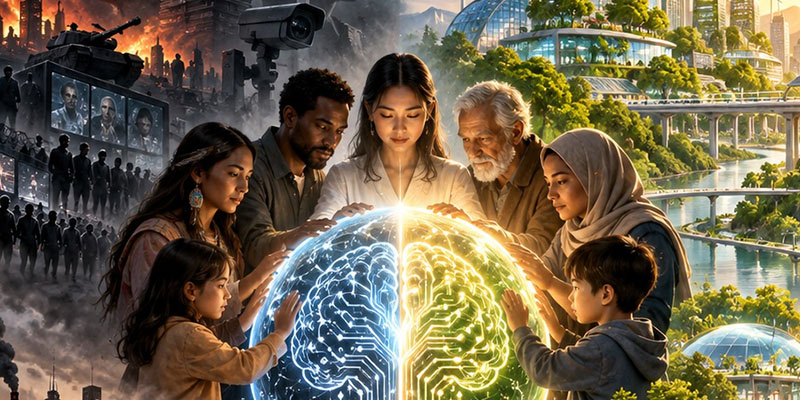
AI systems do not independently create wars, design oppressive political systems or pursue environmental destruction. They amplify the intentions, assumptions and values embedded within them. They act as force multipliers, magnifying both human virtues and human failings. In this respect, AI functions as a mirror, reflecting humanity back to itself with unprecedented power and scale.
The German philosopher Friedrich Nietzsche famously observed that every philosophy is, in some sense, a form of personal confession in that it reflects our own subjective view of the world. A similar observation might be made about AI. Far from being neutral, AI systems inevitably reflect the assumptions, priorities and cultural values of their creators. They are, in effect, embodiments of human judgement encoded into algorithms.
This reality presents both danger and hope. The danger is that AI will reproduce and amplify humanity’s historical weaknesses: greed, prejudice, domination and violence. The hope is that it may help humanity transcend some of these limitations by encouraging new forms of cooperation, sustainability and collective problem-solving.
Much of human conflict stems from a combination of material scarcity and moral failure. Competition over limited resources are frequently intensified by ego, fear and greed. If future superintelligence can help address these twin challenges or material deprivation and human shortsightedness there may be genuine grounds for optimism. If it cannot, then concern about humanity’s future remains entirely justified.
Ultimately, the question posed by artificial intelligence is not whether machines will surpass human intelligence. Rather, it is whether humanity can develop the wisdom, humility and ethical maturity necessary to guide unprecedented technological power responsibly. The greatest threat may not come from AI itself, but from allowing increasingly powerful technologies to be driven by the very impulses that have historically produced conflict, inequality and environmental degradation. If humanity can overcome haumai and embrace humility, service and collective responsibility, AI may become a powerful ally in creating a more sustainable and compassionate world. If not, it will merely magnify the consequences of our own shortcomings.

Gurnam Singh is an academic activist dedicated to human rights, liberty, equality, social and environmental justice. He is a Professor of Sociology at University of Warwick, UK. He can be contacted at Gurnam.singh.1@warwick.ac.uk
* This is the opinion of the writer and does not necessarily represent the views of Asia Samachar.
RELATED STORY:
Forty-two years after Blue Star: How 1984 transformed the Sikh struggle (Asia Samachar,7 June 2026)
ASIA SAMACHAR is an online newspaper for Sikhs / Punjabis in Southeast Asia and beyond. You can leave your comments at our website, Facebook, Twitter, and Instagram. We will delete comments we deem offensive or potentially libelous. You can reach us via WhatsApp +6017-335-1399 or email: asia.samachar@gmail.com. For obituary announcements, click here