ASIA SAMACHAR is an online newspaper for Sikhs / Punjabis in Southeast Asia and beyond. You can leave your comments at our website, Facebook, Twitter, and Instagram. We will delete comments we deem offensive or potentially libelous. You can reach us via WhatsApp +6017-335-1399 or email: asia.samachar@gmail.com. For obituary announcements, click here
Pola Singh (right), and Tan Sri Mohamed Jawhar Hassan, an 80-year-old former chairman of the Institute of Strategic and International Studies (ISIS) and New Straits Times Press (NSTP), exercise regularly at the TTDI Park. They cherish the fruits of their earlier investments in health. Now, they bask in tranquillity, leading lives brimming with fulfilment.
By Dr Pola Singh | Malaysia |
As we navigate the hustle of our working lives, we often prioritize financial security over our overall well-being. The mantra “health is wealth” can feel distant as we chase career goals and family obligations, neglecting the importance of regular exercise and proper nutrition.
In the frenzy of work and commitments, it’s easy to brush aside exercise, ignoring its vital role in sustaining a fulfilling life. Excuses abound, and sedentary habits become the norm, leading to a staggering statistic: only 10-20% of Malaysians exercise regularly.
Yet, as retirement beckons, perspectives shift. Regret sets in for those who realize too late the value of prioritizing health earlier in life. They find themselves constrained by health issues, unable to savour the pleasures they once envisioned.
I’ve witnessed seniors grateful for each day, longing for the vitality they once took for granted. If given the chance, they’d rewrite their past, dedicating ample time to activities that nourish the body and soul.
Neglecting health in youth leads to a costly toll in later years. Medical bills mount, dreams of travel fade, and once-coveted indulgences lose their allure. A bungalow or mansion loses its lustre when stairs become insurmountable obstacles, and pain overshadows daily life.
Besides exercising outdoors, leading a healthy lifestyle is paramount. Smoking is a no-no, and everything should be done in moderation. If you love to drink, do it moderately (cut it down over time); if you love to indulge in food, do not overeat. Reduce your intake of the sweet stuff such as lados, jelebi and barfi. Eat more chappatis and less rice.
Reading widely (and also writing), playing mind games such as chess, sudoku, crossword puzzles, etc., are essential to keeping your brain healthy. Socialize more often with your friends and classmates. These are all open secrets to a fulfilling life.
The repercussions extend beyond physical health. Isolation, stress, and depression creep in, tarnishing the golden years. Culinary delights and leisure pursuits lose their charm when health prohibits enjoyment.
The remedy lies in embracing a proactive approach to health early on. Regular exercise, a balanced diet, and abstaining from harmful habits lay the foundation for a fulfilling life well into old age.
As Malaysians, our life expectancy may be on the rise, but true quality of life eludes many. Let us heed the call to prioritize health, ensuring that our golden years are truly golden. After all, in the journey of life, nothing is more valuable than the gift of good health.
Friends say that I stand as living proof that investing in health and leading a healthy lifestyle yields the richest dividends. Amidst the chaos of life, I have dedicated time to exercise and nourish my mind, now revelling in the joy of a vibrant existence while keeping the doctor at bay.
I will turn 75 this July.
Dr Pola Singh, who retired as Maritime Institute of Malaysia director-general in 2011, is also the author of ‘Uphill — The Journey of a Sikh-Chinese Kampung Boy’
ASIA SAMACHAR is an online newspaper for Sikhs / Punjabis in Southeast Asia and beyond. You can leave your comments at our website, Facebook, Twitter, and Instagram. We will delete comments we deem offensive or potentially libelous. You can reach us via WhatsApp +6017-335-1399 or email: asia.samachar@gmail.com. For obituary announcements, click here
Dear Family & Friends. It is with great sorrow that we announce the passing of Mdm. Har Kaur @ Harwant Kaur A/P Late Sardar Tara Singh, a beloved mother and grandmother, who passed away on March 7, 2024.
ASIA SAMACHAR is an online newspaper for Sikhs / Punjabis in Southeast Asia and beyond. You can leave your comments at our website, Facebook, Twitter, and Instagram. We will delete comments we deem offensive or potentially libelous. You can reach us via WhatsApp +6017-335-1399 or email: asia.samachar@gmail.com. For obituary announcements, click here
Friends and family, it’s with heavy hearts and great difficulty that we announce the passing of Madam Surinderjit Kaur on 11th March 2024 at 2:00pm surrounded by her loved ones. A life so beautifully lived deserves to be beautifully remembered. Please join us to mourn the passing of her.
Husband: Late Mr Balbir Singh (Demru)
Children / Spouses: Amarjit Singh / Jagjit Kaur ( Klang, Selangor ) Manmohan Singh / Sunider Kaur ( Klang, Selangor )
Cortège leaves at 12pm from house (Add: No. 74, Leboh Sembilang Dua, Jalan Teluk Pulai, 41100, Klang) to Bliss Gardens (Lot 85693, Jalan Setia Makmur, U14/49, Seksyen U14, 40000 Shah Alam Selangor)
Saskaar / Cremation: 2:00pm at Bliss Garden
PATH DA BHOG
24th March 2024 (Sunday), from 10am to 12pm Gurdwara Sahib Klang
ASIA SAMACHAR is an online newspaper for Sikhs / Punjabis in Southeast Asia and beyond. You can leave your comments at our website, Facebook, Twitter, and Instagram. We will delete comments we deem offensive or potentially libelous. You can reach us via WhatsApp +6017-335-1399 or email: asia.samachar@gmail.com. For obituary announcements, click here
There is a shabd by Guru Nanak Ji on page 472 of the Aad Sri Guru Granth Sahib (SGGS) in relation to the people who believe in certain days or times being auspicious. Muslims consider Friday to be a blessed day, Christians Sunday, and Hindus Wednesday. According to the Doctrine of Gurbani all days and times are the same. Each day you are alive, doing good, remembering the Creator within is a blessed day.
jay kar sootak mannee-ai sabh tai sootak ho-ay. gohay atai lakrhee andar keerhaa ho-ay. jaytay daanay ann kay jee-aa baajh na ko-ay. pahilaa paanee jee-o hai jit hari-aa sabh ko-ay. sootak ki-o kar rakhee-ai sootak pavai raso-ay. naanak sootak ayv na utrai gi-aan utaaray Dho-ay. ||1|| AGGS Page 472
To understand this shabd, we need to understand the word “sootak” in depth. According to Hindu religious beliefs, there are a handful of days in a year which are not equal as others. If a baby is born on any of these days, the parents have the risk of dying soon. Such a child is called “manglik”. This is just one example; other examples include not eating on certain days of the week, not starting any new business on certain days, not planting crops on certain days, not bathing on certain days, not shaving or certain days, etc.
Guru Ji says here that for one second, if I were to believe in the practice of “sootak” (jay kar sootak mannee-ai), such belief is proven false immediately as everything around us is impure (sabh tai sootak ho-ay).
Guru Ji goes on to explain this statement as to why he thinks that everything around us is impure. We know now – scientifically – that life originates in awkward places. Our universe was once a disk of dust. Out of this disk came the sun, planets, water, earth etc. Then came life. Life took hundreds of millions of years to turn into the form it is now. No one knows what kind of filth and impurities life originated and evolved in. All scientists can do is speculate.
Even now life originates in various dirty and impure places. Guru Ji gives an example of life such as worms, originating in decaying matter (gohay atai lakrhee andar keerhaa ho-ay). In the next three lines Guru Ji explains that water is impure “sootak” too. We know that water is impure as fish live in it, human waste and garbage is thrown into the water. Lakes, rivers, oceans, and aquifers are all polluted. Yet water is essential for life on earth (pahilaa paanee jee-o hai jit hari-aa sabh ko-ay).
Does this then mean all the life forms on earth are impure? We keep this impure water in our kitchen (sootak ki-o kar rakhee-ai sootak pavai raso-ay). Does this mean that our kitchens are impure? Not a single grain of food can be produced without water (jaytay daanay ann kay jee-aa baajh na ko-ay). Does this mean our food is impure?
All these questions lead to the final statement by Guru Ji here. He says that it’s not the things around us or certain days that are impure. It is our mind that is impure. It is our thought process that are impure.
Nothing becomes pure by following the concepts of “sootak”. We need to purify our mind first (naanak sootak ayv na utrai). We can only purify our mind (gi-aan utaaray Dho-ay) through the enlightenment of the messages as contained within the SGGS.
In the following verses Guru Ji talks about various impurities of the mind and how to get rid of them in further detail.
man kaa sootak lobh hai jihvaa sootak koorh. akhee sootak vaykh-naa par tari-a par Dhan roop. kannee sootak kann pai laa-itbaaree khaahi. naanak hansaa aadmee baDhay jam pur jaahi. ||2||
Guru Ji calls the greed as impurity of mind (man kaa sootak lobh hai) and dishonesty as the impurity of our tongue (jihvaa sootak koorh). The impurity of the eyes is lust (akhee sootak vaykh-naa par tari-a) and jealousy towards wealth and success of others (par dhan roop). The impurity of the ears is that they listen to the bad mouthing, slander, and insult of others (kannee sootak kann pai laa-itbaaree) without any regret (pai khaahi). Guru Ji ends these definitions of impurities by saying that no matter how externally cleansed a person is (naanak hansaa aadmee), with all these inner impurities, the person always falls in the cycle of mental and spiritual life and death (baDhay jam pur jaahi). To summarize the message in these lines, Guru Ji is saying that external ritualistic cleansing cannot hide the impurities of one’s mind.
sabho sootak bharam hai doojai lagai jaa-ay. jaman marnaa hukam hai bhaanai aavai jaa-ay. khaanaa peenaa pavitar hai diton rijak sambaahi. naanak jinHee gurmukh bujhi-aa tinHaa sootak naahi. ||3||
In the first line, Guru Ji calls the notions of purity and impurity; auspicious and inauspicious days or time; jootha and sucha etc as being illusionary (sabho sootak bharam hai). All human beings are impacted by this as we are all stuck in the web of materialism (doojai lagai jaa-ay). Try to recall all the impurities that a human harbors from the previous paragraph. These include greed, bad mouthing others, lust, jealousy towards wealth and success of others etc. Just pause here and think about it, what causes these impurities within us? We should recognize when these impurities manifest themselves and should try to get rid of them. We should not be greedy, but share instead. We should rid ourselves of lust and desire. We should refrain from listening to someone bad mouthing others. We should be happy when someone we know is successful etc.
The next line is like a slap on the faces of people who believe in one day being better than another. Life and death have no relationship to a particular day or time. Simply put, a person is born or dies based on the order and rules set by the Creator (jaman marnaa hukam hai bhaanai aavai jaa-ay).
Some people believe that if you pray over food, it becomes “parshad”, with some magical powers. Some others believe that if you pray over water, it turns into “amrit”, with some holistic powers. In the third line Guru Ji says that all food is good, because it is all created by our Creator to be used by us (diton rijak sambaahi). Anything created by the Creator is good and pure (khaanaa peenaa pavitar hai). Praying over food does not make it magical. It’s proven through science that more “karrah” you eat, the more your cholesterol increases and higher your chance of heart disease.
In the final line Guru Ji says that the people who understand this message (naanak jinHee gurmukh bujhi- aa), do not fall into the trap of the concepts of “sootak”. To them all days are the same. They understand that life and death is handled by the Creator, and that he does not delegate this responsibility to anyone else. Thus no one can change this.
The central message of this shabd is for us to not indulge in silly beliefs. If something sounds silly, then it is silly. Gurbani stands the test of time. Everything in it is true and overrides prevalent customs. We should read and understand what Gurbani is trying to tell us. It is filled with answers related to daily life. We need to dig deeper and look harder to understand these concepts and adopt them in our daily lives. This will help us become better humans. Just like viruses that spread through social contact, if we become better humans, society will become better through social contact with such people.
The author, Harmanpreet Singh Minhas, can be contacted at hpsminhas@outlook.com. This article appeared in the The Sikh Bulletin – 2024 Issue 1 (January-March 2024). Click here to retrieve archived copies of the bulletin.
ASIA SAMACHAR is an online newspaper for Sikhs / Punjabis in Southeast Asia and beyond. You can leave your comments at our website, Facebook, Twitter, and Instagram. We will delete comments we deem offensive or potentially libelous. You can reach us via WhatsApp +6017-335-1399 or email: asia.samachar@gmail.com. For obituary announcements, click here
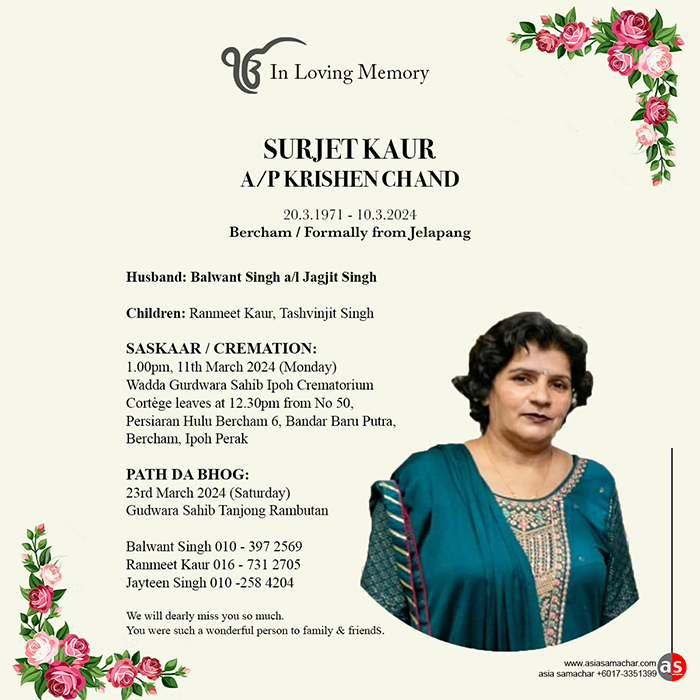
Last Respect: 9.30am, 12 March (Tuesday) at Gurdwara Sahib Petaling Jaya Cortege leaves at 12:30pm to MBPJ Crematorium Kampung Tunku. Crematorium services at 1:30pm
PATH DA BHOG & ANTIM ARDAS
23rd March 2024 (Saturday), 4:00pm – 6:00pm Gurdwara Sahib Petaling Jaya
ASIA SAMACHAR is an online newspaper for Sikhs / Punjabis in Southeast Asia and beyond. You can leave your comments at our website, Facebook, Twitter, and Instagram. We will delete comments we deem offensive or potentially libelous. You can reach us via WhatsApp +6017-335-1399 or email: asia.samachar@gmail.com. For obituary announcements, click here
| Entry: 10 March 2024; Updated 13 March 2024 | Source: Family
ASIA SAMACHAR is an online newspaper for Sikhs / Punjabis in Southeast Asia and beyond. You can leave your comments at our website, Facebook, Twitter, and Instagram. We will delete comments we deem offensive or potentially libelous. You can reach us via WhatsApp +6017-335-1399 or email: asia.samachar@gmail.com. For obituary announcements, click here
ASIA SAMACHAR is an online newspaper for Sikhs / Punjabis in Southeast Asia and beyond. You can leave your comments at our website, Facebook, Twitter, and Instagram. We will delete comments we deem offensive or potentially libelous. You can reach us via WhatsApp +6017-335-1399 or email: asia.samachar@gmail.com. For obituary announcements, click here
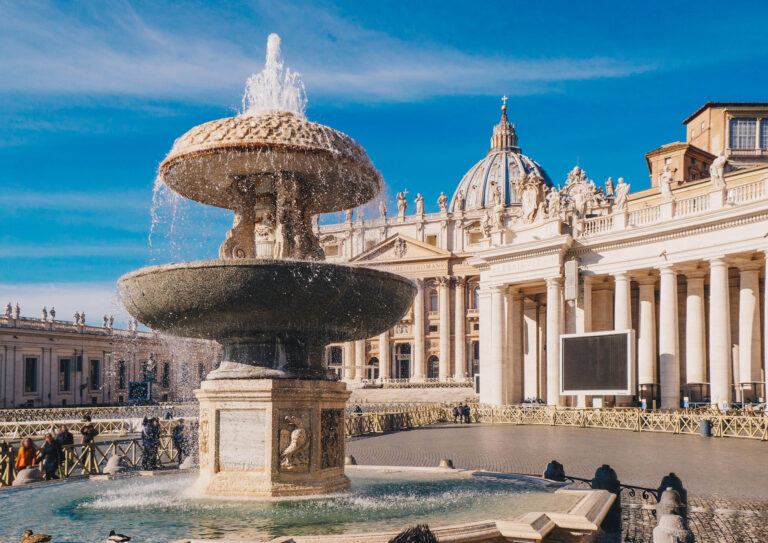
Vatican City, Rome, Saint Peter’s Basilica in St. Peter’s Square
By Tennyson Samraj | Sikh Bulletin |
Abstract: This paper presents a bold, realistic plan for The Sikh’s aspiration for the Khalsa state. To this end, it is proposed: (1) to create the Khalsa State modeled after the Vatican state, where the Chief Guru, like the Pope, can be both the temporal head of the Khalsa State and the spiritual leader of the Sikhs in India and around the world. The Khalsa State is to be created from the area around the Harmandir Sahib Temple of Amritsar, modeled as the Vatican State created around St Peter’s Cathedral. (2) The Punjab state government continues and maintains the current relationship with India’s federal or central Government. (3) The Khalsa State accepts India’s sovereignty and consigns foreign policy to the Indian Government. The Khalsa State would create a religious Enclave for the Sikh people, similar to the Vatican State for Catholics.
INTRODUCTION
Guru Nanak stated that “there is no Hindu or Musalman.” His idea provided the basis for a new religion called Sikhism, a syncretism of two leading religions, Hinduism and Islam. The new faith was designed originally to end the conflict between Hindus and Muslims and bring interfaith dialogue. Interfaith dialogue is not about moving towards one world religion but appreciating our diversity. Not until the Muslim rulers and Hindu kings persecuted the Sikhs did they become self-defensively militant and political after and between Guru Arjan and Guru Govind Singh’s tenure as Gurus. The original intent was never intended to be a political power. The whole purpose of the origin of Sikhism was for the unity between Hindus and Muslims.
In light of the original idea related to the birth of Sikhism, it would be a welcome idea to revisit the background of how Sikhism as a religion came to fruition. Creating a Khalsa state based on the Khalsa Ideal to bring unity in India not only between Muslims and Hindus but unity between all faiths would be an ideal reason to envision a Khalsa state modeled after the Vatican State.
KHALSA STATE IS MODELED AFTER THE VATICAN STATE
The Vatican State was created to end the Papacy’s political power. The creation of the Vatican State reduced the Papacy to playing only a spiritual role. But to appease the church’s power, Mussolini agreed to give the church limited statehood but whose primary purpose was only spiritual. In this process, the Italian Government got land the church owned in Rome and made Rome the Capital of Italy. This model can serve as a precedent for other religious conflicts related to the Khalistan movement, the Plight of Dalia lama, or Muslims’ aspiration for a caliphate. The Vatican model can serve as a basis to settle at least two religious conflicts: (1) the Sikh’s quest for a Holy land and (2) the Tibetans’ hope of the Dalai Lama returning to the Potala Palace.
Creating a Khalsa State around the area of the Harmandir Sahib Temple Complex for the Sikhs would be ideal for the Sikhs (Amir Singh Bains suggests Nankana Sahib–the birthplace of Guru Nanak for the Khalsa state) where the Chief Guru could be the temporal ruler and spiritual leader for all who seek religious tolerance around the world.; creating a Potala state would be ideal for the Tibetans, where the Dalai Lama can be the temporal ruler of the Potala Palace and the spiritual leader of all who practice Lamaism.
The Sikh religion has adapted its core tenets from Muslim and Hindu beliefs. Sikhs’ faith in Monotheism is from Islam’s ideal that God is one. Yet, it holds many deeply religious convictions from Hinduism. Both Islam and Hinduism emphasize the oneness and ‘unborn’ nature of God. The role Sikhs can play in the subcontinent of India is immense. We can define and defend what belongs to both religions and yet remain in India. The Khalsa state would be created with the very goal of bringing unity and harmony not only between Hindus and Muslims but the unity of all religions in India. The oneness of God defined by the Sikhs clearly defines Monotheism as belief in one God, not one’s God. The emphasis is not on one’s God but on the importance that God is one and that God is God of us all. “We are all made of the same Clay.” No one has a monopoly over the truth about God. The belief in the oneness of God provides the Sikhs the basis for fraternity and equality of all humans. To this end, every Sikh temple advocates congregational worship, and every Gurdwara langar provides communal meals to enforce the idea of fraternity.
What does the oneness of God mean? The oneness of God is the basis of secularism–the idea being that all religions must be respected. State and religious laws should be separated. If, for some reason, we cannot distinguish between state laws and religious laws, or when there is no distinction between moral laws and legal laws, we end up with a fundamental state–where there is no separation between state laws and moral/religious laws. When this happens, punishment is extended to immoral behavior. In a secular state, punishment can be given only for illegal conduct. Punishing people for immoral behavior would become necessary if we merge state and religious or moral laws together. That is why, in fundamental states, there is a special wing of the police department called the morality police that executes punishment for immoral behavior. What must be noted is that laws are meant only to regulate behavior and never to legislate morality. However, if a fundamental state is created, the State must enforce both legal and moral laws. To legislate morality is to live in a police state.
Respect for all religions necessitates the need for the separation of state and religious laws. The Rule of law is the basis for the Government, not the Rule of God. If the distinction is not made, then which religious laws should the State include and which religious laws should be excluded would be a difficult task. For this reason, the Rule of law requires the separation of religious laws from state laws. The Rule of law is strictly limited and related to life between the womb and the tomb. State laws only deal with life associated with the existential limits between birth and death. Religious laws lead to both moral life and the afterlife. A secular state can only give its citizens the right to hold beliefs about one’s ethical conduct or convictions related to the afterlife. But, the State cannot make it part of the state laws or attempt to legislate morality. For those who insist on the necessity for the creation of a fundamental state where there is no distinction between state and religious laws, then the Khalsa state modeled after the Vatican State would appease those who insist on a limited sovereign state. Can what was and is good for the Pope and his people be good for the Sikhs and Sikhism Historically, Sikhs have always been part of India, but the history of the Sikhs with their fellow Indians under both the Muslim rulers and the present Indian Government has had a checkered past. But, if a new relationship is to be had, we have to present their aspiration as the need for a holy land, where the land of the pure is to define and defend Sikhism as a religion within the context of a limited sovereign Sikh state. If the Khalsa state is created, the chief Guru would be able to maintain a temporal role but only within the Akal Takht and temple complex, while the rest of Punjab would be a secular state. In such a world, the Khalsa State can enjoy the same freedom with limited sovereignty if neutrality is maintained. Why would such a sovereign state have meaning? To the Sikh people, this would be a realistic goal to achieve. It would comply with the nature of Sikhism –which preaches, practices, and propagates pacifism to the world at large. Nothing would fit better than creating a limited sovereign state modeled after the Vatican State.
The Akal Takht—the supreme authority of Sikhism, and the Akali Dal, the political branch of the Sikhs, have, in contemporary times, advocated for both political and religious freedom. While the Akal Takht has been the supreme authority for the Sikhs from the early days of Sikhism, the Akali Dal, founded on December 14, 1920, has been seen as an Indian Sikh political party that defines the will of the Sikhs best. As a political party, they have ruled Punjab state for decades, and ever since its formation, has remained the political voice of the Sikhs. Realistically, they have political freedom within the homeland of India. What they need to do is to declare Akal Takht as the land of the pure by creating the Khalsa state, where the chief Guru is the temporal leader of the Akal Takht and the spiritual leader of the Sikhs at large. The Sikhs can negotiate with the Indian Government to create a Vatican-style state that allows Sikhs to define and defend their faith as they see fit. The neutrality of the Khalsa State understood in the context of sovereignty, would imply that the foreign and defense policy be in the hands of the Indian Government. The Vatican State enjoys security without any expense. Similarly, Sikhs can expect the same from the Indian Government. Sikhs can expect the same privileges of a limited sovereign state if they subject their foreign policy and defense to the Indian Government.
While it is argued that a limited sovereign state would make the chief Guru the head of the Khalsa state, the rest of Punjab can continue its federal relationship —”one sovereign spiritual country within one sovereign, secular Government, while the Khalsa State can write its constitution for its temporal State, Punjab can be an integral part of India and can share with the rest of India the same currency, passports, legal and parliamentary system of Government. India is a democratic state. The Sikhs can expect the same political freedom offered to all Indians to run for political office like any other Indian.
CONCLUSION
If the purpose of creating a Khalsa state is to bring unity not only between Hindus and Muslims but unity of all faiths and to engage in inter-faith dialogue, the following is suggested.
(1) Petition the Indian Government to create a new state called the Khalsa State (like the Vatican state) around the area occupied by the Akal Takht and the temple complex to create a holy land and not a homeland for the Sikhs.
(2) Declare Harmandir Sahib as an ‘abode of the pure.’ Declare the Akal Takht as the land of the pure’ as envisioned by the Sikhs community. This would allow the Sikhs to define and defend their faith as an enclave within the Punjab state (India) without demanding a sovereign state for all the Sikhs.
(3) Invite the Akal Takht to form the Khalsa State, where the Chief Guru would be the temporal head and the spiritual leader of all Sikhs around the world
(4) Request the Akali Dal to continue to elect their state government to preserve the Sikhs’ culture and tradition in the context of a secular state.
(5) Consign Foreign and Defense Under the Control of India. Acknowledge India’s continued claim that the Punjab state is an integral part of India by consigning foreign and defense matters to the Indian Government.
(6) Appeal to India’s Goodwill. Appeal to India’s goodwill and expect India to direct and dictate the results. This would provide fraternity for the Sikhs.
Author: Tennyson Samraj is the Chair of the General Arts Professor of Philosophy, Burman University. He can reached at tsamraj@burmanu.ca. This article appeared in the The Sikh Bulletin – 2024 Issue 1 (January-March 2024). Click here to retrieve archived copies of the bulletin.
RELATED STORY:
(Asia Samachar, x 2024)
ASIA SAMACHAR is an online newspaper for Sikhs / Punjabis in Southeast Asia and beyond. You can leave your comments at our website, Facebook, Twitter, and Instagram. We will delete comments we deem offensive or potentially libelous. You can reach us via WhatsApp +6017-335-1399 or email: asia.samachar@gmail.com. For obituary announcements, click here
For a long time, Malaysia hasn’t seen a flying Singh on the track. Shawn Roshan Singh hopes to soar at the Asian Under-20 Athletics Championships in Dubai on April 23-26 when he runs in the 1,500m, report the New Straits Times.
The 19-year-old is a promising middle distance runner, and he qualified for Dubai after clocking a personal best of 3:59.33 for bronze at the Innotex Championships in Bukit Jalil in December 2023. The qualifying time was 3:59.50.
“I feel proud to represent Malaysia in the Asian meet. It will be my first overseas competition, I feel excited and honoured.
“I will be competing against the best Asian runners and this will push me hard to do a personal best in the 1,500m,” Shawn, who trains under K. Jayabalan, tells NST.
Shawn will be competing in Sarawak Sukan Malaysia (Sukma) from Aug 17-24.
Shawn’s first taste of national-level competition came when without much training, he competed in a cross country event at the 2016 National Schools Sports Championships in Negri Sembilan where he finished 3th, according to the report.
ASIA SAMACHAR is an online newspaper for Sikhs / Punjabis in Southeast Asia and beyond. You can leave your comments at our website, Facebook, Twitter, and Instagram. We will delete comments we deem offensive or potentially libelous. You can reach us via WhatsApp +6017-335-1399 or email: asia.samachar@gmail.com. For obituary announcements, click here