The inauguration of Shri Ram Janmbhoomi Temple or Ram Mandir in Ayodhya – Photo: Modi Facebook
By Gurnam Singh | Opinion |
On December 6, 1992, a young and rising party worker in the western state of Gujarat, Narendra Modi, helped organise the rally in Ayodhya that led to Hindu mobs tearing down the Century Babri Masjid, a mosque built in 1528 named after the then Mughal Emperor Babur. The ensuing communal riots across the country resulted in the deaths of over 2,000 people.
Today, on January 22, 2024, the same Narendra Modi, this time as the Prime Minister of the BJP Government returned to Ayodhya, to lead the inauguration of the Ram Mandir, a project that has been celebrated by supporters of the Hindutva ideology. While some hail it as a great day for India, others argue that it marks a concerning step away from the principles of secular democracy, further dividing a country known for its diversity.
In a nation boasting a myriad of languages, beliefs, and ethnicities, the consecration of the temple is seen by critics as a dangerous entrenchment and legitimation of the right-wing Hindutva project. Though the primary target appears to by Muslims, independent commentators argue that the project being enacted by these Hindutva extremists could bring more misery to ordinary Indians, regardless of their faith or lack thereof, particularly impacting religious minorities, women, and Dalits.
The act of erasing cultural history through the removal or destruction of monuments poses significant dangers, transcending the immediate physical impact on these structures. Such actions often result in the loss of tangible connections to the past, hindering a society’s ability to learn from historical mistakes, achievements, and diverse cultural contributions. The destruction of monuments can lead to a distorted understanding of history, as it risks erasing the complexities and nuances that shaped a particular period or civilisation. Indeed, far from restoring India’s past pre-Mughal glory, the kind of vandalism associated with cultural genocide can contribute to a loss of identity.
Today, right-wing Hindu groups and BJP politicians push a historical narrative claiming that Mughal-era mosques across India were constructed on the ruins of “razed temples.” This narrative, which demonises Muslims both past and present, poses a threat to thousands of mosques throughout the country. The strategy involves asserting that a mosque or Muslim structure was originally a temple, demanding archaeological surveys to support these claims, and waging legal battles to convert these structures into Hindu temples.
The meticulously orchestrated events in Ayodhya, given the past violence and current political context, should not be seen as a manifestation of dharma or righteous living but as politics of the most contemptible kind. The timing of the inauguration, just ahead of the upcoming national elections in Spring, raises suspicions about the political motives behind the grand ceremony. With Prime Minister Narendra Modi positioning himself alongside prominent figures such as Yogi Adityanath, the hardline Hindu monk serving as the Chief Minister of Uttar Pradesh, and Mohan Bhagwat, the head of the Rashtriya Swayamsevak Sangh (RSS), a right-wing Hindu paramilitary organisation, there is good reason to believe that the shift in India’s political landscape towards the extreme right does not bode well for minorities.
The inauguration of Shri Ram Janmbhoomi Temple or Ram Mandir in Ayodhya – Photo: Modi Facebook
Critics argue that no religious site, whether Islamic, Sikh, Buddhist, or Christian, is safe in a nation rapidly leaning towards a Hindu theocratic state. The foundation of the arguments often rests on mythological Hindu texts dating back thousands of years.
The call for minorities and advocates of secular democracy to unite against the rising Hindutva hegemony is urgent. Through the consecration of the Ram Temple at Ayodhya, the fear is not the creation of ‘heaven on earth’, but the potential breakup of the country, leading to widespread strife and conflict.
A surging BJP, flanked by the RSS and VHP, intoxicated by a sense of invincibility, forms a toxic combination that needs to be addressed in the upcoming elections. It is now incumbent upon opposition parties to form an anti-Hindutva alliance, aiming to defend and reconstruct the secular democratic state that India was established to be. The stakes are high, and the trajectory of the country’s future hangs in the balance.
Gurnam Singh is an academic activist dedicated to human rights, liberty, equality, social and environmental justice. He is an Associate Professor of Sociology at University of Warwick, UK. He can be contacted at Gurnam.singh.1@warwick.ac.uk
* This is the opinion of the writer and does not necessarily represent the views of Asia Samachar.
ASIA SAMACHAR is an online newspaper for Sikhs / Punjabis in Southeast Asia and beyond. You can leave your comments at our website, Facebook, Twitter, and Instagram. We will delete comments we deem offensive or potentially libelous. You can reach us via WhatsApp +6017-335-1399 or email: asia.samachar@gmail.com. For obituary announcements, click here
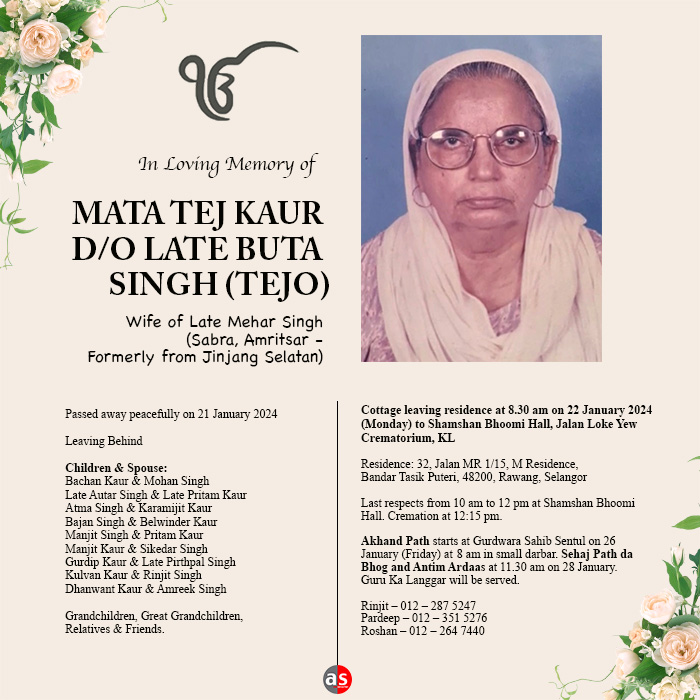
Grandchildren, Great Grandchildren, Relatives & Friends.
Cottage leaving residence at 8.30 am on 22 January 2024 (Monday) to Shamshan Bhoomi Hall, Jalan Loke Yew Crematorium, KL
Residence: 32, Jalan MR 1/15, M Residence, Bandar Tasik Puteri, 48200, Rawang, Selangor
Last respects from 10 am to 12 pm at Shamshan Bhoomi Hall. Cremation at 12:15 pm.
Akhand Path starts at Gurdwara Sahib Sentul on 26 January (Friday) at 8 am in small darbar. Sehaj Path da Bhog and Antim Ardaas at 11.30 am on 28 January. Guru Ka Langgar will be served.
ASIA SAMACHAR is an online newspaper for Sikhs / Punjabis in Southeast Asia and beyond. You can leave your comments at our website, Facebook, Twitter, and Instagram. We will delete comments we deem offensive or potentially libelous. You can reach us via WhatsApp +6017-335-1399 or email: asia.samachar@gmail.com. For obituary announcements, click here
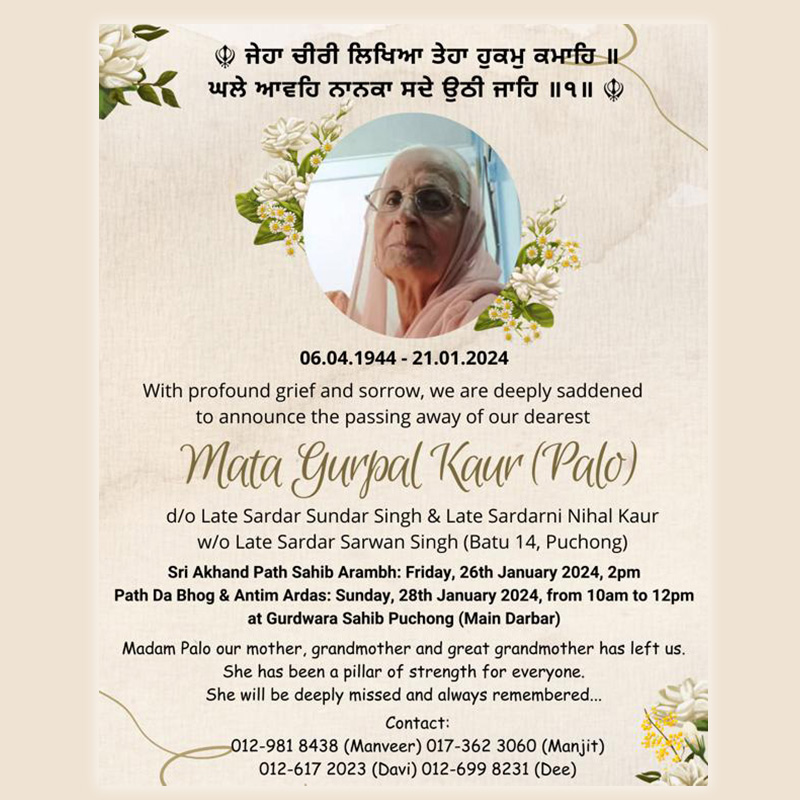
With profound grief and sorrow, we are deeply saddened to announce the passing away of our dearest
MATA GURPAL KAUR (PALO)
d/o Late Sardar Sundar Singh & Late Sardarni Nihal Kaur
w/o Late Sardar Sarwan Singh (Batu 14, Puchong)
6-4-1944 – 21-1-2024
AKHAND PATH: 26 – 28 January 2024
Akhand Path starts at 2pm, Friday, 26 January at Gurdwara Sahib Puchong
PATH DA BHOG
Path da Bhog & Antim Ardaas on Sunday, 28 January, from 10am to 12pm, Gurdwara Sahib Puchong (Main Darbar)
Madam Palo, our mother, grandmother and great grandmother, has left us. She has been a pillar of strength for everyone. She will deeply missed and always remembered.
| Entry: 21 Jan 2024; Updated: 25 Jan 2024 | Source: Family
ASIA SAMACHAR is an online newspaper for Sikhs / Punjabis in Southeast Asia and beyond. You can leave your comments at our website, Facebook, Twitter, and Instagram. We will delete comments we deem offensive or potentially libelous. You can reach us via WhatsApp +6017-335-1399 or email: asia.samachar@gmail.com. For obituary announcements, click here
Ram Janmabhoomi Temple, Ayodhya to be inaugurated on Jan 22, 2024 – Photo: Shri Ram Janmbhoomi Teerth Kshetra
By Devinder Singh Chahal | Opinion |
INTRODUCTION
As the date of the inauguration of Ram Bhumi Mandir is drawing near (January 22, 2024), the Sikhs are confused about their position to celebrate this function with Hindu brothers because RAM appears about 2,230 times in the Aad Guru Granth Sahib (AGGS). Who is this Ram who appears in the AGGS, and who is that Ram whose Mandir is going to be inaugurated on Jan 22, 2024?
DISCUSSION
Sr. Gurinder Singh at Kotkapura reported in Rozana Spokesman that Giani Jagtar Singh Jachak, past Granthi of Darbar Sahib, Amritsar, and international parcharak (preacher), says that there was a news in Hindi newspapers from the Gurdwara of Model Town, Bareilly, UP. It says that the committee has announced that all the Gurdwaras will sing the praise of Ram on the inauguration of Ram Janmabhoomi Temple, Ayodhya, on Jan 22, 2024, at 12:30 PM IST. In this committee, the preacher of RSS, Dhamudar Bharati, and another member, Praveen Arora, were present.
Giani Jachak says that it is a very serious matter, and it is against the Gurmat because the Ram in the Aad Guru Granth Sahib (AGGS) is not the Ram son of Dashrath of Ayodhya.
Jachak quoted the Ram of Ayodhya in the AGGS as follows:
ਰਾਮੁਝੁਰੈਦਲਮੇਲਵੈਅੰਤਰਿਬਲੁਅਧਿਕਾਰ॥
Rām jẖurai ḏal melvai anṯar bal aḏẖikār.
Ram, sad at heart, assembled an army force under his control.
And
ਮਨਮਹਿਝੂਰੈਰਾਮਚੰਦੁਸੀਤਾਲਛਮਣਜੋਗੁ॥
Man mėh jẖūrai rāmcẖanḏ sīṯā lacẖẖmaṇ jog.
Ram Chand was worried about the abduction of Sita and about the injured Lachhman in his mind.
AGGS, M 1, p 1412.
The above quote is about an episode in Ram’s life when his wife was abducted by Ravana.
Is this Ram, an incarnation of Vishnu, of Treta Yuga, or somebody else?
Jachak further reported the Ram of AGGS is different from that discussed above because this Ram pervades everywhere as follows:
ਰਮਤ1ਰਾਮੁਸਭਰਹਿਓਸਮਾਇ2॥੧॥
Ramṯ rām sabẖ rahi▫o samā▫e. ||1||
Ram is pervading1,2 everywhere.
AGGS, M 5, p 865.
And
ਰਮਤਰਾਮਘਟਘਟਆਧਾਰ॥
Ramṯ rām gẖat gẖat āḏẖār.
The all-pervading Ram is the support of every and each heart.
Is this Ram an incarnation of Vishnu, Treta Yuga, or some super god that is mentioned in the AGGS?
However, this sabd starts with Vishnu and Narasingha and includes Vasdev (Krishna) as follows:
ਨਾਰਾਇਣਨਰਹਰਦਇਆਲ॥
Nārā▫iṇ narhar ḏa▫i▫āl.
Vishnu and Narasingha are merciful.
ਬਾਸੁਦੇਵਬਸਤਸਭਠਾਇ॥
Bāsuḏev basaṯ sabẖ ṯẖā▫e.
Krishna dwells everywhere.
ਲੀਲਾਕਿਛੁਲਖੀਨਜਾਇ॥੪॥
Līlā kicẖẖ lakẖī na jā▫e. ||4||
It is not possible to describe his play. 4.
AGGS, M 5, p 897.
(Note: I have added transliteration and English translation for better understanding by the readers.)
Now, a question is:
In the above verse, Vishnu, Narasingha, and Vasdev (Krishna) also dwell everywhere. Is their position the same as that of Ram in the AGGS?
Bhagat Namdev (1270 – 1350)says that Ram speaks in everybody:
ਸਭੈਘਟਰਾਮੁਬੋਲੈਰਾਮਾਬੋਲੈ॥
Sabẖai gẖat rām bolai rāmā bolai.
Ram speaks in everybody. It is Ram who speaks.
ਰਾਮਬਿਨਾਕੋਬੋਲੈਰੇ॥੧॥ਰਹਾਉ॥
Rām binā ko bolai re. ||1|| rahā▫o.
Nobody else other than Ram speaks,
AGGS, Namdev, p 988.
It is evident that Ram was used by Bhagat Namdev about 200 years before Guru Nanak.
Bhagat Kabir (1440-1518), a contemporary of Guru Nanak, has used Ram 219 times in his bani. He says that there is no salvation without the help of Ram:
ਕਹੁਕਬੀਰਸੁਨਹੁਨਰਭਾਈ॥
Kaho Kabīr sunhu nar bẖā▫ī.
ਰਾਮ ਨਾਮ ਬਿਨੁ ਕਿਨਿ ਗਤਿ ਪਾਈ ॥੪॥੪॥
Rām nām bin kin gaṯ pā▫ī. ||4||4||
Kabir says: Oh, Brothers! Nobody has ever found salvation without reciting Ram, Ram… 4.4.
AGGS, Kabir, p 324.
The Ram has been used by Bhagats since long before it was picked up by the Sikh Gurus and entered in the AGGS. Now the question is:
Do the Sikh Gurus use the same Ram that Bhagat Namdev used 200 years ago?
Sr. KBS Sidhu, in his The KBS Chronicle dated Jan 14, 2023, writes about the use of Ram by Guru Teg Bahadur in connection with the inauguration of Ram Bhumi Mandir on Jan 22, 2024, as follows:
ਸੋਰਠਿ ਮਹਲਾ ੯
Soraṯẖ mėhlā 9 Sorat’h, Ninth Mehl:
ੴ ਸਤਿਗੁਰ ਪ੍ਰਸਾਦਿ ॥
Ikoaʼnkār saṯgur parsāḏ.
One Universal Creator God. By The Grace of the True Guru:
Sarvan gobinḏ gun suno ar gāo rasnā gīṯ. ||1|| rahāo.
With your ears, hear the Glorious Praises of the Lord of the Universe, and with your tongue, sing His song. ||1||Pause||
ਕਰਿ ਸਾਧਸੰਗਤਿ ਸਿਮਰੁ ਮਾਧੋ ਹੋਹਿ ਪਤਿਤ ਪੁਨੀਤ ॥
Kar sāḏẖsangaṯ simar māḏẖo hohi paṯiṯ punīṯ.
Join the Saadh Sangat, the Company of the Holy, and meditate in remembrance on the Lord; even a sinner like yourself will become pure.
ਕਾਲੁ ਬਿਆਲੁ ਜਿਉ ਪਰਿਓ ਡੋਲੈ ਮੁਖੁ ਪਸਾਰੇ ਮੀਤ ॥੧॥
Kāl biāl jio pario dolai mukẖ pasāre mīṯ. ||1||
Death is on the prowl, with its mouth wide open, friend. ||1||
ਆਜੁ ਕਾਲਿ ਫੁਨਿ ਤੋਹਿ ਗ੍ਰਸਿ ਹੈ ਸਮਝਿ ਰਾਖਉ ਚੀਤਿ ॥
Āj kāl fun ṯohi garas hai samajẖ rākẖao cẖīṯ.
Today or tomorrow, eventually it will seize you; understand this in your consciousness.
ਕਹੈ ਨਾਨਕੁ ਰਾਮੁ ਭਜਿ ਲੈ ਜਾਤੁ ਅਉਸਰੁ ਬੀਤ ॥੨॥੧॥
Kahai Nānak rām bẖaj lai jāṯ aosar bīṯ. ||2||1||
Says Nanak, meditate, and vibrate upon the Lord; this opportunity is slipping away! ||2||1||
AGGS, M 9, p 631.
The main theme is that Guru Teg Bahadur recommends remembering Ram along with Gobind (Krishna) and Madhoo (Vishnu).
I may add here that Ram and Krishna are the incarnations of Vishnu during the Treta and the Dwapar Yugas, respectively, as follows:
Vedic Periods and Their Avatars
According to Parthasarathy, 2021, Vedic Periods are as follows: (2)
1. Satya Yuga or Krita Yuga: 1,728,000 solar years
2. Treta Yuga: 1,296,000 solar years
3. Dwapar Yuga: 864,000 solar years
4. Kali Yuga: 432,000 solar years
(In the ratio of 4:3:2:1)
Total of One Cycle (Maha Yuga) 4,320,000 solar years
Kali Yuga started in 3102 BCE, i.e., 3,102 + 2,023 = 5,125 years ago.
Therefore, Setambar appeared in Satya Yuga: Age of Satya Yuga + Age of Treta Yuga + Age of Dwapar Yuga + Age of KaliYuga: 1,728,000 + 1,296,000 + 864,000 + 5,125 = 3,893,125 years ago.
Ram appeared in Treta Yuga: Age of Treta Yuga + Age of Dwapar + Age of Kali Yuga: 1,296,000 + 864,000 + 5,125 = 2,165,125 years ago
Krishna appeared in Dwapar Yuga: Age of Dwapar Yuga + Age of Kali Yuga: 864,000 + 5,125 = 869,125 years ago.
Now the question is:
If Ram existed on this Earth during the Treta Yuga about 2,165,125 years ago, when there were no humans. Because Homo sapiens (Wise man) appeared about 200,000 years ago in Africa.
Homo sapiens sapiens(Wiser man) appeared about 160,000 years ago in Africa and they moved to Europe and other worlds (India) around 60,000 and 30,000 years ago. (3)
Major religions of the world appeared as follows:
Hinduism: Most scholars believe Hinduism started somewhere between 2,300 B.C. and 1,500 B.C. (3,523 and 4,523 years ago) in the Indus Valley, near modern-day Pakistan. (1) Judaism appeared more than 3,500 years ago. Buddha appeared in 600 BCE, about 2,623 years ago. Jainism appeared between 700 and 500 BCE, about 2,723 – 2,523 years ago. Mohammad appeared in 570 CE, about 1,453 years ago. Guru Nanak appeared in 1469 CE, i.e., 2023-1469 = 554 years ago.
If Hinduism appeared about 4,523 years ago, but the Ram of Treta Yuga, an incarnation of Vishnu, existed on this Earth 2,165,124 years ago when there were no humans, then who is the Ram mentioned in Hinduism and in the AGGS?
CONCLUSIONS
The above study indicates that a Ram lived on this Earth 2,165,124 years ago during the Treta Yuga for 1,296,000 solar years when there were no humans.
Then there is a Ram whose wife was abducted by Ravana, as mentioned by Preacher Jachak in the AGGS.
Besides, a Ram is pervading everywhere, as mentioned in the AGGS.
Moreover, Ram has been used by Bhagat Namdev about 200 years before Guru Nanak.
Similarly, Bhagat Kabir, a contemporary of Guru Nanak, has used Ram 219 times in his bani. Kabir says that nobody can get salvation without Ram.
Nevertheless, it appears from the above study that Ram, whether of Ayodhya, of Treta Yuga, or somebody else, is an important figure in the minds of the Hindus and the Sikhs.
Parthasarathy, R. (2021). The Time Scale and Yuga System in Puranas. .indica.today/research/time-scales-yuga-puranas/
Pontzer, H. (2012). Overview of Hominin Evolution. https:// www.nature.com/scitable/knowledge/library/ overview-of-hominin-evolution-89010983/
Devinder Singh Chahal, PhD, a retired Professor of Microbiology, is the president of the Canada-based Institute for Understanding Sikhism. Relying on his long life as a Sikh, his training as a scientist and his love of the Guru, Prof Chahal has dedicated an enormous amount of energy trying to reform Sikhi by demonstrating the incorrect interpretations of the Aad Granth. Click here for his work. His most recent book is NANAK and His Philosophy.
ASIA SAMACHAR is an online newspaper for Sikhs / Punjabis in Southeast Asia and beyond. You can leave your comments at our website, Facebook, Twitter, and Instagram. We will delete comments we deem offensive or potentially libelous. You can reach us via WhatsApp +6017-335-1399 or email: asia.samachar@gmail.com. For obituary announcements, click here
The momentous onwards journey of Guru Gobind Singh on 23rd December 1705 marked a pivotal era in the fulfillment of the divine mission initiated by Guru Nanak under the guidance of the Almighty. The journey began from the Mud Fort of Chamkaur, that stirred up Wazir Khan, headquartered in Sirhind approximately 37 kilometers away via Morinda, Punjab (a town within the ancient civilization of Mohenjo-daro and Harappa, which was considered a matured township at around 2600 BC along the Indus River valley in Punjab and Sindh). Wazir Khan had Guru’s two youngest children and their mother, Mata Guzari (the wife of Guru Teg Bahadur Ji, the 9th Guru of the Sikhs), captive, still alive, during this stormy sporadic period.
Wazir Khan, failing to captivate Guruji, in frustration, spared no effort in subjecting the two young children to torture, employing various methods to coerce and pressurize them into embracing Islam and renouncing their father’s faith. This ruthless strategy was intended to undermine the Guru’s mission and diminish his influence. Despite the grave threat to their lives, these resilient children steadfastly adhered to their faith.
Regrettably, on December 26, 1705, just two days following Guru Ji’s successful onward journey, they faced a tragic end, as Wazir Khan executed them by having them bricked. Presently, a district and a historical Gurdwara commemorate the memory of these two sons of Guru Ji in Sirhind, known as Fatehgarh Sahib.
In Chamkaur Sahib, amongst heavy guards by the Moguls surrounding their hideouts, Bhai Daya Singh, Bhai Dharam Singh and Bhai Man Singh collectively decided to meet to gather with Guru Ji on the outskirts of Machhiwara, 27 kilometers away. Guru Ji accepted their request and set to get out on foot first by midnight. By sunrise, he made a brief stop at Jhar Sahib (ਝਾੜ ਸਾਹਿਬ) 12 kms away, a village dominated by Muslims. In this village, two Gujars (Gurjar are Indo-Aryan agricultural ethnic community, residing mainly in India, Pakistan and Afghanista,), named Ramzu and Kalu recognized the Guru and, disregarding his request for being discreet about his presence, they alerted the neighborhood. Despite Guru Ji offering them some of his leftover gold coins to keep silent, they appeared to be informers for the Mughals and continued their actions. Forced to take decisive measures, Guru Ji dealt with the situation and moved on.
Upon reaching Machhiwara, Guru Ji found a garden on the outskirts of the village. Here he had arrived an hour before sunrise. Weary and completely exhausted, he entered the garden, where he eventually settled in a corner among the bushes, resting his head on a raised mud soil. It is here he is said to have composed a couplet in communication with the Almighty…
Mittar Pyare Nu, Haal Mureedan Da Kehna
ਮਿੱਤਰ ਪਿਆਰੇ ਨੂੰ ਹਾਲ ਮੁਰੀਦਾ ਦਾ ਕਹਿਣਾ ॥
Oh dear beloved Master, please convey and express the situation of This follower to the Almighty.
**Guru Ji refers to his situation at this point in time that his abode was resembling furnaces due to the chilly weather in December. He found himself without blankets, clad in torn clothes, having lost his belongings in the River Sarsa. Lacking pitchers of water, cup and saucer, he resorted to eating berries to satisfy his hunger. Being exhausted, mentally, physically and emotionally he slept under the bushes in the garden.
At the break of dawn, his three Sikhs found him in a deep slumber. Gulaba (Gulab Khan) and Nabi Khan, residents of Machhiwara village, generously provided them refuge in their home, where all four sought sanctuary. It was here that Guru Ji had to adopt a disguise as suggested by these Muslim hosts, who shared a close association with Guru Ji and had engaged in significant business dealings with him in the past at Anandpur Sahib. They convinced Guru Ji to wear a blue robe, let his hair down, and bestowed upon him the name “Uch Da Pir,” associating him with a revered saint from the town of Uch, a holy place of Muslims, now located in Pakistan where all the five rivers of Punjab (Ravi, Chenab, Jhelum, Beas and Satluj) meets forming one river called River Panjnad. Guru Ji was made to sit on a cot or a bunk carried by 4 people as was the tradition of how the Muslim saints were carried in a journey with extreme reverence.
While on the journey at the village of Lal, an imperial troop contingent halted them. The Guru communicated with them in Persian, but they demanded further verification. A Qazi Pir Muhammad from Salon village was summoned and he identified the Guru, vouched for him as a Muslim saint. Guru Ji was released, and they arrived at Alamgir, continuing on to Hehar Village in Ludhiana District. (Side-track: In this village, Prithi Chand, the eldest son of Guru Ramdas Ji (our 4th Guru), purchased a considerable amount of land. He declared himself as the Guru, attempted to kill his brother who later became our 5th Guru, Guru Arjan Dev Ji, and distorted the writings of the previous Gurus. Numerous upper-class Hindus, who opposed the Guru’s concept of caste equality, which was gaining social acceptance then, sided with Prithi Chand, expressing their discontent. Later Prithi moved to Lakhnow, in Uttar Pradesh)
From here, Ghani Khan and Nabi Khan departed from the Guru’s company, leaving him in the care of their close associate, Rae Kalha, a prominent Muslim landlord. Kalha warmly welcomed the Guru and housed him in Jatpura, close to his main residence, to safeguard his identity. Responding to the Guru’s request, Kalha dispatched a messenger to Sarhind, located approximately 70 kilometers away, to gather information about the Guru’s family members.
While in hiding and anxiously awaiting news about his younger sons and mother, Guru Ji, a saint solder supreme, a master of pen and sword found it difficult to remain passive. He composed a letter known as Fatah Nama to Emperor Aurangzeb, outlining the challenging circumstances imposed upon him and expressing the severe hardships he endured. In the letter, Guru Ji depicted the unjust situation where the emperor’s vast and well-equipped army confronted a mere forty Sikhs, resulting in the sacrifice of his two eldest sons in their defense.
Kalha’s messenger returned bearing the somber tale of Guru Ji’s younger son and mother, recounting the involvement of Nawab Sher Muhammad Khan of Malerkotia. The Nawab had previously engaged in battles against the Guru at Sarsa and Chamkaur, leading to the loss of one of his brothers and a nephew in the conflicts. Despite the Nawab’s strong opposition to the Guru, the young age of the children, their fearlessness, and their exceptional moral courage deeply resonated with him. When Wazir Khan instructed Sher Muhammad to take custody of the boys and eliminate them, he refused to comply. This act touched the tender chords of the Guru’s heart. At this location, Guru Ji bestowed his blessings upon the Muslim villagers of Malerkotla, assuring them that they would never face displacement during calamities or contentious wars. Hence this is the only Intact Muslim Village in Punjab (on the India side of the border post-partition) till this date. Guru Ji could no longer live in this hiding and he decided to move towards the south west, heading towards Bhatinda in Punjab and took up his abode at Dina, about 60 Kms from Bhatinda.
At Dina, the Guru composed another letter, Zafar Nama to Aurangzeb in Persian poetry. This letter adopts a more resolute tone and comprises 111 couplets, the Zafar Nama is said to contain 1,400 stanzas. The Zafar Nama is divided into three distinct parts. The initial part, consisting of 12 couplets, serves as an invocation to God, seeking resolution to the Guru’s challenges. The second part encompasses 66 verses, from 13 to 78, where the Guru begins by condemning the Emperor for his shortcomings as a ruler, his communalism, and his breach of faith, including treachery despite swearing on the Quran. In the third part, the Guru commends Aurangzeb for certain positive qualities in his character.
Bhai Daya Singh and Bhai Dharam Singh, two of Guru Ji’s three companions from Chamkaur, were given the task of delivering this letter to Aurangzeb. They cleverly disguised themselves as Muslim travelers and handed it to the Emperor in Ahmadnagar, Deccan, in Gujerat, where he had his palaces since January 20, 1706.
This letter shook-up Emperor Aurangzeb and in utmost humiliation he started longing to seek Guru ji’s audience by inviting Guru Ji to his Deccan headquarters. He began to recognise Guru Ji as Darvesh (Godly Saint), but Guru Ji turned down his request in distrust.
Aurangzeb encountered similar fierce resistance from the Marathas of Maharashtra, a neighboring state of Gujarat. In this region, along with Hyderabad, many Hindus were forcefully converted by the Mughals. The key distinction between the Marathas and the Sikhs lies in the fact that the former fought a war to defend their kingdom from Mughal invasions, while the Sikh Gurus waged a defensive war to safeguard Hindus from widespread, coerced, and horrifying conversions to Islam by the Mughal powers, without being confined to any specific kingdom or territory. The Gurus were protecting Hindustan from tyranny and mass conversion of the Hindus. It can be asserted that the Sikh Gurus were the true and earliest freedom fighters of Hindustan. Regrettably, Sikh Gurus’ struggle are not acknowledged in Indian history books, though they fought wars with various sufferings and that they were not confined to any specific boundaries across the nation. They fought defensive wars safeguarding humanity, their rights and freedom to live in dignity.
The Guru stayed briefly in Dina, where the people of Punjab were greatly troubled by his losses and the Mughals’ success. Guru Gobind Singh found himself nearly isolated during this time, with only one Sikh, Dalla, accompanying him. It was in Dina that he learned about Wazir Khan of Sarhind actively gathering an army again and sending scouts to locate, wage another war to captivate Guru ji. Upon receiving this news, Dalla also left. Guru Ji, in response, sent Bhai Man Singh, one of Guru Ji’s three companions from Chamkaur, to the nearby villages to call upon the Sikhs to meet and join Guru Ji.
Subsequently, Guru Ji relocated to the dense Lekhi Jungles, covering an area of about 200 square kilometers, seeking refuge from both the Mughals and the Durrani Empire under the Afghanistan Muslim Empire. Both had similar objectives of forced conversion. It is noteworthy that the Muslim population in Bengal, and now in Bangladesh, traces its roots to the invaders from Afghanistan who preceded the Mughals in the invasion of Hindustan with one of the objectives towards Islamization of the region.
Lekhi forest was also reputed for breeding fine horses. Guru Ji acquired many horses as that was the means of travel and warfare. While it is commonly stated that Guru Ji ventured into the jungle for hunting, it’s crucial to note that such an act contradicts the principles and teachings of the Gurus from the past. Guru Gobind Singh would not have engaged in any form of killing. Instead, his visits to the jungle were focused on honing his archery skills and perfecting precision in the safe use of his bow and arrow on the trees of the jungles.
In this Jungle, Guru Ji adopted a disguise by wearing the blue Haji robe, resembling that of a Muslim. He rallied many Sikhs from the Brar clan to join him, preparing them for protection against an anticipated attack planned by Wazir Khan of Sirhind. Guru Ji proceeded towards the arid regions of the jungle adjacent to the Tar Desert, reaching a village named Khidrana. This is the location where another battle (Battle of Khidrana) unfolded with the Mughals, resulting in a resounding defeat for the Mughal forces. Guru Ji and his fellow Sikhs effectively utilized their mastered bow skills to intimidate and repel the enemy.
Also, around this location, at the Dhilwan Village, Guru Ji encountered the descendant of Prithi Chand, Guru Arjan’s eldest brother, who had eagerly awaited the Guru. Witnessing the Guru dressed in the blue attire of a Muslim Haji deeply moved him. In response to his request, Guru Ji changed his clothing to white and tore his blue robe into pieces to burn. One of these pieces happened to fly into the hands of Bhai Man Singh. Showing reverence, he promptly tied the fragment on his head, and in appreciation, Guru Ji referred to him as Nihang Singh. Subsequently, the Nihang Sikhs adopted this practice, marking the inception of the tradition that continues today, where Nihangs often adorn the blue robe with weapon decorations.
It was at Khidrana that Guru Ji encountered Mahi Bhago, often referred to as the iron lady in Sikh history. She wore men’s dress, ever ready to defend. Mahi Bhago, from a village Chubhal near Amritsar, was the wife of one of the 40 Sikhs who deserted Guru Ji in Anandpur Sahib years ago, who returned home out of fear for their lives. Revered as a Saint Soldier, Mahi Bhago played a pivotal role in inspiring these deserters to come to Guru Ji’s aid at Khidrana, where they confronted the Mughals and fought valiantly. Guru Ji later joined them, and after the Mughals retreated, he met with Mahi Bhago, who recounted how she motivated the 40 deserters to defend Guru Ji. Mahi Bhago continued to follow Guru Ji and lived with him until his demise in Nanded.
In a gesture of magnanimity, Guru Ji pardoned the 40 Sikhs who had laid down their lives in the battle of Khidrana, which marked Guru Ji’s final encounter with the Mughals. To this day, the bravery of these 40 Sikhs, known as Chali Mukhte, is acknowledged in the Sikh daily supplication (Ardas). A Gurdwara stands at this spot called Tutti Ganddi in a town bearing the name given to these Chali Mukhte known as Mukhatsar near Firozpur.
Guru Ji resided at Khidrana until October 1705. Seeking proximity to Sarhind for timely information about any impending expeditions against him from Wazir Khan, and yet desiring to be in a sandy region for a convenient escape, he traveled to Bhatinda, 145 kilometers east. From there, he ventured another 45 kilometers to the east, reaching Talwandi Sabo in early January 1706, where numerous Sikhs joined him. At this location, the Guru constructed a residence with a spacious compound enclosed by a robust wall, naming it Damdama, signifying a fortified mound. Consequently, the village also became known as Damdama Sahib.
In the earlier years, Guru Gobind Singh had the Adi Granth transcribed at Bhaura Sahib in Anandpur. Unfortunately, this particular copy was lost in the war while crossing the Sarsa River . Bhai Mani Singh, akin to Bhai Gurdas in scholarly pursuits, was chosen for his erudition. Given that Guru Gobind Singh had memorized the Adi Granth, he dictated it to Bhai Mani Singh. In the process, Guru Gobind Singh incorporated several hymns of Guru Tegh Bahadur and just one verse of his own. These additions are well organized in the Adi Granth based on their respective tunes and meters. Subsequently, three additional copies of the holy Granth were produced at Damdama Sahib, with one each residing at Akal Bunga in Amritsar, Patna sahib, Anandpur sahib, and Damdama Sahib itself. The original Adi Granth traveled with Guru ji till Nanded.
Residing at Damdama Sahib for nearly 10 months, Guru Ji and his fellow Sikhs made the decision to journey towards Delhi. En route, at Baghaur in Rajasthan, Bhai Daya Singh and Bhai Dharam Singh, who were dispatched to deliver the ZafarNama to Emperor Aurangzeb, met the Guru. The news of the emperor’s keenness to meet Guru Ji was communicated. However, shortly thereafter, Aurangzeb passed away on February 20, 1707, in Ahmadnagar at the age of
TO BE CONTINUED: Guru Ji’s Journey to Delhi and to Nanded…
Note: Aurangzeb was determined to establish an exclusively Islamic state in Hindustan, seeking to eradicate Hinduism entirely from the land of Hindustan. At that time, Guru Tegh Bahadur was in Assam. Upon learning of this development, he promptly headed to Punjab. To uplift the spirits of Hindus and his followers, he embarked on a series of tours in East Punjab, encouraging them to remain resilient.
Guru Gobind Singh asserted that any emperor attempting to control the minds of the people was a tyrant, and those who submitted meekly were merely slaves. In 1699, the Guru founded the Khalsa, an unpaid national army comprising his dedicated followers. This event marked the initiation of a new cadre of freedom fighters. Guided by the Guru, the Khalsa adopted the profession of arms, yielding remarkable results. The once-oppressed individuals, considered the lowest of the low, transformed into courageous warriors unafraid of peril.
Dr Balwant Singh Bains is a Malaysia-based kirtan enthusiast and a practicing physiotherapist with a chain of physiotherapy clinics.
ASIA SAMACHAR is an online newspaper for Sikhs / Punjabis in Southeast Asia and beyond. You can leave your comments at our website, Facebook, Twitter, and Instagram. We will delete comments we deem offensive or potentially libelous. You can reach us via WhatsApp +6017-335-1399 or email: asia.samachar@gmail.com. For obituary announcements, click here
We announce the peaceful passing of Sardar Charan Singh JPN, Ex PDRM (PPH/IPK) of Tapah, Perak, son of the Late Hajara Singh & the Late Ambar Kaur (Village of VeiPui, Amritsar), who left us on 21.1.2024 leaving behind:-
Spouse: Pritam Kaur d/o Late Gurcharan Singh & Late Jaswant Kaur
| Entry: 21 Jan 2024; Updated: 23 Jan 2024 | Source: Family
ASIA SAMACHAR is an online newspaper for Sikhs / Punjabis in Southeast Asia and beyond. You can leave your comments at our website, Facebook, Twitter, and Instagram. We will delete comments we deem offensive or potentially libelous. You can reach us via WhatsApp +6017-335-1399 or email: asia.samachar@gmail.com. For obituary announcements, click here
Grandchildren, Great Grandchildren, Relatives & Friends.
Last respect followed by saskaar / cremation on 21st January 2024 (Sunday) from 1.30pm to 3pm at Jalan Loke Yew Crematorium, Kuala Lumpur
Cortége leaves from home at 1pm
Path da Bhog will be held on Sunday, 28th January 2024, from 10am to 12pm at Gurdwara Kampung Pandan Settlement, KL
Contact:
016 – 2066 114 (Guddi)
016 – 3617313 ( Parveen)
| Entry: 20 Jan 2024 | Source: Family
ASIA SAMACHAR is an online newspaper for Sikhs / Punjabis in Southeast Asia and beyond. You can leave your comments at our website, Facebook, Twitter, and Instagram. We will delete comments we deem offensive or potentially libelous. You can reach us via WhatsApp +6017-335-1399 or email: asia.samachar@gmail.com. For obituary announcements, click here
I refer to ST’s Letter to the Editor “Baba Banta Singh in Malaysia – A missed opportunity” published in Asia Samachar on 17 January 2024; in which the writer laments that “Sikhs in Malaysia that have a different view on Nitnem Bania, Amrit Sanchar Baniaa, Simran and other Sikh practices” missed an opportunity for a dialogue with the preacher.
The lament assumes that Bhai Banta Singh is amenable to a dialogue, open to discussion, and willing and agreeable to an exchange of views – particularly with those who disagree with him.
The truth of this assumption needs to be put to the test.
In April 2022, while speaking at Lal Kila Smagam in Delhi, Banta Singh claimed that Guru Gobind Singh ji fought 14 wars against the Mughal Sultanate. The truth is that Guru Gobind Singh fought only 3 wars with the Mughal Sultanate including Chamkaur and Khidranna. Eleven wars were fought against the Hindu Hill Rajas.
The Delhi Gurdwara Sahib Management Committee (DGSMC) member Bibi Ranjit Kaur took Banta Singh to task and wrote on the social media asking Banta Singh to name his sources for the fake claim that Guru Gobind Singh fought 14 wars against the Mughal Sultanate. She ended her post with ਆਪ ਜੀ ਦੇ ਜੁਆਬ ਦੇ ਇੰਤਜਾਰ ਵਿਚ । Awaiting your response.
The Shromani Akali Dal Youth Wing Chief Jasmeet Singh Pritampura also called on Banta Singh to explain his distortion. He further called upon then Akal Takhat Jathedar Gyani Harpreet Singh to summon Banta Singh and ask for an explanation.
There is no record of Bhai Banta Singh making any attempt to engage Bibi Ranjit Kaur and Jasmeet Singh for a dialogue, discussion or debate. There is no record of him even responding to both these individuals who are not ordinary people who “have a different view” but Sikhs in positions of authority.
In November 2022, one of Banta Singh’s supporters named Gurpal Singh Hansra posted a notification of a scheduled one-day debate between Banta Singh and Sarabjit Singh Dhunda. Dhunda responded to say that even if he was not consulted or asked to take part in the debate by Hansra, he accepted the challenge saying he was prepared to debate Banta Singh for “as many days as necessary.” Dhunda wanted Hansra to confirm that Banta Singh would not “eventually run away” “ਬਾਬਾ ਬੰਤਾ ਸਿੰਘ ਅਖੀਰ ਤੇ ਭੱਜ ਨਾ ਜਾਵੇ।” This debate never happened because Banta Singh did eventually run away. Readers can get the details of so called challenge here: https://www.youtube.com/watch?v=Fi-G-FzE1so
The writer of the letter, ST, makes a number of claims about Bhai Banta Singh as follows: (i) He is regarded as one of the foremost and shiromani parcharaks. (ii) He is regarded as a great Sikh scholar and regularly does Katha at Manji Sahib, Amritsar. (iii) Baba Ji is also known to be a zealous defender of Sikh practices, belief system and literature.
The truth of these claims needs to be put to the test.
A “foremost and shiromani parcharak,”a “great scholar” and a “zealous defender of Sikh practices” can be excused for confusing the truth of 3 wars fought with Mughals with 14 wars. It could simply had been a “counting error” or a “slip of the tongue.”
If indeed it was a genuine error, Banta Singh could have corrected it subsequently and responded to DGSMC’s Bibi Ranjit Kaur and Shromani Akali Dal Youth Wing Chief Jasmeet Singh Pritampura. He did not.
The truth of the matter this is that Banta Singh’s “confusion of 3 battles with 14” was a deliberate distortion of Sikh History. The false claim was made within the framework of an agenda that is decided by his handlers and enablers.
His objective in distorting Sikh History is to exonerate the Hindu Hill Rajas from their crimes. Remember that the Hindu Hill Rajas invaded and attacked the Guru in 11 separate battles. Banta Singh wants to inject a distorted “fact” in the minds of Sikhs that the enmity of the tenth Guru was NOT with the Hindu Hill Rajas but with the Muslim Mughal Sultanate.
Such a distortion is in line with the dictates of RSS, BJP and the supporters of Hindutva who are trying to rewrite history to say that (i) Guru Gobind Singh (and other Gurus) were actually defenders of Hinduism and (ii) that the enmity of Sikhs is with Mughal Muslims and never with the Hindu Hill Rajas when the factual reality is different.
This is the reason why Banta Singh did not correct his distortion and did not respond to Bibi Ranjit Kaur and Jasmeet Singh Pritampura.
So much for Banta Singh being a “foremost and shiromani parcharak,” a “great scholar” and a “zealous defender of Sikh practices.” The truth of the matter is that the RSS is the handler and enabler of Banta Singh. RSS is his sponsor. RSS is his patron.
The Lal Kila Smagam where Banta Singh spoke was organized by the Indian Government in which Prime Minster Narenda Modi personally participated. Banta Singh was their “prime parcharak.” He performed par excellence in propogating the RSS agenda from this government enacted platform.
So there was no “missed opportunity with Banta Singh.” There never was any opportunity as has been proven by Banta Singh’s own conduct in the above mentioned latest two episodes. One cannot “miss” what does not exist in the first place.
Three other points within ST’s letter need comment. The first relates to his statement in para four of his letter as follows: “Guru Nanak Ji would have gone to meet these so call deviant people and had a discourse with them.” (Italics added).
If the intent is to declare “Sikhs in Malaysia that have a different view on Nitnem Bania, Amrit Sanchar Baniaa, Simran and other Sikh practices” to be deviant, then this amounts to shutting the door on the same dialogue and discussion that ST is calling a “missed opportunity.” Labelling and disparaging the other side and hoping for a dialogue with them is anti-thesis to any exchange of ideas.
If, however, the intent of ST Singh is that the Sidhs that Guru Nanak dialogued with were “deviant,” then I must call upon ST Singh to go read the dialogue in Sidh Goshat to see if Guru Nanak labelled and disparaged them as such. It would be beneath Guru Nanak’s character to have done any kind of labelling or judgement with parties he dialogued with.
Second, ST Singh writes in para four: “In his talks in Kampar, Baba Ji had made cursory reference to people who are these days questioning Sikhi, questioning Nitnem Baniaa, questioning Amrit Sanchar Baniaa and questioning some Sikh practices such Simran, etc.” This is indeed an accurate observation except that it is diplomatically put. Banta Singh hardly ever fails to label and disparage his critics with words such as “Nindaks.” This is his way of responding to those who disagree with him.
Finally, there is a world of difference between “questioning Sikhi, questioning Nitnem Baniaa, Amrit Sanchar Baniaa and questioning some Sikh practices such as Simran” and having questions about Sikhi, Nitnem Bania, Amrit Sanchar Bani and Sikh practices such as Simran.”
Banta Singh knows the difference. He knows that Sikhs across the world have questions regarding a host of issues. He knows that the questions are legitimate. He knows that if answered on the basis of Gurbani and Gurmat – his RSS agenda will be exposed. He thus has two options: (i) provide deviant answers that serve the agenda that is decided by his handlers and enablers, and/or (ii) paint the persons who raise questions as persons “questioning Sikhi”, as “Guru-Nindaks” or as “anti-Sikhs.”
Here are some legitimate questions that some Sikhs in Malaysia have on Sikhi, Nitnem Bania, Amrit Sanchar Bania and Simran (the issues pointed out by ST Singh).
Is Sikhi unique or is it part of the framework of Snatan, Vedic and Hindutva designs?
The Aad Sri Guru Granth Sahib (SGGS) has 1,429 pages and 5,000 plus shabds. When deciding on Nitnem Banis – why did we have to resort to 3 (out of 5) rachnas compositions from OUTSIDE the SGGS? Did we run out of banis from the SGGS?
Of the 5 banis that are read to turn the water into Khande de pahul – why are three from outside the SGGS? Those who take the pahul – are they being initiated into Khalsa of the SGGS? If so, then what is the need of recitations from OUTSIDE the SGGS?
Is the chanting of mantras the Simran of Sikhi? What does the SGGS say about the practice of Simran in Sikhi?
There are different answers these questions that will create different levels of satisfaction or dissatisfaction amongst those asking them. It would be one thing to say (to questions 2 and 3) that this is decided in the Sikh Reht Maryada (SRM) – a decision of the panth. It would be another to say the panth needs to re-look issues 2 and 3. It would yet be another to say that something is not right with the panthik decisions – they don’t appear to have been made in accordance with the SGGS. Yet, all the responses would be legitimate. That is because at the end of the day – all the questions are legitimate. They are legitimate concerns of Sikhs.
But to say that these questions are “questioning Sikhi”, or that they are raised by “Nindaks” or by “anti-Sikhs” etc. is the nonsense of those who either lack the capacity to answer such questions or have specific agendas to promote – the RSS agenda in particular.
Banta Singh has the capacity to answer them, but only in accordance with the RSS agenda. He is out to prove that Sikhs are part of the Snatan-Vedic tree. And those who disagree with his agenda are “Nindaks who are questioning Sikhi.”
So there really was no “missed opportunity to dialogue with Banta Singh” to begin with.
ASIA SAMACHAR is an online newspaper for Sikhs / Punjabis in Southeast Asia and beyond. You can leave your comments at our website, Facebook, Twitter, and Instagram. We will delete comments we deem offensive or potentially libelous. You can reach us via WhatsApp +6017-335-1399 or email: asia.samachar@gmail.com. For obituary announcements, click here
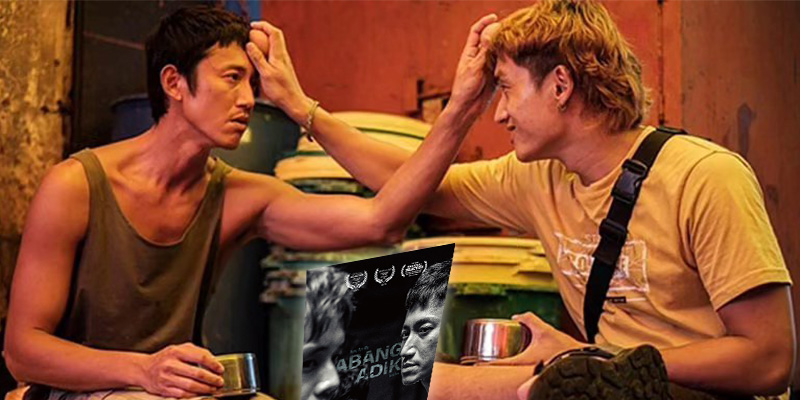
Malaysian film Abang Adik featured in Cantonese, Mandarin, Malay and sign language; makes waves globally, signifying international audience’s resonance to its profound storyline and universal message.
It gained attention and awards at various International Film Festivals in 2023 which include New York Asian Film Festival, Udine Far East Film Festival in Italy, Fribourg International Film Festival in Switzerland, Okinawa Pan Pacific International Film Festival in Japan and China’s Golden Rooster International Film Festival.
The movie has been a box office success in both Malaysia and Taiwan. Wu Kang Jen, a Taiwanese actor, portrayed a deaf and mute orphan who protects, loves and cares for his rebellious and reactionary young brother. He won the Best Leading Actor at Taiwan’s Golden Horse Awards in Nov 2023.
A Tale of Two Brothers
Jin Ong, the 48-year-old Taiping-born film producer and director, is no stranger to the film industry, having produced several films since 2014.
This is a story of two undocumented orphans who found each other, during their most trying times. A tale about brotherly bond, so vast and encompassing.
Even though they are together and share deep love, but individually they are searching for meaning to fill the void and loneliness inside. The absence of their parents, both physically and emotionally were their major setback in life. They only had each other.
Set in the heart of Kuala Lumpur, we are taken to their basic dwelling and vocation in the hustle and bustle of Pudu wet market and its old-town surroundings. The choice of title in Malay, sparks a heartwarming feel, as a Malaysian and gives a good branding to a – Made in Malaysia product.
From Escapism to Realism
Abang Adik is a brilliant composition of issues faced by certain segments of our society, portrayed in a raw form. It does not white wash the truth of their trials and tribulations. A timely piece, moving away from the occasional-stereotype escapism theme to addressing hard reality. This movie has transcended to become a platform of awareness and discussion on the challenges, which are universally felt. It is not just their story, but ours too.
In Jin Ong’s words – “Movies are a powerful medium to deliver messages to a wider audience”.
The takeaway from the movie is impactful. It reflects the powerful and healing role of cinematography to capture and project the distressing hardships that communities face, often not talked about and swept under the carpet, for the audience to reflect and act upon. So, we can share and know that we are not alone. So, we learn to accept and come to terms with our situation. So, we can bring light onto our struggles.
Powerful Narrative
The narrative probes on a couple of issues:
The challenges encountered by stateless individuals in securing a Malaysian identity card
The constant fear and uncertainty they live in, with a strong instinct to survive
The often-unrecognised role of social workers in fighting their cause and bridging the road to freedom, for the society
All communities have demographics of affluent and successful groups and those afflicted by social issues and trials, in this case focusing on those from poverty-stricken and crime-ridden environments. But often, we choose not to see the latter and pick on the glorified group’s well being
Abang’s deafness and absence of family ties, captures the essence of human resilience against universal obstacles
The silence surrounding the main character’s life, which is a metaphor for those marginalized by the administrative system in place and discriminated by society. The ones without a voice.
The Impermanence of Life
Life is not perfect. How dangerous their lives are. Two persons denied of certain basic human rights are constantly running from the authorities and face the stigma and judgement that society casts on them.
The climax in the movie shows how things can go horribly wrong in an instant, and how life changes, in ways we don’t anticipate. The brutal accident crumbles the dynamics and balance of their relationship.
A Moving Musical Score
Jin Ong worked in the music industry before producing films, hence explaining for his appreciation and reflective use of music. The score supported and blended in, with the story and characters. The symmetry of violin and piano, together with the script for the two characters, touched us to the core.
The two have deep connection, though not blood related and go through the worst situations as brothers. During the party for their transgender friend’s birthday, Abang and Adik were dancing and we could see the chemistry, trust and bond between then … the unspoken connection.
When addressed by a monk in the cell during his final days, Abang asks how can one possibly have hope when the odds are against him? He asks why was he even born to this world? A stateless person who is deaf and mute, living outside the society and in constant fear and uncertainty …what is there for him? This scene was played so well that we felt the emotional intensity of his predicament.
From Punitive to Rehabilitative Measures
Abang requested for boiled eggs as his last meal – to rekindle the childhood tradition and bond with Adik … for the last time. The silence between them was deafening. It spoke volumes and moved tears.
Who are we to judge and impose punitive charges? It is very sad to hear, especially of young people with potential to repent and reset, to not be given a second chance in life.
The time has come for law enforcers to evaluate and consider rehabilitative and restorative measures instead of drastic, punitive ones to valid cases. The effect trickles down. It does not only cripple the physical life of the one charged, but his whole family suffers with him, as we witness Adik’s vulnerability and brokenness after the separation with Abang. Consider enforcing community service hours to help re-ignite and re-member the loving, kindness and compassion attributes, that was always there, in each of us.
The Light and Gift
Everyone is seeking an identity, whether it is Abang with his full state recognition wish; the transgender in claiming his right to live as he wishes; and Adik in wanting to be different or the so-called outlier in his family.
When interviewed, the director said that the focus of the movie was on Human Love – the force that kept the two alive. What a powerful a message! He projected that at the end of the tunnel, there is hope. Abang’s sacrifice paved the way for Adik’s awareness and provided him a new lease of life.
Adik found hope in the darkest time. And that was Abang’s best and final gift …that Adik will be ok, in his absence. And the fact that Adik had found closure with his dad, means that he will not be alone. Although life will never be the same again without Abang; Adik will move on, with purpose and meaning.
RELATED STORY:
(Asia Samachar, x 2023)
ASIA SAMACHAR is an online newspaper for Sikhs / Punjabis in Southeast Asia and beyond. You can leave your comments at our website, Facebook, Twitter, and Instagram. We will delete comments we deem offensive or potentially libelous. You can reach us via WhatsApp +6017-335-1399 or email: asia.samachar@gmail.com. For obituary announcements, click here
Passed away peacefully on Friday, 19th of January 2024
She will be dearly missed, lovingly remembered and forever cherished by all her siblings, children, spouses, fifteen grandchildren, four great grandsons and relatives:
Children / Spouses: Dr Rajinder Singh / Tang Kim Hong Sarjit Kaur / Harinder Singh Dr Jasbir Singh / Jagdish Kaur Chand Kaur / Avtar Singh Sujan Kaur / Late Amarjit Singh Jessy
You are welcome to pay your last respects on Saturday, 20.1.2024 from 12pm – 6pm at her residence at 37, Jalan Dinding Lim Garden, Ipoh
Cortege leaves at 12pm on Sunday, 21 January 2024 for cremation at Buntong Crematorium, Jalan Madras, 30100 Ipoh, Perak
Sahej Path Da Bhog will be held on Sunday, 28th January 2024 (10am to 12noon) at Gurdwara Sahib Railway Ipoh followed by Guru ka Langgar.
| Entry: 20 Jan 2024 | Source: Family
ASIA SAMACHAR is an online newspaper for Sikhs / Punjabis in Southeast Asia and beyond. You can leave your comments at our website, Facebook, Twitter, and Instagram. We will delete comments we deem offensive or potentially libelous. You can reach us via WhatsApp +6017-335-1399 or email: asia.samachar@gmail.com. For obituary announcements, click here