Sahej Path Da Bhog will be held on Saturday, 4th March 2023 at 9am at Gurdwara Sahib Butterworth, Jalan Todak, Seberang Jaya, Perai, Penang followed by Guru Ka Langgar.
Please treat this as a personal invitation from the family.
Goodbye to a great mother , grandmother and aunt .She lived a long and wonderful life and was loved by all who knew her. She will be dearly missed but will live on in our hearts forever.
| Entry: 22 Feb 2023; Updated: 26 Feb 2023 | Source: Family
ASIA SAMACHAR is an online newspaper for Sikhs / Punjabis in Southeast Asia and beyond. When you leave a comment at the bottom of this article, it takes time to appear as it is moderated by human being. Unless it is offensive or libelous, it should appear. You can also comment at Facebook, Twitter, and Instagram. You can reach us via WhatsApp +6017-335-1399 or email: asia.samachar@gmail.com. For obituary announcements, click here.
Sooraj kiran mile jal kaa jal hooaa raam || ਸੂਰਜ ਕਿਰਣਿ ਮਿਲੇ ਜਲ ਕਾ ਜਲੁ ਹੂਆ ਰਾਮ ॥ ਜੋਤੀ ਜੋਤਿ ਰਲੀ ਸੰਪੂਰਨੁ ਥੀਆ ਰਾਮ ॥ The rays of light merge with the sun, and water merges with water. Jothee joth ralee sa(n)pooran theeaa raam ||
One’s own light blends with the Eternal Light, and one becomes totally perfect. – Ang 846, Sri Guru Granth Sahib Ji
Gurbaani teaches us that physical demise of the body is inevitable, but it is certainly not the ultimate end. It is a pause, a rest, a cross-roads before the next journey begins. We all come together again and eventually we all become light again.
So with a heavy and broken heart, we inform you of the passing of my dearest Father, Mr Hari Singh A/L Manggal Singh
We ask that you keep his soul in your ardaas. Please continue to pray that his journey in to the Divine Light is a gentle and comfortable one. He deserves this because he was a truly bright and soothing light in our lives.
Akhad Path starts on 23 February 2023 (Thursday) at 9.00am until 25 February 2023 (Saturday) at Gurdwara Sahib Kajang. Path da Bhog will be at 9.00am followed by Kirtan and Smapti (closure) at 11.30am.
And he always will be.
On behalf of my dearest dad, I humbly ask of you for him:
Dayho sajan aseesariaa jio hovai saahib sio mehl. Friends, give me your blessings that | may merge with the One. – Kirtan Sohela
| Entry: 21 Feb 2023 | Source: Family
ASIA SAMACHAR is an online newspaper for Sikhs / Punjabis in Southeast Asia and beyond. When you leave a comment at the bottom of this article, it takes time to appear as it is moderated by human being. Unless it is offensive or libelous, it should appear. You can also comment at Facebook, Twitter, and Instagram. You can reach us via WhatsApp +6017-335-1399 or email: asia.samachar@gmail.com. For obituary announcements, click here.
Sarjit Kaur (2nd from left), Harminder Kaur (5th from left) and Harjap Kaur (6th from left) at the celebration on 10 Feb 2023 – Photo: Supplied
By Asia Samachar | Malaysia |
The celebration continues. The Sikh ladies of Johor Bahru gathered again on 10 February 2023, exactly 50 years to the date when they first informally formed a ladies’ movement.
Grandmothers, mothers, daughters and granddaughters came out in full force to mark the celebration of the forming of the Istri Satsang of Gurdwara Sahib Johor Bahru (GSJB) on 10 February 1973.
Sarjit Kaur and Harminder Kaur Rakmo, two of the five original founders of the movement, were present to add sparkle to the event. They had formed the Istri Satsang along with Satinder Kaur, Jito Kaur and Jaswant Kaur.
“We received encouragement from an active Mami Ji in Singapore to start regular Sukhmani Sahib prayers at our gurdwara in Johor Bahru. One thing led to another, and it has lasted 50 years now,” Sarjit, the oldest surviving founder member, told Asia Samachar. “Even now, I don’t miss doing Sukhmani Sahib da paath.”
How did it all start?
It goes back to an unfortunate event. Satinder lost her husband Major Daljit Singh in 1969 while they were living in Kuala Lumpur. Left with two young girls, she moved back to her parents’ home in Johor Bahru. Satinder and Sarjit used to travel to Singapore, where they learnt reading Gurbani.
Sarjit, 83, has Singapore connection, too. Born in Setapak, Kuala Lumpur, her family moved to Singapore in the early 1940s. Her father Lal Singh served as Gurdwara Khalsa Dharmak Sabha treasurer for 14 years.
“Satinder found it difficult to overcome the trauma of her husband’s passing away,” said Harjap Kaur from Johor Bahru said in a note shared with Asia Samachar. “Looking at her situation, her Singapore-based relative encouraged her to read the Sukhmani Sahib prayers.”
So began the Sukhmani prayer gathering in Johor Bahru in 1973. Sarjit and Satinder were joined by Harminder, Jito and Jaswant. Harminder took on the duty of reading the vaak (hukumnama) and Sarjit did the kirtan.
After completing the Sukhmani reading, they did kirtan and simran. More ladies began joining them in the programme on Tuesdays, from 2pm to 4pm. They came from 7th Mile. Others came by bus from Century Gardens and Ulu Tiram, and from further places like Pontian, located some 50km from Johor Bahru.
“Some took part in degh seva, some in langgar. They worked together,” she said.
GSJB Istri Satsang visit to Pusing gurdwara in 2012 – Photo: Supplied
Recalling the early days, Sarjit said: “It was simple back then, no pardaan (president), no seketar (secretary).” When the ladies conducted their programme, she said men were not allowed to join in the darbar sahib (prayer hall).
“In time to come, Harsharan Kaur started teaching the ladies Panjabi, increasing the number of ladies who could read the Sukhmani. Bibi Sati, daughter of Giani Ghali Ji, then began teaching the Santhiya (reading of the Guru Granth Sahib). Giani Ji was very supportive in educating the children,” said Harjap.
Sarjit noted that back then not many ladies could read or write Gurmukhi. So, this is a valuable contribution to advancement of the women in the society.
Over the years, the ladies movement have contributed in various ways, including monetarily. In 1991, Sarjit said the Istri Satsang donated RM41,000 to the gurdwara’s building fund.
“It was the funds we had saved over the years. We were strict as to how we spend whatever money we raised,” she said.
The ladies’ movement is still going strong.
As part of the celebration, the GSJB Istri Satsang, now led by Sagi Kaur, had donated RM70,000 to pay for the carpeting of gurdwara. Previously, they had donated RM25,000 to the Punjabi school and RM31,000 for general renovations of the gurdwara.
ASIA SAMACHAR is an online newspaper for Sikhs / Punjabis in Southeast Asia and beyond. When you leave a comment at the bottom of this article, it takes time to appear as it is moderated by human being. Unless it is offensive or libelous, it should appear. You can also comment at Facebook, Twitter, and Instagram. You can reach us via WhatsApp +6017-335-1399 or email: asia.samachar@gmail.com. For obituary announcements, click here.
Simarver Singh Bamotra at the HCL Indian Junior Open 2023 (left) and ONCOCARE Singapore Junior Open 2022
By Asia Samachar | Malaysia |
Malaysian squash player Simarver Singh Bamotra emerged champion at the recent Indian Junior Open 2023 for boys under 13, propelling him to the top of the Asian junior ranking.
Fresh from grueling major tournaments in Chennai, Kolkata, Kuala Lumpur, Singapore and Birmingham in the last five months, Simarver kept his pace in New Delhi for the Indian junior open from Jan 30 to Feb 3.
The 12-year old displayed a fine performance to defeat Shrrinith Subramanian Arun Subhas, ranked No 1 in India for boys under 13.
The victory propelled him to the No 1 position in the Asian junior ranking for boys under-13 awarded by the Asian Squash Federation (ASF).
“I aim to become the World Junior champion and turn pro,” he told Asia Samachar in a message relayed by his parents while he was taking part in the British Junior Open 2023 in Birmingham from Jan 4-8.
Simarver has set his eyes to participate in the Professional Squash Association (PSA) tournaments once he turns 15.
He finished 8th position in the British event, the de facto world championships for the younger age groups. He lost to second seeded Eyad Walid Youssef Moussa from Eqypt in the quarterfinals.
The British Junior Open is said to be the toughest junior circuit with only top four players from each country selected to compete.
In December 2022, he emerged champion for boys under-13 at the Singapore Junior Open 2022 and also the 14th KL International Junior Open Squash Championships 2022.
In November 2022, he emerged runner up for boys under-13 in the 8th Bengal Eastern Slam and 1st runner up at the PBA 18th Penang (Malaysian) Junior Open 2022.
In September 2022, he emerged 2nd runner up in his category at the HCL Southern Slam in Chennai, India, and 9th position at the 6th CMS Borneo Junior Open in Kuching, Sarawak. All the above events are part of the Asian Junior Super Series (AJSS).
“Working with such a disciplined and determined athlete has been an absolute pleasure, and I am so proud of what we have achieved together,” said his coach Ibrahim Gul.
ASIA SAMACHAR is an online newspaper for Sikhs / Punjabis in Southeast Asia and beyond. When you leave a comment at the bottom of this article, it takes time to appear as it is moderated by human being. Unless it is offensive or libelous, it should appear. You can also comment at Facebook, Twitter, and Instagram. You can reach us via WhatsApp +6017-335-1399 or email: asia.samachar@gmail.com. For obituary announcements, click here.
Saranpaal Calais is a technology and digital lawyer at the global law firm Allen & Overy.
Only 1.6 per cent of barristers are Asian Australian, and only 0.8 per cent of the judiciary are of Asian descent.
He is also the director of Sikh Youth Australia (SYA) and co-founder of the Young Sikh Professionals network (YSPN).
Born in Hobart (Tasmania) in a Sikh family of Malaysian descent, Saranpaal Calais didn’t often see turbans around him while growing up – a Sikh’s most identifiable asset.
By By Sumeet Kaur | SBS Punjabi | Australia |
“When you’re growing up, all you want to do is fit in with your friends and everyone else. So, it’s hard to look different.
“With my unshorn hair and coming from a diverse background, I had to fight to make my visibility matter, and it took a lot of commitment to work harder to reach this rank,” he tells SBS Punjabi.
Mr Calais, who has significant experience advising on Australian privacy and data protection regulations, has led negotiations on enterprise-wide strategic digital transformation projects for two of Australia’s largest banks.
Among his other professional feats, he co-founded a technology company in 2015 that developed a data analytics platform for the aviation industry.
Giving back to the community
Mr Calais believes that engaging with the proper levels of government is very important for the growth of any community, and he has been instraumental in providing legal assistance and support in many community-related matters.
“For example, bicycle helmet laws restricted Sikhs from using bicycles in Queensland and New South Wales. We made a submission to the government to allow Sikhs to have modified rules around helmets on bikes.
“During the COVID pandemic, when Sikh doctors were not allowed to treat patients because they weren’t able to wear masks appropriately, we made legal efforts to allow Sikh doctors to wear protective gear,” he shares.
Read the full story, entitled ‘Meet legal eagle Saranpaal Calais with a keen eye for helping others’ (SBS Punjabi, 8 Feb 2023), here.
ASIA SAMACHAR is an online newspaper for Sikhs / Punjabis in Southeast Asia and beyond. When you leave a comment at the bottom of this article, it takes time to appear as it is moderated by human being. Unless it is offensive or libelous, it should appear. You can also comment at Facebook, Twitter, and Instagram. You can reach us via WhatsApp +6017-335-1399 or email: asia.samachar@gmail.com. For obituary announcements, click here.
The Malaysian Palm Oil Council (MPOC) has appointed Belvinder Kaur Sron as its new chief executive officer, effective 15 Feb 2022.
“Her appointment has gone through the required processes both at MPOC Board of Trustees and the Ministry of Plantation and Commodities before it was given the final approval by the minister,” according to its statement.
She takes over from Wan Aishah Wan Hamid who resigned last month. Wan Aishah was appointed to the MPOC’s board in November 2021.
MPOC is tasked to promote the market expansion of Malaysian palm oil and its products by enhancing the image of palm oil and creating better acceptance of palm oil through awareness of various technological and economic advantages (techno-economic advantages) and environmental sustainability.
Belvinder graduated with a Bachelor’s Degree (Hons) in Communication from University Kebangsaan Malaysia in 1989. She holds an MBA from the University of Strathclyde, Glasgow, UK in 2000 and completed the Harvard Executive Programme in 2014.
She started her career at the MPOC in 1994 and become its deputy CEO in 2016. She is involved in the marketing of palm oil globally and since 2009 spearheaded the global public affairs campaigns to counter anti-palm oil sentiments.
She is sits as a non-executive director at Malaysian public listed United Plantations Berhad.
ASIA SAMACHAR is an online newspaper for Sikhs / Punjabis in Southeast Asia and beyond. When you leave a comment at the bottom of this article, it takes time to appear as it is moderated by human being. Unless it is offensive or libelous, it should appear. You can also comment at Facebook, Twitter, and Instagram. You can reach us via WhatsApp +6017-335-1399 or email: asia.samachar@gmail.com. For obituary announcements, click here.
Amongst Sikh preachers, scholars and their followers the world over in gurdwaras, university seminars, TV channels and on social media, a debate is raging about the place of logic and rationality, or what in Punjabi we term ‘tarak’ and ‘taraksheelta’, in Sikhi. Characterised as a struggle between so-called ‘missionaries’ and ‘sampradayas’, the divisions appear to be deepening with each side hardening its position and generating its own truth claims.
In very simple terms, the Sikh missionary position is characterised by its assertion that, though characteristically written in the Northern Indian traditional poetic form, Gurbani should be primarily understood through the lens of rationality. In doing so, they cast doubt on the veracity of many miracle stories associated with Sikhi and underplay the importance of religious rituals. Moreover, they minimise or even question the legitimacy of a priestly class and titles such as ‘Sant’ and ‘Brahamgiani’, which are widely used in the sampradaya tradition.
On the other side, the Sikh sampradaya tradition is identified with asserting the primacy of ‘sharda’. This term is derived from the Sanskrit ‘shradda’ which refers to an unquestioning devotion to the divine, which is outwardly demonstrated through various rituals, such as ceremonial worship of, holy texts, artefacts and sites. It may also involve supplication, including bowing down, in front of men who are believed to be spiritually enlightened. They emphasise the importance of revelation, ritual, acceptance and mysticism. They accuse the missionaries of, at best trying to offer a ‘Christianised’ version of Sikhi, or at worst, being ‘nastiks’ or ‘atheists’.
The purpose of this article is not to take any side or to make value judgements about any individual personalities or groups, but to explore the possibility of bridging the differences. Given the realities of a rapidly changing and uncertain world and the power of social media to form opinions on a whim, it is perhaps asking for too much to completely reconcile the two camps. However, by developing a broader appreciation of each other’s perspective and the relationship between reason, truth and belief, it is possible that differences of perspective can be discussed in a convivial manner.
A new age of unreason
In the echo chambers of our hectic social media-driven world, influenced by all kinds of dubious conspiracy theories, the boundary between ‘fake’ and ‘real’ news, or ‘myth’ and ‘fact’ has become blurred or even erased! Centuries-old principles of ‘reason’, ‘logic’ and ‘rationality’ are being cast aside resulting in a free for all where each one of us seeks to claim our own truths. Whilst there is no consensus about why and how humanity appears to have stalled in its endeavour to build on the age of enlightenment where science and reason seemingly triumphed, there is good reason to believe that this trend may be linked to the postmodernist and new age beliefs associated with the rejection of absolute truths and the collapsing of all reality into a subjective realm of self.
In this regard, one needs to consider the immense influence of Friedrich Nietzsche, the 19th-century German philosopher, who argued that truth was always subjective and constructed by the individual. In other words, for Nietzsche, though the physical world exists, the only truth that was possible was what a person interprets and perceives. He believed that all knowledge and understanding is filtered through the lens of culture, language, and individual perspectives. In this regard, though coming from different philosophical trajectories, both Nietzsche and Wittgenstein, come to a similar conclusion that metaphysical concepts only exist through reason which becomes solidified within language. In his book “Thus Spoke Zarathustra“, Nietzsche suggested that facts did not exist, only interpretations and that the pursuit of objective truth was a futile endeavour. Nietzsche’s intervention is seen as part of a wider critique of ‘analytic philosophy’ and a precursor to postmodern ideas about the unstable and problematic nature of truth and knowledge claims.
If we turn the clock back some 300 years ago to a previous age of seismic social and cultural upheaval, namely the so-called European Enlightenment, we see a similar atmosphere of turmoil and confusion. Spanning the 17th and 18th Century, this represents an intellectual and philosophical movement that radically shaped the direction of world history. Notwithstanding the dark side of the Enlightenment, associated with the European imperial project, this period also represented a break from the almost total dominance of orthodox religion and opened new ways of thinking about human well-being, knowledge, government, and the role and power of organised religion.
Written in the wake of the French and American revolutions, The Age of Reason is a book by the American political activist Thomas Paine in 1794, which captures some of the key cultural shifts, most notably the question of the role of organised religion. Paine was scathing about the state of organised religion, which he rejected as corrupt and self-serving. He professed belief in the one God, freedom, justice, equality and kindness towards others. Most critically, he emphasised the importance of belief being underpinned by reason. In today’s age, whilst there seems to be no shortage of belief, though it has clearly shifted from traditional religious authority figures towards the new Gods of film, television, social media and sports.
The Sikh enlightenment
Many of the questions that were being debated amongst European Enlightenment scholars in the 17th Century will be familiar to Sikhs as they resonate with Sikh teachings and the struggles faced by the Sikh Gurus in their crusade against established priestly class and organised religion, some 300 years earlier. However, though no doubt the Gurus had to content with internal conflicts, not least from their own family members, it is the post Guru Period, especially the early 20th Century, when the divisions between the rationalist and traditionalist wings of the Panth become most apparent.
Harjot Oberoi (1994) in his book, The Construction of Religious Boundaries: Culture, Identity, and Diversity in the Sikh Tradition, characterises this as a conflict between ‘Sanatan Sikhs’ and the ‘Tat Khalsa’. The Sanatan worldview advocates a traditionalist devotional interpretation of Sikhi aligned with key religious concepts and beliefs drawn from Hinduism, most notably the Vedas, Puranas, and Hindu epics. The Santanist faction, which in the present days is advocated by the so-called ‘Sant Smajh’ or ‘Society of Saints’ as well as being given legitimacy by a crop of Sikh studies scholars influenced by the kinds of postmodernist thought mentioned above, accuse those who advocate reason and logic of abandoning ‘puratan’ or ‘ancient/original Sikhi, of falling prey to a White European colonial Christian worldview, which they wrongly equate with science and rationality.
On the other hand, the Tat Khalsa worldview promotes a critical approach based on a textual, historical and progressive view of Sikhi. Associated with the Singh Sabha movement and scholars such as Giani Dit Singh, Professor Gurmukh Singh, and Kahn Singh Nabha, the Tat Khalsa has consistently sought to assert a ‘pure’ or ‘true’’’ ‘conception of Sikhi free from Brahmanical influences. In this regard, these scholars can be associated with what might be termed the Sikh enlightenment, representing a period of spiritual and intellectual awakening that took place among the Sikh community during the 18th and 19th centuries. Most importantly this was a period that was influenced by but not reducible to intellectual developments taking place in the West where paradigms associated with science, and reason were displacing the established hegemony of Christianity and the legitimacy of established Biblical explanations.
This period was characterized by a new appreciation for the teachings of the Sikh Gurus, and a renewed commitment to the practice of the religion, based on process of rediscovery and reinterpretation of their spiritual and cultural heritage in the contexts of developments taking place in Europe. The Sikh Enlightenment also saw the development of new forms of religious expression, including devotional music and poetry, and the growth of the Khalsa, the community of initiated Sikhs who are dedicated to the practice of the religion.
The Sikh Enlightenment was not just a religious movement, as was the case in the Singh Sabha Lehar, but also a social and political one that gave birth to the Sikh political party, Akali Dal and the anti-colonial Ghadar Party. It was the values of equality, justice, and compassion, coupled with the revolutionary consciousness imparted by the Sikh Gurus, much of which resonates with developments taking place within the West in the 18th and 19th Centuries, that came to define Sikh praxis in this period.
One of the key tensions between the ‘Sanatan’ and the ‘Tat Khalsa’ centres around how the notion of the ‘puratan’ or ‘old times’ is positioned in relation to ‘the modern’. Perhaps unfortunately so, through the binarism of ‘old’ versus ‘contemporary’, or ‘traditional versus ‘progressive’, unnecessary tensions have been created whereby ‘the modern’ is seen as an assertion of rationality and reason, whereas the ‘old times’ with irrational beliefs and superstition. Indeed, one of the ways in which Western Imperialism and colonialism were justified was around the notion of the ‘civilising mission’ and the ‘white man’s burden’ to enlighten primitive illiterate ‘race’s’.
In truth, all knowledge and wisdom, modern or ancient, are the products of experience and the application of theory. In this regard, there is nothing ‘old’ or ‘new’ about the development of knowledge which has always been realised through (natural) experimentation, observation and the application of theory. That being the case, one does wonder what the true nature of the divisions between the camps is not based on ideas or different readings of text, which will always be the case, but personal and political agendas.
Rationality and human nature
Science and rationality, contrary to popular opinion, are not a product of Western culture. They have, arguably, been a consistent feature of all civilisations in all places and at all times, or at least the beginnings of the modern human species Homo sapiens. Harvard psychology professor, Stephen Pinker, in his latest book, Rationality: What It Is, Why It Seems Scarce, Why It Matters, suggests quotes an example of one of the world’s oldest peoples, the San people of the Kalahari Desert in southern Africa. Until recently, they excelled in their hunter-gatherer lifestyle, which goes back thousands of years. Contrary to the image of pre-modern humans as being savages, these tribes, owed their survival to scientific reasoning. “They reason their way from fragmentary data to remote conclusions with an intuitive grasp of logic, critical thinking, statistical reasoning, causal inference, and game theory.”
Whilst the way we talk about the underlying principles may differ according to the linguistic conventions of any culture, the common thread of rationality and logic that binds all human beings and cultures are there to be seen. Hence, the idea that reason and rationality stand in opposition to Sikhi, or for that matter all faith systems, simply does not stack up. For example, If one were to ask most believers what led them to follow their chosen path, they will provide an instinctive reasoned response. Indeed, it is almost inconceivable to imagine any human communication without recourse to reason.
Hence, rather than seeing rationality as a cultural idea that emerges over time, I think it is much more useful, as Pinker (2022) suggests, to see it as a basic human trait; what makes us human is our inbuilt capacity to reason. Indeed, if one plies logic to this issue, it is inconceivable to see how by abandoning ‘reason’ and ‘rationality’ on what basis can one talk about and evaluate such matters as, historical truth, culpability for injustice, true versus fake practices, reality versus imagination?
Rationality and Gurbani?
A simple cursory scan of Gurbani, which we know is written in poetic form and hence heavily infused with metaphor, simile, personification and magical realism, extols such virtues as wisdom, knowledge, reason, logic and critical thinking but it doesn’t stop there. It is reason and rationality that provides the underpinning for a deeper exploration and realisation of the divine universal force, which is referred to as ‘Ik owankar’, ‘naam’, ‘Paramatma’, and ‘Akaal’. This is a ‘real’ force that permeates all of existence, and then the ultimate purpose/function of the immense mental capacity that humans possess must be to become one with divinity.
Consider the following two quotes from Guru Arjan where he sets out the important relationship between divinity and reason:
“They belong to the human species, but they act like animals. They curse others day and night. Outwardly, they wear religious robes, but within is the filth of material attachment. They cannot conceal this, no matter how hard they try. Outwardly, they display knowledge, meditation and purification, but within cling to the dog of greed. Outwardly they apply ashes to their bodies, but the fire of desire rages within; With a stone of ignorance around their neck, how can they cross the unfathomable ocean of falsehood? Those who realise divinity within O Nanak, those humble beings are intuitively absorbed in the Lord. ||5||” (Guru Arjan Dev Ji in Raag Gauree, SGGS p267)
“They read scriptures and contemplate the Vedas. They practice the inner cleansing techniques of Yoga and control of the breath, but they cannot escape from the company of the five passions; they are increasingly bound to egotism. O Beloved, this is not the way to meet the Divine! I have performed these rituals so many times and exhausted, I have collapsed at the Door of the Divine Spirit praying to be granted a discerning intellect.” (Guru Arjan, SGGS p641)
The key point here that Guru Arjan makes is that human beings have the capacity to reason but because of our inner desires centred on the ego, they are also prone to corruption and untruthful living. He is also critiquing a kind of performative piety, which is bound by ritual and thoughtlessness.
It is important to realise that rationality and reason are not truths in themselves, and indeed, Gurbani also highlights that those who are seen by themselves, or others as educated intellectually minded people are not immune from egotistical thinking and behaviour. As Guru Nanak in Asa di Vaar states:
“You may read and read loads of books; you may read and study vast multitudes of books. You may read and read boatloads of books; you may read and read and fill pits with them. You may read them year after year; you may read them as many months are there are. You may read them all your life; you may read them with every breath. O Nanak, only one thing is of any account: everything else is useless babbling and idle talk in ego”. (Guru Nanak, SGGS p467)
Reason and rationality are not ideologies but simply a set of tools, or if you like, a means to an end. They are a method whereby we can develop consensus, even if that consensus shifts over time. It is a method.
Coming back to those who debate against reason and rationality, there is a key contradiction in their argument: That is, if you reject the basic rules of reasoned argument, then on what basis are you making your arguments and defence of your ‘anti-rationality’? In other words, if you deny the value of reason, logic and rationality, then you should find different ways to make your arguments. But we all know there is no other way of engaging in proper debate, which is why those who oppose reason and rationality end up opposing any form of debate and dialogue. Yet we all know, in his teachings and practice Guru Nanak emphasised the critical importance of dialogue, discerning intellect, critical reflexivity and logic.
The modern band of post-structuralist Sikh scholars, such as Arvind-Pal Mandair, draw attention to the indeterminacy of language and objective reality and the influence of European colonialism. They contend their aim is to open new understandings of Gurbani and other Sikh texts, as well as recover different pre-colonial meanings. Yet, in doing so, they valorise subjectivity and deny the possibility of truth and fact, which also raises questions about the idea of a unified Sikh identity, both as a belief system (dharam) and people (quom). Ironically, whilst constructing the enlightenment and its emphasis on rationality as some Western colonial European imposition on Sikhs, they draw largely from the theories of white western scholars, most notably those identified with German Idealism and French Post-structuralism to make their arguments.
Conclusion
Reason and rationality do not belong to any one culture, nation, or religion, but are a universal component of the human condition, though over the ages and across cultures they may be expressed differently. And there is plenty of evidence to assert the view that Sikhi encourages the use of reason in understanding the nature of one’s existence and purpose. In this regard, as we try to make sense of a ‘post-truth’ age, arguably there has never been a more important time to defend reason, rationality, social progress and the possibility of objective truth.
However, Sikhi also warns the limits and even dangers of an over-reliance on reason, which can only ever be mean to an end; the ultimate purpose in life is not to solve problems or puzzles, but to achieve a state of spiritual transcendence or ‘sehaj avasta’. As Gurbani sates, ‘the mind is the embodiment of the divine light, and its function to realise this’. The key question then is how does one reach such an exalted state of consciousness or inner peace, and in this regard, as Guru Nanak states in the opening verse of Jap Bani, this is not through the multitude of rituals, but to live one’s life according ‘hukam’ or ‘divine order’ ਹੁਕਮਿ ਰਜਾਈ ਚਲਣਾ ਨਾਨਕ ਲਿਖਿਆ ਨਾਲਿ (SGGS p1). Similarly, Guru Arjan states, ‘Let all intellect be burnt away, except only the essence of spiritual wisdom lasts ਸਭ ਬੁਧੀ ਜਾਲੀਅਹਿ ਇਕੁ ਰਹੈ ਤਤੁ ਗਿਆਨੁ (SGGS 1413). So, one can conclude that from a Sikhi perspective, reason and devotion, or if you like, materiality and spirituality, do not need to be seen as diametrically opposed to each other but as equally necessary.
Gurnam Singh is an academic activist dedicated to human rights, liberty, equality, social and environmental justice. He is an Associate Professor of Sociology at University of Warwick, UK. He can be contacted at Gurnam.singh.1@warwick.ac.uk
* This is the opinion of the writer and does not necessarily represent the views of Asia Samachar.
ASIA SAMACHAR is an online newspaper for Sikhs / Punjabis in Southeast Asia and beyond. When you leave a comment at the bottom of this article, it takes time to appear as it is moderated by human being. Unless it is offensive or libelous, it should appear. You can also comment at Facebook, Twitter, and Instagram. You can reach us via WhatsApp +6017-335-1399 or email: asia.samachar@gmail.com. For obituary announcements, click here.
ADIOS: Local Sikhs gather at Gurdwara Sahib Rawang on Jan 29, 2023, to say farewell to part of the gurdwara complex that will be demolised to make way for a new compex. – Photo: Supplied
By Asia Samachar | Malaysia |
It has been close to five decades since the 85-year-old gurdwara in Rawang last saw some major renovation. The local Sikhs have been building up plans for some time now for a makeover of one part of the gurdwara complex.
The time has finally come. Gurdwara Sahib Rawang (GSR) is moving forward with a definite plan for a major renovation of the complex that houses the langgar (kitchen and dining hall), granthi room and offices.
“This idea for gurdwara renovation and upgrading was mooted almost 20 years ago. The previous committees, together with the Sanggat, had laid the foundation, brick by brick, to get all the paperwork in order, and obtain necessary approvals from all the relevant departments,” GSR building committee chairman Harmendar Singh Khosa told Asia Samachar.
The proposed renovation will preserve the uniquely designed darbar sahib, the primary prayer hall. It was renovated in 1974 from the original wooden structure first built in 1938 to a concrete structure.
The new proposed building will have the following facilities: Langgar hall, kitchen, granthi quarters, pathi quarters, classrooms, storerooms, second darbar, parking bays, disable washrooms, office, Isteri Satsang room and Naujawan Room.
The renovation is estimated to cost RM3.4 million. The team are geared up to raise about RM2.4 million, taking into account that the RM650,000 already in the gurdwara’s coffer and another M374,000 raised at an event last month.
“Although the Covid-19 pandemic had stalled our plans for a couple of years, we are today back on track,” he said.
He noted that the construction cost has gone up by some 30% to RM 3.4 million, mainly due to the higher cost of materials and labour.
“Our elders took the challenge to built this Gurdwara in 1938,” Harmender said at a high tea on Jan 29 to bid farewell to the old structure, say ardas (prayer) for the plans ahead and to kickoff of the fundraising campaign.
The existing building will be demolised in March, followed by piling works for the new structure.
“We can continue organising programmes at the gurdwara from next month onwards, but we will cater the food as the kitchen is no longer in operation,” he said.
The Gurdwara Sahib Rawang darbar sahib, renovated in 1974, will not be touched. – Photo: GSR Facebook
Recalling the gurdwara’s history, Harmender recalled the involvement of the late Babu Bachan Singh, then a Mining Overseer at the Rawang Tin Mines.
“Together with the Sanggat [congregation], he managed to convince the Rawang Mines Manager, Mr McCormick to allocate a piece of land for the construction of the Gurdwara. That piece of land is the very same one where we are standing on today. Babu Bachan Singh did the Secretary and Treasurer Sewa from then until the early 80s.
“The first structure of the Gurdwara was a wooden one, and the current concrete Darbar Sahib sits atop the very same foundation, at that same very height. The concrete base foundation has never been touched since,” he told the gathering.
Now, the team is looking towards building a complex that will serve the local Sikh community, consisting of some 150 families, for the next 50 years.
“This is our Gurdwara, where we have celebrated Gurpurbs, weddings, birthdays, deaths, amrit sanchaar, kirtan, samelan, Hola Mohalla and Vaisakhi games, and not forgetting Punjabi school. We have always stood together, old and new Sanggat side by side in this together, and now we invite everyone to take this huge big giant step to do it better, again, together,” he said.
The Rawang gurdwara is one of the earliest adopters in harnessing solar energy for a cleaner and more sustainable environment through the installation of 48 units of rooftop solar photovoltaic (PV) panels in 2016.
For 50 years, the gurdwara has also been harvesting rainwater. Concrete tanks collect and store rainwater for washing of cooking utensils and general cleaning.
HOW YOU CAN HELP? You can contact Harmendar Singh Khosa at +6016-6685900 for more details. Cheques can be made to GSR Building Fund (Account No: 8008 600 827, Bank: CIMB Bank).
ASIA SAMACHAR is an online newspaper for Sikhs / Punjabis in Southeast Asia and beyond. When you leave a comment at the bottom of this article, it takes time to appear as it is moderated by human being. Unless it is offensive or libelous, it should appear. You can also comment at Facebook, Twitter, and Instagram. You can reach us via WhatsApp +6017-335-1399 or email: asia.samachar@gmail.com. For obituary announcements, click here.
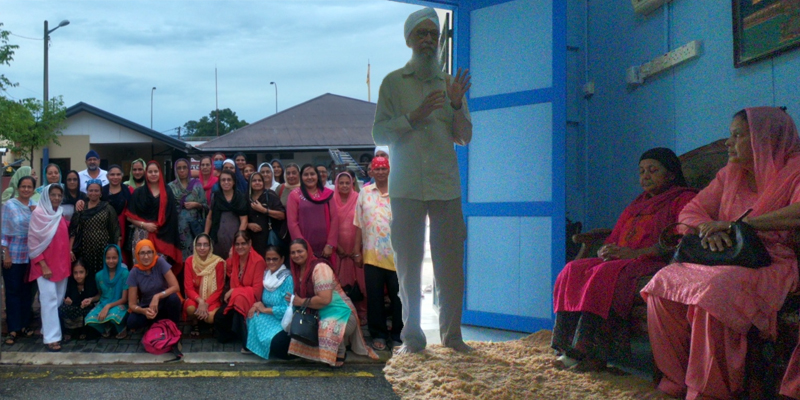
Shah Alam ladies team visiting a number of gurdwaras in Selangor. Right: Master Daljit Singh briefing them on the Ulu Yam senior citizen retreat centre – Photo: Supplied
By Asia Samachar | Malaysia |
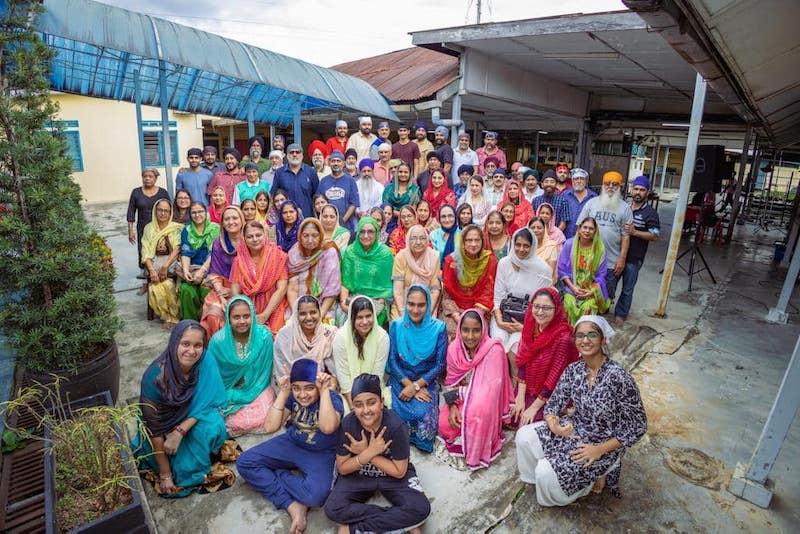
Istri Satsang of Gurdwara Sahib Guru Nanak Shah Alam visited a senior citizen retreat centre in Ulu Yam, Selangor, and a few nearby gurdwaras.
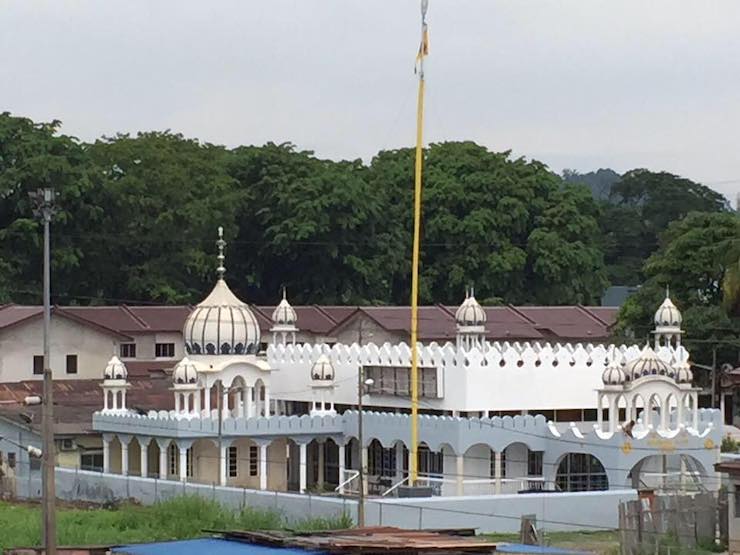
The trip, organised on a Monday (Feb 6), was to allow its members to spend time and mingle with residents of the centre. They also visited gurdwaras in Ulu Yam, Rasa and Serendah, as well as a Sikh campsite called the Khalsa Land. They donated groceries at all the places visited.
“This trip was an eye opener for us to come forward and do sewa [selfless service] and share more love with our old parents and the senior citizens,” said a team member.
ASIA SAMACHAR is an online newspaper for Sikhs / Punjabis in Southeast Asia and beyond. When you leave a comment at the bottom of this article, it takes time to appear as it is moderated by human being. Unless it is offensive or libelous, it should appear. You can also comment at Facebook, Twitter, and Instagram. You can reach us via WhatsApp +6017-335-1399 or email: asia.samachar@gmail.com. For obituary announcements, click here.
ASIA SAMACHAR is an online newspaper for Sikhs / Punjabis in Southeast Asia and beyond. When you leave a comment at the bottom of this article, it takes time to appear as it is moderated by human being. Unless it is offensive or libelous, it should appear. You can also comment at Facebook, Twitter, and Instagram. You can reach us via WhatsApp +6017-335-1399 or email: asia.samachar@gmail.com. For obituary announcements, click here.