Lawmaker Ramkarpal Singh has been appointed as Deputy Minister of Law and Institutional Reform, joining the Cabinet of Prime Minister Anwar Ibrahim.
The outspoken lawmaker is one of the six MPs from the DAP, a key component member of the Pakatan Harapan (PH) coalition led by Anwar, to be made deputy ministers.
Anwar made the announcement in a live broadcast today (Dec 9).
In the last general election in 2018, his elder brother Gobind Singh Deo made history when as the first Sikh to become a minister of Malaysia’s federal government. Their eldest brother, Jagdeep Singh Deo, is a state assemblyman in Penang.
Their late father Karpal Singh was a legendary lawmaker and lawyer.
ASIA SAMACHAR is an online newspaper for Sikhs / Punjabis in Southeast Asia and beyond. When you leave a comment at the bottom of this article, it takes time to appear as it is moderated by human being. Unless it is offensive or libelous, it should appear. You can also comment at Facebook, Twitter, and Instagram. You can reach us via WhatsApp +6017-335-1399 or email: asia.samachar@gmail.com. For obituary announcements, click here.
Fauja Singh captured on video walking out shirtless with a woman. In a Punjab-based media portal interview (right), he denied he was having an affair with the woman
By Manjit Kaur (UK) | OPINION |
How do fake godmen, some of them carrying the title sant or baba, build a following so easily? And how do they get away with their escapades?
Here’s the tragedy. The so-called sant or a baba gets various benefits such as money, fame and women. Even if they had behaved dastardly or committed immoral acts, like so many others before them, they are likely to come back at some point and continue to prey on innocent victims again.
Britain recently encountered a potential case of a ‘sant baba’ allegedly abusing his standing.
Fauja Singh was on video walking half naked with a woman with whom he was allegedly having sexual relations. He was confronted by the local Sikh community. Not long after, he left to the relative security of Punjab, and immediately puts out a video claiming that he was the victim of a kidnapping, fake video, and forced confession.
The allegations concerning the fake ‘Baba’ Fauja Singh, a.k.a. Surinder Singh of the Akaal Bunga cult the UK, raises many questions. Why and how can such characters build a following so easily?
While it would be wrong to suggest all sants and babas are sexual predators, it is worrying to note the rampant incidents of them sexually exploiting trusting followers. It must be noted that Sikhs are not the only ones plagued with such individuals; it is a common story amongst other faiths too. There are many reports in the media of yogis, maulvis, fakirs, gurus, swamis, pastors, and priests being caught red handed committing all kinds of ‘sins’ with their devotees.
How do the ‘babas’ operate?
The way many of them operate as sexual predators is to create the impression that they have the spiritual powers to cure their followers of all kinds of psychological, spiritual, relationship and even financial problems! Because they already know the kinds of people who will be drawn to them tend to be vulnerable and desperate, like a clever salesman, it doesn’t take them long to capture their imagination. They will always begin by presenting themselves as humble, caring, peaceful individuals and their ability to reassure their potential victims can result in an immediate feeling hope.
One of ‘Baba’ Fauja Singh’s specialities was his skillful manipulation of body language and appearance. He was famed for his titled posture, friendly smile, and long white flowing chola. The irony is, when he was caught on video with his female companion allegedly perfuming sexual acts in a car, all he had on was some boxer shorts!
Many so called ‘Sikh Babas’ convince their followers through wrong interpretations of Gurbani and by spinning wild stories or ‘gap khania’ about their own lives and family history. One of their main tricks is to emphasise miracles stories and to flatter their followers by claiming them to be special people with good ‘karma’. Because they know of the importance of Gurbani to Sikhs, they have no qualm in using the saroop of Guru Granth Sahib as a prop to lure people into their cult. So, in this case, we know that the ‘Baba’ Fauja Singh had been collecting money to have a special Guru Granth Sahib Saroop printed in gold letters. It is alleged that he had escaped to Punjab along with a significant amount of gold and money donated by followers for this project.
Typically, the victims of these conmen are women and girls, who are themselves often victims of abuse in their families. They are usually crying out for help, but because of traditions linked to family and community honour and shame (izat). Rather than going for professional help, they end up in hands of these conmen, who claim to be able provide miracle remedies.
The many reasons for turning to these babas include, the inability to give birth to sons, having been accused of possession by evil spirits, suffering from domestic violence, wanting to control a violent partner who may be abusing drugs and alcohol and/or having extra marital relationships. Some may simply be depressed and in need of hope, which religion and religious priests can provide. Sometimes ordinary persons, healthy individuals may be dragged into the cult through friends and relatives who are followers of the ‘Baba’. Indeed, these babas will often use their followers to recruit more members.
Not all women are innocent victims.
There is a common saying that it ‘takes two to tango’ and in Punjabi we say, ‘you need two hands to clap’! In this case, whilst clearly ‘Baba’ Fauja Singh, given his claimed status and power holds most of the responsibility, there is a question about the role of the woman. From the video, she comes across an adult. Of course, we don’t know the full-story, and it may be the case that she was subject to coercion and emotional blackmail; and in this regard, the truth can only be known if she makes a public statement. Some people argue that her confidentiality must be respected, but others say, if victims don’t speak out, abusers will continue to abuse. One option might be for her to make an anonymous statement or video, and this is something that those who exposed the ‘baba’ should consider. By doing so, we would know clearly what her role was and, especially as an adult, if in some way she also was responsible.
Though we can’t say anything more about this specific case, we do know from famous past cases of fake Godmen and sexual abuse that sometimes women have been part of the conspiracy. Cases involving Yogi Harbhajan Singh of the 3HO Cult, Bhagwan Shree Rajneesh of the Osho Cult, Gurmeet Ram Rahim Singh Insan of the Dera Sacha Sauda cult, come to mind, for being all these Godmen were powerful women. In such cases, though the women may well have been groomed, they will progress in the cult to a point where they also gain power and influence. So, whilst they may have in the past felt what is taking place was wrong, they become desensitised to such an extent that the abusive and corrupt behaviour of the baba and the cult become normalised. And one should not discount the possibility that some women may just be as evil as the baba, so they become partners in the crime.
What is to be done?
Because these fake ‘babas/sants’ have managed to establish a powerful base within the Sikh community, along with sophisticated PR campaigns, including exploitation of social and other media, the battle is not easy. However, as the exposure of ‘Baba’ Fauja Singh has shown, by working collectively across Panthic Jathebandhis, we can at a local, regional and national, and international level make a real difference. This must start with a clear statement that such individuals are not welcome in our places of worship and congregation. Because they usually begin by approaching individuals, we also need to warn those people who allow them into their homes to think about safeguarding. We would not allow our child to go to a nursery unless it was properly checked and registered, so why do let these fake ‘babas/sants’ access to vulnerable children and adults without any checks?
Another step we can take is to have the formal title Sant banished or registered. This means that no individual or group who claim to be members of the Sikh Panth should be allowed to use such titles without the permission of the Panth, and this should be through a proper transparent process. I would appeal to those Gursikhs who are followers of Sants and Babas to support a campaign and get the titles removed. If your Sant is a true Gursikh they will not refuse the request from the Sangat. Indeed, such a move may well be a good test to see if your Baba is true to Gurbani. And if you are unprepared to come off the fence, then one can only assume you are either too brain washed to act or worse still you and your Baba are part of the problem.
To end, let me make it crystal clear, I have no reason to believe that most so called ‘Babas/Sants’ are not noble individuals, but I know in and amongst them there are many bad apples. But these bad apples are damaging the whole Panth and the sooner they are crushed the better!
Manjit Kaur, a UK-based therapist and counsellor, is a presenter of the 1 Show on Akaal Channel. She can be contacted via email at manjitkaur1show@gmail.com
ASIA SAMACHAR is an online newspaper for Sikhs / Punjabis in Southeast Asia and beyond.Facebook | WhatsApp +6017-335-1399 | Email: editor@asiasamachar.com | Twitter | Instagram | Obituary announcements, click here |
Old Sikh watercolour on paper by Lim Cheng Hoe (1955) – Source: Collection of National Gallery Singapore; Donated by Michael Lim Hock Ann (Mr)
By Bhupinder ‘Bo’ Singh | Opinion |
Ever wondered, why the followers of the path of Guru Nanak Ji are called Sikhs? The word Sikh means a student. The word Guru means the spiritual Master, Teacher – whose light removes the darkness of spiritual ignorance. In that context the word Sikh makes sense, as our Guru has made us – the followers – students for life. But Sikhs don’t go to schools with classrooms, nor have a structured system of instructions, no formal examinations, where passing the examination implies understanding of what was taught, resulting in the promotion to next level. So, how does Guru’s education system work?
Let us start with what it is like to be without the Guru in life? Guru Ji has provided the answer by saying:
ਗੁਰ ਬਿਨੁ ਘੋਰੁ ਅੰਧਾਰੁ ਗੁਰੂ ਬਿਨੁ ਸਮਝ ਨ ਆਵੈ ॥
“Gur bin ghor a(n)dhaar guroo bin samajh na aavai.” (SGGS, Pg. No. 1399)
Translation: Without the Guru, there is utter darkness; without the Guru, understanding does not come.
So, the light of understanding, which dispels darkness comes from the Guru. The transformation of the Sikh of the Guru becomes evident, when the blind chase (in darkness of ignorance) of material wealth becomes secondary in life, from being a sole objective in life:
“Kabir gur laagaa tab jaaneeaai miTai moh tan taap. Harakh sog dhaajhai nahee tab har aapeh aap. 189.” (SGGS, 1374)
Translation: Kabir, one is known to have imbibed teachings of the Guru, when his bodily fever (of jealousy) and cravings of material acquisition are eradicated. He is not burned by (either the) pleasure or pain, and so he sees the Lord Himself everywhere. ||189||
Thus, Guru’s education that transforms the state of mind (above pleasures and pains, jealousy, and desires):
ਗੁਰਮੁਖਿ ਉਪਦੇਸੁ ਦੁਖੁ ਸੁਖੁ ਸਮ ਸਹਤਾ ॥
“Gurmukh upadhes dhukh sukh sam sahataa.” (SGGS, 131)
Translation: Through the Guru’s Teachings, one can endure pain and pleasure alike.
This teaching is not in any academic curriculum. The educational institutes with their structured education can make us valued experts in a chosen field, a respected authority figure, but becoming impervious to both pleasures and pain is not imparted. It is for this reason Guru Ji extols us to get the education from the Guru in these words:
Translation: Take the Guru’s understanding, you are ignorant unlettered; without devotion, even the clever (worldly educated) have drowned (in the world ocean).
Thus, the role and function of the Guru becomes clear. The academic education does not teach us on how not to get drowned in the oceans of desires and greed. Guru’s education is going to change life’s direction from desires and consumptions to reining those in. The consequence is ego is reined in and humility is inculcated. The walking on the Guru’s path is called as “Sikhee”, which Guru has defined as:
ਸਿਖੀ ਸਿਖਿਆ ਗੁਰ ਵੀਚਾਰਿ ॥ ਨਦਰੀ ਕਰਮਿ ਲਘਾਏ ਪਾਰਿ ॥
“Sikhee sikhiaa gur veechaar. Nadharee karam laghaae paar.” (SGGS, 465)
Translation: (Those) imbibing the teachings of Guru’s thought process; the merciful (God) grants His Grace, ferries them across (the worldly ocean).
Translation: Through the Gurdwara, the Guru’s Gate, one obtains understanding. By being washed through this Gate, (mind) becomes pure.
Here, Guru Ji has shared how through the detergent of “Naam” the filth or dirt of mind is removed. The filth clinging to mind is pride, ego, greed, and desires, which has to be removed by imbibing humility. Coming to Guru’s door is becoming humble. Guru teaches us to shed ego in these words:
“Bholiaa haumai surat visaar. Haumai maar beechaar mun gunn vich gunn lai saar. 1. Rahaau.” (SGGS, 1168)
Translation: O ignorant one, forget your egotistical intellect. Subdue your ego and remember the one supreme virtue in your mind – (of living by Naam or Divine virtues). ||1||Pause||
One who has made humility his/her own nature, becomes blessed as:
“Kar kirapaa jis kai hiradhai gareebee basaavai. Nanak ieehaa mukat aagai sukh paavai. 1.” (SGGS, 278)
Translation: One whose heart is mercifully blessed with abiding humility, O Nanak, is liberated here, and obtains Divine peace hereafter (in God’s Court). ||1||
When Guru Ji has been given the reins, then the Sikh has relinquished ego, pride, desires, and ambitions. The feeling of having a master Guru who is all knowing, ushers in a kind of ego ceiling in the student that s/he is just the dust at the feet of the master. This leads to the cultivation of humility in the student, leading to serenity:
“Aapas kau jo bhalaa kahaavai. Tiseh bhalaiee nikaT na aavai. Sarab kee ren jaa kaa mun hoi. Kahu nanak taa kee niramal soi. 3.” (SGGS, 278)
Translation: One who claims to be virtuous, virtue does not draw near him. One whose mind has become the dust of all – says Nanak, his pristine reputation spreads around. ||3||
Guru Ji tells us that every human being has yearning for state of ‘Sahaj’, un-rocked by the storms of life’s crisis, which is obtained from Guru. It is innate human nature with which one is born but forgot after birth by becoming attached to the world. That human longing can only be fulfilled through the Guru:
ਸਹਜੈ ਨੋ ਸਭ ਲੋਚਦੀ ਬਿਨੁ ਗੁਰ ਪਾਇਆ ਨ ਜਾਇ ॥
“Sahajai no sabh lochadhee bin gur paiaa na jai.” (SGGS, 68)
Translation: Everyone longs to be in ‘Sahaj’ centered and balanced, but without the Guru, no one can.
It is only through ‘Sahaj’ that merger with divine takes place. The foundation of humility becomes the support the superstructure of ‘Sahaj’. The Guru’s teachings will inculcate ‘Sahaj’ where everything takes place effortlessly:
ਗੁਰ ਬਿਨੁ ਸਹਜੁ ਨ ਊਪਜੈ ਭਾਈ ਪੂਛਹੁ ਗਿਆਨੀਆ ਜਾਇ ॥
“Gur bin sahaj na uoopajai bhaiee poochhahu giaaneeaa jai.” (SGGS, 638)
Translation: Without the Guru, ‘Sahaj’ (celestial peace) is not produced, O Siblings of Destiny; go and ask the spiritual teachers about this.
The experience of ‘Sahaj’ is what the student of the Guru reaps by reining in the ego. Such a student like a sponge is constantly absorbing Guru’s teachings and incorporating them in life. Thus, the seeker in life, a Sikh – the student for life feels the awe of the Creator in creation, and sings His praises:
Translation: Ooraa: Sing the Praises of the One whose limit cannot be found.
Ooora is the first letter of Gurumukhi, and through that Guru Ji gives us the message of singing praises, employing acrostics. Then the Sikh writes this alone:
ਲਿਖੁ ਨਾਮੁ ਸਾਲਾਹ ਲਿਖੁ ਲਿਖੁ ਅੰਤੁ ਨ ਪਾਰਾਵਾਰੁ ॥੧॥
“Likh naam saalaeh likh likh a(n)t na paaraavaar. 1.” (SGGS,16)
Translation: Write the Praises of the Naam, the Creative power of the Lord; write over and over again that He has no end or limitation. ||1||
Guru Ji considers those hands beautiful which write the praises of the Almighty:
ਹਰਿ ਜਸੁ ਲਿਖਹਿ ਬੇਅੰਤ ਸੋਹਹਿ ਸੇ ਹਥਾ ॥
“Hur jus likheh beant soheh se hathaa.” (SGGS, 709)
Translation: Those hands, which write the Praises of the infinite Lord are beautiful.
When writing the praises, the Sikh is singing, listening, believing, and thus developing full faith in Almighty, simultaneously filling self with reverential love:
ਗਾਵੀਐ ਸੁਣੀਐ ਮਨਿ ਰਖੀਐ ਭਾਉ ॥
“Gaaveeaai suneeaai mun rakheeaai bhaau.” (SGGS, 2)
Translation: Sing, and listen, and let your mind be filled with love.
The Gurbani words become touchstones by which the life is lived leading to emancipation:
ਸੁਨਤ ਕਹਤ ਰਹਤ ਗਤਿ ਪਾਵਹੁ ॥
“Sunat kahat rahat gat paavahu.” (SGGS, 288)
Translation: Listening, speaking, and living it (experiencing Naam), emancipation is obtained.
As long as we live, we are doing all these three things in life – listening, talking, and living a life. But when we live the life incorporating Guru Ji’s teachings in all these three areas, there an inner transformation is initiated as words heard, utterings and actions are aligned. With its unlimited potential spanning the entire life, final outcome is merger of the Sikh in the Unlimited. The concept is that a Sikh, in complete humility subsumes to his/her Guru, the Master under whom s/he apprentices. The firm conviction of the Sikh in life is:
“Joe gur kahai soiee bhal meeThaa man kee mat tiaag. 1. Rahaau.” (SGGS, 1339)
Translation: Whatever the Guru says is good and sweet to me. I have renounced the intellectual wisdom of my mind. ||1||Pause||
The self-motivated Sikh, ever enthusiastic, ever ready to improve self, thus keeps scaling up on the development ladder. The working environment in Guru’s school is different as the Sikh becomes his/her own critic, critically analyzing own actions to make improvements as well as the cheerleader. There is a great emphasis on learning in a group setting, which Guru Ji called ‘Sadh Sangat’. It acts as a nursery of the peers where a Sikh is always on the lookout for the areas of self-improvements. This nursery Guru Nanak Ji is called ‘Dharmsal’ a place to practice ‘Sikhee’ was started in Kartarpur in 1521. But today we have put it aside, enamored by the western style institutional education. Guru Ji saw great value in putting spiritually elevated next to laymen, to be a source of empowerment and model for emulation to those striving to grow.
Additionally, this type of setting provides for continuous feedback about what the Sikh knows, and areas to be worked upon. The Sikhs higher on the rungs of ladder of learning provide the mentoring, guidance, and direction to those striving at the lower rungs. In such a nurturing arrangement those on lower rungs can look up to those on upper rungs for counsel and support. There is a camaraderie amongst those Sikhs at a similar level. Thus, in this environment the mentor, and the mentee are both encouraged to flourish. This acts like a tight rope walk, but the other students provide the safety net in case of fall, and also act as a support group to prop again in case of a fall. In such nurturing environment the evil tendencies shall be purged out incorporating Guru Ji’s teachings:
“Rahat rahat reh jaeh bikaaraa. Gur poore kai sabadh apaaraa.” (SGGS, 259)
Translation: The evil tendencies shall be slowly and steadily purged out, by the Shabad, the Incomparable Word of the Perfect Guru.
Thus, the collective psyche of the group is always ascending upwards in the spirit of ‘Chardi kala’. It is for this reason alone Guru Ji has compared the Sikh to a mythical white swan whose diet consists of pearls alone. The pearls represent the virtues as ‘Naam’. In contrast there are “Baglas” or herons. The herons are white like swans, but are opportunistic, plus having a hypocritical nature. So, when they close their eyes and become quiet, they are simply waiting for their prey of frogs and fishes. Guru Ji has described the scenario in these words:
ਹੰਸਾ ਹੀਰਾ ਮੋਤੀ ਚੁਗਣਾ ਡਡਾ ਭਾਲਣ ਜਾਵੈ ॥
“Hansaa heeraa motee chuganaa bag ddaddaa bhaalan jaavai.” (SGGS, 960)
Translation: The swans peck at the diamonds and pearls, while the heron chases after frogs.
The approach of “learner for Life” is what Guru Ji has prescribed for the Sikhs. With this unique approach in life the formal education which ends upon completion of academic studies and graduating does not happens in the ‘Dharamsaal’ of the Guru. It is time to revive this model of a Sikh a student for life. As it is with the Guru Ji as mentor, guide, and a coach the spiritual progress of the Sikh takes place. The Sikh obtains the wealth of ‘Naam’ from the Guru:
ਸਤਿਗੁਰੁ ਸਿਖ ਕਉ ਨਾਮ ਧਨੁ ਦੇਇ ॥
“Satigur sikh kau naam dhan dhei.” (SGGS, 286)
Translation: The True Guru gives His Sikh the wealth of the Naam.
The uniqueness of Guru’s education is the imparting ‘Naam’, which is not imparted in any other school or institution. This ‘Naam’ leads to merger with the Creator, ending cycles of reincarnations:
Translation: With the wealth of the Naam, their faces are radiant, and they attain the True Lord. ||1||
This happening of the radiance of Divine Light within took place through the teachings of the Guru:
ਆਤਮ ਰਾਮ ਪਰਗਾਸੁ ਗੁਰ ਤੇ ਹੋਵੈ ॥
“Aatam raam paragaas gur te hovai.” (SGGS, 123)
Translation: The Divine Light of the Supreme Soul shines forth from the Guru.
When that radiance of Divine Light is experienced then the Sikh only utters in thankfulness:
ਐਸੇ ਗੁਰ ਕਉ ਬਲਿ ਬਲਿ ਜਾਈਐ ਆਪਿ ਮੁਕਤੁ ਮੋਹਿ ਤਾਰੈ ॥੧॥ ਰਹਾਉ ॥ “Aise gur kao bal bal jaeeai aap mukat mohae tarai. 1. Rahao.” (SGGS, 1301)
Translation: I am a sacrifice, a sacrifice to such a Guru; He Himself is liberated, and He carries me across as well. ||1||Pause||
Bhupinder ‘Bo’ Singh, Houston. Born in Bhamo, Myanmar, he now lives in Houston, US, where he runs a manufacturing company formed with his son. A mechanical engineer by training, he has authored a number of books, including Connecting with the Master – A collection of essays on topics related to Sikhism (2006) and In Bully’s Eyes – An Illustrated Children’s book on Bullying(2019).
ASIA SAMACHAR is an online newspaper for Sikhs / Punjabis in Southeast Asia and beyond.Facebook | WhatsApp +6017-335-1399 | Email: editor@asiasamachar.com | Twitter | Instagram | Obituary announcements, click here
Darbar Sahib, Amritsar, photographed in February 2019. Popularly known as the Golden Temple. Photo by Saheb Singh
By Asia Samachar | India |
The Shiromani Gurdwara Parbandhak Committee (SGPC) has taken to task the Union Aviation Ministry for ignoring Punjab, especially Sri Guru Ram Dass Jee International Airport in Amritsar, in the new agreement regarding flights between Canada and India, reports Tribune News Service.
SGPC spokesperson and general secretary Gurcharan Singh Grewal said under the new agreement, airports had been included for flights from many cities in India, but Punjabis, especially Sikhs, had been discriminated against by ignoring Amritsar.
In the budget session of the SGPC on March 30, 2022, led by SGPC president Harjinder Singh Dhami, he said a a special resolution was passed to demand direct flights from Amritsar and was sent to the relevant ministries of the Government of India.
“Still the government deliberately did not give its due share of flights to Punjab. This is unfair to Punjabis. While they have to bear the loss of their valuable time to reach Punjab from Delhi, this also puts a huge financial burden on them,” he said, according to the report.
Grewal appealed to the Prime Minister Narendra Modi that due share of flights from Canada to India should be allocated from this airport.
It noted that the agreement provides for unlimited flights between Canada and India between selected airports, but excluded Amritsar and Chandigarh in Punjab, home to the majority of the Sikh community and the destination of the majority of travellers from Canada.
“A majority of travelers between Canada and India are connected to Punjab. As a result of no direct travel options between Canada and Punjab, these travelers are forced to spend substantial extra time and money in order to reach their destinations,” said WSO president Tejinder Singh Sidhu in the letter.
ASIA SAMACHAR is an online newspaper for Sikhs / Punjabis in Southeast Asia and beyond. When you leave a comment at the bottom of this article, it takes time to appear as it is moderated by human being. Unless it is offensive or libelous, it should appear. You can also comment at Facebook, Twitter, and Instagram. You can reach us via WhatsApp +6017-335-1399 or email: asia.samachar@gmail.com. For obituary announcements, click here.
Living life at her own pace, at her will. Truely master of her life. Always strong, always there. She shall not be mourned but shall be cherished for she is one of the pillars to our home. May your light be at the shrine of the One.
Akandh Path: 15 to 17 December 2022 at Gurdwara Sahib Pathey, Ipoh (K.K Road)
| Entry: 7 Dec 2022: Updated: 15 Dec 2022 | Source: Family
ASIA SAMACHAR is an online newspaper for Sikhs / Punjabis in Southeast Asia and beyond. When you leave a comment at the bottom of this article, it takes time to appear as it is moderated by human being. Unless it is offensive or libelous, it should appear. You can also comment at Facebook, Twitter, and Instagram. You can reach us via WhatsApp +6017-335-1399 or email: asia.samachar@gmail.com. Forobituary announcements, click here.
King Charles spoke with local schoolchildren outside the Guru Nanak Gurdwara
By Asia Samachar | Britain |
King Charles today officially opened the Guru Nanak Gurdwara in Luton in an event that symbolised togetherness with the presence of leaders from many faiths.
Among faith leaders present were Bedford bishop Rt Rev Richard Atkinson, Luton Buddhist community representative Janaka Alahapperuma and Grassroots and the Luton Council of Faiths director David Jonathan.
When the King arrived, the Luton Punjabi Kirtan School sang and played the tabla and baja (harmonium). His Majesty was so intrigued by the baja he asked teacher Jaswant Kaur Bola for a demonstration and she was happy to oblige. “He was very knowledgeable and it was the experience of a lifetime for the kids,” she said, as reported by the Luton Today.
The King – dapper in grey suit and matching bandana, teamed with a pink silk polka dot tie and handkerchief – also took a great interest in the gurdwara’s voluntary vaccination programme which was overseen by a quartet of medics, three of whom played football together. Drs Manraj Bahrey, Ajeet Bagga, Talib Abubacker and Kuldip Sule were responsible for a rollout which saw more than 24,000 people from the local BAME community innoculated, the report added.
ASIA SAMACHAR is an online newspaper for Sikhs / Punjabis in Southeast Asia and beyond. When you leave a comment at the bottom of this article, it takes time to appear as it is moderated by human being. Unless it is offensive or libelous, it should appear. You can also comment at Facebook, Twitter, and Instagram. You can reach us via WhatsApp +6017-335-1399 or email: asia.samachar@gmail.com. For obituary announcements, click here.
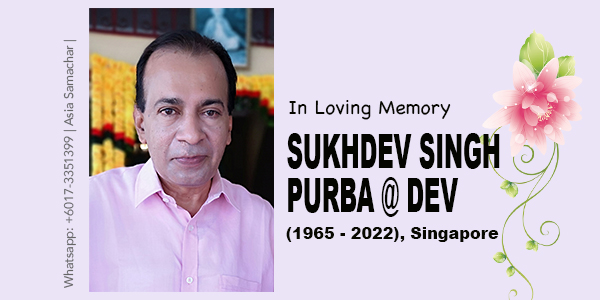
Parents: Late Sardar Karam Singh Purba & Late Sardarni Sarjit Kaur Jassal
Pind: Moga, Punjab
Companion: Leah Sutiman (Singapore)
Siblings / Spouse: Late Devinder Singh Late Balvinder Singh / Ansulaben Daljit Kaur Kulwant Kaur / Gurcharan Singh Randhawa Late Jasbir Kaur / Late Raj Pal Sharma (India) Rani Jagdish / Naeem Ansari Kuldeep Kaur / Jonathan Tickner (Australia) Late Santokh Singh / Dalbir Kaur Jaspal Kaur Late Satwant Singh Late Ravinder Kaur / Bhajnik Singh Mann
Family members to be contacted: Kulwant Kaur (Kanthi): 011-11179622 Rani Jagdish: 018-9419026 Jaspal Kaur (Palo): 012-4058579
Path Da Bhog: 11 December 2022 (Sunday), from 9:30 a.m. to 12:00 p.m., at Gurdwara Sahib Police Ipoh.
We mourn the great loss of a Son, Brother, Companion and Uncle who has always loved his family unconditionally. He is deeply missed and forever loved. May he rest in peace!
Punjab’s drug and alcohol abuse came to the attention of India’s highest court. This time around, the justices made some stern remarks.
“We are not concerned with A government or B government. So far as Punjab is concerned, the drugs problem is increasing. The youth will be finished. It is very unfortunate that this is happening. Who is the sufferer? The poor people. Illegal manufacture and transportation has to stop because it ultimately affects the health and the society,” said Supreme Court bench of justices M R Shah and C T Ravikumar in New Delhi on Dec 5.
In the case concerned, they asked the Punjab government to spell out specific steps taken to curb the production and sale of illegal liquor, reports PTI. The justices were concerned over the burgeoning illicit liquor trade and drug menace in Punjab, and asked the state government to fix responsibility on the local police for failing to keep vigil.
Senior advocate Ajit Kumar Sinha, appearing for the Punjab government, assured the court that the state is taking action and has already destroyed over 13,000 illegal liquor ‘bhattis’ (distilleries), according to the report.
The top court was hearing a plea arising out of a September 2020 order of the Punjab and Haryana High Court that had disposed of a petition seeking transfer of some FIRs registered in Punjab in relation to distillation of spurious liquor, its sale and inter-state smuggling to the CBI. The high court had disposed of the plea following an assurance by the state’s counsel that concerns raised by the petitioners will be duly dealt with and suitable action initiated. Sinha told the Supreme Court that over 36,000 FIRs have been registered in the last two years.
The bench shot back, saying: “You (government) are only filing FIRs, but according to you in every gali and mohalla there is a ‘bhatti’.” When one of the lawyers sought compensation for the families of those who died due to consumption of spurious liquor, the bench said it has to be a policy decision.
“It is very unfortunate. But who asked you to consume the (spurious) liquor? Why should a common man who is paying taxes suffer?” the bench said.
The apex court asked the Punjab government to file a reply stating what concrete steps have been taken to stop domestic and commercial production of spurious liquor and how penalty seized could be utilised for an awareness campaign or increasing the manpower to tackle the problem.
“The state may also come out with a circular on effective investigation and enquiry….that if any illegal bhatti is found, the concerned local police will be held responsible for not keeping a vigil,” the bench said and posted the matter for resumed hearing on December 12. The top court had earlier expressed dissatisfaction over the progress in investigating some cases of illicit liquor trade in Punjab and said the state is treating the issue with “kid gloves”.
ASIA SAMACHAR is an online newspaper for Sikhs / Punjabis in Southeast Asia and beyond. When you leave a comment at the bottom of this article, it takes time to appear as it is moderated by human being. Unless it is offensive or libelous, it should appear. You can also comment at Facebook, Twitter, and Instagram. You can reach us via WhatsApp +6017-335-1399 or email: asia.samachar@gmail.com. For obituary announcements, click here.
Grandchildren: Kashwinder, Shahwinder, Arwinder, Lalita, Ravinderjit, Jasmin, Jagwin, Phrmpreet , Shailinder, Anoopjot, Tavleen and many great grandchildren
Mindful of the 10 day period and as per her wishes too, Akhand Paath will commence at Gurdwara Sahib High Street (Jalan Balai Polis, Kuala Lumpur) on 14-12-22 at 9.00 am & Path Da Bhog will be on 16-12-22 at 9 am, followed by Kirtan from 9.30 am – 11.30 am. Ardas at 12.00 noon followed by langgar.
Contact: 013-3984558
It is story of a woman in ancient India whose son had died. She walked from place to place wailing, crying and weeping; asking for help to bring her son back to life. Arriving at place of a saint, she asked the saint to help her out who said, Don’t worry, leave your son here and go out and find a mustard seed from a house that has not experienced death. When you bring it back, I can help you. The woman searched from house to house, but each had experienced death. She finally realized what the saint meant. She turned to religion to find answers to her questions. She understood, Death is natural, whosoever is born, must die.
Guru Arjan Dev says: Just as the peasant sows his crop and harvests it whether ripe or unripe, in a similar way the sickle of death does not care for a human being at any age, whether old or young.
Mum had a full innings spanning 3 months short of 90 years and despite being blessed to have her for such a long time, being mortals we still feel that we did not have enough time with her.
She spent her childhood in Pontian and later in Cheema village when the war broke out following which she got married at the age of 16 to the Late Saroop Singh with whom she had 4 sons. She was a fulltime housewife like most mothers of her generation and did a great job of parenting in bringing up her 4 boys and was still teaching them how to parent until now ?.
She loved to cook and was most happy when cooking for her loved ones and any guests that she had over. The other passion was sewing, having stitched Daris (that goes with the bride on their wedding day) for quite a number of brides. Until this year, her grandsons would still go up to her and ask in their broken Punjabi “Dadiji can you stitch this as it is slightly torn/loose, etc”
Her sons and grandchildren learnt the meaning of service and love from her as well as how to maintain relationships with those near and distant. She showed by example the importance of the family unit and was the rock of the Mann family that we could always depend on when things got a bit tough.
She has made it tough for all those whose lives she has touched to ever forget her and we are eternally grateful to Waheguru for blessing us with such a mother, grandmother and great-grandmother.
| Entry: 6 Dec 2022; Updated: 8 Dec 2022 | Source: Family
ASIA SAMACHAR is an online newspaper for Sikhs / Punjabis in Southeast Asia and beyond. When you leave a comment at the bottom of this article, it takes time to appear as it is moderated by human being. Unless it is offensive or libelous, it should appear. You can also comment at Facebook, Twitter, and Instagram. You can reach us via WhatsApp +6017-335-1399 or email: asia.samachar@gmail.com. Forobituary announcements, click here.
Recent years have seen a resurgence in nostalgia for the British empire. High-profile books such as Niall Ferguson’s Empire: How Britain Made the Modern World, and Bruce Gilley’s The Last Imperialist, have claimed that British colonialism brought prosperity and development to India and other colonies. Two years ago, a YouGov poll found that 32 percent of people in Britain are actively proud of the nation’s colonial history.
This rosy picture of colonialism conflicts dramatically with the historical record. According to research by the economic historian Robert C Allen, extreme poverty in India increased under British rule, from 23 percent in 1810 to more than 50 percent in the mid-20th century. Real wages declined during the British colonial period, reaching a nadir in the 19th century, while famines became more frequent and more deadly. Far from benefitting the Indian people, colonialism was a human tragedy with few parallels in recorded history.
Experts agree that the period from 1880 to 1920 – the height of Britain’s imperial power – was particularly devastating for India. Comprehensive population censuses carried out by the colonial regime beginning in the 1880s reveal that the death rate increased considerably during this period, from 37.2 deaths per 1,000 people in the 1880s to 44.2 in the 1910s. Life expectancy declined from 26.7 years to 21.9 years.
In a recent paper in the journal World Development, we used census data to estimate the number of people killed by British imperial policies during these four brutal decades. Robust data on mortality rates in India only exists from the 1880s. If we use this as the baseline for “normal” mortality, we find that some 50 million excess deaths occurred under the aegis of British colonialism during the period from 1891 to 1920.
Fifty million deaths is a staggering figure, and yet this is a conservative estimate. Data on real wages indicates that by 1880, living standards in colonial India had already declined dramatically from their previous levels. Allen and other scholars argue that prior to colonialism, Indian living standards may have been “on a par with the developing parts of Western Europe.” We do not know for sure what India’s pre-colonial mortality rate was, but if we assume it was similar to that of England in the 16th and 17th centuries (27.18 deaths per 1,000 people), we find that 165 million excess deaths occurred in India during the period from 1881 to 1920.
While the precise number of deaths is sensitive to the assumptions we make about baseline mortality, it is clear that somewhere in the vicinity of 100 million people died prematurely at the height of British colonialism. This is among the largest policy-induced mortality crises in human history. It is larger than the combined number of deaths that occurred during all famines in the Soviet Union, Maoist China, North Korea, Pol Pot’s Cambodia, and Mengistu’s Ethiopia.
How did British rule cause this tremendous loss of life? There were several mechanisms. For one, Britain effectively destroyed India’s manufacturing sector. Prior to colonisation, India was one of the largest industrial producers in the world, exporting high-quality textiles to all corners of the globe. The tawdry cloth produced in England simply could not compete. This began to change, however, when the British East India Company assumed control of Bengal in 1757.
According to the historian Madhusree Mukerjee, the colonial regime practically eliminated Indian tariffs, allowing British goods to flood the domestic market, but created a system of exorbitant taxes and internal duties that prevented Indians from selling cloth within their own country, let alone exporting it.
This unequal trade regime crushed Indian manufacturers and effectively de-industrialised the country. As the chairman of East India and China Association boasted to the English parliament in 1840: “This company has succeeded in converting India from a manufacturing country into a country exporting raw produce.” English manufacturers gained a tremendous advantage, while India was reduced to poverty and its people were made vulnerable to hunger and disease.
To make matters worse, British colonisers established a system of legal plunder, known to contemporaries as the “drain of wealth.” Britain taxed the Indian population and then used the revenues to buy Indian products – indigo, grain, cotton, and opium – thus obtaining these goods for free. These goods were then either consumed within Britain or re-exported abroad, with the revenues pocketed by the British state and used to finance the industrial development of Britain and its settler colonies – the United States, Canada and Australia.
This system drained India of goods worth trillions of dollars in today’s money. The British were merciless in imposing the drain, forcing India to export food even when drought or floods threatened local food security. Historians have established that tens of millions of Indians died of starvation during several considerable policy-induced famines in the late 19th century, as their resources were syphoned off to Britain and its settler colonies.
Colonial administrators were fully aware of the consequences of their policies. They watched as millions starved and yet they did not change course. They continued to knowingly deprive people of resources necessary for survival. The extraordinary mortality crisis of the late Victorian period was no accident. The historian Mike Davis argues that Britain’s imperial policies “were often the exact moral equivalents of bombs dropped from 18,000 feet.”
Our research finds that Britain’s exploitative policies were associated with approximately 100 million excess deaths during the 1881-1920 period. This is a straightforward case for reparations, with strong precedent in international law. Following World War II, Germany signed reparations agreements to compensate the victims of the Holocaust and more recently agreed to pay reparations to Namibia for colonial crimes perpetrated there in the early 1900s. In the wake of apartheid, South Africa paid reparations to people who had been terrorised by the white-minority government.
History cannot be changed, and the crimes of the British empire cannot be erased. But reparations can help address the legacy of deprivation and inequity that colonialism produced. It is a critical step towards justice and healing.
Dylan Sullivan is a Graduate student in the Department of Political Economy at the University of Sydney. Jason Hickel is a Professor at the Institute for Environmental Science and Technology (ICTA-UAB) and Fellow of the Royal Society of Arts. The opinion piece first appeared at AlJazeera
ASIA SAMACHAR is an online newspaper for Sikhs / Punjabis in Southeast Asia and beyond. When you leave a comment at the bottom of this article, it takes time to appear as it is moderated by human being. Unless it is offensive or libelous, it should appear. You can also comment at Facebook, Twitter, and Instagram. You can reach us via WhatsApp +6017-335-1399 or email: asia.samachar@gmail.com. For obituary announcements, click here.