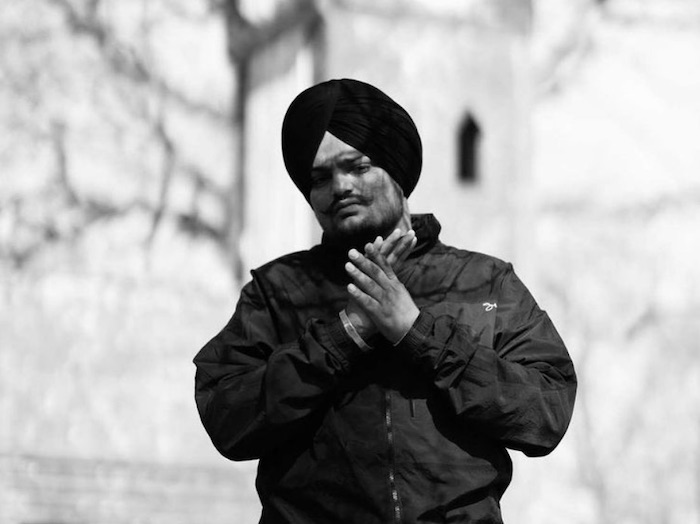
Eight sharp shooters who killed Punjabi singer Sidhu Moose Wala, have been identified, reports an Indian newspaper quoting unnamed sources.
They belong to Punjab, Haryana, Rajasthan and Maharashtra. This comes at a time when Punjab police teams are conducting raids in three states and it’s an ongoing operation to nab the suspects, reports the Hindustan Times.
At this juncture, police have arrested three men in connection with the murder of the popular rapper, singer and song writer in Jawaharke village in Mansa district of Punjab on May 29.
The first arrest took place two days after the incident that shook millions of followers of the singer.
The murder comes a day after the withdrawal of the security cover of the 27-year-old singer. He was among the 424 VIPs who lost their security cover yesterday as part of the Bhagwant Mann government’s exercise to crack down on VIP culture.
He is one of Punjab’s biggest pop stars, though known for his temperamental and edgy lyrics.
Moose Wala, who’s real name is Shubhdeep Singh Sidhu, is one of Punjab’s biggest pop stars, though known for his temperamental and edgy lyrics. He has had several brushes with the law, called out for promoting gun culture through his songs and social media activity.
Due to his popularity, Congress tapped him to run in recent state assembly election, but he lost.
His latest track, The Last Ride, was released this month. It features the iconic crime scene where American rapper Tupac was murdered in his BMW in 1996.
ASIA SAMACHAR is an online newspaper for Sikhs / Punjabis in Southeast Asia and beyond.Facebook | WhatsApp +6017-335-1399 | Email: asia.samachar@gmail.com | Twitter | Instagram | Obituary announcements, click here
In one of my chat groups, some sent the following translation for Gurbani quote of the day.
“By singing the Almighty’s glorious praises, by constantly contemplating on the name of the Lord, a sincere yearning to meditate wells up in us. We can’t meet the Lord by visiting sacred shrines of pilgrimages, by fasting, by having ceremonial feasts and giving to charity. Good karma and righteous living can only be found in meditating on the Lords name. It washes away the stains of sins and mistakes. The Almighty can only be merciful to us if we sincerely focus our attention on him. The rest is only a show of drama we are playing in. Let’s reflect on it.”
I reflected on the entry and found the translation a little problematic. Let me explain. I will quote bits of it and share my understanding. Emphasis (in uppercase) are mine.
“We can’t MEET the Lord by visiting sacred shrines of pilgrimages, by fasting, by having ceremonial feasts and giving to charity.”
On the surface, the statement resonates Sikhi. Gurmat rejects pilgrimages and fasting in the name of religion. You may gain outwardly from those activities – better health or expanding your worldview via travel – but there is nothing spiritual about them. But this paradigm about wanting to ‘meet the Lord’ puts us on a wild goose chase. God is within. No need to run around looking for him. We just need to look within – internalise – to realise Him.
“Good karma and righteous living can only be found in MEDITATING on the Lords name.”
It depends on how we understand meditation here. If it’s about constant repetition of a certain word – mantar chanting – then once again we are being sent on a goose chase. Meditation is about living a life based on our understanding of the Shabad.
“The Almighty can only be merciful to us if we sincerely FOCUS our attention on him.”
This sentence fits well if we think of God as some external being, some thing out there. But God is all pervading, all around, and within. God needs neither attention nor adulation. Notice the corruption at work here: I focus on You and You be merciful to me. I scratch your back, you scratch back mine! We want to reduce God to our daily deals.
“The rest is only a show of DRAMA we are playing in.”
Again, depends on how we define drama. Life is real. Shabad enjoins us to live a God-loving, God-rejoicing life. Living a productive life, showing compassion to those around us and extending a helping hand where needed are some of the daily actions we can undertake. Life is here and now. This is it!
Hb Singh is a Kuala Lumpur-based journalist with some experience in dealing with Sikh organisations, both from within and outside.
* This is the opinion of the writer, organisation or publication and does not necessarily represent the views of Asia Samachar.
ASIA SAMACHAR is an online newspaper for Sikhs / Punjabis in Southeast Asia and beyond.Facebook | WhatsApp +6017-335-1399 | Email: editor@asiasamachar.com | Twitter | Instagram | Obituary announcements, click here
Babaji was a loving and inspirational person not only to his family and friends but also to the Kuching sangat. May Vaheguru bless his soul.
Wife: Late Charan Kaur
Missed by children, grandchildren, great grandchildren, relatives and friends.
Saskaar / Cremation: 2pm, 7 June 2022 (Tuesday) at Kuching Buddhist Memorial @ Seniawan, Bau
Cortège leaves residence in Kuching at 12:30pm.
Family and friends are invited to pay final respects to the dearly departed.
Path da Bhog: 18 June 2022 (Saturday), 12pm, at Gurdwara Sahib Kuching)
Contact:
Jasbir (016 873 4669)
Tejbir (0111 605 7945)
| Entry: 6 June 2022 | Source: Family
ASIA SAMACHAR is an online newspaper for Sikhs / Punjabis in Southeast Asia and beyond.Facebook | WhatsApp +6017-335-1399 | Email: asia.samachar@gmail.com | Twfffitter | Instagram | Obituary announcements, click here
“ghale aavahi naankaa sade uthee jaahi” (O Nanak! All of us come to this world when sent by the Divine, and depart from the world when called back by Him. – Guru Angad Sahib, Guru Granth Sahib, 1239)
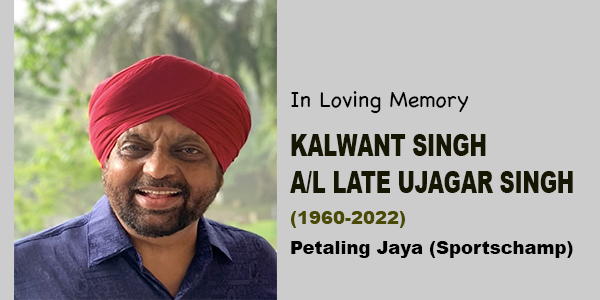
SARDAR KALWANT SINGH A/L LATE SARDAR UJAGAR SINGH
17th March 1960 – 5th June 2022
(Aged 62)
Peacefully departed to Waheguru’s Embrace
Loving Husband, Father, Grandfather, Brother & Uncle will be fondly remembered for all the lives he has touched with his generosity, kindness & charm
Path da Bhog: 12 June 2022 (Sunday), from 5pm to 7pm, at Gurdwara Sahib Petaling Jaya
All Family, Friends & Acquaintances are invited to pay your final respects to the dearly departed.
Contact: Tina (012-217 0146) or Gurpreet (011-2326 8869) for further details.
| Entry: 5 June 2022 | Source: Family
ASIA SAMACHAR is an online newspaper for Sikhs / Punjabis in Southeast Asia and beyond.Facebook | WhatsApp +6017-335-1399 | Email: asia.samachar@gmail.com | Twfffitter | Instagram | Obituary announcements, click here
After a lull for two years, due to the Covid19 virus restrictions, this year once again we are seeing powerful public commemorations and demonstrations against the Indian Army assault on the Akaal Takht and Darbar Sahib in Amritsar in June 1984, the seats of Sikh political and spiritual sovereignty. 38 years have passed since that tragic and extremely bloody event where in effect the Indian State declared war on its ‘own’ people.
For Sikhs, the reason for the attack was simple, to destroy the spirit of Sikhs and their demand to exercise religious, economic, and political sovereignty as set out in the Anandpur Resolution. The Sikh narrative suggests the attack was the culmination of strained relations with the Indian State going back to the partition of Punjab in 1947 and a betrayal of Sikhs ever since within the post-partition newly formed increasingly centralised Union of Indian States.
The justifications given by the Indian State were that a small group of ‘armed terrorists’, led by a religious fanatic Sant Jarnail Singh Bhindranwale, had taken over the Gurdwara and it was their duty to eject them to maintain law and order and to the pilgrims entering the Gurdwara Complex. If that was the case, why was there a need to deploy tanks, rocket-propelled grenades and 10,000’s infantry?
Another version that many commentators have given is that the attack on the Darbar Sahib was an act of revenge by the then PM of India, Indira Gandhi, for the role that Sikhs played in opposing her during the infamous ‘emergency’ which lasted from 25 June 1975 until its withdrawal on 21 March 1977. It’s worth recalling that under the emergency democratic norms were suspended, most of Indira Gandhi’s political opponents were imprisoned, and the press was censored. Several other human rights violations were reported from the time, including a mass forced sterilization campaign spearheaded by Sanjay Gandhi, the Prime Minister’s son.
Amongst various groups, Sikhs were amongst the most active opponents of the emergency, labelling the actions of Indira Gandhi and her Congress party as ‘fascistic’ and dictatorial. In an ironic twist, it’s worth noting that many national political leaders, including the current BJP PM of India, Narendra Modi, took refuge in the Darbar Sahib to escape arrest. In keeping with their traditions of fighting tyrannical rule, less than 2 weeks into the emergency on the 9th of July 1975, Sikhs launched the first mass of many mass protests from the Darbar Sahib Amritsar. The upshot of her action and the public reaction was that Indira Gandhi was displaced as PM and arrested in December 1975 and charged with “planning the killing of all opposition leaders in jail during the Emergency.”
Angered by this the Congress Party supporters demanded her immediate release. They even hijacked an Air India flight in protest of their leader’s arrest. In the face of such national unrest, Gandhi was freed from prison after spending one week in detention for breach of privilege and contempt of the Indian Parliament.
Though the ‘official’ line is that Indira Gandhi sent in the Army to ‘flush out militants, who were being supported by anti-national foreign elements’ in reality there were two ulterior reasons. The first was that she had not forgotten the role that Akali Sikhs played during the emergency and her subsequent embarrassment of losing power in 1977 and imprisonment. And secondly, as Harjinder Singh Dilgeer has argued, she attacked the Darbar Sahib to present herself as a great national hero to win the general elections planned towards the end of 1984 and the rest is history.
Perhaps unaware of Sikh history, the Indian State wrongly thought that through time, bribery and propaganda, Sikhs would quickly forget what happened in 1984 and things would return to normal. The truth is, as the years have passed by, if anything, the June 1984 attack is gaining in prominence, with news books, films and documentaries appearing as each year passes. Moreover, since social media was still in the realm of science fiction in 1984, the Indian State could not have envisaged how its capacity to control the narrative would be undermined with the advent of the internet. A simple google search of ‘Operation Blue Star’, the name that was given to the Army Operation, reveals over 200,000 hits.
The reality is that, though the Indian State probably won the armed conflict in that most of the so-called insurgents were either killed, captured, or exiled, in terms of the propaganda war, this is not the case. Indeed, in the context of the rise of Mr Narendra Modi and his dangerous Hindutva Nationalist project, along with the decline of the Congress Party brand, and the rise of a new and highly educated generation of Sikh activists that are adept at using social media, if anything they are winning the propaganda war. Indeed, the recent victory of the Punjabi Farmers to get the Central BJP Government to repeal the farm laws has raised the spirit of Sikhs that together, despite being a minority community within India, can still wield political power.
Though supporters of the Government deny it has no axe to grind with Sikhs. Indeed, if anything, it claims they are pro Sikh, as has been demonstrated in its support for various festivals commemorating, for example, the 550th birth anniversary of Guru Nanak, and more recently the huge celebration of the 400th birth anniversary of Guru Tegh Bahadur in the Red Ford in Delhi. For some support for festivals is as best superficial, and at worst a cynical attempt to co-opt Sikhs into the Hindutva project. But whatever one’s perspective, the truth is that the sense of alienation felt by successive generations of Sikhs is such that many commentators are expressing concerns about a marked deterioration in the law and order situated in Panjab, especially in the context of the suspicious deaths of two famous Sikh Punjabi celebrities with similar-sounding names, Sandeep Singh Sidhu, aka Deep Sidhu, and Shubhdeep Singh Sidhu, aka Sidhu Moose Wala.
As for a solution, I am not sure there is one since the damage has been done and is irreversible and history has been cast in stone. Those collective memories of 1984 are deeply etched onto the Sikh psyche and will never be forgotten. However, given that 95% of Sikhs live within the Indian State, there is a need to find a negotiated settlement to normalise relations with the Indian State.
This is not an easy task given that Sikhs themselves are fragmented and, even though we have the SGPC and Akaal Takht, because of political patronage and corruption, there is no credibility in their capacity to represent the collective Sikh voice. Moreover, given the increasing influence that diaspora Sikhs have on the Sikh struggle, any settlement must incorporate them as well. So, only when some representative body representing the common interests of the global Sikh diaspora is established, can there be any prospect of meaningful dialogue. Given the sorry state of Sikh political groups, this itself will be a momentous task, though a quick SGPC election and the election of an inclusive unified untainted leadership may make things easier.
Whilst it is important that any table talk that is planned comes with no preconditions, I think a list of demands, if for no other reason than to unite Sikhs with a common minimum platform, will be necessary, in advance of any talks. Whilst not wanting to pre-empt what those might be, I would like to suggest 5 key demands that could form the basis of a negotiated settlement to normalise relationships between Sikhs and the Indian State.
1: Unconditional release of all remaining political prisoners, with full compensation for their financial losses.
2: A public official state-level apology for Operation Blue Star and reparations for the damage and losses, both for individuals, institutions and the State of Punjab.
3: Official state-level recognition that the systematic killing of Sikhs after the assassination of Indira Gandhi in Nov 1984 and a full UN-led investigation with the possibility of prosecutions of crimes against humanity.
4: A declaration that the Indian constitution Sec 25 will be amended to clearly reflect the distinctive separate Sikh religious and ethnic/quomi identity.
5: A commission is established to consult on the possibility of a Punjab referendum to determine the future relationship between Punjab and India.
It is highly unlikely that the Indian state will concede to any of these demands and therefore I fear for generations to come Sikh/Indian relations will at best be strained.
Gurnam Singh is an academic activist dedicated to human rights, liberty, equality, social and environmental justice. He is an Associate Professor of Sociology at University of Warwick, UK. He can be contacted at Gurnam.singh.1@warwick.ac.uk
* This is the opinion of the writer and does not necessarily represent the views of Asia Samachar.
ASIA SAMACHAR is an online newspaper for Sikhs / Punjabis in Southeast Asia and beyond.Facebook | WhatsApp +6017-335-1399 | Email: editor@asiasamachar.com | Twitter | Instagram | Obituary announcements, click here |
L-R: Capt Amarinder Singh, Sunil Jakhar, Navjot Singh Sidhu and Amarinder Singh Raja Warring
By Prabhjot Paul Singh | Opinion |
India’s grand old political party – Congress – is at crossroads as it is passing through its worst existential crisis. Going through its “reformational” phase after a series of defeats in the last two general elections where it just managed to get 44 and 52 seats in Lok Sabha, it has been losing leaders left and right. Its loss has been BJP’s gain.
It has performed no better in Assembly elections of various states in recent years.
The Association of Democratic Reforms said in a report that 222 electoral candidates left the Congress to join other parties during polls held between 2014 and 2021, while 177 MPs and MLAs quit the party during the same period, nearly 45 percent of MLAs who defected between 2016 and 2020 joined the BJP.
The trend instead of slowing down has picked pace in 2022. The count of senior party functionaries saying goodbye to Congress is rising by day. Pretending to be unmindful of the continuous exodus, the Congress High Command has lapsed into silence mode.
It has failed to stem the exodus of leaders despite some attempts to bring in structural reforms through much-hyped Chintan Shivir, or brainstorming session, in Udaipur.
Starting with former Union Ministers Kapil Sibal, Ashwani Kumar and RPN Singh, the party also lost Bollywood star-turned politician Shatrughan Sinha. Sinha had a short stint in Congress while others had been Congress loyalists all their life.
Interestingly, Shatrughan Sinha, who had earlier come from Bharatiya Janata Party, joined Mamata Banerjee’s TMC party to get entry into Lok Sabha from Asansol in a bye-election last month.
Kapil Sibal has joined Akhilesh Yadav and party – Samajwadi Party – to get into Rajya Sabha from Uttar Pradesh.
Senior leaders like Jitin Prasada and Jyotiraditya Scindia, besides former Mahila Congress chief Sushmita Dev and P C Chacko, were among those who set the exodus from Congress in motion.
At one stage, both Jyotiraditya Scindia and Sachin Pilot were projected as future leaders of Congress.
While Jyotiraditya Scindia moved to BJP and is now Civil Aviation Minister in the Narendra Modi Government, Sachin Pilot, too, raised a banner of revolt in Rajasthan where his claim to the Chief Ministerial post was overlooked and Ashok Gehlot got the High Command nod.
After the Congress High Command decided to replace Capt Amarinder Singh as Chief Minister six months before the end of his term, he, too, left the party and floated his own outfit, the Punjab Lok Congress. He then entered into an alliance with the BJP and the Sanyukat Shiromani Akali Dal led by Sukhdev Singh Dhindsa to contest the Punjab Assembly elections in February this year.
Other Punjab Congress leaders who quit the party and joined BJP were Rana Gurmit Singh Sodhi and Fateh Jung Singh Bajwa. Both of them contested the Punjab Assembly elections and were unsuccessful like Capt Amarinder Singh to get into the new Punjab Vidhan Sabha.
Since Punjab Congress was tormented by factionalism, the then State Pradesh Congress Committee chief Sunil Jakhar was replaced by Navjot Singh Sidhu. After the party suffered a debacle in the State Assembly elections, Sunil Jakhar was faced with disciplinary action for anti-party activities. He also quit the party and joined BJP.
Even Navjot Singh Sidhu had a short tenure as the Pradesh Congress Committee chief. After the Assembly elections, he was replaced by Amarinder Singh Raja Warring.
The change of leadership in the State did not stem the defections. Complaining of “suffocation” within the party, senior functionaries, including former legislators, are walking out of the party.
Not far behind Sunil Jakhar to hold the Saffron flag are senior Punjab Congress leaders like Balbir Singh Sidhu, Sundar Shyam Arora, Kewal Dhillon, Raj Kumar Verka, and Gurpreet Singh Kangar. Never before have so many Punjab Congress leaders left the party in such big numbers.
It is also for the first time that no one from Congress represents Punjab in Rajya Sabha. All the seven seats have been captured by the Aam Aadmi Party (AAP).
Other than these Punjab leaders, Congress also suffered the existential crisis in other parts of the country. The Patidar leader Hardik Patel’s resignation as working President of Gujarat Congress didn’t come as a surprise as he had been criticising Congress and its leaders for not having a “roadmap for the people”, Patel said in his resignation letter that India wanted solutions for issues like Ram Mandir in Ayodhya, revocation of Article 370 from Jammu and Kashmir, implementation of GST, and Congress “only played the role of a roadblock and was always only obstructive”. As expected he joined the BJP ahead of the Gujarat assembly elections.
Before Hardik Patel and Sunil Jakhar, Ripun Bora, a former Assam PCC chief quit the Congress party and joined Trinamool Congress (TMC) in April. He too raised a finger at the infighting within the Congress which, he claimed, had “demoralised” party workers and paved the way for BJP to grow.
Prabhjot Singh is a veteran journalist with over three decades of experience covering a wide spectrum of subjects and stories. He has covered Punjab and Sikh affairs for more than three decades besides covering seven Olympics and several major sporting events and hosting TV shows. For more in-depth analysis please visit probingeye.com or follow him on Twitter.com/probingeye
ASIA SAMACHAR is an online newspaper for Sikhs / Punjabis in Southeast Asia and beyond.Facebook | WhatsApp +6017-335-1399 | Email: editor@asiasamachar.com | Twitter | Instagram | Obituary announcements, click here
Decolonisation has become something of a buzzword within academia in recent times, with many universities seeking to find ready-made solutions. Mention a toolkit and you will have your hands snapped off. Toolkits can assist on a journey toward decolonisation, but true decolonisation does not work like a sat-nav system; it requires a much deeper dive, a disruption of the certainty of racialised identities, and ultimately, an ontological rebirthing.
The challenge of decolonisation can be compared to a rainbow. The rainbow is real insofar as it is visible to our eyes but only when it rains and the sun shines. Interestingly, the rainbow, with its vivid colours, is said to come from the scattering of white light, but in reality, there is no such thing as ‘white light’, or rather that white light, as we know it, is made up of an infinite shade of colours spanning the spectrum. Put another way, white light represents an obliteration or absence of colour.
Another interesting fact about a rainbow is that when it appears, it is personal to us; which is why the rainbow moves as we move. In other words, it is a perception corresponding to our unique standpoint. And last, in mythology, we are told that there is a pot of gold at the end of a rainbow, which probably means that if we are able to understand the true essence of a rainbow, we may just be gifted with the richness of wisdom, or perhaps we should avoid futile treasure hunts!
So, what does all this mean for decolonisation? It means a realisation that like white ‘colour’ ‘whiteness’ only exists as a negation of something else; it has no inherent properties for itself. However, it can erase all other wavelengths of light by collapsing them together. In other words, other than as a supremacist dehumanising discourse, whiteness has no ontological purpose.
When we realise this, we can realise that just like light, we are all made up of the same essence, but we do, perhaps through birth and experience develop slightly different wavelengths, which is what makes us unique persons. We are the same but we are also different. But relying on our visual sense alone to register our differences is at best problematic, and at worst dangerous.
Decolonisation requires us to see each other holistically, indeed, to see into each other’s souls. The educationalist Henry Giroux suggests that we need to become ‘border crossers’’. In a world where humanity is divided along physical, economic and cultural boundaries , the task of a border crosser is to transcend false identities. This requires an existential shift which I fear toolkits simply can never achieve.
Ultimately decolonisation is the liberation of ourselves, and when we can truly comprehend the tricks that light plays with our perceptions and thinking, we may just be able to realise the true pot of gold, that is the possibility of seeing the Other in non-hierarchical ways, as equals yet with unique personalities.
Gurnam Singh is an academic activist dedicated to human rights, liberty, equality, social and environmental justice. He is an Associate Professor of Sociology at University of Warwick, UK. He can be contacted at Gurnam.singh.1@warwick.ac.uk
* This is the opinion of the writer and does not necessarily represent the views of Asia Samachar.
ASIA SAMACHAR is an online newspaper for Sikhs / Punjabis in Southeast Asia and beyond.Facebook | WhatsApp +6017-335-1399 | Email: editor@asiasamachar.com | Twitter | Instagram | Obituary announcements, click here |
Paternal Grandparents: Late Baba Sham Singh / Late Nand Kaur (Gurusar, Punjab)
Maternal Grandparents: Late Natha Singh / Late Harnam Kaur (Mansa, Bathinda)
Last Respect from 9.30 am to 12.00 pm, 5 June 2022 (Sunday), at Jalan Loke Yew Crematorium, Kuala Lumpur
Saskaar / Cremation: 12pm, 5 June 2022 (Sunday), at Jalan Loke Yew Crematorium, Kuala Lumpur
Contact:
Surender Singh – 0122929033
Rajdev Singh – 0173113659
Inderrjit Singh – 0126654931
| Entry: 4 June 2022 | Source: Family
ASIA SAMACHAR is an online newspaper for Sikhs / Punjabis in Southeast Asia and beyond.Facebook | WhatsApp +6017-335-1399 | Email: asia.samachar@gmail.com | Twfffitter | Instagram | Obituary announcements, click here
Banker Khushwant Singh with more than two decades of risk management expertise leaves Malayan Banking Bhd (Maybank) to join Capital A Bhd, formerly known as AirAsia Group Bhd.
The 48-year-old banker will be responsible for the overall risk management framework and its adoption towards effective risk management at the investment holding company, he said in an update at his LinkedIn profile.
As the risk management head, he will report directly to the board’s risk management committee.
Khushwant is a risk management professional with 24 years global banking risk experience, with added experience in establishing and managing risk functions in two start up financial institutions in the Middle East, according to his profile.
He leaves Maybank, Malaysia’s largest financial institution by asset size, after serving for 11 years.
For the last six years, he has served as the operational risk head for its group global banking business. Here, he was responsible for the overall ownership of all operational risk management framework, standards, policies and methodologies in alignment with the business objectives of Maybank Group’s Global Banking aspirations.
In the Middle East, he spent about three years collectively as the senior specialist for risk at Al Khalij Commercial Bank and then as the operational risk and fraud manager at Abu Dhabi Finance. Prior to that, he had served Standard Chartered Bank Malaysia for a decade, leaving as the manager for fraud control unit.
Khushwant is also an active in volunteer work having served in a Sikh youth organisation in its top leadership. He is also an auditor with a gurdwara in Klang.
Khushwant’s dad, Charan Singh, had served in the Police Field Force (PFF) while his mother Mother Pritam Kaur was the homemaker. Khuswant is married to Naraern Kaur and the couple has two children.
Capital A, an investment holding company, is supposed to be the group’s transformation from an airline to a digital travel and lifestyle brand consisting of four business verticals: aviation (Airlines, Santan, GTR), digital (airasia Super App, Teleport, BigPay), ventures (airasia academy, airasia grocer) and engineering (Asia Digital Engineering).
ASIA SAMACHAR is an online newspaper for Sikhs / Punjabis in Southeast Asia and beyond.Facebook | WhatsApp +6017-335-1399 | Email: asia.samachar@gmail.com | Twitter | Instagram | Obituary announcements, click here
Grandson of the late Sardar Surjit Singh Panesar & late Sardar Jeswant Singh Dhaunsi
Passed away peacefully on 2 June 2022
Leaving behind beloved :
Father: Updesh Singh
Mother: Harjit Kaur
Brother: Hardish Singh
Sister: Prishveen Kaur
Grandmother, uncles, aunties and a host of relatives & friends to mourn their loss.
Cortege leaves residence No 45, Jalan USJ 11/2, Subang Jaya, Selangor
Saskaar / Cremation: 2pm, 4 June 2022 (Saturday) at Kampung Tunku Crematorium, Petaling Jaya
Path da Bhog: 19 June 2022 (Sunday), from 10am – 12pm, at Gurdwara Sahib Subang. Guru Ka Langgar will be served.
Contact:
Gurmit 016 – 215 4336
Hardish 012 – 359 3130
| Entry: 3 June 2022 | Source: Family
ASIA SAMACHAR is an online newspaper for Sikhs / Punjabis in Southeast Asia and beyond.Facebook | WhatsApp +6017-335-1399 | Email: asia.samachar@gmail.com | Twfffitter | Instagram | Obituary announcements, click here