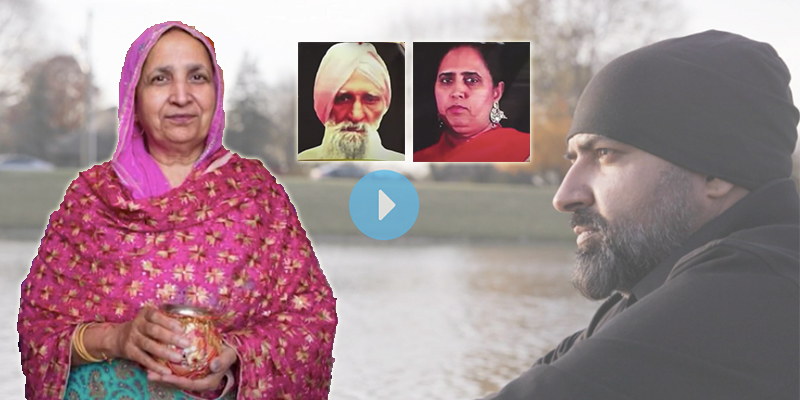
Fateh Singh lies on his cot half-asleep, flirting with the faint breeze and listening to the sounds of the summer night and the musical snores. The rumble of heavy trucks is one of the sounds of the night as he continues to drift midway between the bloodsoaked dreams of his boyhood and the bloodier realities of his beloved Punjab today.
Even the whoosh of heavy hydraulic brakes does not sound any alarm bells in his head. They don’t make any effort at stealth at all. The crunching of their loud metal-soled army boots on the gravel outside belies the administration’s claims of a covert operation. They are not slit-eyed and bow-legged; they wear olive green fatigues. They quickly form a single file and enter the courtyard on the double, the Sten guns hanging from their shoulders marking time on the sides of their torsos as they slap back and forth.
There is no hatred in their eyes, but no compassion either. They are dumb, mute automatons out to do their job. Hukam Singh swings off the cot with an oath, displaying the kind of agility that only extremely fat people have, and a rifle butt comes crashing down on the back of his unprotected head. Fateh Singh is too old to fight and continues to lie on the cot until he is jerked roughly to his feet.
The sevadars huddle together like Siamese twins mumbling incoherently out of fear, but their protests of innocence crumble before their eyes after bouncing off the inscrutable masks that are the soldiers’ faces. Their lips are silent now, but their eyes dart around looking for a saviour or an escape route. Their keskis, which Hukam Singh insists every man, woman and child must wear at all times inside the gurdwara, are rudely snatched from their heads and used to tie their hands behind their backs.
The old woman from Udhampur is lying prostrate on the ground, begging for her husband’s, or at least her son’s life, who cowers against the south wall with his hands tied behind his head with his turban. Fateh Singh looks around and sees that there are at least twenty-five or thirty Sikhs in the courtyard. There are old men and women and little children. And there are young men with hard expressions and sullen faces who stare back proudly and fearlessly at death, clad in olive green and black shiny metal.
There is Hukam Singh groaning with pain and muttering the foulest of curses, ones that would make truck drivers blush. The woman on the floor is wailing now and her mournful dirge is interrupted by gut-wrenching sobs that can see what is about to happen, even as her eyes cannot. The mouths of the Sten guns look as large as annons as the white marble wall behind their backs begins to push them, slowly and relentlessly, towards the shiny black circles of death. Their eyes can only see row upon row of neat geometric circles getting larger and larger until they look as big as railway tunnels and blacker.
ASIA SAMACHAR is an online newspaper for Sikhs / Punjabis in Southeast Asia and beyond.Facebook | WhatsApp +6017-335-1399 | Email: asia.samachar@gmail.com | Twitter | Instagram | Obituary announcements, click here
A storm of controversy is swirling in Punjab as people digest news of the broad daylight murder of Sidhu Moose Wala, a popular rapper, singer and song writer. Here are 10 things about the Punjab singer who blended hip-hop, rap and folk music.
Real Name: Shubhdeep Singh Sidhu
Age: 28. He was born in Moosa village, Mansa district
Early Days: He studied engineering from Punjab before moving to Canada in 2016.
Road to Fame: He is one of Punjab’s biggest pop stars, though known for his temperamental and edgy lyrics.
Controversy: He has had several brushes with the law, called out for promoting gun culture through his songs and social media activity.
Politics: Due to his popularity, Congress tapped him to run in recent state assembly election, but he lost.
Latest Track: His latest track, The Last Ride, was released this month. It features the iconic crime scene where American rapper Tupac was murdered in his BMW in 1996.
Death: Multiple gun shots by unidentified people a day after his security cover was trimmed by the state
Security Details: Police said Moose Wala’s security detail had been reduced to two commandos from four, and that these officers weren’t travelling with the singer when he was attacked. More than 400 people in Punjab, including Moose Wala, had thier security detail withdrawn or scaled back.
Who’s Responsible: State police chief VK Bhawra on Sunday said that a Canada-based gangster had claimed responsibility for the attack. The name Goldy Brar has been bandied about.
ASIA SAMACHAR is an online newspaper for Sikhs / Punjabis in Southeast Asia and beyond.Facebook | WhatsApp +6017-335-1399 | Email: asia.samachar@gmail.com | Twitter | Instagram | Obituary announcements, click here
Malvind Benning (extreme right) after scoring the third goal to seal Port Vale’s 3-0 victory over Mansfield at Wembley Stadium on 28 May 2022
By Asia Samachar | Britain|
Malvind Singh Benning thrilled his team and supporters when Port Vale defeated Mansfield 3-0 for the League Two playoff final at Wembley Stadium on Saturday (May 28).
The left wing-back played an excellent game and capped it with a stunning goal just five minutes before the end of the match, ensuring Port Vale winning the trophy of the day and moving up to League One next season.
The 27-year-old footballer also made history as the first Sikh to score at Wembley in full professional competition.
“Best day of my life!!!! Scoring at Wembley and getting promoted with @OfficialPVFC what dreams are made of!,” Mal tweeted after the game.
In an earlier interview, he told Football Daily: “The main thing for me is being from an Indian – Sikh origin, a lot of kids can hopefully look up to that.” He added that he could wait to represent British South Asian players at Wembley as his side take on Mansfield in the League Two play-off final.
The Premier League is the highest division of professional football in England, followed by The Championship, League One and League Two.
In last year’s FA Vase Cup final at Wembley, Amar Purewal scored in last year’s FA Vase Cup final at Wembley, a competition for England’s high level semi-professional teams. The Football Association Challenge Vase is an annual football competition for teams playing in Steps 5 and 6 of the English national league system.
After the game, Benning who scored for Port Vale, helped his team seal promotion to Sky Bet League One as they beat Mansfield 3-0.
Mal told Sky Sports Football: “The main thing is we got the win. I’m happy to get the third goal and kill the game off. I talked earlier this week about Asians in football and I don’t care it’s me, it’s not about me, but it’s a massive step today.
“I saw it go into the back of the net and I just thought ‘I’ve scored at Wembley’. The gaffer has come back and we’ve rallied around him and he’s rallied around us.”
The long-serving full-back left Mansfield Town Football Club after almost six years, during which he has earned a reputation as a fans’ favourite for his dedicated performances. Mal left the club having amassed 251 appearances in all competitions – the 18th highest of any player in the Stags’ history, reported MansfieldTown.Net.
ASIA SAMACHAR is an online newspaper for Sikhs / Punjabis in Southeast Asia and beyond.Facebook | WhatsApp +6017-335-1399 | Email: asia.samachar@gmail.com | Twitter | Instagram | Obituary announcements, click here
Sidhu Moose Wala (during an election rally in February 2022). He was shot dead on 29 May 2022 while riding in a Jeep (right)
By Asia Samachar | Punjab|
Punjabi singer and Congress leader Shubdeep Singh Sidhu Moose Wala was shot dead in Punjab today (May 29). He was reportedly shot at least 10 times near a temple in village Jhawahar Ke and was declared brought dead at the Civil Hospital in Mansa, reported The Indian Express.
The incident comes a day after the withdrawal of the security cover of the 27-year-old singer. He was among the 424 VIPs who lost their security cover yesterday as part of the Bhagwant Mann government’s exercise to crack down on VIP culture, the report added.
He was shot dead by gangsters, one news report said, quoting an unnamed police source.
Videos of his fired-upon vehicle and dead body became viral soon after the incident.
Sidhu Moose Wala belonged to Moose Wala village near Mansa and was the voice of many superhit songs in the last few years. Moose Wala had contested the Assembly polls on a Congress ticket from Mansa. He was defeated by AAP’s Dr Vijay Singla with a margin of 63,323 votes.
Moose Wala had joined the Congress amid much fanfare in November last year. With Congress granting him ticket from Mansa Assembly constituency, then sitting Mansa MLA, Nazar Singh Manshahia, had revolted against the party saying that he would oppose the candidature of the controversial singer, the report added.
ASIA SAMACHAR is an online newspaper for Sikhs / Punjabis in Southeast Asia and beyond.Facebook | WhatsApp +6017-335-1399 | Email: asia.samachar@gmail.com | Twitter | Instagram | Obituary announcements, click here
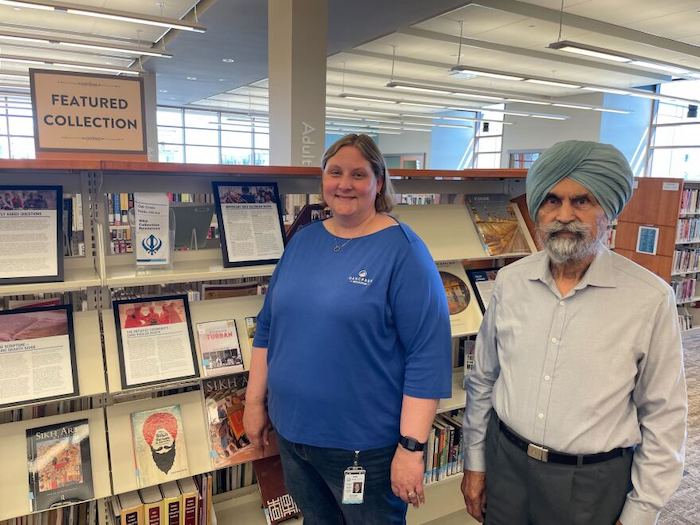
Library Director Jill Lininger (left) and Sikh Temple Official Kulwant Singh Dhaliwal stand in front of the Oak Creek Library’s featured collection on Sikhism. – Photo: Eddie Morales / WUWM
By Eddie Morales | United States|
A new collection of books about the religion and its culture is bridging communities and educating the public.
Library Director Jill Lininger is standing in front of the Sikh book collection in the Oak Creek library. Fluorescent lights illuminate multiple shelves displaying about 120 books and movies.
There are coffee table books on Sikh art, holy scriptures, history books and documentaries.
She points out her favorite book in the collection. “So this book is called Ajeet Singh: The Invincible Lion. And it has a young boy, I’m gonna guess he’s probably six or seven years old. And he is making the muscle pose with his arms above his head showing off how strong he is.”
It’s a story written in English and Punjabi about a boy’s triumph over bullying at school.
The collection was made available to the public in April. Lininger says it’s a continuing effort to educate locals about Sikhs since the Oak Creek Sikh Temple shooting in 2012.
“I think that what’s most significant about what we have here is to start with, it’s a lot of books about Sikhism for non-Sikhs,” says Lininger. “And so it allows the community to start to learn about the diversity in our community and learn about what Sikhism is as a religion and as a culture.
An official at the Oak Creek temple, Kulwant Singh Dhaliwal, says after the shooting, hundreds of people visited the temple to learn more about Sikhism. He says the library’s collection is another resource for non-Sikhs to better understand the religion.
“We try to put in books that are very simple, short and concise that give the factual information without any kind of controversial subjects in it to introduce to the people who Sikhs really are, what their real values are,” he says.
Read the full article, ‘Want to know about Sikhism? Head to new book collection in Oak Creek’ (23 May 2022, WUWM), here.
ASIA SAMACHAR is an online newspaper for Sikhs / Punjabis in Southeast Asia and beyond.Facebook | WhatsApp +6017-335-1399 | Email: asia.samachar@gmail.com | Twitter | Instagram | Obituary announcements, click here
Born in 1933, Mata Mohinder Kaur epitomized the noblest qualities of true faith in Waheguru, selfless service, eternal optimism and the belief that “God resides within all”. Her life of self-sacrifice was inspired by the following Sikh models:
Perpetual faith of Bibi Nanki,
Dedicated spirit of sewa by Mata Khivi,
Chardi kalaa of Mai Bhago and Mata Gujri,
Sarbat da bhala (blessings for everyone) as conceptualized in Gurbani (Ardas)
From a young age, she believed in sharing what she had with others, no matter how little she had. Despite being surrounded by hardships during her youth, she always set aside whatever extra she had for the sake of others. Her generosity towards others was her guiding principle throughout her life and grew proportionally as time blessed her with the fruits of life. Her kindness and philanthropic endeavours earned her immense respect and deep love from people around her.
The doors of her house were always open for anyone who sought love and comfort (she fostered 14 orphans of different races and faith before she had children of her own).
Even in her advanced age, she dedicated herself entirely to making people’s lives better by financially sponsoring the education of needy children and paying the medical expenses of the physically disabled.
She grew up in a kampung (village) and while the world shifted around her as time passed, the kampung spirit was always a part of her essence. Her warm demeanor and compassion for others invoked nostalgia of the kampong’s community, allowing her to connect with people on a deeper level. To her, life was not bound by the material goods one has, but by one’s ability to live to the fullest and cherish a new day full of hope and opportunities.
She had the capacity to always see the glass half-full instead of half-empty. She constantly projected her unflappable optimism and inspired others to overcome life’s challenges with confidence.
She gracefully proved that she would not stop and deter from her path regardless of the innumerable obstacles she faced at different stages of her life. Hers was a story of utmost determination, undying spirit and indomitable courage. When life threw her a curveball, she did not succumb to the situation but instead succeeded in finding a new direction to her life (eg. instrumental in initiating her husband Kartar Singh Dalamnangal‘s refurbishing and real estate business). She was a woman who definitely lived life on her own terms without bowing down to anyone. Her insurmountable determination, rock solid dedication and constant zeal to reach zenith was remarkable and inspired by the indomitable strength she possessed.
She believed in keeping one’s faith strong and in helping others to make the journey of their lives much easier (she was a long-term donor and sponsor in two charitable NGOs in Punjab for female orphans). Her relentless zeal and resilience become a source of encouragement for those around her, especially those who were dealing with adverse situations in their life (eg. relatives and various others in the community). She was the backbone and support system who stood shoulder to shoulder in helping many achieve success in their lives.
(The article was written by a family member. Mohinder Kaur, affectionately known as Bibi Mendro, passed away on 26 November 2021, at the age of 88.)
ASIA SAMACHAR is an online newspaper for Sikhs / Punjabis in Southeast Asia and beyond.Facebook | WhatsApp +6017-335-1399 | Email: asia.samachar@gmail.com | Twitter | Instagram | Obituary announcements, click here
Crossroads captures the story of a community responding to an act of violence, and their right to be safe and treated equally, as Sikhs living in America. It revolves around the Fedex shooting in April 2021 killing eight and injuring several others.
The short documentary was scheduled for release in advance of two more tragic gun violence: the Buffalo racially-motivated shooting in a predominantly Black neighborhood on May 14 and the Texas slaughter of 19 children and two teachers ten days later.
WORLD Channel, which released the documentary, noted that it recognizes the victims and the loss by their families, and acknowledges the violence fueled by the racist hate and extremism that persists in the American narrative and continues to impact communities of color in America.
“Crossroads was scheduled into our programming in advance of the recent tragedy. The film is one of many in a series of resilience and hope, sharing how a community comes together following a horrific loss, and represents strength in the face of senseless violence,” it added.
The documentary was produced by Sarita Khurana.
FedEx operates one of its largest US-based hubs in Indianapolis, where over 80% of the employees are South Asians/Punjabi. In April 2021, former Fedex worker Brandon Scott Hole opened fire, killing eight and injuring several others. While the Sikh community grieves the loss of four of its members, the police and FBI conclude their investigations by declaring the mass shooting not as a hate crime. Many, like Amrith Kaur Aaakre of the Sikh Coalition, question the transparency and findings, including why Indiana’s Red Flag Law was not pursued by the prosecutor’s office; the law could have prevented the shooter from purchasing more firearms. As the community rebounds from the tragedy, the local Gurdwaras continue to be a source of healing, strength and resilience for all.
ASIA SAMACHAR is an online newspaper for Sikhs / Punjabis in Southeast Asia and beyond.Facebook | WhatsApp +6017-335-1399 | Email: asia.samachar@gmail.com | Twitter | Instagram | Obituary announcements, click here
Western Australia has announced changes to the skilled migration program 2022-23 for subclass 190 and 491.
The government has added 194 new occupations to the graduate occupation list, taking the total to 331 occupations.
As a part of McGowan government’s $195 million Reconnect Western Australia strategy, broadening the list aims to attract a wide range of skills aligned with the state’s current and future workforce requirements.
Talking about the benefits of the changes, International Education Minister David Templeman said, “Providing a skilled migration pathway is key for attracting international students to Western Australia to retain their capabilities once they have completed their studies.”
These nominations will be available for applicants who have a nominated occupation identified on the Western Australian skilled migration occupation list (WASMOL) or Graduate occupation list (GOL) using the visa subclasses: skilled nominated visa- subclass 190 or skilled work regional(provisional visa) – subclass 491.
SBS Punjabi spoke to Perth based migration agent Narinder Kaur Sandhu in regards to the new announcement. She says that previously state nomination was not a popular option in Western Australia but within a year a lot of occupations have been added, making it one of the most extensive lists in the country.
“There are now 331 occupations listed in the graduate occupation list, including newly added occupations, such as hairdresser, bricklayer, finance brokers, IT field professionals, motor mechanic, carpenter, cook, dancers, many health occupations and much more.
“If any international student graduates from Western Australia, this program will provide a quick pathway to permanent residency,” said Ms Sandhu.
Read the full story, ‘This Australian state has expanded its skilled occupation list to attract offshore migrants and international students’ (SBS Punjabi, 25 May 2022), here.
ASIA SAMACHAR is an online newspaper for Sikhs / Punjabis in Southeast Asia and beyond.Facebook | WhatsApp +6017-335-1399 | Email: asia.samachar@gmail.com | Twitter | Instagram | Obituary announcements, click here
Battle of Amritsar documentary all set for UK release
By Asia Samachar | Britain|
It looks like the battle is far from over. The impending UK release of the ‘Battle of Amritsar‘ documentary has been greeted with a ‘coordinated attack, intended to have the film banned’, according to one of its promoters.
The documentary, looking at the larger picture of events revolving the June 1984 attack of the Indian army on the Darbar Sahib (popularly known as the Golden Temple) in Amritsar, is scheduled to start screening in Britain on Sunday (May 29).
In a message at a GoFundMe page for the documentary, Shamsher Singh said one of the venues screening the documentary notified them that they had been subject to a coordinated hate campaign to try and force venues to ban its release.
“Thousands of emails were received by venues, and upon closer inspection they were found to be from a singular source, indicating they were being sent as part of a coordinated campaign,” he said in a comment. Asia Samachar has confirmed the message.
He said the emails made claims that “the screening promotes and glorifies a known and designated terrorist by both India and UK, Jarnail Singh Bhindranwale…The screening trailer below promotes him as some sort of hero, which is dangerous and could incite people to commit violence. I urgently request you to prevent this screening from taking place else the Hindus and Sikh community will be left with no option but to report the screening to the Home Office as it directly involves the promotion of a terrorist figure.”
Commenting on the attack, Shamsher said: “This latest attempt at censorship and disinformation targeting our Shaheeds and Khalistan has all the hallmarks of the Indian States ‘cyber warriors’, armies of IT officers set up by all the three branches of the Indian security forces to wage online attacks. The narratives perpetrated by India are rooted in genocide and state violence, and are designed to intimidate and silence Sikhs.”
He said that the Indian IT cell activities range from hacking, creation of false news sites and overwhelming websites and social media through bots, or computer programs which create thousands of false profiles.
With the ‘high calibre feature documentary film’ ready, the promoters were raising funds to screen it in the UK. They also plan to screen it Canada and the United States.
“Cinematically, I’ve not seen anything made like this before,” commented one of the early viewers in a social media comment promoting the screening.
ASIA SAMACHAR is an online newspaper for Sikhs / Punjabis in Southeast Asia and beyond.Facebook | WhatsApp +6017-335-1399 | Email: asia.samachar@gmail.com | Twitter | Instagram | Obituary announcements, click here
A Sikh performing a literal ‘arti’ at a Sikh gurdwara. Is this a Sikh ritual? – Photo: Videograb
By Rishpal Singh Sidhu | Opinion |
While Sikhism does not condone superstitions and the practice of blind rituals, worshipping of idols (Durga puja) and inanimate objects, participating in religious fasts, and pilgrimage to holy places in the belief that the performance and practice of these rituals will result in special blessings from Waheguru, what are the acceptable rituals, rites, ceremonies, and practices of the Sikh faith? While these words are often loosely considered as synonyms, is there a real difference in meaning and usage between them or is it just a question of lexical semantics? What were the views of Guru Nanak and our other Sikh Gurus on this important subject? Should the Sri Guru Granth Sahib and the SikhReht Maryada be the reference or starting point for an understanding of the validity and justification of these practices?
The word ritual is derived from the Latin ritualis, “that which pertains to rite (ritus).” In Roman times and religious use, ritus was the conventional way of doing something or “correct performance, custom”. Its original meaning may also be related to the Sanskrit rta (visible order) in Vedic religion. Initially recorded in English in 1570, this word first came into use in 1600 to mean the “prescribed order of performing religious services.” One ascribed meaning defines a ritual as a religious service or other ceremony which involves a series of actions (ceremonies, rites?) in a fixed order. Conversely, a rite has also been described as an established, well structured and ceremonial act, while rituals are the actions that are performed in a rite with a symbolic meaning. According to the Oxford Classical Dictionary (4th ed, 2012), the definition and interpretation of the word ritual is highly debated among social scientists.
As our Sri Guru Granth Sahib is considered a living Guru, its closing ceremony each evening is the “Sukhasan”, meaning ‘relaxed pose’ and implying a posture of or state of rest, peace and tranquility, and it could well be described as a ritual, as would the opposite ‘Prakash’ ceremony of waking the Sri Guru Granth Sahib each morning. Rites of passage have existed at all times and in all cultures throughout human history. They have been defined as rituals or ceremonies that surround milestone events in a person’s life such as birth, maturity, reproduction, and death. In this context, the SikhReht Maryada clearly prescribes four acceptable rituals or rites of passage which include the birth and naming, marriage, amrit sanskar, and funeral ceremonies which very clearly define the distinction between Sikh and Hindu practices.
“Caste, icon-worship, and empty rituals were its common rejections.”1 At a young and early age, Guru Nanak spoke against the practice of janeu or sacrificial thread of the Hindus. Guru Nanak “denounced external actions and rituals that were empty and oppressive”2 and that segregated society on the basis of religion, caste, race, class or gender, and also “ explicitly rejected the prevailing rituals of his day”3. Ritual barriers were absolutely essential for caste and “the Sikh Gurus rejected almost all the cardinal beliefs of the caste society. They repudiated the authority of the Vedas and allied scriptures, discarded the authority of Avtarhood, disowned all its sectarian gods, goddesses, and Avtaras, and condemned idol worship, formalism, ritualism, and ceremonialism”.4
While some scholars believe that Sikhism is derived from the Bhakti movement and is thus a brand of Hinduism, it clearly differs from other saints of the Bhakti movement on the concept of God and the world. Sikhism lays emphasis on the concept of ‘nirguna bhakti’, worshipping the formless one. Guru Nanak did not subscribe to the idea of renunciation or mukti from maya, and this did not find a place in his teachings. Prior to the publication of Kahn Singh Nabha’s Hum Hind Nahin (We are Not Hindus) Oberoi opines that “the Sikhs had shown little collective interest in distinguishing themselves from the Hindus. Sikh notions of time, space, corporeality, holiness, kinship, societal distinctions, purity and pollution, and commensality were hardly different from those of the Hindus. Also, the two shared the same territory, language, rites de passage, dietary taboos, festivals, ritual personnel, and key theological doctrines.”5
The Singh Sabha Movement was established in the Punjab in 1873 in response to the proselytizing activities of Christians. It was also influential in rejecting the use of ghee lamps and the placing of water under the SriGuru Granth Sahib to ward off evil as Hindu idolatry. Bhai Gurmukh Singh was one of the most prominent figures of the Singh Sabha Movement and he published the Vidyarak monthly journal in 1880, one of whose aims was an exposition of the Sikh rituals.6 While it is not uncommon for Sikhs and Hindus to share and celebrate each other’s culture and festivals such as Diwali and Holi, it is questionable whether such celebrations should necessarily extend to the practice of rituals such as Karva Chauth by womenfolk to pray for the well-being and longevity of their husbands. Karva Chauth is not part of Sikh dharma. It is imperative to transcend this and other similar rituals and pilgrimages, including frenzied singing and dancing to find God.
Sikhism lays emphasis on the concept of ‘Nirguna Bhakti’, meaning devotion and worship of the Divine as formless. The practice of Naam Simran (meditation on God’s name) is the truest form of love and devotion towards God, and together with Kirat Karni (living an honest life) and Wand Kay Shako (sharing what one has with the community), can well be considered Sikh ritual practices in the broadest sense of the word.
There have been sporadic reports of aarti (also spelt arati, derived from the Sanskrit word, aratrika, which refers to the light that removes ratri, or darkness) being performed in front of the Sri Guru Granth Sahib in some gurdwaras. This Hindu and Jain ritual represents the waving of lighted lamps and is performed to express love and gratitude to a god or a person to be honoured. In performing this rite, the worshipper circles the lighted lamp three times in a clockwise direction while chanting a prayer or singing a hymn. Sikh history tells us that Guru Nanak recited the following on observing the ritual aarti being performed at Jagannath mandir.
The fragrance of sandalwood is the incense, the wind is the fan, and all the vegetation are flowers in offering to You, O Luminous Lord. ||1||
ਕੈਸੀ ਆਰਤੀ ਹੋਇ ਭਵ ਖੰਡਨਾ ਤੇਰੀ ਆਰਤੀ ॥
What a beautiful lamp-lit worship service this is! O Destroyer of fear, this is Your Aartee, Your worship service. (SGGS, p.663, SGGS translations by Dr. Sant Singh Khalsa)
Our SriGuru Granth Sahib is replete with pronouncements on some ‘blind’ ritual practices and a selection is reproduced below.
ਤੀਰਥ ਵਰਤ ਸੁਚਿ ਸੰਜਮੁ ਨਾਹੀ ਕਰਮੁ ਧਰਮੁ ਨਹੀ ਪੂਜਾ ॥
Pilgrimages, fasts, purification and self-discipline are of no use, nor are rituals, religious ceremonies or empty worship. (SGGS, p.75)
ਆਚਾਰੀ ਨਹੀ ਜੀਤਿਆ ਜਾਇ ॥
Through ritual actions, God cannot be won over. (SGGS, p.355)
ਬੰਧਨ ਕਰਮ ਧਰਮ ਹਉ ਕੀਆ ॥
They are entangled with religious rituals, and religious faith, acting in ego. (SGGS, p.416)
ਸਗਲ ਪਰਾਧ ਦੇਹਿ ਲੋਰੋਨੀ ॥
You sing lullabies to your stone god – this is the source of all your mistakes. (SGGS, p.1136)
ਵਰਤ ਨ ਰਹਉ ਨ ਮਹ ਰਮਦਾਨਾ ॥
I do not keep fasts, nor do I observe the month of Ramadaan. (SGGS, p.1136)
ਹਜ ਕਾਬੈ ਜਾਉ ਨ ਤੀਰਥ ਪੂਜਾ ॥
I do not make pilgrimages to Mecca, nor do I worship at Hindu sacred shrines. (SGGS, p.1136)
It was not that long ago that women were not permitted entry to the Golden Temple during the early morning service and read/recite the vak (from Sanskrit vaka, a random reading/commandment taken for guidance from the Sri Guru Granth Sahib), or lead the congregation in saying Ardas. It has long been the customary practice for the eldest son to light the funeral pyre of his mother and father. Nikky Guninder Kaur Singh described the pain of “not being able to participate more fully in my mother’s funeral simply because I was a daughter and not a son.”7
The Shiromani Gurdwara Parbandhak Committee (SGPC) in Amritsar has for long been a male dominated organization that wields enormous power in Sikh life, including making rules and regulations for Sikhs to follow throughout the world. The official version of the Sikh Rehat Maryada was drafted between 1932-1936 and approved by the SGPC in 1945, almost eight decades ago. The time is nigh at hand for an enlightened re-visitation of some of these rules, regulations, practices, and ceremonies.
References
1. Singh, H. (1995). Berkeley lectures on Sikhism. Manohar, Delhi, p. 19
2. Goa, D. & Coward, H. (1986). Ritual, word and meaning in Sikh religious life; A Canadian Field Study. Journal of Sikh Studies. 13, p.11.
3. Ibid, p.13.
4. Singh, J. (2006). Percussions of history; The Sikh Revolution & in the Caravan of Revolutions. The Nanakshahi Trust, p.98.
5. Oberoi, H. Conference paper. From Ritual to Counter-Ritual: Rethinking the Hindu-Sikh Question, 1884-1915. p. 136.
6. Jagjit Singh, Singh Sabha Lahir, p.23, as cited in Oberoi, H. (1997). The construction of religious boundaries; Culture, Identity and Diversity in the Sikh Tradition. Delhi, Oxford University Press, p.285.
7. Singh, N. G. K. (2000). Why did I not light the fire? The refeminization of ritual in Sikhism. Journal of feminist studies in religion, 16(1), 63-85.
Rishpal Singh Sidhu is a semi-retired casual academic at the School of Information and Communication Studies, Charles Sturt University, Australia. He has a passion for research, writing, and teaching. He is the compiler and editor of the book, Singapore’s early Sikh pioneers; Origins, Settlement, Contributions and Institutions, published by the Central Sikh Gurdwara Board in Singapore in 2017. He is currently based in Sydney, Australia.
* This is the opinion of the writer, organisation or publication and does not necessarily represent the views of Asia Samachar.
ASIA SAMACHAR is an online newspaper for Sikhs / Punjabis in Southeast Asia and beyond.Facebook | WhatsApp +6017-335-1399 | Email: editor@asiasamachar.com | Twitter | Instagram | Obituary announcements, click here |