UA-56202873-1
Page 390

Eye on risk

By Asia Samachar| MALAYSIA  |

Kirenjeet Kaur will be the face of risk management at Manulife Malaysia. She joins the member of the Canadian-based financial services group from AmBank Group.

Here, she will be be assuming the role of chief risk officer (CRO) effective July 2021, according to an update at her personal LinkedIn page.

She leaves AmBank Group after a stint of four-and-a-half years. She was the group’s head business operational control wholesale banking.

“My colleagues have been very accommodating & cooperative throughout my journey in AmBank. There were some disagreements but we managed to put our differences aside & respect each other’s opinion to achieve common goals,” she shared in an entry at the LinkedIn page.

Prior to this, she had work stints at AIG, Eastspring Investments Bhd and Scope International.

CROs for leading insurers are playing a critical role in the present risky and uncertain environment, according to a recent McKinsey report. They have risk oversight of activities conducted by the first line (business and corporate functions) and assure the chief executives and boards that companies are achieving a proper risk-management balance. In approaching heightened risk levels, CROs aim to limit the downside danger but also enable the business to make the necessary risk–reward trade-offs to capture the upside. It is a delicate balance, it added.

The publicly listed Manulife Holdings Bhd has the following subsidiaries: Manulife Insurance Bhd, Manulife Investment Management (M) Bhd and Manulife Insurance Labuan Ltd. Its assets under management as at 31 March 2021 is over RM12 billion, according to its website.

Kirenjeet has a Bachelor of Arts (BA) in Accounting and Financial Analysis from Anglia Ruskin University.

RELATED STORY:

Power counsel for wheels (Asia Samachar, 23 July 2021)

Small town Sikh lady made partner at big Malaysian accounting firm (Asia Samachar, 1 July 2021)

ASIA SAMACHAR is an online newspaper for Sikhs / Punjabis in Southeast Asia and beyond.Facebook | WhatsApp +6017-335-1399 | Email: editor@asiasamachar.com | Twitter | Instagram | Obituary announcements, click here |

Up at 4am to get oxygen for Mandalay

By Asia Samachar| Myanmar  |

Mandalay Sikhs are not sitting back as the nation is buckling under a surge of Covid-19 cases, with hospitals across the country reportedly suffering from a lack of medical equipment, beds, oxygen and doctors.

A band of Sikh youth from the second-largest city in Myanmar are making available oxygen for those stricken by the novel coronavirus.

“The situation is terrible. Here, people are facing a lack of oxygen. We are trying to make it available to whom we can reach out,” one Sikh volunteer on the ground told Asia Samachar.

What does it involve? At 4am, a volunteer drives the ambulance belonging to the Mandalay Sikh Youth to an oxygen factory and will have to wait patiently in the usually long queue.

“It’s very difficult as there are so many people. Some days, oxygen runs out,” he said.

Myanmar was thrown into turmoil following a Feb 1 military coup. The military has launched a bloody crackdown on dissent that has killed more than 900 people according to a local monitoring group. A mass civil disobedience movement has also paralysed the economy, with many banks shuttered and authorities unable to issue bills or collect taxes, reported AFP.

In a report, World Bank has said that the proportion of the country’s population living in poverty was “likely to more than double” by the beginning of 2022 compared with 2019 levels.

RELATED STORY:

Sikh entrepreneur opens tyre shop in Mandalay (Asia Samachar, 22 June 2021)

‘Oxygen langgar’ warriors featured on cover of Reader’s Digest India (Asia Samachar, 27 June 2021)

ASIA SAMACHAR is an online newspaper for Sikhs / Punjabis in Southeast Asia and beyond.Facebook | WhatsApp +6017-335-1399 | Email: editor@asiasamachar.com | Twitter | Instagram | Obituary announcements, click here |

Filmmaker Harpreet Kaur bags 3 Emmy Awards

By Asia Samachar| United States  |

Consummate filmmaker and storyteller Harpreet Kaur bagged three Emmy Awards for production in a regional competition.

She contributed the lion’s share of the seven awards won by Maryland Public Television (MPT) at the 63rd Emmy® Awards ceremony presented by National Capital Chesapeake Bay Chapter of the National Academy of Television Arts & Sciences (NATAS) on Saturday (June 26).

The three awards were for the Maryland Farm & Harvest, an MPT series on Maryland’s farmers and the state’s agriculture industry. It puts a human face on farming and educates viewers about agriculture.

Harpreet swept two awards for segment producer awards and her team won an award for the magazine program series category.

The National Capital Chesapeake Bay Chapter of NATAS comprises television industry professionals dedicated to fostering and recognising outstanding achievements in television production in Maryland, Virginia, and Washington, D.C. Its annual Emmy Awards competition acknowledges excellence in areas including entertainment programs, news and documentary shows, and sports programming, according to an MPT statement released on its website.

This is not the first stardom moment for Harpreeet, a graduate of Pennsylvania State University who started her career as a news reporter in the DC metropolitan area. In 2019, she became the first Sikh woman to win a prestigious Emmy Award from NATAS.

For over a decade, she has directed award winning documentaries shedding light on social and human rights issues.

Her award-winning feature documentary, The Widow Colony – India’s Unsettled Settlement, has been screened by members of the United States Congress and members of Parliament in Canada and the United Kingdom, and has been endorsed by various human rights, civil rights and social welfare organizations around the world. Her most recent film, A Little Revolution– A Story of Suicides and Dreams has seen similar success.

“I’ve been able to impact the lives of the individuals in my films and have inspired audiences to become proactive,” she said in a note on her LindkedIn page.

In 2016, Harpreet was also featured in the launch of The Sikh Project, a major photography exhibition by British photographers Amit and Naroop. The exhibition features 38 portraits of turbaned Sikhs, including Harpreet.

RELATED STORY:

Singapore Sikh documentary bags award at Indian film festival (Asia Samachar, 15 Dec 2020)

ASIA SAMACHAR is an online newspaper for Sikhs / Punjabis in Southeast Asia and beyond.Facebook | WhatsApp +6017-335-1399 | Email: editor@asiasamachar.com | Twitter | Instagram | Obituary announcements, click here |

We must stop using the term ‘Sikhism’ and assert uniqueness of ‘Sikhi’!

1

By Gurnam Singh | OPINION |

The Chairman of the Indian Parliamentary Standing Committee recently put out a call to experts to submit their suggestions for the exclusion/inclusion of the history content in the National Council of Educational Research and Training (NCERT) textbooks. Through the aegis of the NCERT, an autonomous organisation set up in 1961 by the Government of India to assist and advise the Central and State Governments on policies and programmes for qualitative improvement in school education, the expressed intention of the consultation is to remove references to “unhistorical facts and distortions about Indian national heroes from textbooks, ensuring equal or proportionate references to all periods of Indian history, and highlighting the role of great historic women heroes”.

Though I am generally sceptical about most actions of the Indian state, in terms of process, on this occasion, their call for submissions from interested parties concurs with democratic ideals of public policy formation. Time will tell if they listen to the case being presented on behalf of Sikhs.

My fear is that, because of the lack of competence and total loss of credibility on the Shiromani Gurdwara Parbandhak Committee SGPC, the ‘Panthic’ perspective may well become undermined by submissions from shady groups claiming to represent the Sikh voice. For example, what is stopping the Sikh version of the RSS making their own submissions, or groups like the Sant Smajh who largely accept beliefs and practices associated with Vedanta and Sanatan Dharam?

As well as ensuring the Panthic perspective is represented, there is perhaps a deeper challenge we face, and that is the one of translation. For example, though I totally agree that Sikhi is completely distinctive from all the major world faiths, I do not accept it is a ‘religion’, but, as Bhai Gurdaas Ji points out, a ‘Panth’, which has a completely different meaning.

Moreover, our concept of God or the divine being, of life and death and a whole range of other theological precepts is completely different, but tragically much of the mainstream literature maintains that ‘Sikhi is an off shoot of Hinduism, or that is an amalgam of Hinduism and Islam.

The problem with trying to fit Sikhi into the dominant Vedic and Islamic paradigms within the context of India, is that by doing so the distinct essence can be lost. We face the same challenge the world over as we try to constantly fit our narrative into the broader Abrahamic paradigm.

SEE ALSO: Expressing authenticity: Gurmat not Sikhism or its derivative, Sikhi

But if we are to establish out claim for distinctiveness, we must seek to elevate our own concepts, the two central opens in this regard being, ‘panth’ and ‘quom’. That also means we need to stop using the term ‘Sikhism’, which is nowhere to be found in any historical Sikh text, and instead normalise the term ‘Sikhi’, which is. I am sure that if we referred to Christianity or Islam as ‘Christianism’ and ‘Islamism’, followers of these faiths would not be too pleased.

I think ultimately the only solution to the perennial problem of misrepresentation of Sikhi and Sikhs and the issue of national RE curriculum is for the establishment of an international body that is recognised by the United Nations to represent the Global Sikh Panth. Like the World Council of Churches or the World Jewish Congress, such a body could bring ALL the main Panthic bodies together, to compile, amongst other things, a complete official compendium of Sikh history, theology and rehit (code of conduct).

I know this is a big ask, but I am unsure how else we can resolve the many divisions on range of issues that the Panth is experiencing. Such a document would not be designed to undermine critical scholarship or debate, but to act as a reliable reference point for policy makers. It may just also help to create some clear water between the true Panthic Sikhs and those who have ulterior motives!

As for the Indian Government and the national curriculum, I don’t hold out much hope as I believe their intentions to establish Hindutva are clear. But we should not need prompting from the Indian state to put our own house in order.

[Gurnam Singh is an academic activist dedicated to human rights, liberty, equality, social and environmental justice. He is an Associate Professor of Sociology at University of Warwick, UK. He can be contacted at Gurnam.singh.1@warwick.ac.uk]

* This is the opinion of the writer and does not necessarily represent the views of Asia Samachar.

RELATED STORY:

Science, religion and the Covid-19 crisis (Asia Samachar, 30 May 2020)

ASIA SAMACHAR is an online newspaper for Sikhs / Punjabis in Southeast Asia and beyond.Facebook | WhatsApp +6017-335-1399 | Email: editor@asiasamachar.com | Twitter | Instagram | Obituary announcements, click here |

Sardar Sojan Singh Pannu (1947-2021), Ampang

SARDAR SOJAN SINGH PANNU S/O LATE SARDAR FAUJA SINGH

16.12.1947 – 23.7.2021

Beloved Wife: Sardarni Sukhdev Kaur d/o Late Sardar Bachan Singh

Children / Spouses:

Simran Kaur Pannu
Gurroshan Singh Pannu / Balvinder Kaur
Kavita Kaur / Balvinpal Singh Sohi
Amarpreet Kaur

Grandchildren: Diiyaapal Kaur Sohi

Saskar/Cremated: 24th July 2021

Path da Bhog: To be advised

Contact:

+61480177272 – Gurroshan Singh

+60173267165 – Kavita Kaur

+60176235390 – Balvinpal Singh Sohi

A light from our family is gone A voice we loved is stilled
A place is vacant in the home Which never can be filled

We have to mourn the loss of one We would’ve loved to keep
But God who surely loved his best Has finally made him sleep

After a lifetime of his love and joy And music to fill our ears
God leaves these wondrous memories To help us through our tears

Sardar Sojan Singh s/o Late Sardar Fauja Singh, aged 74, passed away peacefully on 23 July 2021.

Forever loved and cherished by his children and loved ones.

| Entry: 24 July 2021 | Source: Family

ASIA SAMACHAR is an online newspaper for Sikhs / Punjabis in Southeast Asia and beyond.Facebook | WhatsApp +6017-335-1399 | Email: editor@asiasamachar.com | Twitter | Instagram | Obituary announcements, click here |

A gurdwara on the legs of a dragonfly

8
By Vishal J. Singh | Gurdwara Design |

The Fellowship Camps in Cameron Highlands carry many a fond memory for me, and I’d like to start off this article by taking a heartwarming stroll down memory lane.

As I reminisce the past through my rose-tinted sunglasses, I began to remember all the lessons in camaraderie and community-building that I was lucky enough to experience with my fellow Sikh brothers and sisters, while attending these camps that were usually held around the Chinese New Year Holidays on an annual basis. Never did I feel so connected to my own culture, and never did l learn more about my own faith than when I was attending these Fellowship Camps, and I do remember adoring every moment of being there. Friendships that last a lifetime really do have humble beginnings, and I truly am grateful for these camps.

Thinking about these camps, I began to daydream, that if I had the chance to design a Gurdwara in the highlands, either for the local Sanggat or for the Naujawan who attend camps like these, then what kind of design could I propose that would suit the environment of the highlands as optimally as possible?

This line of mental questioning led me to envision what a Gurdwara for the highlands could look like, and the following is a conceptual proposal only that was composed in my mind’s eye to satisfy the floating queries of my occasional bouts of architectural daydreaming, as I like to call it. As mentioned before in all my previous articles, this proposal is conceptual only, meaning it is not a real commission or project, but simply my vivid imagination having a little bit of fun from an architectural point of view.

This conceptual Gurdwara, located in the highlands, is designed primarily around the idea that whatever structure that needs to be built on the sensitive hill slopes of the highlands, there should be as minimal structural impact on the natural terrain as possible. Instead of building a structure that forcefully flattens the terrains of the gentle slopes, the structure is designed to “sit” lightly on its site, and the inspiration for this idea comes from nature itself, specifically from flying insects such as dragonflies or butterflies.

Observing the anatomy of dragonflies for example, the body of the entire insect is supported on its long and slender legs, which gently lands on whatever surface it lands on, and there is no fear of collapse that the legs will not be able to support the entire body of the dragonfly. Similarly, clever engineering principles of contemporary architecture can also be applied to create lightweight structures that mimic this miracle of natural design, thus allowing for buildings to be built on slopes that create a minimal impact on the natural terrain of the site, thus trying to preserve the sensitivity of the landscape as much as possible.

The entire Gurdwara is conceived as a series of structural steel and bamboo platforms, that follow the natural terrain of the hillside, and sits on a frame of slender white columns to provide the necessary support it needs to stand. The Langgar Hall and the Giani’s Accommodation Quarters, with whatever supplementary rooms that are needed, are located below the Darbar Sahib, shown in light brown in the image above. There is a bamboo staircase that leads to the Nishan Sahib Plaza above and the Darbar Sahib too, connected to the entrance court and the Langgar Hall Level too.

Looking from the right side, this proposed Gurdwara carries a very strong horizontal look that is elevated above the hillside itself, thus allowing for the natural terrain of the site to remain as it is, untouched and unaltered as much as possible. The Darbar Sahib is on the highest level, and the Langgar Hall and the Giani’s Accommodation Quarters are located below, next to an open – air gazebo for people to spend time in to enjoy the surroundings.

The Darbar Sahib is fitted with a series of recycled bamboo slats arranged diagonally, that create a striking visual language for the walls of the Gurdwara itself, and the gaps in between allow for cool mountain air to circulate in and out of the Darbar Sahib.

There is even a part of the Darbar Sahib that is totally open to the outside but can be closed with sliding glass doors, so that the sanggat can enjoy the spectacular views of the surrounding areas, while allowing cool gusts of wind to cross the entire hall from one side to another.

The usage of recycled bamboo for both the floors and the walls are rooted in the commitment of using natural, sustainable materials that are preferably locally sourced, for the partial construction of this proposed Gurdwara, where possible. This decision of using bamboo here, is thus is part of the greater ‘green’ agenda that is integral to the eco-friendly design of this Gurdwara.
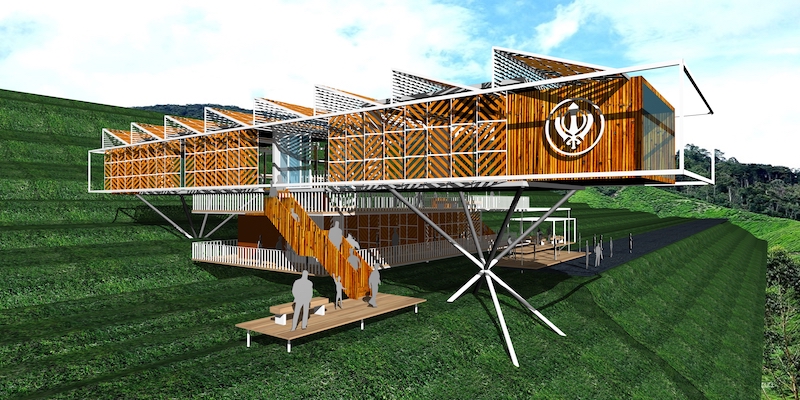
The left side of the elevated Darbar Sahib is connected to a bamboo staircase that leads to a platform below allowing the Sanggat views of the surroundings, while allowing them to also walk along the slopes, should they want to explore the landscape as well.

The natural environment as we know it truly is under a lot of pressure. Just recently, they have been devastating floods in Germany and China, and relentless heat waves and wildfires are raging across parts of the United States and Canada. Clearly, the effects of climate change are beginning to take place more aggressively, which is projected to be even worse in the future. Perhaps the time for a new paradigm truly has arrived, where instead of plundering nature for our benefit, we start to look for ways to work with nature, and the architectural industry has a momentous role in helping to lead the way to a safer, greener world. This proposed Gurdwara design is born from that hope, of designing buildings that work with nature, rather than against it. We can all do our part, and the simplest of ideas, either conceptual or action-orientated, can and do lead to great changes in the future.

Stay safe. Waheguru Bless.

The next proposal will imagine designing a Gurdwara that can expand structurally and reconfigure its general look and layout as required over time, for specific functions or events.

Vishal J. Singh, an aspiring architect, holds a Bachelor of Architecture Degree from Infrastructure University Kuala Lumpur and enjoys engaging in architecture and its theories as his first love.

* This is the opinion of the writer, organisation or publication and does not necessarily represent the views of Asia Samachar.

RELATED STORY:

Into the Future: Gurdwara that walks (Asia Samachar, 19 Jan 2021)

ASIA SAMACHAR is an online newspaper for Sikhs / Punjabis in Southeast Asia and beyond.Facebook | WhatsApp +6017-335-1399 | Email: editor@asiasamachar.com | Twitter | Instagram | Obituary announcements, click here |

The end of Captain’s era

By Harjeshwar Pal Singh | OPINION |

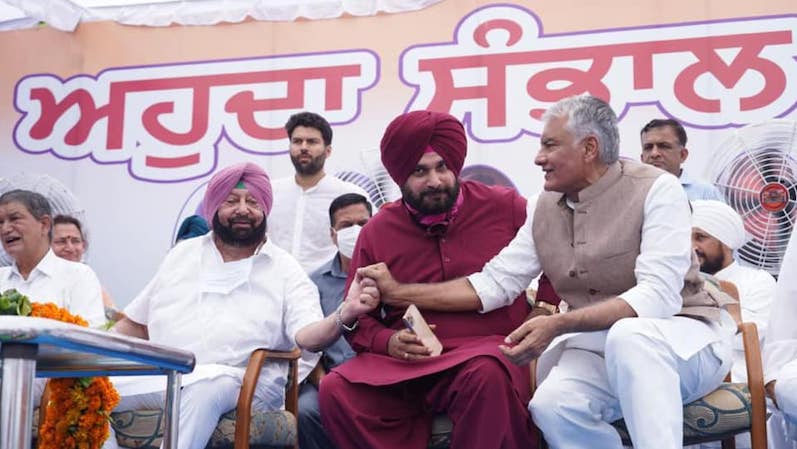
Now that the Captain Amarinder Singh era is coming to an end after a quarter century of dominance in Punjab politics, it is time to take stock of his career.

His career since he became the Punjab Congress president in 1998 can be divided into three phases.

The time from 1998 till 2004 can be seen as the period of struggle for ascendency. During this phase the royal from Patiala had to face considerable hostility from the old guard of the Congress. The likes of Jagmeet Brar and Rajinder Kaur Bhathal were consistent thorns and it was only the determined support of Sonia Gandhi at the centre which propped up Amarinder Singh as the chief minister (CM) in 2002. Luck also played a part as the division between the Parkash Singh Badal and Gurcharan Singh Tohra factions helped Congress to win both the 1999 Parliamentary elections and 2002 assembly elections. During this time Amarinder was surrounded by a core which included Rana Sodhi, Rana Gurjit, Kewal Dhillon, BIS Chahl and Bharat Inder Singh Chahal (BIS).

The period 2004-2014 was the zenith of Amarinder’s in Punjab Politics. His decision to scrap the river water sharing agreement in 2004 made him the first mass leader of Punjab Congress, a bold and fearless leader who was willing to sacrifice his CM ship for the interests of Punjab. At the same time Amarinder broadened the social base of Punjab congress adding the Jatt Sikh peasantry to the traditional Hindu and Dalit base of congress. One of Amarinder’s abiding legacies remains his replanting of Congress into Punjabs soil despite hostility towards the Gandhis. He led Congress twice to victory and Congress never won less than 44 seats under his command. This achievement gave him an edge over the Congress high command and made his name as a bold and charismatic regional leader not afraid to speak his mind.

In this Amarinder-Badal era of politics, ideology and workers were sidelined in favour of moneybags and winning ability, leading to blurring of the distinctions between political parties. Big ticket corruption made its entry and oiled the political machines. Ideological dexterity helped Amarinder to firmly secure a centrist space in politics and to appeal to multiple constituencies simultaneously. If he appeared as a champion of Sikh and farmers interest in his first tenure, appeal to national security and Hindu anxiety characterised his second stint in power.

Amarinder was feted during his first tenure as a bold and decisive administrator by his ensuring timely and hassle free procurement and ending corruption in public services. His decision to imprison the Badals and other Akali ministers on corruption charges also added to his popularity. Despite defeats in the 2007 and 2012 assembly elections and his replacement by Partap Singh Bajwa as PPCC chief, Captain remained the tallest congress leader. His crowning achievement came in the 2014 Lok Sabha elections when he defeated the formidable Arun Jaitley from Amritsar at the height of Modi wave. The Patiala royal was ruthless against his political rivals — Bibi Bhathal, Jagmeet Bear and Partap Singh Bajwa virtually ending their careers, this nipped in the bud many potential revolts against him. Over the years, Amarinder established a reputation of a national statesman — suave, secular and sophisticated, a darling of the liberal media but at the same time a hawk on national security and foreign policy which helped him to carve a niche in national politics many times at a variance with his party.

The last phase of Amarinder Singhs career 2014-2021 saw him declining steadily. A number of corruption cases led him to compromise with his former foes Badals and a slew of new leaders like Bhagwant Mann and Navjot Sidhu emerged in Punjab who eclipsed him in popularity. The spectacular self immolation of AAP and aided by Parshant Kishore’s adroit marketing led to Captain again tasting power in 2017. However his current tenure has been a disaster. Incompetence, inaccessibility, pusillanimity, collusion and outsourcing of administration marked his current regime. Failure to fulfil promises like justice for beadabi, jobs, drug eradication etc dented his credibility. His notorious inaccessibility and tendency to be surrounded by a coterie cut him off from popular and worker sentiment. The perception that he played second fiddle to Modi and colluded with the Badals chipped at his carefully created image of a bold Punjab politician. His abominable brand of politics playing the “Hindu, national security and Khalistan“ card marked him as a cynical power hungary politician. Images of “parties”, ”sitaphals” and “female friends” in lavish farmhouses strengthened the image of a licentious feudal unconcerned with state affairs. The vice like grip of bureaucracy in decision-making and administration made the government unaccountable while MLA’s running mafia rackets made it appear rapacious.

The arrogant and complacent CM failed to gauge the public and worker mood until it was too late for him as the Congress MLA’s under an ambitious and popular former celebrity in alliance with a new Congress high command pulled the rug from under his feet.

Harjeshwar Pal Singh is an assistant professor at Sri Guru Gobind Singh College, Chandigarh, where he teaches history. He is an avid political commentator.

RELATED STORY:

Has Navjot Sidhu slayed the dragon of Punjab politics? (Asia Samachar, 19 July 2021)

SAD joins BSP for 2022 Punjab state polls (Asia Samachar, 13 June 2021)

ASIA SAMACHAR is an online newspaper for Sikhs / Punjabis in Southeast Asia and beyond.Facebook | WhatsApp +6017-335-1399 | Email: editor@asiasamachar.com | Twitter | Instagram | Obituary announcements, click here |

Power counsel for wheels

By Asia Samachar| MALAYSIA  |

Susheel Kaur, a general counsel for Mercedes-Benz Financial Malaysia, has been recognised as a powerhouse when it comes to being an in-house lawyer.

She bagged the In-House Lawyer of the Year 2021 at the recent Asian Legal Business Malaysian Law Award 2021.

Organised by Thomson Reuters, the annual award ceremony recognises the best legal minds in the country both in-house and for those in private practise.

The 38 year-old mother of two was also recognised as one of the 17 Rising Star Lawyers under 40 in Malaysia. She was also listed as finalist for In-House Young Women of the Year, In-House Women of the Year and In-House Team of the Year alongside with other great legal names.

Susheel Kaur has 14 years’ experience as a lawyer – almost six years’ experience as a general counsel for Mercedes-Benz Financial Malaysia and eight years of extensive litigation experience as a deputy public prosecutor (DPP) in Securities Commission Malaysia.

She was involved in setting up the legal and compliance department of Mercedes-Benz Financial Malaysia in 2016.

Mercedes-Benz Services Malaysia is part of the Daimler Financial Services group, the financial services arm of the Daimler group, operating globally in 40 countries. As one of the largest automotive financiers in the world, Daimler Financial Services is also the world leader in commercial vehicle financing.

It is supported by more than 40 authorised dealers nationwide and offers a broad range of automotive finance and insurance solutions for customers in Malaysia.

In her previous at the SC, Susheel was involved in landmark cases involving capital market and securities offences involving anti-money laundering charges.

She believes with humility, hardwork and determination every young girl can dream big. It’s her personal goal to mentor as many young girls as possible to achieve their full potential.

Born in Klang, Selangor, Susheel’s parents are Sarbjit Singh (popularly known as Sheel Vision Video man) and Kuldip Kaur.

RELATED STORY:

Small town Sikh lady made partner at big Malaysian accounting firm (Asia Samachar, 1 July 2021)

ASIA SAMACHAR is an online newspaper for Sikhs / Punjabis in Southeast Asia and beyond.Facebook | WhatsApp +6017-335-1399 | Email: editor@asiasamachar.com | Twitter | Instagram | Obituary announcements, click here |

Southampton church to reopen as gurdwara

1
Southampton Methodist church in Burgess Road

By Tom Orde| Britain |

The Methodist Church on Burgess Road was put on the market earlier this year with a price tag of £1.2million.

It has now been given a new lease of life and been snapped up by a Sikh group called Gurdwara Khalsa Darbar.

The Grade II listed building which is thought to have been built in the 1930s is undergoing a £50,000 revamp.

Two prayer rooms have already been refurbished, according to a spokesperson for the community group.

Meanwhile, the building will “stay in keeping” with the character of the area and remain part of Swaythling heritage.

Designed by Herbert Collins, the church has seen a dwindling congregation in recent years and its state has deteriorated.

With a neo-Georgian style and octagonal shape, the redbrick building could hold 1,000 worshippers at a time.

A spokesperson for the Gurdwara said: “Part of the rich heritage that Herbert Collins created in Swaythling, is the Methodist Church in Burgess Road, for nearly a century this building has graced the local skyline and it is a unique example of the work of his genius.

“Over the past few years with the decline of the Methodist congregation the building has sadly deteriorated and indeed needs a considerable amount of money spent to restore this grade two listed building.”

“The building was recently put up for sale with all the uncertainty of its future which comes with new ownership.”

The spokesperson added: “However I am delighted that members of the local Sikh community have purchased the building and now have started a complete restoration project and the Gurdwara Khalsa Darbar have taken stewardship of this wonderful building.

“They a keen to play their role in our local community and give special recognition of Herbert Collins his work and further plans around this will be announced in due course.”

Measuring 14,575 Sq Ft, the former church was constructed with a steel frame with brick elevations under a domed roof with parapets.

The two-storey building includes dance studios, changing rooms, and an office and hall.

Senior elder of the Gurdwara, Mr Amrik Gill, has invited worshippers to ceremonies to mark the building becoming a Temple.

They will take place at 12pm today and 12pm on Friday.

Read the full story, ‘Southampton Methodist church in Burgess Road to become new Sikh temple’ (Southern Daily Echo, 22 July 2021), here.

RELATED STORY:

The ‘green’ gurdwara for tomorrow (Asia Samachar, 7 July 2021)

ASIA SAMACHAR is an online newspaper for Sikhs / Punjabis in Southeast Asia and beyond.Facebook | WhatsApp +6017-335-1399 | Email: editor@asiasamachar.com | Twitter | Instagram | Obituary announcements, click here |

Pulapol Sikhs distribute dry ration in Setapak

0

By Asia Samachar| MALAYSIA  |

Over the weekend, Gurdwara Sahib Pulapol (GSP) volunteers handed out dry ration packs, each worth about RM100, to the needy in the neighbouring Setapak area as well as Segambut and Kajang.

As volunteers are still unable to access the GSP building due to the pandemic lockdown, the event took place at the Ayer Panas Food Court.

The sponsorship came from ACS, Ipoh Old Boys (KL Angolianz) through local NGO Educare Group.

GSP felt that it is an appropriate time to assist those in need during this pandemic and at the same time it is crucial to have a database of those who are affected and also those who are not able to sustain their day-to-day living, especially those residing within the vicinity of Setiawangsa and Wangsa Maju parliamentary constituencies as the GSP sanggat comes mostly from these areas.

GSP has also donated all its dry stock for langgar to Sukuna Orphanage Lindungan Ikhlas, Air Panas since the gurdwara is unable to run its regular programmes due to the lockdown.

RELATED STORY:

Brickfields Panjabi restaurant provide free food twice a day (Asia Samachar, 14 July 2021)

ASIA SAMACHAR is an online newspaper for Sikhs / Punjabis in Southeast Asia and beyond.Facebook | WhatsApp +6017-335-1399 | Email: editor@asiasamachar.com | Twitter | Instagram | Obituary announcements, click here |