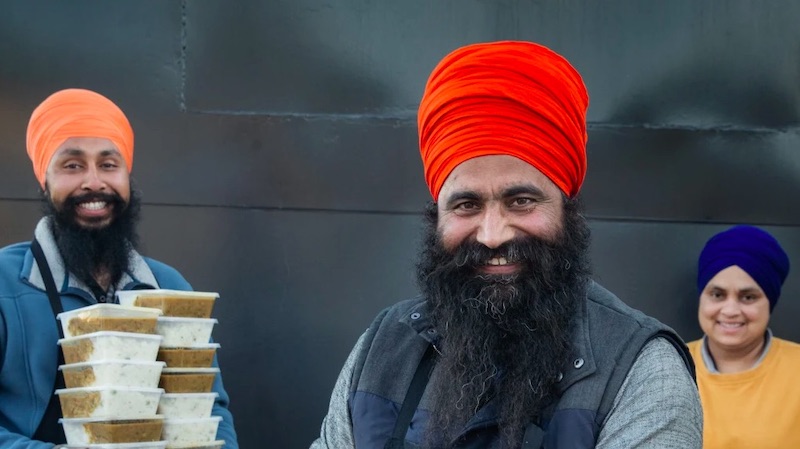
Sikhs expressing their views on Khalistan on the social media are more and more becoming targets of the Indian government.
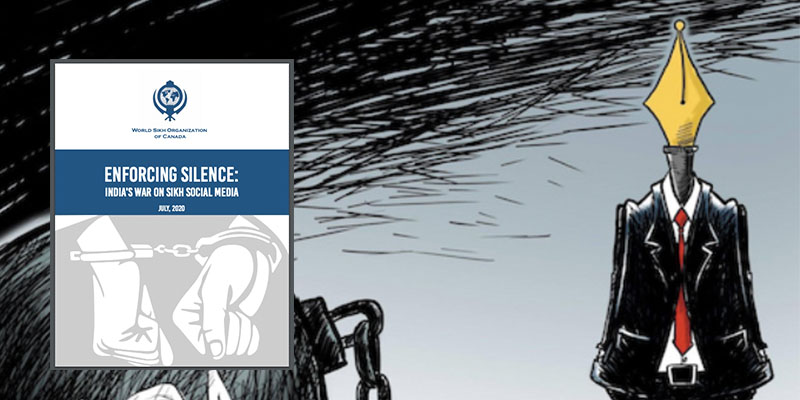
The Indian authorities are increasingly using social media to target and prosecute Sikhs and members of other minority communities who advocate on human rights and political issues, according to a newly released report by a Canada-based Sikh organistion.
“Social media posts deemed critical of India or supportive of separatist movements are reported for removal and in some cases, lead to individuals being detained and charged for terrorism related offences. In particular, Sikhs expressing support for Khalistan are being targeted,” according to the World Sikh Organization of Canada (WSO) report.
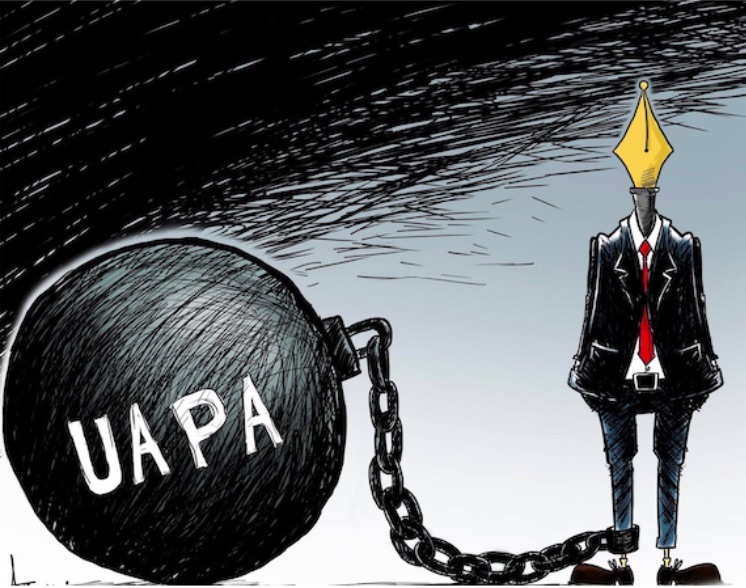
It noted that since June 2020, hundreds of Sikhs have been detained and interrogated in India due to their social media activities and some have been charged with offences related to support for Khalistan under the Unlawful Activities Prevention Act (UAPA).
The report lists out more than a dozen incidents where the Indian authorities had targetted Sikhs for their social media entries.
Citing one example, in February 2019, an 18-year-old boy was detained after he liked a poem on Facebook promoting Khalistan.
The Indian authorities released the youth in exchange for a written apology and deactivation of his Facebook account, it cited a report in the Times of India. The authorities were said to be searching for the people who had shared the post.
The report comes on the heel of the blocking of the #Sikh hashtag on Facebook and Instagram, two of the largest social media platforms. The incident came to light in early June during the run-up to the anniversary of the Indian army assault on the most popular Sikh religious centre in Amritsar in 1984.
At the same time, a number of Sikh platforms, including independent media channel Akaal Channel, was blocked on Facebook and Youtube for viewers in India.
FLAGGING SOCIAL MEDIA CONTENT
The newly released report noted that social media content that India deems offensive, particularly in relation to Khalistan, is being reported and flagged for removal on a wide scale.
“Khalistan refers to a sovereign state governed in accordance with Sikh principles and values. Khalistan is a construct that is understood in different ways and is a source of robust discourse and debate amongst Sikhs worldwide. ‘
“Discussing or promoting Khalistan is within recognized freedoms of expression and political discourse and should not be confused with extremism or terrorism,” it noted.
However, it added that the Indian authorities were attempting to marginalise and repress dissenting voices through draconian anti-terror laws such as the UAPA.
“Legitimate political expression that India finds objectionable or threatening is branded as extremism and those expressing such views are targeted by the State,” it said.
In a statement, WSO president Tejinder Singh Sidhu said India was attempting to silence dissenting voices and censor Sikh social media content.
The Report concludes with the following recommendations to social media platforms:
social media platforms establish a dialogue with the WSO and other Sikh stakeholders to identify Sikh historical figures being reported for censorship by Indian authorities and to better understand issues such as Khalistan and 1984;
social media platforms consider whether providing assistance to Indian investigations involving Khalistan or other political advocacy online is based on actual criminal activity or the suppression of dissenting voices;
where the disclosure of information that would result in a substantial risk of mistreatment of an individual, social media platforms not share information;
where content is restricted, there must be a clear mechanism within social media platforms to appeal the decision and have it reviewed by a human moderator well versed in the nuances of this topic.
ASIA SAMACHAR is an online newspaper for Sikhs / Punjabis in Southeast Asia and beyond.Facebook | WhatsApp +6017-335-1399 | Email: editor@asiasamachar.com | Twitter | Instagram | Obituary announcements, click here |
Sikh volunteers Manpreet Singh, Gurkirapal Singh and Sukhwinder Kaur. – Photo: SIMON SCHLUTER / Brisbane Times
By Jewel Topsfield | AUSTRALIA |
In 2017, when Sikh volunteers began distributing free meals to the homeless from a van in Tooradin and Frankston, they were curious: would people like their vegetarian Punjabi curries?
“In the starting, we were thinking ‘People will like it or not like it?’,” recalls Manpreet Singh, the vice-president of Sikh Volunteers Australia.
“It was not just simple curries, it was very special curries we were making according to their taste. Because most of the people don’t like hot food we were trying to make it milder.”
They needn’t have worried. The food vans, plastered with Love all & Share all stickers, have become famous in Melbourne south-east.
Twice a week the volunteers – known as sevadars – distribute dishes such as creamy mutter paneers (a curry made with peas and fresh cheese), vegetable kormas, saag (a leaf vegetable dish) and alu pakora (fried potato slices) from Tooradin caravan park and Young Street car park in Frankston.
They have added pasta and soups to their repertoire, although when Sikh Volunteers Australia served these in Bairnsdale during the bushfires, thinking they might be better suited to country tastes, the locals begged for curries.
Read the full story, ‘Meet the Sikhs who keep coming to the rescue for vulnerable Victorians’ (Brisbane Times, 18 July 2020), here.
ASIA SAMACHAR is an online newspaper for Sikhs / Punjabis in Southeast Asia and beyond.Facebook | WhatsApp +6017-335-1399 | Email: editor@asiasamachar.com | Twitter | Instagram | Obituary announcements, click here |
LET’S say there is a topic titled, “Rape! Is it a woman’s fault?”. Between a news channel and a movie, one would expect the former to be more insightful than the latter, right?
But imagine, if the reverse happens!
Bernama TV ‘s Darah Muda (Young Blood) is a talk show that caters to young viewers.
On the other hand, Pink is a 2016 Hindi movie, starring Amitabh Bachchan as a lawyer representing three women of “questionable characters” who were accused of crime against men with powerful connections.
In a prime time episode of Darah Muda screened on July 12 (and repeated the next day), the topic was “Serangan seksual! Salah wanita ke?” (Sexual assault! Is it women’s fault?”), hosted by a young duo, male and female, and with an invited guest- a preacher.
The talk went on fine with some sensible and valid points exchanged. However, towards the end of the programme, as the guest was summarising his points, he had to be cut short due to lack of time. Just then, the female host, while giving her final words to the viewers, said the following:
“Jadi, kalau anda wanita, jangan jadi penyebab untuk orang ada attention dengan anda!” (So, if you are a woman, don’t become the reason for people to have attention on you!).
Compare that statement to Pink, where the title of the film has no relationship as being the favourite colour of girls but rather conveys a hard-hitting message that women should have the absolute FREEDOM, to speak up, walk freely at night or to do just about anything boys could do.
The host may have had good intentions, but her statement was painfully wrong.
If she implied that a good girl can only be measured or be safe by how she dresses – especially Muslim girls with head scarves like herself, then Noor Suzaily Mukhtar (or Suzi to her family), should still be alive today.
That’s because on October 7, 2000, the then 24-year old computer engineer was brutally raped in a bus, sodomised and killed by a maniac driver.
She was in a baju kurung, and that too with a tudung! So, why her dressing still could not shield her from the sexual assault?
When can we ever learn that decent clothes don’t prevent rapes?! And sexy clothes don’t cause rapes! When can the society be educated that even if a woman is standing stark naked in front of a man, he still doesn’t have any bloody right to rape her!
One reason out of many why a rape happens is when the perpetrator with the smallest of minds or the most ‘damaged’ mental faculty, has found an opportunity to strike.
In Suzi’s case, the rapist Hanafi Mat Hassan was such, where he could even flash a smile as the death sentence was read out.
Rape is always about the perpetrator’s crime, not the victim’s short dress or neckline!
So much so that, the question to ask is – what’s a woman – or even a child – has got to do in a rape? (with all respects to gender sensitive cases).
In the open letter, “Rape: Moral guardians need to change mindset” (Malaysiakini, May 26, 2008), Azrul Mohd Khalib enlightened an Islamic group that there is a disturbing trend that has been observed where a lot of Malay men find it a thrill to have sex with a girl wearing a tudung.
He further states, “Quite a few pornographic handphone videos originating from this country now involve girls wearing the tudung. Would you (referring to the Islamic group) suggest then that women should not wear the tudung? The clothing a woman wears should not – and is not – the issue.”
In a letter referring to Pink when it was screened on TV, “Thanks, RTM, for a great movie” (The Star, Sept 13, 2019) , Chrismira A. reinforced – I hope men who think of women as “lesser beings” watched it and caught the important lesson from this great cinematic work, ie, when a woman says “No”, it means no!
It does not matter if she is your friend, a girlfriend, a sex worker or even your own wife. When she says no, you STOP!
Another point highlighted in the movie is how society is wrongly putting its effort into “saving” boys.
“We should save our boys, because if we save our boys, then our girls will be safe.” What this means is that it’s always the girls that need to cover up, lest the guys cannot handle themselves.
Bernama TV, you need to own up for the blunder made on the channel with regards to matters of women and rape. Otherwise, it will remain shameful that a Bollywood movie has given much better wisdom than a Malaysian national news agency.
RELATED STORY:
(Asia Samachar, 23 June 2020)
ASIA SAMACHAR is an online newspaper for Sikhs / Punjabis in Southeast Asia and beyond.Facebook | WhatsApp +6017-335-1399 | Email: editor@asiasamachar.com | Twitter | Instagram | Obituary announcements, click here |
PUNJABI | NEW RELEASE: Many years ago, Aussie-based Dya Singh and team produced a wonderful video to help children – and adults, too – to pick up the Penti. That’s what they call the Gurmukhi Alphabet, the script deployed by the Guru Granth Sahib. Now, it’s finally available on the Youtube.
“Created last century, already seen my millions, finally on our site. Please use to teach your kids and encourage Punjabi teachers to use,” he said in a note sent to Asia Samachar. Click here.
[TAKE NOTE OF ASIA SAMACHAR OFFICIAL WHATSAPP NUMBER: +6017-3351399. You can contact us to provide news alerts, community updates or obituary announcements. Stay in chardi kalaa]
ASIA SAMACHAR is an online newspaper for Sikhs / Punjabis in Southeast Asia and beyond.Facebook | WhatsApp +6017-335-1399 | Email: editor@asiasamachar.com | Twitter | Instagram | Obituary announcements, click here |
Kuljeet Singh’s Breathe: Into the Shadows – Photo: Supplied
By Dipanita Nath | INDIA |
In a world full of cops and a serial killer, he is a nobody. Breathe: Into The Shadows, on Amazon Prime Video, pivots on personalities that are towering, twisted or tormented — except Pritpal Singh Bharaj. “No personal vendetta, no property issues, no family issues,” says the detective played by Amit Sadh in the series, “Why would anyone mess with a guy like this?” It was up to Delhi-based theatre actor-director Kuljeet Singh to make sure that audiences cared and rooted for the ordinary Pritpal. Singh has made his web series debut with this role and, like Pritpal, held his ground.
Pritpal is the kind of character Singh has promoted on stage for 20 years to break the stereotypes of a Sikh character driving taxis, doing bhangra or dying in uniform. Pritpal is a soft-spoken family man even if he likes his pint and can pour a stream of abuses. “The initial roles that were offered to me, which I refused, were about doing shava shava and balle balle. I am very conscious of the process as a Sikh actor. I know thousands of sardars who don’t get up in the morning and say balle balle. This narrative has always troubled me,” says Singh, 42.
Kuljeet Singh has been on the Delhi stage since 1996. He handled backstage for the Partition drama Toba Tek Singh by Khalsa College, where he studied English literature. The following year, Singh became general secretary of Khalsa College’s dramatic society Ankur, and then its president. It was during this time that Singh was on stage for a college festival and heard the audience, unused to turbaned actors, hoot. “Somebody shouted, ‘Oye, tere barah baj gaye’. I come from this background of anxiety of whether I would be accepted in theatre,” he says.
See full story, ‘Kuljeet Singh on why ‘an ordinary sardar’ in Hindi cinema is a rare entity’ (The Indian Express, 19 July 2020), here.
ASIA SAMACHAR is an online newspaper for Sikhs / Punjabis in Southeast Asia and beyond.Facebook | WhatsApp +6017-335-1399 | Email: editor@asiasamachar.com | Twitter | Instagram | Obituary announcements, click here |
Coventry’s Belgrade Theatre has decided to stop using the term BAME (Black, Asian and Minority Ethnic), saying it is outdated.
The UK theatre said it made the decision after listening to local black artists who want to see the term eradicated across the industry, reports BBC.
Echoing the reasons set out by Black Creative Network, the theatre said its use “reinforces the assumption of white British as the ‘norm’ or default” and that the move was “only the first step on a long journey”.
Last month, UK students and artists explained why they felt the term – which originated in the ’60s and ’70s – was no longer relevant to them.
More than 7.6 million people in the UK came under the category of black, Asian and ethnic minority in the most recent census.
Setting out its “statement of intent”, BBC reported that the theatre said the group of West Midlands-based artists identified several problems with the term and similar acronyms.
“Although originally intended to refer to groups of people as a means of measuring diversity across organisations… it stripped away people’s individual identities and encourages us to see those who are not white British as a single, homogeneous group,” it said.
BAME came into sharp when UK started getting reports that people from the BAME background were the most dying from the novel coronavirus pandemic. But the homogenising nature of the term does little to tell more about what was happening on the ground.
In an opinion piece at Varsity, Sawen Ali argyed that the terms ‘BAME’ and ‘Black’ were often conflated to present a misleading idea that the justice system, educational system, and class system inflicts the same structural oppression across all non-White groups.
“It is no secret that Black Britons are far more likely to be stopped and searched, excluded from school, or end up homeless than not only White people, but also their Asian counterparts. To conceal this anti-Blackness under the guise of it being a ‘BAME’ experience not only obfuscates from the material reality that Black people live within, but also trivialises the Black struggle for equality in the UK,” it argued.
ASIA SAMACHAR is an online newspaper for Sikhs / Punjabis in Southeast Asia and beyond.Facebook | WhatsApp +6017-335-1399 | Email: editor@asiasamachar.com | Twitter | Instagram | Obituary announcements, click here |
Culture is about group behavior and behavior is driven by values and beliefs. Culture is formed by people working in an organization and this is led by the leaders. Culture is about how people feel while working at an organization (and this is the reason for their behavior).
A strong organizational culture will consist of articulated and simplified values (and its associated behaviors). It acknowledges its people’s FEAR (during the time of uncertainty, like the current pandemic or what could be stopping them in achieving the organization goals). It also builds resilience (how do deal with blockers when it comes to changing behavior) and redefine success (what are the goals and how relevant it is to the people in the organization).
In the context of the Gurdwara, the culture is shaped by the overall committee members and sewadars, led by the key leaders (Granthi Ji, President, Vice President, Secretary, and Treasurer).
In an organization, the leaders and employees can articulate an amicable set of behaviors and values in line with their business goals. What’s challenging about culture is the beliefs of individuals and how do we garner the emotional commitment of the employees towards the goals.
In an organization, leaders can influence their people to behave voluntarily in shaping the culture. To a certain extent, they can even dictate how people behave. However, it is slightly different for an non-government organisation (NGO) or a Gurdwara.
When dealing with an organisation, failure to comply with directions can see a person facing consequences in terms of rewards, benefits, etc. Hence, the shaping ability is somewhat more controlled (even then, it’s very challenging). When it comes to NGOs and Gurdwaras, it boils down to living up to the shared purpose of the outfit . Equally important to note is that it has to be done voluntarily.
Changing behavior is not an easy task for an individual, leave aside a group of people.
Culture is like personality or character of an individual. Once you’ve learned to be a certain kind of person, that is you in all aspects of your functioning. You will be reluctant to do things differently. Hence the difficulty in changing culture. So culture only matters when there is a problem. In the same sense, personality only matters when things are not working right for you.
So how do we build a strong culture for gurdwara teams? I will attempt to answer this question in a few steps…
STEP 1
First, identify the problems/challenges we are facing with regards to teamwork among gurdwaras. We must be able to articulate the root cause with clarity. All parties involved must agree (via consensus) the problem at hand.
Next, we must also describe what are the behaviors we see ourselves doing when the teamwork is in its perfect condition. Once we have identified the behaviors, we need to agree on the values needed to be put in place and what beliefs we need to change. Remember to keep this as simple as possible so people can easily form a picture in their mind which will allow them to remember. Finally, develop ways and means to measure those behaviors (as in, are we living up to it or not).
STEP 2
What are some of the problems/challenges we may face in living up to the new way? This involves changing processes, policies, and procedures.
STEP 3
How will we support each other in living up the new behaviors? This is when we can introduce huddles – a casual and honest conversation in small groups focused on our behaviors. If it is something that was against the new norm, then we need to openly tell the person about it and also vise versa, acknowledge people for doing or living up to the new norm
STEP 4
Is our purpose clear and do we all subscribe to it? As per my understanding, a gurdwara is a place of assemble and worship. It serves as a focal point for Sikhs to gather to hear the spiritual discourse and sing Shabad as a gateway through which spirituality could be reached. Today, a gurdwara is also a community centre and offers food, shelter, and companionship to those who need it. Are our new behavior in-line with this purpose? If it is not, then we need to realign our behaviors.
Once all this is somewhat in place, we can then start implementing the entire “project”. The above can be done over a few workshops.
During implementation, it is important to ensure all members involved are updated on the progress of others.
Whenever somebody comes and tells me they want to change their organization culture, I first ask them to define the business problem, which they think culture can help and what have they done about the problem. Culture change is not an easy task; it requires commitment at the highest level for it to be successful.
The author is a senior consultant for change management at a Malaysian-based firm
ASIA SAMACHAR is an online newspaper for Sikhs / Punjabis in Southeast Asia and beyond.Facebook | WhatsApp +6017-335-1399 | Email: editor@asiasamachar.com | Twitter | Instagram | Obituary announcements, click here |
PATH DA BHOG:26 July 2020, from 10.00 to 12.00pm, at Gurdwara Sahib Port Klang| Malaysia
ਘਲੇ ਆਵਹਿ ਨਾਨਕਾ ਸਦੇ ਉਠੀ ਜਾਹਿ ॥੧॥
GAIGINDAR KAUR D/O LATE TARA SINGH
(1 January 1939 – 17 July 2020)
Village: Thunda, Amritsar
81 years old.
Deeply missed by sister, grandchildren, relatives and friends.
Husband: Late Bhajan Singh s/o Socha Singh
Children / Spouses:
Amarjit Kaur / Balraj Singh
A. Swaran Kaur / Dr. Balwinder Singh (Melbourne)
Manjit Singh / Dr. Sharan Kaur (Auckland)
Path da Bhog: 26 July 2020, from 10.00 to 12.00pm, at Gurdwara Sahib Port Klang
Contact: Manjit Singh 0122777913
Message from the Family: Kindly adhere to Covid-19 SOP.
| Entry: 17 July 2020; Updated: 24 July 2020 | Source: Family
ASIA SAMACHAR is an online newspaper for Sikhs / Punjabis in Southeast Asia and beyond.Facebook | WhatsApp +6017-335-1399 | Email: editor@asiasamachar.com | Twitter | Instagram | Obituary announcements, click here |
Harmindar Singh Dhaliwal taking oath as a Federal Court – Photo: Bernama
By Asia Samachar Team | MALAYSIA |
Court of Appeal judge Harmindar Singh Dhaliwal was elevated to the Federal Court last week, making him the only Sikh in Malaysia’s top court.
The 61-year-old judge took the oath of office on 10 July. Born in Negeri Sembilan, he was elevated to the Court of Appeal in March 2016.
He joins the 14-justices strong Federal Court led by Chief Justice Tengku Maimun Tuan Mat. With eight women justices, this is the first time women outnumber men in the nation’s top court.
“He is a well respected judge,” a senior lawyer told Asia Samachar.
Sikh judges who made it to the top Malaysian court, at one time also known as the Supreme Court, in the past were justices Sarwan Singh Gill (popularly known as SS Gill), Pajan Singh Gill and Ajaib Singh. (Corrected).
In 1974, Sarwan rose to the rank of Chief Justice of the High Court in Malaya (Hakim Besar Mahkamah Tinggi di Malaya), making him the first Indian to land the position. He held it till 1979.
Sarwan started his career as the Senior Assistant Registrar of the Supreme Court, Ipoh, in May 1956 and became the Registrar of the Supreme Court, Federation of Malaya in 1957. On 1 Sept 1962, he was made the a judge of the Supreme Court.
In the same recent oath-taking ceremony last week, Bhupindar Singh Gurcharan Singh Preet, a former Malaysian sessions court judge and deputy public prosecutor (DPP), was appointed as a Judicial Commissioner of the High Court of Ipoh. See here.
The 57-year-old law graduate, who began his career as a legal advisor at the Ministry of Works in 1992, was most recently the chairman of the Parole Board since March 2013.
In May 2019, Amarjeet Singh Serjit Singh, who was then the highest ranking Sikh federal counsel, was appointed as a JC. See here.
He was then heading the civil division at Attorney-General’s Chambers (AGC) and was a household name in Malaysia for appearing on behalf of the government in various high profile cases.
ASIA SAMACHAR is an online newspaper for Sikhs / Punjabis in Southeast Asia and beyond.Facebook | WhatsApp +6017-335-1399 | Email: editor@asiasamachar.com | Twitter | Instagram | Obituary announcements, click here |
Every community that has survived the test of time and existence must have incorporated their unique approaches to dispute and conflict resolution. Scholar John Burton describes dispute as being a short term disagreement that is easy to resolve whilst conflict are long term deep rooted issues where there is much less motivation for parties to seek resolution. It requires external assistance for resolution.
A brief history of dispute resolution in a Sikh Community?
Sikh community as in many other communities of the Indian subcontinent uses the panchayat system to deal with resolution of various issues in the community including poverty, illiteracy, women abuse, child abuse and other social evils. The Panchayat system that has been prevailing in India was introduced during the Vedic time or perhaps even pre-Vedic times.(1) The goodwill of all the classes of people were assured as the system is based on secular ideals. The people of the village will choose their respective leader to be part of the Panchayat. The main function is to govern namely to ensure that records of the village is kept including a land registry which is carried out by the clerk also known as the Patwari and each village had a watchman, the Chowkedar, responsible for keeping an eye on the members of the community and to report to police when situation necessitates.
Spiritually, one of the source of authority in Sikhism has been the panj-pyarey. The institution of panj-pyarey holds a unique status within the Sikh Panth. It is instituted by the tenth Guru, Gobind Singh Ji, in 1699. The panj-pyarey were the first amritdhari Sikhs, who are believed to have received Guru’s authority by virtue of the act of offering their lives to the tenth Guru to create the Khalsa brotherhood. The significance of the institution of panj-pyarey is evident from the way it is respected within the Sikh tradition. Occasionally, the panj-pyarey are asked to resolve disputes among members of the management committee of Gurdwaras. There is depth of literature on the democratic functions and values that the panj-pyarey brings to the Sikh community.(2)
Other methods of resolution of disputes within the Sikh Community has been effected through references to family elders, village head or the Granthi in Gurdwaras.
These various methods of resolution, however, have always rested on some form of decision being made for the parties. The Panchayat operates in an inquisitional and authoritarian fashion which convenes in a public location, usually the village square. The Panchayat allows one disputant at a time to state his or her case. Questions are then asked by the Panchayat members (and sometimes by the audience). Then the second disputant states his or her case, and questions are asked. Sometimes third parties are heard and may be quizzed, too. The first disputant maybe allowed to speaks again (if needed) for clarification.
During the open discussions, the Panchayat can suggest parties to consider concessions or agreement on issues raised. The parties may also be asked to consider certain suggested solutions. After hearing the parties and having the open discussions, the Panchayat members withdraw to discuss the disputes and issues raised. Once they have come up with their decision, the leader of the Panchayat announces the suggested solution or the decision in public together with their opinions or reasoning of the Panchayat.
The enforcement of the decision very much depends on the community will and social pressure. Defiance by any member of community could lead to one being excommunicated.
As the community progresses and assimilate in other communities and cultures around the world, the Sikh community confront multi-dimensional social, religious and political issues both internally and externally. The influences of the community itself reduces as people start to reason and develop a more individualistic perspective to life.
In recent times, therefore, mediation has gained more prominence as the method of resolution that is most suitable for community disputes or conflicts as it rests upon mutual consent, agreement and is able to retain the sanctity of relationship.
Most recently on the 27 February 2020, Hindustan Times reported that a mutual settlement between a Sikh and Muslim community successfully resolved decades old land dispute in Uttar Pradesh. The settlement was initiated by a District Magistrate.(3) This was seen as an example of harmony and that issues may be resolved through meaningful dialogue in mediation.
What is Mediation?
Mediation is a voluntary process in which an impartial person (the mediator) facilitates communication and negotiation between parties to assist the parties in reaching an agreement regarding a dispute.(4) It is an informal and flexible dispute resolution process.
The mediator’s role is to guide the parties toward reaching their own resolution. He or she helps both sides define the issues clearly, understand each other’s position and move closer to resolution through joint sessions and separate caucuses (private sessions) with the parties.
Community Mediation
Community dispute resolution existed in many different cultures throughout the world. In some cultures, the dispute resolver is a “sacred” figure worthy of special respect and whose role sometimes overlapped with that of the traditional “Wiseman” or “Chieftain”. Due to the respected position of these local leaders or wise men, members of the communities feel safe and comfortable bringing their disputes before them in the hope of resolving their conflicts or disputes.
In Malaysia, the Government through the Department of National Unity and Integration (DNUI) introduced a community mediation program by training community leaders as community mediators in a pilot program referred to as the Peaceful Neighbour (Rukun Tetangga). This trained local volunteers serving as community mediators, generally focus on community and neighbourhood conflict and often serve those who cannot afford to go through court processes or professional alternative dispute resolution providers.
Typical types of community mediation are disputes between landlords and tenants, members of homeowner’s associations and small businesses and consumers. Many community mediators offer their services for free or at a nominal fee.
Practice and Procedure of Mediation – Photo: Asia Samachar
Process of Mediation
The mediator manages the process and helps facilitate negotiation between the parties. A mediator does not make any decisions nor force any party into accepting what he or she thinks is a fair solution to the dispute. The parties are encouraged to participate directly by engaging with each other with the assistance of the mediator. The parties are also responsible for generating options and negotiating their own settlement or agreement. The role of the mediator is therefore only as a facilitator and he or she must remain impartial and neutral at all times throughout the mediation process.
The mediation session begins by the mediator describing the process and the ground rules to the parties. Each party will have equal opportunity to present their views of the dispute in turn. The mediation process helps each side understand better the other’s point of view.
If parties reach a mutually acceptable solution, it will then be translated into a Settlement Agreement. Here parties may consult with their lawyers prior to finalizing the agreement to be sure that they have made fully informed decisions and that all their rights are protected (if there are lawyers in attendance). However, if lawyers are not involved, the mediator drafts the Settlement Agreement and gets the parties to check and verify the contents and the agreed terms. The parties then execute the agreement and the mediator signs as the witness to the said agreement.
However, if parties are not able to come to an agreement, they can always terminate the mediation process at any time.
It is crucial to note that a mediator’s role is only to facilitate communication between the parties, steering them towards a mutual acceptable solution and should never be confused by evaluating the dispute, advising the parties, supporting the parties or taking sides or counselling.
Simply put, the mediator’s role is to separate the people from the problem; focus on interests not positions of the parties; invent options for mutual gain and insist on objective criteria.
When and How Mediation Is Used?
When parties are unable to negotiate a resolution to their disputes by themselves, or do not want to litigate for fear of the complex legal system or wish to avoid the stress of appearing in court, or perhaps due to financial constraints, they may want to explore mediation as an alternative dispute resolution mechanism. Parties may seek the assistance of a mediator who will help them explore ways of resolving their differences by helping them reach a mutually acceptable solution or agreement. Parties may choose to go to mediation with or without a lawyer depending upon the costs involved or type of problem or dispute they have.
Disputing parties may choose to submit to mediation at any time, either before or during and even after the court proceeding.
Mediation can be used in most conflicts ranging from disputes between consumers and merchants, landlords and tenants, employers and employees, family members in such areas as divorce, child custody and visitation rights, eldercare and probate as well as simple or complex business disputes or personal injury matters.
How mediation can assist in resolving issues in Sikh Community?
The Sikh community has always been very progressive with strong cohesive community values. However, like any other community, there are bound to be conflicts and issues. The disputes can range between the community members, gurdwara committee members to family issues, inter-religion, inter-racial issues within the community. To preserve the strong communal values instilled in the Sikh culture, mediation is the perfect way forward in resolving these Sikh community disputes in an amicable way.
The key component in any mediation is parties’ participation. The mediator should encourage disputing parties to participate and be actively involved in discussion that affects, thereby creating responsibility rather than opting for a third party to resolve their issues.
Confidentiality is the next key component to a successful mediation. It must be emphasis to the parties throughout the mediation process that all that is discussed in the mediation will always be kept confidential not only by the parties but also the mediator. This assurance to the parties is very important for parties to have trust in the mediation process.
However, community mediation must not be confused with counselling. The mediator can never stop being impartial and neutral, and must never perform the functions involving evaluation, supervision, integration, advice, support or act as counsellor. A community mediator’s role is to resolving conflicts and to restoring relations among community members and restoring social unity within the community. In other words, his or her role is to establish a harmonious society and stable community relations through a friendly resolution of disputes.
It is important for the mediator to make the mediation process a safe haven for parties in the community to come forward to mediate their disputes/problems/conflict without the fear of being shamed or judged by their members or peers. The importance of confidentiality must be stated to not only give comfort but to ensure that parties feel safe with discussing their personal feeling and emotions and being able to have open discussions. Mediators must never judge any parties coming forward to mediate their dispute but encouraged to have taken this step in resolving a conflict or dispute.
Some of the suggestions that could make mediation work in Sikh community are as follows:
Training the Granthi (Priest) in every Sikh Temple
Training committee members or people in the community who are interested in the training to be mediators
Coming up with a Code of Conduct for Sikh Community Mediation and emphasising on confidentiality
Provide talks and literature to the community to cause awareness of this process called mediation
Make mediation as being part of the service / ‘seva’ to help families, friends, associates to resolve their differences.
It is the authors’ view that mediation in the Sikh Community should be encouraged as mediation helps parties to mend broken relationships in making parties understand the other person’s perspectives. It has a win-win outcome, and it saves time, money, and anxiety of going to court. It is also a process where parties are assured that whatever is discussed in the mediation process remains private and confidential. Further, as parties decide their own outcome, mediation empowers the parties in coming up with a mutually acceptable settlement or decision.
The authors are practising advocates & solicitors and accredited mediators. They co-authored the Practice and Procedure of Mediation book published by Sweet and Maxwell in 2020. They have extensive experience in the field of alternative dispute resolution. They have successfully trained a few batch of community mediators for the state of Penang including the Justices of Peace and were integral to the setting up of the Penang JP Mediation Bureau.
FOOTNOTES
(1) Defence of Europe by Sikh Soldiers in the World Wars by Mohindra S Chowdary
(2) Guru Gobind Singh: Historical and Ideological Perspective by Madanjit Kaur
ASIA SAMACHAR is an online newspaper for Sikhs / Punjabis in Southeast Asia and beyond.Facebook | WhatsApp +6017-335-1399 | Email: editor@asiasamachar.com | Twitter | Instagram | Obituary announcements, click here |























 By Asia Samachar Team | CANADA |
 In a statement, WSO president Tejinder Singh Sidhu said India was attempting to silence dissenting voices and censor Sikh social media content.
 RELATED STORY: