SASKAAR / CREMATION: 12 noon, 29 March 2020 (Sunday) at Jalan Kuari Cheras, Kuala Lumpur. Cortège leaves Gurdwara Sahib Parliment at 11am| Malaysia
ਘਲੇ ਆਵਹਿ ਨਾਨਕਾ ਸਦੇ ਉਠੀ ਜਾਹਿ ॥੧॥
NARANJAN KAUR DHILLON D/O LATE SARDAR HARNAM SINGH DHILLON & LATE MATA KARTAR KAUR
(23.10.1934 – 28.03.2020)
Village: Amritsar
Residence: Rahang, Seremban
Brothers, Sisters & In-Laws:
Late Santokh Singh Dhillon
Late DR. Harbhajan Singh Dhillon & Late Sheila
Late Hardial Singh Dhillon
Gurbachan Kaur Gill & Late Darshan Singh Gill
Tehal Singh Dhillon & Sarjit Kaur
Beloved Nephews & Nieces
Saskaar / Cremation: 12 noon, 29 March 2020 (Sunday) at Jalan Kuari Cheras, Kuala Lumpur
Cortège timing: Cortège leaves Gurdwara Sahib Parliment at 11am
Contact:
Tehal Singh 016-3116264
Ravinder Singh 016-6906513
Message from Family: Due to the Covid-19 partial lockdown, we have been advised to keep the funeral a small affair. Hence, this announcement is meant to inform relatives and friends. We appreciate the love and support that we have received thus far. We thank you for that.
| Entry: 29 March 2020 | Source: Family
ASIA SAMACHAR is an online newspaper for Sikhs / Punjabis in Southeast Asia and beyond.Facebook | WhatsApp +6017-335-1399 | Email: editor@asiasamachar.com | Twitter | Instagram | Obituary announcements, click here |
Poetics of Structure – Experiencing The Bones Of A Building – Design by Vishal J. Singh
By Vishal J. Singh | GURDWARA DESIGN |
“Fashions come and go, but geometry lasts forever,’ — Paraphrased from an interview with Ieoh Meng Pei, Chinese – American Architect, (1917–2019)
Leoh Meng Pei, or simply I.M. Pei, was an extraordinary man. Born in China but grew up in the United States, and worked as an architect till the ripe old age of 102, and passing away in 2019, he is best known for modern buildings that projected bold, geometric designs internationally.
Undeniably, his biggest accomplishment was when he was commissioned to design the new extension of the Louvre Museum in Paris, France, specifically the striking glass pyramid that marks the entrance of the museum. The elegant glass pyramid was a beautiful manifestation of his ideas. He believed that geometry, engineering and structure should be the driving force behind any design. It should be celebrated (meaning shown and not hidden) in architecture, and designs should not blindly follow popular trends or fashions that come and go in the creative arts. In almost any building, it is the structure of the building, typically a reinforced concrete skeletal frame or a steel based one in our times, that holds up the complex, and gives it its strength and integrity. The walls, either metal, brick, glass and anything else, serves as a series of infill panels that cover the building up to offer protection and shelter.
Based on this idea that architecture is a celebration of geometry and engineering, which leads to the development of the structure and subsequently the whole building, the following proposal for a modern Gurdwara complex embodies and expresses that idea in a conceptual design. This proposal celebrates the structure of the Gurdwara by allowing a good deal of the skeletal frame that supports its presence in the landscape exposed for public appreciation and for future expansion. The buildings ‘envelope’, meaning the way it is covered, are a various combination of metal deck sheets, glass panels and mobile metal cabins.
Poetics of Structure – Experiencing The Bones Of A Building – Design by Vishal J. Singh
The Gurdwara proposal is basically a building that is constructed of a typical reinforced concrete skeletal frame, where part of that frame is left exposed, as its main method of support, while the other important parts of the building that consist of the Darbar Sahib and the Langgar Hall are designed with panels of light-weight metal deck sheets and tempered glass that act as protective divisions from the outside. The Darbar Sahib in particular is elevated above to the first floor, leaving the ground floor totally open for the Sanggat (congregation) to enter and circulate freely, while also allowing natural ventilation to take place as unhindered as possible.
The ground floor is an open, ‘free-flowing’ platform, meaning that no permanent walls are built to house any specific functions such as offices, storerooms and the kitchen. These areas are defined by the incorporation of mobile metal cabins, seen as large metal boxes in orange, like individual shipping containers, that can be ‘installed’ and removed as needed. This design approach allows for flexibility in the usage of the space in the long run, and can allow for a multitude of functions and additions to take place over time as and when required.
(On a side note, all the visuals in this article are now supplemented with white human-like figures to convey a sense of scale and to allow for the readers to perceive a sense of how big the building is in relation to the size of people shown within.)
Poetics of Structure – Experiencing The Bones Of A Building – Design by Vishal J. Singh
The Darbar Sahib is located on the first floor of the Gurdwara complex, and can be accessed by a main staircase located near the main entrance foyer, where a bridge-like platform above a water feature connects the outside to the inside. The Darbar Sahib has metal cladding covering its structure and creating an enclosure with a dramatic double height volume for prayer and for congregating.
Poetics of Structure – Experiencing The Bones Of A Building – Design by Vishal J. Singh
The Nishan Sahib Plaza is located next to the main entrance of the Gurdwara Complex and behind the Nishan Sahib is the mobile metal cabins that act as a kitchen for the Langgar Hall located at the back. A sense of openness permeates the entire complex so as to allow pedestrian circulation to take place freely from anywhere on the premises.
Poetics of Structure – Experiencing The Bones Of A Building – Design by Vishal J. Singh
The Langgar Hall is located at the back of the complex on the left and is divided into both open areas that’s next to a water feature, and with an enclosed hall for the Sanggat to commune, perform ‘sewa’ and eat and drink with their fellow brothers and sisters in a more internal setting. The Langgar Hall also has part of its skeletal frame exposed as to allow for possible future expansion of the space if the need to house a bigger Sanggat ever comes into place.
Poetics of Structure – Experiencing The Bones Of A Building – Design by Vishal J. Singh
The Langgar Hall on the left, is a triangular shaped enclosure, and follows the same triangular like design for the Darbar Sahib to maintain a sense of planning and aesthetic consistency. The similar slope and frame allows for the whole Gurdwara to be viewed as one complex, despite being separated by the connecting open platform that allows the Sanggat to circulate freely within its premises.
Occasionally in literature, the human body is sometimes simply referred to as ‘flesh and bones’, although clearly it is, medically, a far more complex biological entity than that. It’s the bones, and by extension, the skeleton that gives the body its rigid but flexible humanoid form, that allows it to stand up straight and perform a variety of actions while the flesh is what clings on to bones to give it mass.
Similarly in architecture, it’s the structure, firstly expressed through its skeletal frame once the design starts taking shape, that holds up the building and gives it it’s form, and there are architects who feel that this critical aspect and function in design should be visually celebrated out in the open rather than concealed unacknowledged in the walls. This conceptual Gurdwara proposal seeks to validate that belief in architectural thought, that is to say that structure, or at least parts of it, should be celebrated out in the open, shown through the visuals presented in this article, to allow for a better sense of appreciation of what actually allows a building to take form, to be built, to be habited and eventually used rather than just pretty colours or fancy superfluous decoration.
Architecture and engineering (the act of technically drawing and building a structure) have had an unbreakable relationship with each other from the day the first building was built eons ago, and simply cannot exist without each other. Architecture is about designing spaces that serve and uplift the human spirit, and engineering is the means, through making a structure, that allows for those needs to be fulfilled. A century ago, it was once said by a well known architect, Walter Gropius, that ‘architecture begins where engineering ends,” and in the field of design, those words were true then, and they stand true till today.
Waheguru Bless.
The next proposal will imagine designing a Gurdwara that is built of sustainable timber and meant to be an eco-friendly structure placed by the edge of a forest or a jungle that incorporates traditional design building methods and ideas with modern aesthetics and sensibilities.
Vishal J. Singh, an aspiring architect, holds a Bachelor of Architecture Degree from Infrastructure University Kuala Lumpur and enjoys engaging in architecture and its theories as his first love.
* This is the opinion of the writer, organisation or publication and does not necessarily represent the views of Asia Samachar.
ASIA SAMACHAR is an online newspaper for Sikhs / Punjabis in Southeast Asia and beyond.Facebook | WhatsApp +6017-335-1399 | Email: editor@asiasamachar.com | Twitter | Instagram | Obituary announcements, click here |
Temperature check for gurdwara visitors on 20 March 2020, prior to latest set of restrictions – Photo: Khalsa Dharmak Sabha Singapore Facebook page
By Asia Samachar Team | SINGAPORE |
A Singapore gurdwara will continue providing langgar, or free vegetarian meals, in take-away packs at designated timing.
Khalsa Dharmak Sabha (KDS), located at 18 Niven Road, made the decision in view of the Singapore government’s latest measures to halt the spread of the novel coronavirus Covid-19.
“Given that several of our sanggat are in need or langgar, we will continue to pack langgar in takeaway boxes tor you to take away. Howewer, instead of collection at the langgar hall, the takeaway langgar will now be served at the entry gate,” KDB president Sarbjit Singh in a statement.
“To ensure no bouncing or crowding at the langgar collection point, sanggat is advised to collect the langgar packs and immediately move on to consume the langgar at your home, office, or school. Do not hang around and crowd outside the Gurdwara.”
Langgar can be collected between the following three windows: 7am-9am, 11.30am-2.30pm, and 7pm-8pm.
KDS was established in1923.
In a joint meeting on 26 March, Singapore’s Co-ordinating Council of Sikh Institutions (CCSI) advised all gurdwaras to cancel all congregational prayers and gatherings, effective 27 March, in line with the government’s Covid-19 instructions.
It was decided that gurdwaras to suspend all programmes, including family sponsored and group programs, until 30 April.
Gurdwaras would remain open for private worship limited to 10 people at any one time, the council said.
ASIA SAMACHAR is an online newspaper for Sikhs / Punjabis in Southeast Asia and beyond.Facebook | WhatsApp +6017-335-1399 | Email: editor@asiasamachar.com | Twitter | Instagram | Obituary announcements, click here |
Many people who have relied on the support from others for their day to day routine were caught off guard with the sudden movement control order due to the Covid-19 pandemic.
The elderly, the poor and those with mobility problems were the most affected by this order.
Luckily, volunteers from groups and organisations like Gurdwara Sahib Subang, Selangor have come forward to help.
ASIA SAMACHAR is an online newspaper for Sikhs / Punjabis in Southeast Asia and beyond.Facebook | WhatsApp +6017-335-1399 | Email: editor@asiasamachar.com | Twitter | Instagram | Obituary announcements, click here |
A Sikh programme in Kampar in Perak, Malaysia – Photo: Shanno Randhawa
By Santokh Singh Bains (Chicago) and I.J. Singh (New York) | OPINION |
We all look for good things in life that please the eye or titillate the senses. The more the better! When they are not necessarily sating a specific need or hunger, then what exactly are they doing? Why are we so driven to such stimulants?
Humans are complex and human pleasures often come from giving more to others, even more than in taking from others. So, the desire to give seems universal. For a living example look at any mother, be she poor as a church mouse or richer than rich. Look at her year old celebrating his first year when he can’t count or comprehend the idea of a birthday gift.
Watch a new mother fawning and crooning over her new baby – an absolute delight to behold, impossible to fully capture or convey in words. Think! Isn’t it true that sometimes the giving of a gift gives us unparalleled joy and supreme delight, more than receiving one? It’s indeed in giving that we receive as a Biblical truism proclaims. Guru Granth points to a similar frame of mind when it reminds us to transcend the self in giving.
ਆਪੁ ਗਵਾਇ ਸੇਵਾ ਕਰੇ ਤਾ ਕਿਛੁ ਪਾਏ ਮਾਨੁ ॥
Aap gavaaye seva karae taa kitch paaye maan’ Guru Granth p.474).
Yet, the maternal instinct and human mind are such that a sense of owning the paradigm and the beloved creeps in to become the dominant theme. It complicates the giving nature of a relationship by bringing in a level of ownership and control in the exchange. And the relationship becomes, to a greater or lesser extent, transactional. For every quid there must be a quo!
For example, even though, no sane mind would ever downgrade giving to the needy as over-emoting, the complexity of human nature dramatically transforms how we value and categorize our relationships to things, ideas and people.
Look, for instance how good people, no matter their religious label, relate to the peerless history and traditions of their particular religious identity. We make no exceptions here and include all — Jews, Christians, Muslims, Hindus or Sikhs, Jains, Buddhists et al, even Brand X, if any. For a believer, the passion often runs deep and defines his/her core existence – often leading us into areas beyond common sense.
Nothing unusual or undesirable in such behavior except when we step into behavior that might, in its deep-seated death-defying loyalty, clash with fundamentals of common sense.
For a moment, let’s focus on our own religious identity – Sikhism or Sikhi. Remember Sikhi is only about 550 years old. Young enough to be one of the youngest and most relevant to our modern existence in a complex world. Yet, it arose in an ancient culture – the timeless mythology of ancient India and its Hindu religious lore; hence some practices have ancient roots. Remember that new religious traditions do not arise de novo in a vacuum. They take life amidst existing culture, language, music, cuisine, traditions and values; some may be valued only if modified, others are best jettisoned. When Sikhi arose in India, the existing cultural context and antecedents were largely Hindu and also Islamic. Many of those old traditions even though irrelevant today persist.
In about 240 years Sikhi had been nurtured into its present form by ten Guru-Founders. From then on (1999-onwards) the traditions and teachings as treasured in the Guru Granth guide the practicing Sikhs worldwide. Naturally the teachings would comment on the existing context to explain, not necessarily to approve,
Naturally, a Sikh would treasure the scripture as holy and he should. Remember also, that Sikhism arose in a sea of Hindu lore that speaks of innumerable gods, goddesses, holy beings and similar entities. We will not enter the debate of how many gods and goddesses exist and how each entity is to be revered, or appropriately respected. Most such matters are for Hindus and technically have nothing to do with Sikhi!
But forget not that most Sikhs came from age-old Hindu lifestyle. A standing joke proclaims that when a new way of behavior clashes with an age-old custom, the result is often less a change of the old into the new but often old ideas re-dressed and reframed as new. Keep in mind that the default position of the human mind is inertia. It does not readily shift unless and until forced to do so.
Surely, we are not the only Sikhs who love going to gurduaras — our places of worship. Often, we are flabbergasted by the shenanigans and rigmarole that define the protocol. Given that there is magic in it that can and will capture the mind, such that any and every matter of critical judgment is banished and readily suspended.
The dictated formality totally overcomes the reality. For example, the Guru Granth is to be escorted to its place at the beginning of an event. Tradition asserts that only male Sikhs may have that honor. A prominent team leads the mini-procession; one man is deputed to lead by sprinkling water ahead of the brief 3 to 4 minutes long walk. During the few minutes of settling down with the Guru Granth at its designated site and for a while afterwards, worshippers continue to hand vestments for the Guru Granth. And there are as many or more who hand new vestments to the officiants — not to keep or use but merely to touch, often for no more than a few seconds, these vestments to the Guru Granth, and then return to the devotee who can now take them back to his own home or business to sell as blessed and holy.
The procession never ends. Surely many devotees now see the Rumalaas (vestments) now as specially blessed. And some like us wonder! The Guru Granth is a book, isn’t it? And it clearly directs us that its sight is never going to liberate us; for that we need to engage with its message (ਡਿਠੈ ਮੁਕਤਿ ਨ ਹੋਵਈ ਜਿਚਰੁ ਸਬਦਿ ਨ ਕਰੇ ਵੀਚਾਰੁ ॥ Dithae mukt na hoveyee, jitcher sabd na karae vitchaar” p. 594). So largely the function, however sober and serene, becomes more of a drama than a transforming experience. The influence of ancient Hindu customs can often be seen during Akhand Path recitations when many Sikhs enthusiastically follow undesirable practices such as: (i) continuous burning of Agarbattis (incense sticks), (ii) continuous burning of Jot (flame) and (iii) keeping water in a Garbi (vessel) to be later used as Amrit.
Where did these unnecessary accoutrements come from? I remind you of inertia as the default position of the mind. Surely many Sikh practices are rooted from and minor modifications of the Hindu past. If every one of the zillion Hindu deities are individually celebrated and clothed, cooled in hot weather and fanned in heat, then why not the Guru Granth as well? If every little deity or a baby has to be fed why not offer food to the Guru Granth as well? If a baby has a wardrobe of clothes, why not the Guru Granth as well. All this, even though it comes to us in the form of a book of ideas.
Surely, most of us have seen each of these ideas practiced at important multimillion-dollar gurduaras catering to our educated elite.
We humans have grave difficulty in relating to ideas, no matter how noble or ignoble. Often, we need to humanize an idea to come to terms with it. Hence the ironic thought that “I don’t know whether God created Man in his own image, but Man has certainly created God in own very human image.” Also forget not the roots of Sikh existence connected to Hindu mythological and historical roots – a connection not always easy to uproot, despite the revolutionary message of the Gurus. The problem lies in the human mind not in the Sikh message at all; the default position of the human mind is inertia, as in Newton’s Laws of Motion.
So where do we stand today?
USED AND UNUSED RUMALAAS: PROBLEM OF PLENTY?
Today, many gurdwara managing committees in India and elsewhere face a serious problem. It is a problem of plenty. Huge stocks of used and unused rumalaas (also known as rumalaa sahibs) occupy too much space in many gurdwara premises and gurdwara managing committees really don’t know how to resolve the issue.
A couple of years back, Sikhs from various countries of the world expressed anguish over a condemnable incident, occurring presumably somewhere in the USA, and involved disposal of rumalaas as trash. The posting went viral. It highlighted thousands of rumalaas being unloaded at a garbage disposal facility. The man, who presumably made the clip, could be heard saying: “This garbage has come from gurdwaraas. The bags are full of rumalaas that the devotees had offered at the gurdwaras with immense faith.”
Sometime back, a gurdwara in British Columbia, Canada, went ahead with saskaar (burning) of a huge stock of old and new rumalaas along with several other religious items like various kakkaars and paintings of Sikh Gurus. At another gurdwara, as many as 30 huge black bags containing rumalaas were brought out for the purpose of burning them. The flames were massive and the fumes awful.
Besides the above-mentioned three instances of the disposal of rumalas, several gurdwara managing committees use various methods to secretly dispose of their huge stocks of old and new rumalaas. These include ways of rumalaas getting back to traders for resale.
UNIQUE WAY TO RE-USE OLD RUMALAAS
Supreme Sikh Society of New Zealand has found a unique way by which old rumalaas are being put to good use. This Sikh organization joined hands with the members of Cook Island, Samoan and other island communities. These members re-use old rumalaas to make art pieces, curtains etc. for use at their own religious places.
About 150 members from Samoan, Tongan, Maori and Cook Island communities had hosted the Sikh community members at an interesting event organized in Mangere on 20th November, 2017. While explaining the significance of rumalas for Sikhs, Daljit Singh of Supreme Sikh Society recommended that the items made out of used rumalaas should be used by island communities only at their holy places or for their holy activities. Cook Island community’s leader appreciated the gesture as a friendly overture between the Sikhs and their communities. He further assured the Sikhs that they would fully respect the rumalaas which would be used at their religious places. At the 2-hour-long event, the island communities presented a sample of how old rumalaas would be used at these communities’ religious places. Gurdwaraas located in Takanini, Otahuhu, Avondale, Papatoetoe, Wellington and Christchurch sent excess stocks of their used rumalaas to Maraes for their proper re-use.
The unique project is being carried out with the support of Auckland Council, Healthy Families, WISE Auckland and Auckland Regional Migrant Services along with several other community organizations.
AKAL TAKHAT MARYADA
Apparently, the Akal Takhat Maryada (section 4, chapter 11, article 17, part c) prohibits the use of rumalaas for making shirts or frocks for children. We don’t know how, when and under what circumstances the Akal Takhat issued the above-mentioned edict. But now the time has certainly come to revisit it and cancel/change this edict. After consulting Jathedars of other Takhats, Shiromani Gurdwara Parbandhak Committee (SGPC) members and some eminent Sikh scholars, the Akal Takhat Jathedar should come forward to replace the old edict with a suitable new one.
In view of the old edict of the Akal Takhat, many devout Sikhs argue that turning rumalaas into shirts, frocks and other dresses amounts to sacrilege (beadbi). We would insist that not to use them towards useful purpose is surely “beadbi.” Or is this something like the example we started with where a fond new mother loads her newborn with truckloads of new dresses that he/she can’t wear. Surely, other ways exist to show one’s love.
SHIRTS, FROCKS & OTHER DRESSES
One way of looking at the problems concerning Sikhs would be to think about what our Gurus would do in such situations. It is said that in the Sakhi dictated to Bhai Nand Lal by Guru Gobind Singh, the Guru had said that no human should remain naked (in the absence of clothes). Everyone knows that millions of people in India and other countries do not have enough clothes to cover their bodies. If we would turn our old Rumalaas into shirts, frocks and other dresses for poor, homeless and other unfortunate people, we would prove ourselves to be good Sikhs.
NEW RUMALAAS AT GURDWARAS
A local Granthi at a gurdwara repeatedly requested the Sangat not to donate new Rumalaas because the gurdwara already had sufficient stock of brand new Rumalaas. But the Sikhs never paid heed to his sane advice and continued to bring bright and expensive Rumalaas from outside, thus causing serious storage problem at the gurdwara. This is the position at numerous gurdwaras today.
HUGE STOCKS OF OTHER ITEMS
Some gurdwaras have excess stocks of various Kakkars, pictures of Sikh Gurus, Chandanis, Chandoyas and Chaur Sahibs. The excess stocks of these items should be sent to smaller gurdwaras. Some devout Sikhs donate huge stocks of groceries to gurdwaras in their respective areas. Instead of feeding poor and homeless people, large quantities of surplus food, butter milk etc. are sometimes thrown away.
CONCLUDING REMARKS
The issues we raise today are simple to understand and easier to resolve in the present world where plenty of people – Sikhs and non-Sikhs, would appreciate such largesse for their use. The huge stocks of old and new Rumalaas lying in gurdwara premises is undoubtedly one such problem. While there may not be “one size fits all” solution, Sikh leaders need to discuss this problem and lay out suitable solution(s).
I.J. Singh is a New York based writer and speaker on Sikhism in the Diaspora, and a Professor of Anatomy. Email: ijsingh99@gmail.com.
Santokh Singh Bains is a Chicago based writer and free lance journalist. His debut book titled Sikhs, Sikhism and the World was published in 2019. He can be reached at santokhbains713@gmail.com
* This is the opinion of the writers, organisation or publication and does not necessarily represent the views of Asia Samachar.
ASIA SAMACHAR is an online newspaper for Sikhs / Punjabis in Southeast Asia and beyond.Facebook | WhatsApp +6017-335-1399 | Email: editor@asiasamachar.com | Twitter | Instagram | Obituary announcements, click here |
Malaysian gurdwaras will skip the congregational prayers and all gurdwara-based programmes for Vaisakhi which falls on 14 April, the last day within the extended partial lockdown for Covid-19.
This will be the first time that the Vaisakhi celebration, which usually attracts a strong turnout at most gurdwaras, for many decades.
Malaysian Gudwaras Council (MGC) is advising all gurdwara to cancel Vaisakhi celebrations on 14 April 2020 in compliance with the movement control order (MCO), noting that there was a possibility the order may be extended.
“This is a difficult decision and MGC hopes that all the Sanggat would understand the rationale behind it,” said MGC president Jagir Singh in a letter (see full letter below) to be sent out to all Malaysian gurdwaras.
Vaisakhi, which marks the establishment of the Khalsa brotherhood in 1699, is one of the largest functions for gurdwaras globally.
When contacted, Jagir told Asia Samachar it was a unanimous decision by the council’s executive committee.
Across the causeway, Singapore gurdwaras have decided to cancel all congregational prayers and gatherings from 27 March to 30 April, which would mean that the Vaiskahi celebrations will not be taking place at gurdwaras. See here.
In an earlier decision, Singapore Khalsa Association (SKA) had announced the cancellation of the Vesakhi Mela 2020, a signature event of the SKA and one of Singapore’s largest Vaisakhi events. It was planned for April 11-12. See here.
When contacted, Khalsa Diwan Malaysia (KDM) and Sikh Naujawan Sabha Malaysia (SNSM), two of the larger Sikh organisations in Malaysia, welcome the decision.
“Under the present circumstances, it’s good advise. We are supportive of the move,” said KDM president Santokh Singh.
KDM’s Punjabi education wing has suspended the running of 43 Punjabi Education Centres (PECs), the weekend Punjabi classes mostly operating gurdwaras nationwide, in line with closure of schools under the MCO.
On its part, SNSM jathedar Dr Jasbir Singh said it was devising Sikhi-related activities that families can undertake in their homes for Vaisakhi and beyond. “They are being finalised as we speak,” he said.
Kuching gurdwara, home to the largest Sikh population in Sarawak in East Malaysia, will adopt the MGC advisory.
“We are not out of the woods yet (with Covid-19). The safety of the Sanggat and the larger population comes first. We may organise a programme at a later date, depending on the situation,” said Sarawak Sikh Temple Association (SSTA) president president Dr Kalwinder Singh Khaira.
Malaysian Gurdwaras and other places of worship were ordered close from 18 March when Malaysia initially imposed the MCO to arrest the spread of the novel coronavirus.
Also ordered close were all government and private premises, except providers of essential services such as utilities, telecommunications, transport, banking, health, pharmacies, ports, airports, cleaning and food supplies.
1. The YAB Prime Minister has announced that the MOVEMENT CONTROL ORDER (MCO) which was originally for period from 18 March 2020 to 31 March 2020 has been extended to 14 April 2020. Vide Section 11(4) of Act 342 read together with Section 24(a) of the same Act, it is an offence to contravene any of the provisions of the MCO.
2. Vaisakhi that is the Sajna Divas of the Khalsa falls on 14 April 2020 which date is within the MCO. There is also a possibility for the MCO to be extended further if the situation does not improve enough.
3. The Malaysian Gurdwaras Council (MGC) after due deliberations and taking all above factors into consideration including the need to ensure the safety of the Sanggat has decided on the following:
(i) The Vaisakhi celebrations on 14 April 2020 should be cancelled in compliance with the MCO. This is a difficult decision and MGC hopes that all the Sanggat would understand the rationale behind it.
(ii) The Gurdwaras Committees at their absolute discretion may hold the Vaisakhi programme at a later date when conditions permit. This will be especially so where the Gurdwaras have kept the Sadharan Paath in commemoration of Vaisakhi day.
(iii) At all times, there should be strict compliance with MCO. All social distancing rules should be observed.
(iv) All Sikhs are encouraged to recite Gurbani Paath in their own homes and then to do Ardas for the well-being and health of the whole world community (Sarbat Da Bhalla).
(v) For the duration of the MCO from 18 March 2020 to 14 April 2020, the following amongst others, to be complied with:
a) Places of worship to remain closed.
b) No gatherings allowed.
c) Gurdwaras may allow private worship and essential religious rites subject to the group size being not more than 10 persons.
d) Social distancing to be observed, that is persons remain more than 1 metre away from the next person.
6) Absolute hygiene and cleanliness to be observed all the time.
Dhanwad.
Jagir Singh, President, Malaysian Gurdwaras Council
ASIA SAMACHAR is an online newspaper for Sikhs / Punjabis in Southeast Asia and beyond.Facebook | WhatsApp +6017-335-1399 | Email: editor@asiasamachar.com | Twitter | Instagram | Obituary announcements, click here |
Sikhs prepare to cremate those killed in a barbaric Kabul gurdwara shooting
By Asia Samachar Team | AFGHANISTAN |
ON Wednesday, a gunman who claims to be from the Islamic States launched a barbaric attack on a gurdwara in Kabul, killing 25 Sikhs, including a six year old child.
The lone gunman stormed Gurdwara Guru Har Rai in Shor Bazaar in central Kabul and held some 80 worshippers hostage for several hours and wounding eight people. He was killed by Afghan Special Forces aided by international troops.
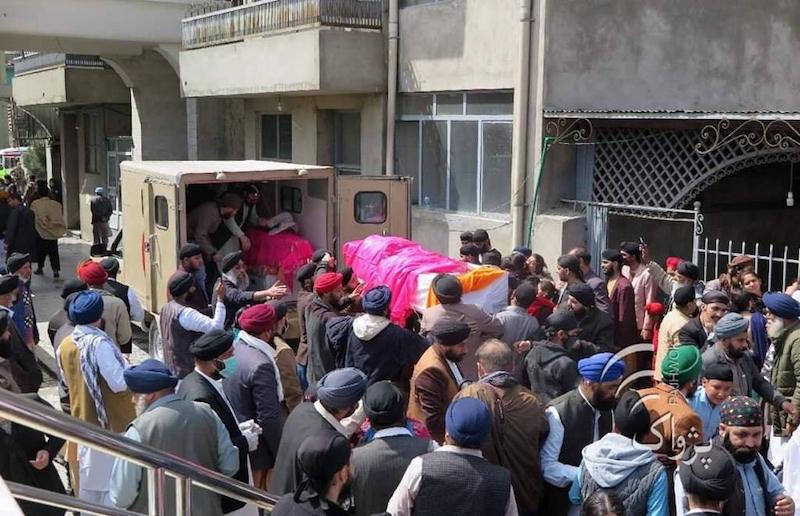
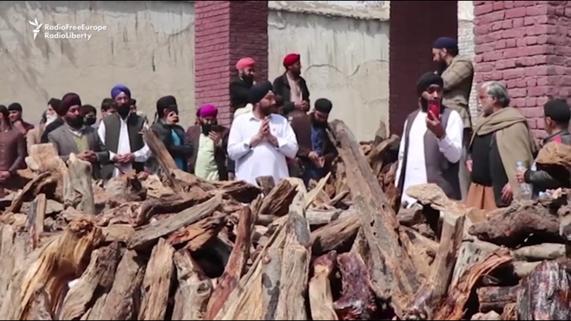
The next day, (26 March), as the small Sikh community gathered to cremate their death, an explosive denoted near the crematorium.
The explosion went off Thursday near the gate of a crematorium in Kabul, as the frightened mourners struggled to continue with the funeral prayers and cremation, reports AP.
The Islamic State affiliate in Afghanistan claimed responsibility for the attack on the group’s Amaq media arm, according to SITE Intelligence Group, which tracks militant postings and groups. The gunmen was identified as Indian national Abu Khalid al-Hindi, according to the report.
Maroon-colored cloth covered the many coffins surrounded by more than 100 family members who came to say their final farewell. The coffins were taken from their house of worship, known as a Gurdwara, to the crematorium for burial.
Dozens of wailing women remained behind in the Gurdwara as their loved ones were carried away.
Among the dead was Tian Singh, an Indian national, India’s External Affairs Ministry said in a statement.
Sikhs, a small religious minority in Afghanistan which numbers fewer than 300 families, have been targeted by Islamist militants before.
A suicide bombing targeting the Sikh community and claimed by IS killed more than a dozen people in 2018 in the eastern Afghan city of Jalalabad.
Cremation of Sikhs who died in Kabul gurdwara killing – Photo: Videograb from Radio Free Europe/Radio Liberty
Cremation of Sikhs who died in Kabul gurdwara killing – Photo: Videograb from Radio Free Europe/Radio Liberty
ASIA SAMACHAR is an online newspaper for Sikhs / Punjabis in Southeast Asia and beyond.Facebook | WhatsApp +6017-335-1399 | Email: editor@asiasamachar.com | Twitter | Instagram | Obituary announcements, click here |
POST ATTACK: SIkhs outside the Kabul gurdwara that was atacked by a gunman killing some 25 Sikhs – Photo: Video grab from Ruptly
By Dr. B.S. Bains | OPINION |
Countries with religious sovereignty need to be more sensitive with their minority society who are born to different religious families. Not forgetting they too contribute to the history of the nation for years. They cannot be eliminated from their social fabric.
Afghanistan’s recent killing has been brutal. The undercurrent of these countries does not bring about peace and harmony in the social set-up. Rather it is a pseudo projection to the world, of them being harmonious and in parity.
The mighty sovereignty of these countries has a wave of somehow converting the minority in which ever method possible. There are enough evidence around the world of this act. This act in Afghanistan has been very saddening. The world body and the social NGO need to increase steps to look into the cry of these minority group living in consistent fear and suppression.
The Sikh Empire under the rule of Maharaja Ranjit Singh extended from Delhi to Afghanistan, during the early half of the 19th Century. With the fall of the Sikh Empire and under British Rule, till today, the Sikh Community, in that continent suffer social discrimination and are marginalized by the sovereign rulings. There are numerous incidence to this statement if you do an Internet search.
The Punjabi race is a hard working race and the Sikhs of Punjab are the brave, focused, never interrupting and self-made society with strong teachings and self-discipline by their Gurus. They are the asset to any society they live in on this planet. They stand up even stronger each time they faced a social catastrophe.
Dr Balwant Singh Bains is a Malaysia-based kirtan enthusiast and a practicing physiotherapist with a chain of physiotherapy clinics. He is also a chief senior consultant royal physiotherapist
ASIA SAMACHAR is an online newspaper for Sikhs / Punjabis in Southeast Asia and beyond.Facebook | WhatsApp +6017-335-1399 | Email: editor@asiasamachar.com | Twitter | Instagram | Obituary announcements, click here |
SASKAAR / CREMATION: 11.30am, 27 March 2020 (Friday), at Hindu Crematorium, Jalan Templer, Seremban, Negeri Sembilan. Cortège leaves at 11.00am from residence at No 20, Jalan Nyior 3, Taman Nyior, Ampangan, 70100 Seremban| Malaysia
ਘਲੇ ਆਵਹਿ ਨਾਨਕਾ ਸਦੇ ਉਠੀ ਜਾਹਿ ॥੧॥
SARDAR DALBIR SINGH S/O LATE SARDAR KARTAR SINGH (AGED 71+)
(25.9.1948 – 26.3.2020)
Passed away peacefully on the 26th of March 2020 leaving behind:
Wife: Mata Kartar Kaur (Tari) D/O Late Sardar Kishen Singh
Sons & Daughters in law, Daughter, Granddaughter, Grandson, Sisters & Brothers in law, Nephews & Nieces and a whole lot of relatives and friends to mourn their loss.
Cremation / Saskaar: 11.30am, 27 March 2020 (Friday), at Hindu Crematorium, Jalan Templer, Seremban, Negeri Sembilan
Cortege Timing: Cortège leaves at 11.00am from residence at No 20, Jalan Nyior 3, Taman Nyior, Ampangan, 70100 Seremban, Negeri Sembilan.
Contact: Balvinder Singh 012-3301587
Message from Family: Due to the Covid-19 partial lockdown, we have been advised to keep the funeral a small affair. Hence, this announcement is meant to inform relatives and friends. We appreciate the love and support that we have received thus far. We thank you for that.
| Entry: 27 March 2020 | Source: Family
ASIA SAMACHAR is an online newspaper for Sikhs / Punjabis in Southeast Asia and beyond.Facebook | WhatsApp +6017-335-1399 | Email: editor@asiasamachar.com | Twitter | Instagram | Obituary announcements, click here |
Though it is too early to begin to speculate what the mid and long term effects that the coronavirus disease (COVID-19) crisis will have on our universities, or for that matter, on all the major public sectors, and society as a whole, I think we can be certain, it will not be “business as usual.”
If this crisis has done nothing else, it has reminded us all of the importance of caring for each other and for working collectively and of NOT allowing our lives to be determined by a selfish me culture where personal achievement becomes the governing principle. I am reminded of an African proverb that is so precinct at this time of stress, distress but hopefully of reflection and introspection. It goes something like this: “If you want to go fast, then go alone, but if you want to go far, then go together.”
For the past 30 years or so, universities across the world have become transformed from public institutions to private businesses, where students have become turned into customers, and academics into managers, administrators and financial speculators.
An article by a group of activist academics entitled “After the pandemic: re-imagining our universities“, offers some insights into what that might be, such as developing ‘new methods of teaching and research with communities beyond our disciplines and classrooms’ and to ‘reclaim the trust and democratic authority to steer our institutions in the directions we need to go, whether that is tackling climate change or soaring inequality’.
For me a more fundamental starting point would be to work from the premise that access to good quality higher education is a human right, and not privilege. That the social good provided by education is far more important than the commercial aspects. That we should not see education as a business, but an essential public service that is no different to access to health care, housing, transport, clean water and healthy nutrition.
We need to move away from the obsession with return on investment as if it were some kind of commodity that can be exchanged for financial gain or loss. This kind of thinking, what was massively accelerated by the introduction of large student fees and a debt culture, is beginning to haunt not only governments, but all of those who work in the system.
At the moment it is difficult to see what good the novel coronavirus crisis will have for humanity, but, perhaps, if nothing else, it has put us all in the same boat, enables us to share the same anxieties, and the terrible effects of isolation and uncertainty. For just a brief moment, we have all become part of what Guy Standing termed the ‘Precariat’ to describe a ‘social class formed by people suffering from precarity or a condition of existence without predictability or security, affecting material or psychological welfare’.
And so, in our moment of precarious togetherness, let us discover a new purpose for building collective co-operative social life. This will need us to establish a new bold purpose for education, which becomes essentially about nourishing the mind and stimulating the human spirit towards a more caring world, where human activity is orientated away from exploiting to nurturing human and natural resources.
[Gurnam Singh is an academic activist dedicated to human rights, liberty, equality, social and environmental justice. He is an Associate Professor of Sociology at University of Warwick, UK. He can be contacted at Gurnam.singh.1@warwick.ac.uk]
* This is the opinion of the writer and does not necessarily represent the views of Asia Samachar.
ASIA SAMACHAR is an online newspaper for Sikhs / Punjabis in Southeast Asia and beyond.Facebook | WhatsApp +6017-335-1399 | Email: editor@asiasamachar.com | Twitter | Instagram | Obituary announcements, click here |