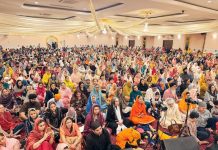
TTSH executive director for central health Loh Su Ching (left) with Gurmail Kaur (2nd from right) and the CST Istri Satsang team that visited Covid-19 battle frontliners – Photo: Supplied
By Asia Samachar | SINGAPORE |
Healthcare are among the people on the frontline of the battle to fight the continuous spread of Covid-19. They are exposed to all sorts of dangers and challenges. Yet, they bravely carry out their responsibilities.
A group of Sikh ladies decided to do something, small as it may be, to recognise the bravery and sacrifices of those battling the coronavirus.
The Istri Satsang (women’s wing) from the Central Sikh Temple (CST) made a cash donation of S$2,000 and some non-perishable items and hand sanitizers.
A team, led by CST Istri Satsang president Gurmail Kaur, visited the Tan Tock Seng Hospital (TTSH) and the National Centre for Infectious Diseases (NCID) to hand over the donation. Earlier, they held a congregational prayer for the well-being of everyone involved in battling the virus.
Istri Sat Sang (CST) has been a social platform for Sikh women for over seven decades since its inception in the early days of Singapore’s modern history, helping to build the social support structure. It organises numerous programmes focussing on the religious, social and humanitarian initiatives.
ASIA SAMACHAR is an online newspaper for Sikhs / Punjabis in Southeast Asia and beyond.Facebook | WhatsApp +6017-335-1399 | Email: editor@asiasamachar.com | Twitter | Instagram | Obituary announcements, click here |
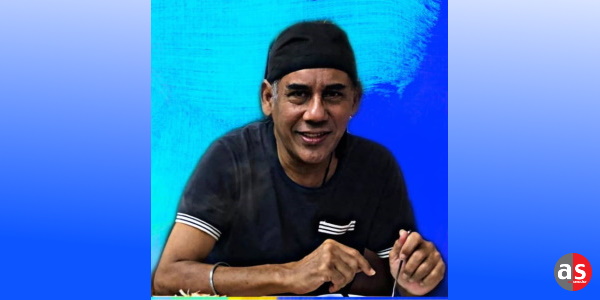
Bhangra artist Bhupinder Singh Rai has released his second single track ‘Bachke’.
This follows his first single track “Glassi” released in October 2015 with Bollywood playback singer Ritu Phatak.
Bhupinder, also known as Bob, began singing Punjabi songs at private functions. He later took vocal training under the tutelage of music composer and director Arvinder Singh Raina, who composed the music for the new track.
“My singing style is mostly influenced by Asa Singh Mastan and UK Band Alaap,” Bhupinder told Asia Samachar. “But I don’t do this for a living. It’s my hobby, my interest.”
The 47-year singer is a director of a Kajang-based company involved in industrial vacuum business. He used to manage a Malaysian bhangra group Nach De Sitarey in the 1980s and 1990s.
ASIA SAMACHAR is an online newspaper for Sikhs / Punjabis in Southeast Asia and beyond.Facebook | WhatsApp +6017-335-1399 | Email: editor@asiasamachar.com | Twitter | Instagram | Obituary announcements, click here |
1. Kristallnacht,1938: Germans pass by the smashed windows of a Jewish-owned shop in the aftermath of Kristallnacht, the German anti-Semitic pogrom (Photo: Universal History Archive/Getty Images). 2. New Delhi, 1984: Hindu mob after setting fire to Sikh houses in 1984. 3. Gujarat, 2002. 4. Hindu mob attacking a Muslim in North Delhi in 2020 (Photo: Danish Siddiqui/Reuters)
By Gurnam Singh | OPINION |
In a recent interview on Democracy Now, a news agency that prides itself in its independence from corporate and government interests, Cambridge historian Dr Priyamvada Gopal compares the current situation in India following the Bharatiya Janata Party’s (BJP) introduction of the Citizens Amendment Act (CAA) and the recent anti Muslim violence in Delhi to the 1930’s Nazi holocaust. SEE HERE.
What we saw last week in North Delhi, she argues, was NOT a conflict or riot between two religious groups but organised genocidal violence by a majority Hindu community against a minority Muslim population. She goes on to suggest that much of the Indian media has succumbed to vested interests and has adopted the “language of ‘clashes,’ and even ‘riots’ and ‘communal violence’, when in fact, what we have been seeing is Hindu nationalist attacks on Muslims in India”. For Gopal, the best characterisation of the violence in Delhi is to see it as a manifestation “an uneven distribution of power” that has resulted in “deep, structural violence.”
Many critical observers of the current state of India and the unfolding violence in Delhi argue it is comparable to 1930’s Germany and Kristallnacht or the ‘Night of Broken Glass’.
On 9th and 10th Nov 1938, similar violence against Jews was carried out by paramilitary forces and civilians throughout Nazi Germany. I would add that there are frightening similarities with the anti-Sikh pogroms between 1-3 Nov 1984 when over 10,000 lives were lost and of course the violence against Muslims that were directly orchestrated by Narendra Modi in Gujarat in 2002.
Since independence, there has been a regular pattern of such violence against religious minorities and Dalit’s across India. By framing what is almost always organised state sponsored terrorism as ‘communal violence’, the politicians and state are provided with a perfect smokescreen to escape responsibility. Since there is a regular pattern of majoritarian violence in India, I fear that, unless those politicians responsible for orchestrating the violence are identified and prosecuted, last week’s violence may actually be a curtain raised for a nationwide pogrom, a trial run to test the reaction of the international community.
Some argue that the repetitive nature of these small and large scale genocides within the Indian state over the course of its 70-odd years of existence since 1947 represents the inherent nature of what is rapidly becoming a failed state. Indeed, one needs to recall that India was born in violence and bloodshed and not in some romantic democratic transfer of power.
As mentioned earlier, though the narrative of ‘communalism’ in India is often framed as Hindu vs Muslim, the reality is that the real axis of division is the ‘Hindi’, namely, the Indian states whose official language is Hindi and have a Hindi-speaking majority, namely Bihar, Madhya Pradesh, Rajasthan, Uttarakhand, Uttar Pradesh and the National Capital Territory of Delhi, and the rest of India. If communalism is a smokescreen, then the real politics is one of centralisation and economic and cultural imperialism, which is manifest in suppression of regional languages, identities and aspirations. In this regard, one could compare the policies and strategies of the BJP/RSS (Rashtriya Swayamsevak Sangh) with the very same strategies adopted by the British during their rule.
It is against this backdrop that we need to see the anti-Sikh violence throughout the 1980’s, which resulted in the November 1984 pogroms in Delhi and the deaths of over 100,000 Panjabis across Northern India, mostly at the hands of state sponsored actors, either through proxies posing as terrorists or extrajudicial killings of Sikh youth by the police. Sadly, through media manipulation and a powerful state propaganda machinery, much of this period was characterised as a battle between democratic secular India seeking to confront Sikh terrorism, supported by external agents!
When a state feels compelled to deploy its own security apparatus against minorities on a regular basis, then you know this is not only a dangerous place to live, but is itself afraid of its own existential death. Today we live in an internet age where social media in particular has meant that suppressing the ‘truth’ is almost impossible. Despite the efforts of state players, each episode of genocidal violence simply exposes the deep cracks and dysfunctionality of what is rapidly becoming a Hindutva Colonial state.
Many people, Panjabis and Sikhs in particular, have sacrificed much in the struggle to remove the British imperialists and establish an independent India where all its citizens were able to feel the glow of freedom. Sadly, what we are seeing is a nightmare scenario emerging, though within the darkness there is still some light in the form the solidarity shown by Sikhs who also experienced similar genocidal violence in 1984. As well as the Gurdwaras opening up their doors and offering protection and providing food for the victims in North Delhi, we have seem amazing individual acts of heroism, such as the example of 53 year old Mohinder Singh and his son Inderjit Singh who used their Bullet motorcycle and scooter to help transport 60-80 Muslim neighbours to a safe location from the epicentre of the violence which was in the Hindu-dominated neighbourhood of Gokalpuri in northeast Delhi.
It is clear that it in the selfless humanitarian intervention of Mohinder Singh that we can see true faith in action. True faith is concerned with peace, love and justice and anybody that disowns these principles has no right to identify with any faith.
The Hindutva/RSS is certainly a threat to minorities in India, be they Muslim, Sikh, Dalit, etc, but perhaps the greatest threat is to Hindus themselves, the vast majority who live in poverty and suffer state violence themselves on a daily basis. By identifying such a racist, casteist, chauvinist hateful project with Hinduism is indeed an insult to this great tradition, and it is important that the false rhetoric of ‘communal violence and strife’ is rejected. What we saw in Delhi and have been seeing in India for decades is state sponsored violence.
Individuals for sure have a responsibility towards their fellow human being, then arguably there is an even greater responsibility on those countries and international bodies such as the UN to confront India. Patrick Cockburn, in a piece in the Independent (28 Feb 2020) headed ‘While Muslims are being murdered in India, the rest of the world is too slow to condemn’, raises important questions about the failure of the so called democratic Western nations to respond to what is without doubt a classic case of fascist violence. He argues that ‘fascist behaviour by present day political leaders and their governments, similar to that of fascist regimes in Germany, Italy and Spain in the 1930s and 1940s, should not be made lightly’ but ‘Modi and the BJP appear closer than other right-wing regimes to traditional fascism in their extreme nationalism and readiness to use violence.’
The inability of the powerful nations to raise concerns probably highlights either a tacit complicity with Modi’s policy or a deep crisis of international governance or both! If nothing is done, then no doubt we are likely to see an intensification of violence against Muslims and other groups who oppose Hinduva fascism. In such a scenario, there is a real possibility of wide scale violence and perhaps even civil war with immense bloodshed and a balkanisation of the whole sub-continent. As we have seen in other places, such as Syria and Iraq, the unfolding tragedy will be responsible for unleashing reactionary, nationalist, fundamentalist and sectarian forces across the region, and in the ensuing fires of hate it will be the most vulnerable sections of the population that will suffer the most.
Until and unless the vast majority of Indians, whatever faith or non-faith tradition they identify with, and the international order, unifies to confront the politics of hate that has become the hallmark of the Indian state, then the future for India and the whole sub-continent is bleak.
[Gurnam Singh is an academic activist dedicated to human rights, liberty, equality, social and environmental justice. He is an Associate Professor of Sociology at University of Warwick, UK. He can be contacted at Gurnam.singh.1@warwick.ac.uk]
* This is the opinion of the writer and does not necessarily represent the views of Asia Samachar.
ASIA SAMACHAR is an online newspaper for Sikhs / Punjabis in Southeast Asia and beyond.Facebook | WhatsApp +6017-335-1399 | Email: editor@asiasamachar.com | Twitter | Instagram | Obituary announcements, click here |
Team spirit ran high for some at the SNSM Holla Mahalla Games 2016 – PHOTO / SNSM
By Asia Samachar | MALAYSIA |
The annual Holla Mahalla Games, a signature event of a Malaysian Sikh youth with games like badminton to athletics, has been postponed indefinitely due to the continued spread of the coronavirus (Covid-19).
The games, organised by the Sikh Naujawan Sabha Malaysia (SNSM), were scheduled for the later part of the month.
The cancellation follows a similar move across the causeway when the Singapore Khalsa Association (SKA) announced the cancelation of the Vesakhi Mela 2020.
The two-day Singapore event, which usually gets a government minister to its opening, was expected to attract some 4,000 people for sporting competitions and fun games. In the pipeline were also new simulator and augmented reality (AR) games.
On the Malaysian side, in a letter released today, SNSM jathedar Dr Jasbir Singh said the ‘heavy decision’ took into consideration the ‘advice and cautions by relevant and governing authorities, both local and international.’
ASIA SAMACHAR is an online newspaper for Sikhs / Punjabis in Southeast Asia and beyond.Facebook | WhatsApp +6017-335-1399 | Email: editor@asiasamachar.com | Twitter | Instagram | Obituary announcements, click here |
Kavneet Singh taking questions from the school children – Photo: ASC
By Asia Samachar | UNITED STATES |
The American Sikh Council (ASC) representative S.Kavneet Singh participated in an event teaching world religions and bullying prevention held at Middle School 890 in Brooklyn, NY on Feb 6, 2020. The three-hour event had over ten speakers/participants from all the major faith traditions.
The format was held in what is known as community circles. Each guest speaker ran a 12-minute circle conversation with a group of around 10-15 students. The school children pose various questions to the speakers and then the guest speakers rotate groups, in order to cover all the children. The circle format instead of panel is bit more intimate while it provides deeper understanding and more ‘small group’ discussions with the students.
Most of the questions by the students were focused on learning about the practices of the various religions. The questions also included personal opinions on one’s faith, information on the scriptural texts, about suffering of humans, common misconceptions, death, after-life, hell-heaven, etc.
Guiding Questions:
Tell us about the religious tradition or spiritual practices of your childhood.
How has your faith changed over time?
Are there specific texts or documents that are important for teaching about your religion? Why are these texts special? Do people disagree about the history or meaning(s) of these texts?
Does your religion have an explanation for why people suffer in the world?
What would you say is, from your perspective, the most commonly held misconception about people of your religion?
How do you practice your beliefs? Are there rituals, objects, or dates that are important to you?
There were several representatives from the New York Department of Education in attendance, participating and observing the ongoing discussion. Out of the over 125 students who participated the majority of the students were 6th graders, but there were also 7th and 8th graders involved in the event.
He further highlighted the bias against adults and how the trickle-down effect impacts the children. The overwhelming reason for the unrelenting bias is the ubiquitous ‘turban’.
Ms Caroline remarked, “The information given by Kavneet Singh was very informative, the children were extremely engaged while the representatives from the DOE the an eye-opener for many of us.”
This was the fourth year American Sikh Council (ASC) representatives interacted with the convention attendees by educating and answering many questions posed by the various specialists and educators. Brochures covering the Sikh Faith, Sikhs and Scouts, History of Sikh Americans, Bullying of Sikh American Children were displayed and distributed. The recently published book supported by the American Sikh Council ‘Bullying of Sikh American Children – Through the Eyes of a Sikh American High School Student’, www.bullyingasikhamericanchildren.org was displayed; as this is another resource tool which can be used by all school professionals and law enforcements officials to help the widespread bullying and victimization of many minorities groups like the Sikh American children.
Bullying of Sikh American school children is a pervasive problem across America. The networking and the outcome of ASC’s collective work was a great success, but in order to continue to sustain this ongoing work ASC requests all the gurdwaras to generously support these very important educational initiatives in order to help our next generation thrive and not simply survive.
Extracted from American Sikh Council (ASC) newsletter for March 2020. The original article was entitled ‘ASC does a workshop on the Sikh Faith and Bullying Prevention at the Middle School 890, Brooklyn, NY on 2020’.
ASIA SAMACHAR is an online newspaper for Sikhs / Punjabis in Southeast Asia and beyond.Facebook | WhatsApp +6017-335-1399 | Email: editor@asiasamachar.com | Twitter | Instagram | Obituary announcements, click here |
The statue of Maharaja Ranjit Singh on the evening of its inauguration at Lahore Fort on 27 June 2019.—Photo via Press Information Department on Twitter
By Asia Samachar | BRITAIN |
Maharaja Ranjit Singh, leader of the Sikh empire in the early 19th century, has topped a BBC history magazine poll of the greatest leaders in world history.
The Sikh leader, founder of the Sikh empire who forged a modern empire of toleration and who famously owned the Koh-i-Noor diamond, topped the poll by BBC World Histories Magazine.
Dubbed the Lion of Punjab, Ranjit (1780–1839) was described by his nominator historian as a modernising and uniting force, whose reign “marked a golden age for Punjab and north-west India”.
At the beginning of this year, BBC World Histories Magazine asked historians to nominate their ‘greatest leader’ – someone who exercised power and had a positive impact on humanity – and to explore their achievements and legacy. The list was voted on by more than 5,000 readers, with Ranjit named as the history’s greatest leader.
Taking more than 38% of the vote, Maharaja Ranjit Singh was described by nominating historian Matthew Lockwood as a modernising and uniting force, whose reign “marked a golden age for Punjab and north-west India”, according to an entry at the magazine’s website. See here. writes Lockwood is an assistant professor of history at the University of Alabama.
In second place, with 25% of the vote, is African independence fighter Amílcar Cabral (nominated by Hakim Adi), who united more than one million Guineans to free themselves from Portuguese occupation and in turn propelled many other colonised African countries to rise and fight for independence. British prime minister Winston Churchill (nominated by Andrew Roberts) is in third position with 7% of the vote for his sharp political manoeuvring that kept Britain in the war.
Further down the list, according to the entry, American president Abraham Lincoln (nominated by Adam I P Smith) is in fourth place and British monarch Elizabeth I (nominated by Tracy Borman) is the highest ranked female leader in fifth position, with 4% of the vote.
On 27 June 2019, Pakistan’s Lahore Fort saw the unveiling of an equestrian sculpture to mark the 180th anniversary of the death of one of Lahore’s most famous and significant historical figures.
“But even more than that, in a region riven by ethnic and religious strife, in an era scarred by rising religious fundamentalism and growing tension between India and Pakistan, the statue was intended to be a symbol of a previous age of toleration and stability, and the near-mythical ruler who presided over it: Maharaja Ranjit Singh,” writes Lockwood.
Even his physical impairments were transformed into strengths, he adds.
When a curious Lord Auckland, Governor-General of British India, enquired about Ranjit’s blind eye – his left eye was blinded and his face scarred by smallpox – his foreign minister countered that the Maharaja was like the sun, which also only had one eye, continuing that “the splendour and luminosity of his single eye is so great that I have never dared to look at his other eye”.
Ranjit Singh had become a Sikh Napoleon, a Punjabi sun king. Sikhs, however, did not have to reach to European history to find comparisons; Ranjit Singh was simply the most dazzling in a long line of Sikh warrior-chiefs and soldier-saints stretching back to the 17th century, writes Lockwood.
You can read his full entry, ‘Who was Maharaja Ranjit Singh?’, here.
ASIA SAMACHAR is an online newspaper for Sikhs / Punjabis in Southeast Asia and beyond.Facebook | WhatsApp +6017-335-1399 | Email: editor@asiasamachar.com | Twitter | Instagram | Obituary announcements, click here |
PATH DA BHOG UPDATE: PROGRAMME CANCELLED IN VIEW OF COVID-19 RESTRICTIONS
ਘਲੇ ਆਵਹਿ ਨਾਨਕਾ ਸਦੇ ਉਠੀ ਜਾਹਿ ॥੧॥
TARA SINGH S/O BAGH SINGH
(23 November 1945 – 4 March 2020)
Village: Gurdaspur
Wife: Minderjit Kaur D/O Balwant Singh
Children & Spouse :
Karamjeet Singh & Rajinder Kaur
2. Keljeet Singh & Treshal Kaur
3. Datin Kelvinderjeet Kaur & Dato Jasvir Singh
Grandchildren:
Resheal Kaur
2. Dhanvir Singh
3. Ammretjeet Kaur
4. Manvirjeet Singh Chohan
5. Harjit Singh
UPDATED: PROGRAMME CANCELLED IN VIEW OF COVID-19 RESTRICTIONS
Contact:
Karamjeet Singh 016 229 2512
Keljeet Singh 016 5551664
Dato’ Jasvir Singh 012 2915111
| Entry: 4 March 2020; Updated: 6 March 2020; Updated: 18 March 2020 | Source: Family
ASIA SAMACHAR is an online newspaper for Sikhs / Punjabis in Southeast Asia and beyond.Facebook | WhatsApp +6017-335-1399 | Email: editor@asiasamachar.com | Twitter | Instagram | Obituary announcements, click here |
NEW DELHI — Forty-six people have been killed, more than 250 injured and four mosques set on fire in the sectarian violence in Delhi that coincided with President Trump’s visit to India.
The violence, which lasted over three days and nights and was mostly directed at Muslims in northeastern areas of Delhi, was not surprising. Over the past six years, Prime Minister Narendra Modi, his colleagues in the Hindu nationalist Bharatiya Janata Party, their armies of social media trolls and a vast majority of India’s television networks have consistently been building an atmosphere of hatred, suspicion and violence toward India’s Muslim minority.
The pogrom in Delhi follows in the wake of the discriminatory citizenship law that Mr. Modi’s government passed in December. Indians, especially Muslims, have been protesting the law. Before the killings in Delhi, 19 people were killed when protests broke out in the neighboring state of Uttar Pradesh, which is administered by the B.J.P.
In recent elections in Delhi, Mr. Modi’s party ran a dangerously sectarian campaign. Its leaders equated the protests against the citizenship law with treason and called for the murder of protesters. The B.J.P. lost the Delhi elections and the protests continued. On Feb. 23, Kapil Mishra, a leader of the B.J.P., incited mobs in northeast Delhi to remove a group of Muslim women who were holding a sit-in and blocking a road to protest the citizenship law. Violence erupted soon after.
A week later, the detailed accounts of violence raise fundamental questions about the role played by the Delhi police in abetting the Hindu mobs and targeting Muslims. When Mr. Mishra gave the speech that lit the fire, Ved Prakash, the deputy commissioner of police for northeast Delhi, stood beside him and did not intervene. The next day, as the mobs swung into action, Mr. Prakash and other police officers were shaking hands with a Hindu mob, which shouted slogans celebrating the Delhi police and its support.
Top police officers casually expressed their support of the Hindu mobs and their fear of Muslims. “Jai Shree Ram,” the old devotional chant praising the Hindu deity Ram, has been adopted as a war cry by the Hindu nationalist mobs in the past three decades. There were reports of the Delhi police personnel charging at Muslim neighborhoods while shouting, “Jai Shree Ram!”
A particularly gruesome video, which has been fact-checked and verified, shows Delhi policemen standing around five badly injured Muslim men lying on the road, forcing them to sing the national anthem. They can be heard hurling abuses. One of the men has died of his injuries.
To read the full story, ‘Why Delhi Police Did Nothing to Stop Attacks on Muslims’ (New York Times, 3 March 2020), go here.
Hartosh Singh Bal is the political editor of The Caravan magazine in New Delhi and the author of “Waters Close Over Us: A Journey Along the Narmada.”
ASIA SAMACHAR is an online newspaper for Sikhs / Punjabis in Southeast Asia and beyond.Facebook | WhatsApp +6017-335-1399 | Email: editor@asiasamachar.com | Twitter | Instagram | Obituary announcements, click here |
PATH DA BHOG: 15 March 2020 (Sunday), 5 – 8 p.m., at Gurdwara Sahib Khalsa Dharmic Jatha, Penang | Malaysia
ਘਲੇ ਆਵਹਿ ਨਾਨਕਾ ਸਦੇ ਉਠੀ ਜਾਹਿ ॥੧॥
SARDAR BHAG SINGH
Son of the late Ralla Singh (Pind: Abhipur) and Mata Chand Kaur
Retired Senior Assistant (Student Affairs) at Catholic High School, Tanjung Malim, Perak
Passed on in Tumpat, Kelantan on 29th February 2020
Husband to Chan a/p Eh Kiow (Penolong Pegawai Farmasi, Klinik Kesihatan Tg Malim)
Father to Zoraver Singh Mavi and Zoraester Singh Mavi
Path Da Phog: 15 March 2020 (Sunday), 5 – 8 p.m., at Gurdwara Sahib Khalsa Dharmic Jatha, Penang
For details, contact:
Prem Singh (016-534 7295)
Makhtear Kaur (016-432 6557)
Datuk Himmat Singh (019-2179456)
Amarjeet Rizmie (012-2082786)
Please treat this as a personal invitation.
| Entry: 3 March 2020 | Source: Family
ASIA SAMACHAR is an online newspaper for Sikhs / Punjabis in Southeast Asia and beyond.Facebook | WhatsApp +6017-335-1399 | Email: editor@asiasamachar.com | Twitter | Instagram | Obituary announcements, click here |
The Dubai gurdwara will install four airport-style temperature scanners in light of the continued spread of the deadly coronavirus.
Gurudwara Guru Nanak Darbar, the only Sikh place of worship in the United Arab Emirates (UAE), will install four scanners at its entrances and the basement parking lots.
“We are fixing them tomorrow,” the gurdwara chairman Surender Singh Kandhari told Asia Samachar in a text message, adding that the equipment cost US$15,000 each.
The proactive step is in response to the unabated spread of the virus, known as COVID-19. Globally, it has killed more than 3,100 people and infected over 90,000. Aside from China, the major virus hotspots are South Korea, Iran and Italy.
A fortnight ago, Singapore gurdwaras announced that they were taking precautionary measures, including screening staff temperature and wearing gloves and masks when preparing food, as the nation battles the virus. Singapore Khalsa Association (SKA) had also announced the cancellation of its Vaisakhi mela.
If any visitor visiting the Dubai gurdwara is detected with high temperatures, Surender said they would be requested to refrain from entering the place of worship and would be reported to the Dubai Health Authority.
“This is not to create any panic. We are just taking a precaution. We welcome everyone to the Gurudwara. Let us just be careful and better be safe than sorry,” he said.
The Dubai gurudwara, located in Jebel Ali, Dubai, is known for serving free meals to all visitors through its community kitchen, catering to over 50,000 Sikh devotees in the UAE.
On average, some 2,000 people attend langar daily at the gurudwara every day, and 15,000 people visit over the weekends.
“People from all walks of life come to us. We have installed hand sanitizers and the cleaning services of the kitchen, floors, toilets, and carpets will be organised every two hours.
“We have to stick to various requirements of the ISO certification and keep high standards in hygiene and cleanliness because, for us, cleanliness is next to godliness,” he said.
He said the gurdwara has also published safety guidelines from Dubai Health Authority (DHA), Indian Embassy and the Consulate General of India as notices across the gurudwara in English and Gurmukhi.
ASIA SAMACHAR is an online newspaper for Sikhs / Punjabis in Southeast Asia and beyond.Facebook | WhatsApp +6017-335-1399 | Email: editor@asiasamachar.com | Twitter | Instagram | Obituary announcements, click here |