


















UA-56202873-1
Page 509

Don’t Blame Victims Burning in Delhi’s Violence, Again

1
Desecration of a Muslim mosque – Photo: Video grab
By Mallika Kaur| OPINION |

While Trump and Modi display further bonhomie this week, #DelhiBurning trends on Twitter, and mainstream media rushes to control the narrative around plumes of smoke rising from New Delhi neighborhoods right now. The extent of injuries and casualties are unconfirmed; the videos and photos that have made it out are chilling.

“Friends are in East Delhi. Police won’t allow our attempt to take medical supplies in. I am worried. Can I text back later?” writes a former student. Her family lived through the anti-Sikh pogroms in Delhi past. The inconvenient memories of the survivors of that violence know how it can escalate into even a pogrom, know how victims are blamed for their own victimization, know that the targeting is a deathly signal to minorities much beyond the scope of the current violence: after all, this violence has been performed in the capital city, kilometers away from where Trump dined! These inconvenient memories reject the politically expedient explanations of “Hindu-Muslim riots.”

Since December, much before Trump’s mega visit, citizens in India have been protesting new laws that are widely understood as anti-Muslim. These laws were barely cloaked with rationales of national security and government benevolence. India’s Muslim minority has felt deathly vulnerable in the face of legalized discrimination and social emboldening of the anti-Muslim Indian right-wing.

Now, Muslims are bearing the bloody brunt in the capital of the country. Social media shares videos of police engaging in violence against injured Muslims lying collapsed on the ground, of forcing bloodied Muslim men to sing the national anthem and chant Hindu slogans, of encouraging armed mobs shouting vicious anti-Muslim slogans, of assailants running right by the police and then proceeding to attack Muslims. Indian media houses have minimized the violence as “between two groups”and the government characterized the whole crisis as “orchestrated.”

A BJP spokeswoman tweeted the violence and killing (of a police constable) was a “ploy to embarrass India,” and ironically attributes it to the same “anti-India forces” that accompanied Bill Clinton’s visit to India in 2000. On the eve of Clinton’s visit, 35 Sikh civilians were summarily executed in Chattisinghpora village in Kashmir, by masked assailants. The role of the Indian forces in the massacre and the later cover-up — including by executing local Kashmiri Muslims men, dubbed “Pakistani terrorists” — was alleged by locals from the onset; then reported internationally; and eventually confirmed in part by the Indian Supreme Court.

By now, many across Delhi, and Sikhs across the world, are retriggered by memories of the pogroms of 1984, when Delhi was shut down for days while armed, organized, government-backed mobs unleashed sadistic, sexualized, ravaging violence against Sikhs (many in their own homes, lists for which had been provided to the “mobs”). Thousands were murdered in days.

The survivors seethed at the mockery and shaming to which they were subjected in the aftermath. Being taunted walking down a street — “Yeh Sikh Kaise Bach Geya” (How did this Sikh survive)? Being prodded with gibes about the recent trauma — “Sardar toh sirf chiriya ghar mein milenge” (You’ll have to go to the zoo to find a Sikh now)!

These memories are inconvenient to any narrative peddled now about “antinational” “bad” Muslims “clashing” with “good” Hindu Indian citizens. It is also inconvenient to Indian liberal narratives which while intent on rejecting the current politics of hate, ignore the pre-Modi, the pre-2002, the pre-1990 history of India. Meanwhile these ignored histories contribute to the popularity of the current strongmen; directly relate to the draconian clampdown on the entire Kashmir Valley; fuel India’s oft-rung alarm bells against nuclear neighbor Pakistan, triggering inter-generational traumas for those living along the volatile border.

Targeted destruction of only Muslim property – Photo: Shaheen Bagh Official Twitter account

For too long, there has been an electorally expedient blueprint that actively fuels divisions and mistrust, creates an enemy community, and stokes communal hostility to prevent everyday citizens from exhibiting everyday humanity.

Rather than condemning the armed attackers, Indian politicians of various hues have rushed to issue concerned statements that India’s ‘image’ is being sullied by the protestors, who are the targets of the violence. Meanwhile, once my former student confirms the well-being of her Muslim friends in East Delhi — and now that some lawyers have succeeded in obtaining a midnight court order for medical access for the injured — I’m sure she will text me back. Hope is hounded, but kept alive by these citizens.

Mallika Kaur @mallikakaur is a lawyer and author of “Faith, Gender, and Activism in the Punjab Conflict: The Wheat Fields Still Whisper,” 2020. She teaches at BerkeleyLaw.

RELATED STORY:

Black November: India’s judicial system failed 1984 victims (Asia Samachar, 25 Nov 2019)

ASIA SAMACHAR is an online newspaper for Sikhs / Punjabis in Southeast Asia and beyond. Facebook | WhatsApp +6017-335-1399 | Email: editor@asiasamachar.com | Twitter | Instagram | Obituary announcements, click here |

Kishbir Kaur (Gogi) Sandhu, (1961-2020), Bidor

PATH DA BHOG: 7 March 2020 (Saturday), 10am to 12 noon, at Gurdwara Sahib Bidor, Perak, followed by Guru Ka Langgar | Malaysia

BIBI KISHBIR KAUR (GOGI) SANDHU

D/O LATE SARDAR INDER SINGH AND
LATE SARDARNI MAHANDRA KAUR (BIDOR)


Age: 58

Passed away peacefully on 23 February 2020. Deeply missed, always remembered, loved and forever cherished by loved ones.

Siblings:

Mdm Gurmit Kaur-Penang
Dr Bajan Singh-Tapah
Mdm Belbir Kaur(Bell)- Penang
Mdm Dip Kaur-Kajang
Mdm Satwindar Kaur-Kajang
Mr Reshminder Singh-Penang

Brothers in law, Sister in law, Nephews, Nieces, Grandnephews and a host of relatives and friends.

The Sahej Path Da Bhog will be held at Gurdwara Sahib Bidor, Perak on Saturday 7th March 2020 at 10am to 12 noon followed by Guru Ka Langgar.

The family wishes to express their gratitude to all well wishers, wreaths and condolences received during our recent bereavement.

Please treat this as a personal invitation for the Path Da Bhog.

Contact:

  • Dr Bhajan Singh (012 334 2546)
  • Mr Reshminder Singh (012 498 0577)
  • Lt Col Satwant Singh (Retired) (012 644 5148)
  • Mdm Belbir Kaur-Bell (016 431 7470)


| Entry: 28 Feb 2020 | Source: Family

ASIA SAMACHAR is an online newspaper for Sikhs / Punjabis in Southeast Asia and beyond. Facebook | WhatsApp +6017-335-1399 | Email: editor@asiasamachar.com | Twitter | Instagram | Obituary announcements, click here |

Singapore cancels Vaisakhi mela

1
CROWD PULLER: The Vesakhi Mela in 2019 – Photo: SKA
By Asia Samachar | SINGAPORE |

Singapore’s largest Vaisakhi event will not be taking place this year due to the coronovirus infections.

The Vesakhi Mela 2020, one of the signature annual events anchored by the Singapore Khalsa Association (SKA), was earlier planned for April 11-12.

SKA president Hernaikh Singh said the event was cancelled to help the nation combat the virus Covid-19.

“It was a really difficult decision as much planning and effort have been put in by the organising committees for these events as well as the fact that our members and the larger community were looking forward to these events. However, we feel that they will understand and appreciate the rationale behind our decision,” he said in a message sent to Asia Samachar.

Some 4,000 people were expected to attend the two-day event which included sporting competitions and fun games. In the pipeline were new simulator and augmented reality (AR) games.

On Feb 7, Singapore increased the Disease Outbreak Response System Condition (DORSCON) level to Orange, one notch below top level of Red. Since January, it has implemented a series of measures, including travel restrictions.

As of this morning (Feb 28), Singapore has recorded 96 cases of Covid-19. As at Feb 25, 33 who were still in hospital and seven in critical condition in the intensive care unit.

In a meeting on Feb 15, Singapore Sikh institutions and gurdwaras agreed looked at a number of potential ‘key measures’ to control the spread of Covid-19. These included taking precautionary measures, including screening staff temperature and wearing gloves and masks when preparing food.

In a one-page guideline issued by the Co-ordinating Council of Sikh Institutions (CCSI), it urged gurdwaras to be on a heightened alert but noted that programmes would proceed. It made some suggestions on attendance and participation, darbar sahib (prayer hall), langgar lall (commuity kitchen), and general cleanliness and hygiene.

Earlier, SKA had also announcement the postponement of its cultural night for 2020 planned for 22 Feb which was supposed to feature a Sydney-based musician famous for his ‘tumbi’ and folk songs. It had also cancelled its Family Day planned for 21 March.

“When the situation improves, we do plan to organise several social, cultural and sport events,” said Hernaikh.

A scene from Singapore Vesakhi Mela 2019 – Photo: SKA


RELATED STORY:

Singapore minister to join thousands at SKA Vaisakhi event (Asia Samachar, 12 April 2019)

Singapore gurdwaras take measures to fight coronavirus (Asia Samachar, 16 Feb 2020)

ASIA SAMACHAR is an online newspaper for Sikhs / Punjabis in Southeast Asia and beyond. Facebook | WhatsApp +6017-335-1399 | Email: editor@asiasamachar.com | Twitter | Instagram | Obituary announcements, click here |

Fairness for all faiths

0
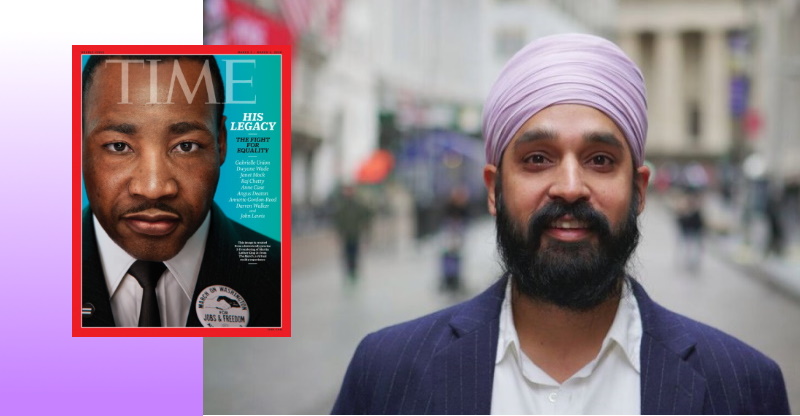
Simran Jeet Singh (Photo: David Ambrose / TIME) and the TIME cover for March 2020 issue
By Asia Samachar | UNITED STATES |
A Sikh interfaith activist has been featured by TIME magazine as one of the 16 people and groups fighting for a more equal America.

In an entry at the US-based magazine, activist, writer, and scholar Simran Jeet Singh talks about challenges faced by the minorities in the United States.

The 9 March 2020 issue, with Martin Luther King Jr. on its cover, looks at the state of equality in the United States today.

Here is the TIME write-up, entitled ‘Fairness for all faiths’, on Simran Jeet.

Growing up Sikh in San Antonio, Simran Jeet Singh felt “highly visible yet entirely unknown,” he says. He was a high school senior when a streak of hate crimes against Sikhs swept the U.S. in the months after 9/11, and he realized that “ignorance is actually a matter of life and death.” He’s turned that drive into a career as a scholar and advocate for religious freedom. On his podcast Spirited, he interviews prominent figures about spirituality, and he has a regular column for Religion News Service. Notably, he’s written about the idea of “religious supremacy.” Just as white supremacy is a dangerous thread in American life, he argues, so is the idea that one religion is superior. For Singh, 35, religious equality requires challenging the assumption that Christianity is the default. “Then,” he says, “we can actually create an even playing field for people of different traditions.”

Simran Jeet is the author of ‘Fauja Singh Keeps Running‘, a children’s illustrated book that captures the true story of a Sikh man who was the oldest person to run a marathon.


RELATED STORY:

Fauja Singh keeps running, now in a children book (Asia Samachar, 21 Feb 2020)

ASIA SAMACHAR is an online newspaper for Sikhs / Punjabis in Southeast Asia and beyond. Facebook | WhatsApp +6017-335-1399 | Email: editor@asiasamachar.com | Twitter | Instagram | Obituary announcements, click here |
 Kartar Singh (1931-2020), Cameron Highlands, ex-LLN

AKHAND PATH: 6-8th March 2020, starts 9am, at Gurdwara Sahib Subang | Malaysia

KARTAR SINGH S/O RATTAN SINGH

5 Jun 1931 – 26 Feb 2020

Village: Dhunda, Amritsar

A very charismatic, responsible and a natural-born leader. Helping others was always his nature. A spiritual person from heart and soul. A strong father figure to all of us. You will always be remembered, Father.

Wife: Late Bachan Kaur Katha Singh Sandhu (Chhola Sahib, Amritsar)

Children:

Hardial Singh, Jasbir Singh, Ragbir Singh, Gurmit Kaur, Dharm Pal Singh, Rawendhar Kaur, Jernail Singh, Hardheal Kaur

Spouses: Karamjit Kaur, Sukhdarshan Kaur, Jasbindar Kaur, Gurcharan Singh, Indra Devi,  Amarjeet Singh, Paramjit Kaur, Sunil Singh.

21 Grandchildren & 14 Great Grandchildren

Saskaar / Cremation: 1pm, 27 Feb 2020 (Thursday), at Gui Yuan Crematorium and Funeral Hall Petaling Jaya (Addr: Jalan 51A/229, Seksyen 51A, 46100 Petaling Jaya, Selangor)

Akand Path: 6-8th March 2020, starts 9am, at Gurdwara Sahib Subang

Contact: 

Hardial Singh 016 536 9522

Amrit Singh 012 659 1096


| Entry: 26 Feb 2020 | Source: Family

ASIA SAMACHAR is an online newspaper for Sikhs / Punjabis in Southeast Asia and beyond. Facebook | WhatsApp +6017-335-1399 | Email: editor@asiasamachar.com | Twitter | Instagram | Obituary announcements, click here |

BETWIXT & BETWEEN – Amrit Vela

0
By I.J. Singh and Ravinder Singh Taneja | OPINION |

Our past shapes, or misshapes us, making us what we become. The past is the foundation, brick, and mortar needed to create a durable protective shield for our existence. So, we can’t possibly walk away from it. To willingly disown the past is not only impossible (its lure is tighter than a boa’s embrace) but could be suicidal to our sense of self.

The present is in the moment, but we use it mostly to rue the past while drooling for a magical future. Yet, life requires adjusting to changing times and realities. Time marches on.. How to accommodate this inevitably changing reality while resisting the change at the same time? How then to build a future to define us without denying the past?

All existence is just a moment of time between the past and the future; “Hum aadmi haen ik dami”(Guru Granth p 660). But the moment can destabilize and threaten, making for inner conflict. Ergo, resistance to the change that comes with time becomes an essential defense mechanism to preserve our sense of self.

Let’s come to this from another perspective.

Human societies – primitive or modern – are rooted in tradition. Traditions are the glue that binds a people into a community. Like the forces that unite electrons and atoms to create complex molecules and larger structures, cultures develop families, communities, even nations. Some traditions come to define the foundations of religions, others form belief systems of civil societies, without an associated religious identity.

Both religious and secular societies resist change and amendments of their laws and traditions. This creates stability. But at times non-religious civic societies are expected to respond to changing times, and they do so with interpretations or modifications of hallowed traditions. Religions, on the other hand, resist such freedom of thought and action because their traditions become etched in stone, since their formulations become coated with unnecessary non-earthly governing structures.

Every so often, we need to revisit, review, and re-examine our laws, traditions, and conventions — both secular and faith-based — to understand what time has wrought. I offer a simple illustration to make my point. Surely readers will add and subtract as they should.

Take, for instance, the notion of amrit vela in Sikhi. Amrit Vela – literally ‘the ambrosial hour,’ is conventionally thought of as the pre-dawn hours (perhaps between 3 – 6 AM.). It is then that our inner and outer environmental existence is most conducive to the divine ambrosia of naam. Sikh tradition asks a Sikh to start the new day at Amrit Vela.

Let us revisit this idea; does amrit vela point to some clock time, or is there higher principle at work?

Most religions started centuries ago when human communities were mostly agricultural and pastoral. Daily life followed a circadian rhythm out of necessity: The day began with day-light and ended with sunset. Not surprisingly, amrit-vela coincided with the time just before demands of work and family took over.

Haven’t times changed? Technology has disrupted the pattern and rhythm of agricultural and pastoral societies, changing the way we live. The car disrupted the horse and carriage; small personal computers disrupted mainframes. A new wave of automated technology (Artificial Intelligence) is sweeping the world and threatens, once again, to redefine and restructure our daily life.

How does any generation calibrate its time for rest and activity? Where lies the transition from one to the other? How does Amrit vela fit in?

For a religious institution, like a gurdwara, to insist that for a Sikh, anywhere in the world, Amrit vela just before the sun is barely peeping (preferably 4 am), and that is the time for a particular prayer— or else, it is blasphemy! Well! What do you think?

Does blasphemy not lie in our off-kilter insistence on starting the day at a particular hour? Prayer can, indeed, move mountains; timing (discipline) is essential. Keep in mind that the listener’s mind is the target of Gurbani. Paramount is the message not the clock time.

Here we are: living in the present moment, but tied by formidable conditioning to the past, buffeted by the unknown future. Our judgements on issues that matter often fall short of our current needs and values.

Obvious difficulties surface if amrit vela is fixed clocked time. For someone working the night shift, early morning might be the bedtime he needs. Different time zones across the world would imply multiple amrit velas. Which one is right? And forget not the multiple activities in a full day.

Could rising at pre-dawn hours be a personal preference, dictated in no small measure by one’s circadian rhythm and social conditioning? Some people are natural larks, others may be night owls.

Why not turn to Gurbani itself for guidance? Amrit vela literally means immortal or beyond time. Earlier, we had referred to Guru Nanak’s insight that the present is the only moment we have, when we are alive, since the next breath, is never guaranteed.

Amrit vela becomes a call to live in the moment when life is. A successful life, in this sense, would be one that is transcendental — i.e., one that surpasses its limitations by becoming god-like in consciousness. This is possible only if every breath (the building blocks of our life) and every moment is lived in naam-awareness.

By extending our view of Amrit Vela to mean human life, we will, in effect, be holding ourselves accountable for every breath – instead of a fixed time zones in a 24- hour cycle, viewing amrit vela as a human opportunity to transcend to more gratifying heights (Gobind milan ki eh teri bariya, Guru Granth p.12).

Guru Arjan advises us that “Har simran ki sagli bayla” (Guru Granth p.150)- Every moment is time to remember God.

There is no fixed time for Amrit Vela: “Saa ruth suhaavee jith har chith aavai” (Guru Granth, p. 1183).

 I.J. Singh is a New York based writer and speaker on Sikhism in the Diaspora, and a Professor of Anatomy. Email: ijsingh99@gmail.com.  

* This is the opinion of the writers, organisation or publication and does not necessarily represent the views of Asia Samachar.

RELATED STORIES:

POLITICS IN GURDWARAS: Low Hanging Fruit (Asia Samachar, 15 Oct 2019)

1984: What a Different World Teaches Us 

I.J. Singh explores Sikhi in all its dimensions (Asia Samachar, 10 Nov 2018)

ASIA SAMACHAR is an online newspaper for Sikhs / Punjabis in Southeast Asia and beyond. Facebook | WhatsApp +6017-335-1399 | Email: editor@asiasamachar.com | Twitter | Instagram | Obituary announcements, click here |

Sarnkor @ Swaran Kaur (1929-2020), Kampar

PATH DA BHOG: 7 March 2020 (Saturday), 10am – 12pm, at Gurdwara Sahib Kampar | Malaysia

ਜੇਹਾ ਚੀਰੀ ਲਿਖਿਆ ਤੇਹਾ ਹੁਕਮੁ ਕਮਾਹਿ ॥ ਘਲੇ ਆਵਹਿ ਨਾਨਕਾ ਸਦੇ ਉਠੀ ਜਾਹਿ ॥੧॥

Jayhaa Cheeree Likhi-aa, Tayhaa Hukam Kamaahi, Ghalay Aavah Naankaa, Saday Uthee Jaahi


SARNKOR @ SWARAN KAUR D/O DIAL SINGH

(9.4.1929 – 25.2.2020)

Village: Tarn Taran.

Husband: Late Nand Singh s/o Jiwan Singh (Retd HA, Kampar Hospital)

Children, Spouses, grandchildrens & great grandchildrens.

Saskaar / Cremation: 12.00 pm, 26 Feb 2020 (Wed), at Kampar Sikh Crematorium

Path da Bhog: 7 March 2020 (Saturday), 10am – 12pm, at Gurdwara Sahib Kampar. Guru ka Langar to be served thereafter

Contact:

Harcharan Singh (019-3172921)

Jit Singh (016-5947905)

CDR (R) Keshvinder Singh (012-5982393)


| Entry: 25 Feb 2020: Updated: 28 Feb 2020 | Source: Family

ASIA SAMACHAR is an online newspaper for Sikhs / Punjabis in Southeast Asia and beyond. Facebook | WhatsApp +6017-335-1399 | Email: editor@asiasamachar.com | Twitter | Instagram | Obituary announcements, click here |

Short film ‘Langgar’ on beautiful gesture from first Sikh Guru

0
EDITOR’S PICK | A short film which talks about the ‘Langar’ is serviced to anyone and everyone. No one should go hungry… So please spread the word of this kind gesture which has been given to us by the first Sikh Guru – Gurjant Singh Films (Published on 23 Feb 2020). To view, click here.

ASIA SAMACHAR is an online newspaper for Sikhs / Punjabis in Southeast Asia and beyond. Facebook | WhatsApp +6017-335-1399 | Email: editor@asiasamachar.com | Twitter | Instagram | Obituary announcements, click here |

Why Pakistani Punjabis disowned mother tongue

0
By Ishtiaq Ahmed | OPINION |

The biggest linguistic nationality of Pakistan (since December 1971) is the Punjabis. Yet, the national language of Pakistan is Urdu, which is the mother tongue of merely 7-8 percent of the total Pakistani population, now in the neighbourhood of 213 million. The Punjabis constitute 48-55 per cent of Pakistan’s population depending on whether Saraiki, spoken in southern Punjab and northern Sindh, is treated as a dialect of Punjabi or a separate language.

The Punjabis dominate state and society at all levels – political, civil bureaucracy and the ubiquitous Pakistan military as well as the economic and financial sectors. Yet official policy from the very inception of Pakistan has been to employ Urdu as the medium of instruction in schools. Teaching of Punjabi in schools has been prohibited. All official business of the state is conducted either in English or in Urdu.

In the 1980s, some Punjabi intellectuals tried to bring out a daily newspaper in Punjabi, Sajjan. It was published for a while but went out of print because neither the government nor the private sector helped it through advertisements and public notices. Until the early 1990s, members of the Punjab Assembly were forbidden to address the House in Punjabi. This ban was temporarily removed by the writer Hanif Ramay who at that time was the speaker of the Punjab Assembly. However, the ban was revived afterwards.

Some valiant champions of Punjabi continue to propagate the cause of the Punjabi language, but this has been confined to small intellectual circles. They have been demanding that Punjabi be taught in school at the primary level, but no government has accepted the idea. The Punjabi language therefore is relegated to informal day-to-day communication. Why have Pakistani Punjabis disowned their mother tongue?

We need to find clues in the peculiar cultural and political evolution of Punjab. The Punjabi language belongs like most others of northern India to the Indo-European family of languages. It began to be used in literary communications and writings from at least the thirteenth century. Legendary Sufi Master Baba Farid Uddin Shakarganj is noted to have written in Punjabi using the Persian script. That tradition continued in the writings of later Sufis such as Shah Hussain, Bahu Shah, Bulleh Shah, Waris Shah, and into the nineteenth century through Mian Muhammad Bakhsh and Khawaja Ghulam Farid. They used the native vernacular to connect with people.

On the other hand, with the founding of Sikhism in the Punjab by Guru Nanak in the 15th century, Punjabi became the language of a brotherhood which consolidated as a religious community under the spiritual successors of Guru Nanak. Sikhism adopted a distinct script, Gurmukhi, devised by Guru Angad, the first Guru who succeeded Guru Nanak. It should be mentioned that the Devanagari script continued to be used in the Punjab by Hindus all along and Hindu religious ceremonies were conducted in Sanskrit.

However, and this is most noteworthy, the state officialdom in Punjab hailed from the Turco-Afghan nobility who conducted their affairs in Persian and owed loyalty either to the ruler in Delhi or Kabul. In northern India, the common lingua franca was Hindustani, which in more literary forms was expressed as Hindi written in the Devanagari script or Urdu written in the Persian script. Towards the end of Mughal rule Urdu began to be cultivated by the literati while Persian continued to the state language.

Read the full story, ‘Why Have Pakistani Punjabis Disowned Their Mother Tongue’, (Nayadaur.Tv, 22 Feb 2020), here.

Ishtiaq Ahmed, a Swedish political scientist and author of Pakistani descent, is a Professor Emeritus of Political Science at Stockholm University and an Honorary Senior Fellow at Institute of South Asian Studies, National University of Singapore. He can be reached on billumian@gmail.com

RELATED STORY:

(Asia Samachar, 20 Feb 2020)

ASIA SAMACHAR is an online newspaper for Sikhs / Punjabis in Southeast Asia and beyond. Facebook | WhatsApp +6017-335-1399 | Email: editor@asiasamachar.com | Twitter | Instagram | Obituary announcements, click here |

Mohinder Singh (1938-2020), Lim Garden, Ipoh

AKHAND PATH: 5th to 7th March 2020 at residence 2A, Lengkok Kandy, Taman Lim, 30100, Ipoh, Perak. PATH DA BHOG: 8 March 2020 (Sunday), 10am-12pm, at Wadda Gurdwara Sahib Ipoh, followed by Guru Ka Langgar | Malaysia

SARDAR MOHINDER SINGH S/O NATHA SINGH

30 Sept 1938 – 22 Feb 2020

Village: Methab Kot, Amritsar

Departed: 22 February 2020

Leaving behind his beloved wife Sarjit Kaur Dhillon, children and grandchildren.

Akhand Path: 5th to 7th March 2020 at residence 2A, Lengkok Kandy, Taman Lim, 30100, Ipoh, Perak.

Path Da Bhog: 8 March 2020 (Sunday), 10am-12pm, at Wadda Gurdwara Sahib Ipoh, followed by Guru Ka Langgar

Contact: Rabinder 012-383 8584

Message from Family: It pains us to even think that you are no longer with us. You are with Waheguru now. We thank Waheguru to have had you in our lives. We miss and love you deeply.


| Entry: 23 Feb 2020; Updated: 29 Feb 2020 | Source: Family

ASIA SAMACHAR is an online newspaper for Sikhs / Punjabis in Southeast Asia and beyond. Facebook | WhatsApp +6017-335-1399 | Email: editor@asiasamachar.com | Twitter | Instagram | Obituary announcements, click here |