














UA-56202873-1
Page 527

How I learnt to tie my Phag (turban)

1
Sarabjeet and Diana
By Sarabjeet Singh | SINGAPORE |

Haven’t done something like this before. I feel, because I’ve seen similar posts before, I must offer that obligatory warning that this is a long post. Jump right to the end to understand my motivations for this. If you feel compelled to then come back to the start, I hope you feel some of the emotions I felt stringing this together ❤️

Some of you among my family and friends have asked me how I learnt to tie my Phag (Turban). Let me say off the bat it hasn’t been easy, still isn’t. I keep at it because it fills me with love and pride for my identity as a Sikh. My father is the first reference point for what a beautiful Phag, to me, looks like. I wanted to be able to tie a Phag just like Papa ❤️ Also because Papa takes a lot of pride, too, when he ties his Phag. It makes him look neat and dignified. He has mentioned to me previously, and also recently over the phone, that it must be done “ਪਿਆਰ ਨਾਲ” (lovingly). You mustn’t rush it.

Unfortunately, Papa spends extended periods of time away. I haven’t had the chance to learn from him and didn’t observe carefully when he is around and ties his Phag. Also, on my part, I just didn’t get round to asking him to teach me. In hindsight, I should have. I will be sure to ask when we meet next.

A picture of my family and Papa Davinder Masson looking sharp wearing his Phag. To me, Papa’s Phag is so beautiful and the “standard” I set for myself. I’m still on my journey and far from tying a Phag that is close to this.

The first few Veers (brothers) who helped me were Sewadars (volunteers who serve) and Giani Ji’s (men learned in Sikh religious scripture) from Khalsa Dharmak Sabha Gurdwara. I always went to them to ask for help to tie a Phag. No matter how busy they were, they never turned me away. Also, like Papa, they did so for me “ਪਿਆਰ ਨਾਲ” (lovingly).

They told me that I could always come for help to tie a Phag. If I had the time, they would also be most happy to teach me. They did not impose this on me but offered out of brotherhood, kindness and love. This was not expressed through words. It was what I felt. Their gesture also made me fall in love with the Phag, the way I look wearing one, and I wanted to learn how to tie one.

Sarabjeet Singh is a passionate biker

Next steps. I watched many videos online on Youtube and tried to make time after work on some weekdays to tie a Phag. I knew where to get the cloth and materials and bought my first Phag from Khaira’s Shop, the one-stop-shop for almost all things Punjabi in Singapore! All members of the Khaira family also guided me and shared knowledge on different materials for ”Phagga” (plural for Phag).

After my first purchase, I’ve gone back for several more Phagga in different colours to try. I recently showed Uncle Khaira and Veerji (his son who helps at the shop) a picture of me wearing a Phag for a @ysa.sg event. They both smiled, and Veerji patted my shoulder to say, “You make me proud! Come to the shop wearing your Phag next time”. I have given him my word and will do so.

Back to the online videos though. After several searches I came across Veerji Sargun Singh @sikhmodel on Instagram and Youtube. I knew I was at the right place when in one of his videos, he said exactly what Dad tells me, and a little more: “You must do all steps properly from (ਪੱਗ ਦੀ ਪੂਣੀ) preparing the folds of the cloth for your Phag, adding some water if needed, and tying your Phag. Don’t rush it. You must do it “ਪਿਆਰ ਨਾਲ” (lovingly).“

I watched his videos whenever I could and I did not learn everything at once. Each time I watched any of his videos I would learn something new and apply it when I next tied a Phag. Sometimes it even got a little frustrating. Sargun Veerji in almost all his videos, I can’t recall one where he doesn’t stress the point, always mentions that preparing the Phag is the hardest but most important step. I realised this with some frustration. Sometimes, if I felt I hadn’t tied a “good enough” or satisfactory Phag, I would unravel it and start again. The most number of times this has happened trying to tie a Phag is five! More recently, I feel I’ve gotten it right by the second try ?

This is a long post. Don’t feel obliged to read all the paragraphs but if you choose just one, read this. I wanted to share my experience and story tying a Phag because actually, it is a story of love and support I have been blessed and privileged to have received from my community and including of course my family. So that’s the shorter answer to the question “How did you learn to tie your Phag”. More on my family perhaps in future because my wife Diana is Chinese and some of you have also asked how she is responding to her husband wearing a Phag. I will just say, it has grown on her, she thinks I look handsome ? and she now helps me too ❤️

On that note, if this post helps any Sikhs – boys, girls (yes they wear Phagga too ❤️) and adults, it would be a bonus. Another bonus is if this helps my non-Sikh friends understand a little more about the people in my community. Even better, if reading this made you feel curious enough to act on it, feel free to reach to anyone from the Young Sikh Association (Singapore) @ysa.sg for our new “Culture, Community & Conversations” initiative. We will be humbled and privileged to host you, speak to you, and I have no doubt also learn from you, because you care enough to find out more!

Sarabjeet Singh is the president of Young Sikh Association (Singapore), YSA. Check out Sarabjeet’s Facebook original posting, here, where he has left some captions to accompany the photographs


RELATED STORY:

(Asia Samachar, 1 Nov 2019)


ASIA SAMACHAR is an online newspaper for Sikhs / Punjabis in Southeast Asia and beyond. Facebook | WhatsApp +6017-335-1399 | Email: editor@asiasamachar.com | Twitter | Instagram | Obituary announcements, click here |

Wellington honours Jallianwala Bagh martyrs with photo exhibition

By EKTA NZ | NEW ZEALAND |

The real learning from the tragic Jallianwala Bagh massacre in Amritsar is that rightful protest by public cannot be put down state oppression, says a New Zealand based history professor.

When launching the Jallianwala Bagh Massacre Photo Exhibition in Wellington last month, Prof Shekhar Bandyopadhyay said General Reginald Dyer’s use of brute force to break the morale of the people resulted in the start of the crumbling of the mighty British Empire.

Prof Bandyopadhyay, director of the New Zealand India Research Institute at the Victoria University of Wellington, was one of the speakers at the launch of the photo exhibition of the 1999 massacre.

The one-week exhibition, organised by the charitable organisation Ekta New Zealand Inc, was curated by the Partition Museum of Amritsar.

It was officially launched on 21 November 2019 by the New Zealand chief Government whip Michael Wood and the Indian High Commissioner Muktesh K. Pardeshi in the St Peters Church.

The launch was attended by approximately 100 Wellingtonians, including local Members of Parliament, members of the Diplomatic Corp, Race Relations Commissioner, community and faith leaders.

Exactly a century ago, hundreds of people peacefully protesting colonial rule were shot dead on the orders of a British general, resulting in the bloodshed at Jallianwala Bagh, a walled garden in the northern Indian city of Amritsar in Punjab, India.

The launch kicked off with a Karakia in the church garden led by the Rev Canon Donald Rangi. The Jallianwala Bagh story was told through videos of Nanak Singh’s poem ”Khooni Vaisakhi” and a cultural performance. Many in the audience were visibly moved by the presentations and were trying hard to hold back tears.

Wood, in showing how he felt, won the audience heart by producing a photo of the Archbishop of the Anglican church prostrating at the memorial of the Jallianwala Bagh. An Anglican himself, Wood said he identified completely with the regret that the Archbishop expressed.

All guests who were at the event found the exhibition very informative, the launch very moving and the program professionally delivered.

Exhibition curator Ganeev Dhillon, who is based in Amritsar, said it was very encouraging to see the level of interest that the audience was shown in the subject.

“We are glad that the Partition Museum was able to bring the exhibition to Wellington through Ekta” she said.

Ekta’s Sunita Musa and Charanjit Singh, who co-chaired the project, said that the community has the responsibility towards the 400 or so people who were killed that Vaisakhi Day to tell their story.

“We should not forget these Shaheed’s nor their sacrifices. We had a Remembrance ceremony on 12 April and have now brought the photo exhibition. Wellington is the second city in the world to host this exhibition outside India,” said Sunita.

This is the Jallianwala Bagh massacre entry in the Encyclopaedia of Britannica:

“Soon after Dyer’s arrival, on the afternoon of April 13, 1919, some 10,000 or more unarmed men, women, and children gathered in Amritsar’s Jallianwala Bagh (bagh, “garden”; but before 1919 it had become a public square), despite a ban on public assemblies. It was a Sunday, and many neighbouring village peasants had also come to Amritsar to celebrate the spring Baisakhi festival. Dyer positioned his men at the sole, narrow passageway of the Bagh, which was otherwise entirely enclosed by the backs of abutted brick buildings. Giving no word of warning, he ordered 50 soldiers to fire into the gathering, and for 10 to 15 minutes about 1,650 rounds of ammunition were unloaded into the screaming, terrified crowd, some of whom were trampled by those desperately trying to escape. According to official estimates, nearly 400 civilians were killed, and another 1,200 were left wounded with no medical attention. Dyer, who argued his action was necessary to produce a “moral and widespread effect,” admitted that the firing would have continued had more ammunition been available.”


ASIA SAMACHAR is an online newspaper for Sikhs / Punjabis in Southeast Asia and beyond. Facebook | WhatsApp +6017-335-1399 | Email: editor@asiasamachar.com | Twitter | Instagram | Obituary announcements, click here |

Indian spy machine alive and kicking, judging by German case

1
Indian couple convicted of spying for Delhi – DW report. On right: RAW logo
By Asia Samachar Team | MALAYSIA |

The Indian spy machine is alive and kicking when it comes to keeping tabs on the Kashmiris and other minority communities like the Sikhs all around the world. An Indian-engineering spying case in Germany provides some insights into the workings of the Indian agency.

On Thursday (12 Dec 2019), a German court sentenced a married Indian couple living in Moenchengladbach after they admitted to spying on Sikhs and Kashmiris for the Indian secret service.

Manmohan S. was handed a suspended prison sentence of 18 months for acting as a foreign intelligence agent, while his wife Kanwal Jit K. was fined 180 days’ wages for aiding him, reports AFP.

The report quoted a courts statement as saying that Manmohan was recruited by the Indian foreign intelligence agency Research & Analysis Wing (R&AW) at the beginning of 2015, and asked to spy on the Kashmiri opposition movement.

“The accused reported on the internal affairs of the Sikh temples in Cologne and Frankfurt, as well as on protest events in the Sikh community,” the statement said.

The 51-year-old was paid 200 euros ($223) a month for the information he provided, and attended regular meetings with an Indian intelligence officer from July 2017.

On top of the suspended sentence, S. was also ordered to a pay 1,500 euros to a charitable institution. The couple now have a week to appeal the decision, the report added.

RAW was founded in 1968 primarily to counter China’s influence. Over time it has shifted its focus to India’s other traditional rival, Pakistan, and the Indian diaspora communities overseas. It is said that it has agents in virtually every major embassy and high commission.

RELATED STORY:

Indian couple go on trial in Germany for spying on Sikhs – Report (Asia Samachar, 21 Nov 2019)


ASIA SAMACHAR is an online newspaper for Sikhs / Punjabis in Southeast Asia and beyond. Facebook | WhatsApp +6017-335-1399 | Email: editor@asiasamachar.com | Twitter | Instagram | Obituary announcements, click here |

Daljit Kaur (1959-2019), Also known as Daliah / Lia Sidhu

PATH DA BHOG: 21 December 2019 (Saturday), 10am – 12pm, Gurdwara Sahib Selayang | Malaysia

DALJIT KAUR D/O INDER SINGH (KALJUG)

Also known as Daliah / Lia Sidhu

Village: Malia, Tarn Taran Amritsar

Born: 29 March 1959

Departed: 14 December 2019

Husband: Kuldip Singh Sidhu

Children: Gulshan Raj Singh, Monisha Raj Kaur, Sharon Kaur Sidhu

Saskaar / Cremation: 2pm, 15 Dec 2019 (Sunday), at Jalan Loke Yew crematorium, Kuala Lumpur

Cortège timing: Cortège leaves from 60 Jalan Tasik Indah 4, Taman Tasik Indah Batu 5 Jalan Ipoh 51200, Kuala Lumpur, at 1pm, 15 Dec 2019 (Sunday)

Path da Bhog: 21 December 2019 (Saturday), 10am – 12pm, Gurdwara Sahib Selayang

Contact:

Kuldip (016-3552288)

Gulshan (018-2228759)

Sharon (0166790146)


You were our livewire and have touched the lives of so many, and will be deeply missed and cherished by all of us

She ran the biggest multiracial matchmaking bureau ‘Cupid’s Touch’ in Malaysia for over 20 years


| Entry: 14 Dec 2019; Updated: 16 Dec 2019 | Source: Family

ASIA SAMACHAR is an online newspaper for Sikhs / Punjabis in Southeast Asia and beyond. Facebook | WhatsApp +6017-335-1399 | Email: editor@asiasamachar.com | Twitter | Instagram | Obituary announcements, click here |

Arguments for and against a Sikh ethnic category in UK Census

2
By Gurnam Singh | UK | OPINION |

Like most other developed countries, in the UK we have a census every 10 years. The next census in England and Wales will be in 2021. According to the UK National Office of Statistics (ONS), the purpose of the census is to provide an accurate estimate of all the people and households in order that public policies and provisions can be developed to meet the diverse needs of the population.

Information gleaned from the census enables various governmental, both central and local, to develop policies, plan and run services, such as schools, health services, roads and libraries, decide how to allocate funds to make sure public funds get to where they are needed most.

In the UK, various Sikh organisations have been fighting a campaign for greater recognition of Sikhs, who they feel are largely ignored when it comes to allocation of services.

Historically, it is true that UK Sikhs have tended to be subsumed within a broader ‘South Asian’ or ‘Indian’ category, and it has been the contention of some Sikhs that we deserve to be classified as a separate ‘ethnic group’. Their primary arguments are that Sikhs meet all the necessary criteria to be defined as an ethnic group and that already in UK law there is recognition of this fact.

KEY JUSTIFICATION

The key legal justification centres on The Mandla v Dowell Lee judgement in the House of Lords in 1983 which asserted that within the terms of the 1976 Race Relations Act Sikhs, given their sense of ‘shared history’, ‘cultural traditions’, ‘common geographical origin’, ‘common language’ and ‘common religion’ Sikhs, like the Jews, can be considered both, a religion and an ethnic community. Such a conception, it is argued, is consistent with the ‘miri piri’ concept that Sikhs are both a ‘dharam’ (religious community) and ‘Kwom’ (Nation).

Over the years, particularly in the post 1984 period, Sikhs in the UK and arguably across the world, have become more politically active, especially around the issue of Sikh human rights, discrimination and Sikh identity.

In the UK this has led to various concessions by the UK government, one being that a separate tick box to record Sikh identity was introduced in the 2011 Census, though this was placed under the category of religion/faith. Within the ethnic category, there is no reference to Sikhs and this forms the crux of the argument made by the Sikhs Federation.

The 2011 UK Census recorded about 430,000 Sikhs based on a question about religion, which it was not compulsory to answer. However, though it is unclear how they arrived at this figure, the Sikh Federation claim that the actual figure of Sikhs living in the UK is between 700,000 to 800,000.

After going through a series of consultations with Sikh groups, the UK Office for National Statistics (ONS) decided that there was not a case for including a Sikh box in the ethnicity category. Clearly unhappy with this outcome the Sikh Federation launched a campaign arguing that this was in fact illegal, given historic precedent and appealed to the High Court. Lawyers representing the federation argued in the court that because not all Sikhs identify as being religious, but as ‘ethnic Sikhs’ the census would in fact be disenfranchising them. Moreover, they argued that the Government had already acknowledged in writing that Sikhs were experiencing “significant disadvantage” in terms of employment, housing, health and education, and that having data on the ethnically Sikh population would help public bodies to “better meet the needs of the Sikh population”.

In the light of the above arguments, it needs to be noted that, though there is a significant groundswell of support for the Sikh Federation position, it is not universal and significant individuals from various sections, such as Lord Indarjit Singh, have made arguments, ranging from ‘there was no need for a separate box because we are already counted under the religion category, to it would be misrepresentation of the teachings of the Guru of ones to become separated off.

POLITICAL MOBILISATION

I will come back to these arguments later but there is a need to consider the broader context of this struggle for recognition which, within political theory, can be understood as a case for of ethnic mobilisation, which has been widely documented by the British Sociologist, John Rex. For Rex the key issue is not authenticity of identity but political mobilisation, where identification is simply a proxy for organising people with a shared interest.

Coming from a cultural theory perspective, this mobilisation around a sense of shared identity for political purposes, is, what Indian literary critic and theorist Gayatri Spivak terms a strategic essentialism. This refers a political tactic in which a specific group mobilises on the basis of shared cultural and/or political identity to represent themselves. Though major differences may exist between members of these groups, and amongst themselves, they engage in continuous debates, this concept, enables such groups temporarily “essentialize” themselves and to bring forward their group identity in a simplified way to achieve social justice. However, what has transpired over the past 30 years is that rather than promoting general human and social rights, as Spivak herself acknowledges in her 2008 book Other Asias, it became deployed in nationalist enterprises to promote ‘non-strategic’ essentialism. This unleashed all kinds of dangerous ethno-religious nationalism across the world, with Hinduva and Islamist fascism being the most obvious examples.

In much of my writing and research on racism and anti-racism, I have constantly argued against the dangers of this kinds of identity politics, and I see the clamour for religious recognition as an example of this. In India and much of the Middle East, religion-based identity politics has and is tearing the people apart. And for centuries in Europe religion has been an excuse for all kinds of horrors, the Nazi Holocaust being the most notable example. And so, though I recognise the rights of all people and groups to choose whatever labels they wish, I do feel that religion generally is an unhelpful category for developing social policy and can be divisive.

NANAK’S MESSAGE

We have all this year been celebrating the 550th anniversary of Guru Nanak, and arguably the most powerful messages to come out has been is that Nanak was opposed to religious divisions and labels that ended up dividing people. When he said there is “No Muslim, No Hindu”, I believe he was highlighting the dangers of creating binary identities. And it is a fact that the followers of Nanak came from all traditions and none. Even today, especially in West Panjab, we see many Muslims and Sindi Hindus claiming Nanak as one of theirs.

Ethnically, no doubt Nanak was a Punjabi, but his teachings were advocating a universalist philosophy. And so as a Sikh or follower of Nanak I feel blessed to have been given the responsibility and honour of both adopting this philosophy and sharing it with the world.

Sikhs are neither a religion nor an ethnic group. They come in all shapes, colours and sizes and Sikhs are spread across the world. Sikhi is a philosophy, a technology and a way of life. It is an invocation to fight for social, environmental justice, human rights and equality. It is a belief system that promotes a social life, honest living and redistribution of wealth.

Because Sikhi rejects the idea of a God sitting in judgement dishing out punishments, it is NOT a religion. Sikhi advocates the belief that all of nature is divine and the our purpose is to live a life in balance with the laws of nature. Sikhi advocates healthy eating and exercise for the body and education and reflection for the mind (naam simran). Sikhi is an invitation for anybody who believes in these ideals to work together for the betterment of the planet.

To classify Sikhi as a religion or ethnic category is to insult the universalist expansive philosophy of Nanak. Panjabi is a culture, Panjabis are an ethnic group and Panjab is a nation.

So, if we need a tick box, then perhaps we should ask for a Panjabi tick box. We are NOT Indians but Panjabi. Those who live in the UK are British Panjabi’s. Our mother tongue is Panjabi. Ask yourself, what was Guru Nanak’s ethnicity?

The answer is simple, he was a Panjabi, but his philosophy had no limits.


[Gurnam Singh is an academic activist dedicated to human rights, liberty, equality, social and environmental justice. He is a Visiting Fellow in Race and Education at University of Arts London and a Visiting Professor of Social Work at University of Chester as well as a presenter at UK-based Akaal channel]

* This is the opinion of the writer and does not necessarily represent the views of Asia Samachar.


The need to recognise Sikh ethnicity (Asia Samachar, 31 July 2019)


ASIA SAMACHAR is an online newspaper for Sikhs / Punjabis in Southeast Asia and beyond. Facebook | WhatsApp +6017-335-1399 | Email: editor@asiasamachar.com | Twitter | Instagram | Obituary announcements, click here |

History making Sikh MPs back in British Parliament

0
MPs Preet Kaur Gill and Tanmanjeet Singh
By Asia Samachar Team | UK |

Two Sikh MPs who created history in the 2017 snaps elections are back in the Parliament, now firmly under the firm control of the Conservation Party, after yesterday’s general elections.

Preet Kaur Gill made history for being the first Sikh female to be elected as a Member of Parliament while Tanmanjeet Singh Dhesi became the first turban-wearing Sikh MP.

Both are from the Labour Party which was unable to dethrone Prime Minister Boris Johnson’s Conservatives which won 364 of the 650 seats in the House of Commons, giving the Tories their biggest majority held since Margaret Thatcher’s win in 1987. Labour won 203 seats.

Preet won Birmingham Edgbaston with 27,217 votes, fending off Tory challenge of Alex Yip, with 15,603.

Tanmanjeet retained the Slough constituency with 29,421 votes, almost double that of Tory contender Kanwal Toor Gill (15,781).

“‪Immensely grateful to the good people of #Slough for having once again bestowed their faith in me. I won’t let you down and will be a strong, solid voice for you in Parliament and beyond,” said Tanmanjeet in a Facebook entry.

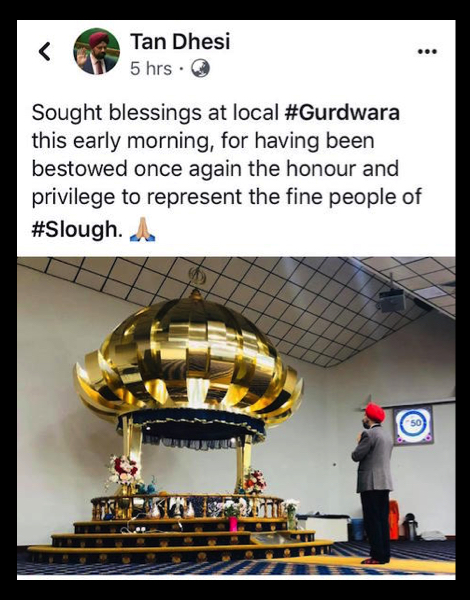
In another entry later, he says: “Sought blessings at local Gurdwara this early morning, for having been bestowed once again the honour and privilege to represent the fine people of Slough.”

Other Labour candidates who won included veteran MP Virendra Sharma, Lisa Nandy, Seema Malhotra and Valerie Vaz who another Indian-origin Tory candidate Gurjit Bains.

All the Indian-origin MPs from the previous Parliament were successful in clinching their seats, with Gagan Mohindra and Claire Coutinho for the Conservative Party and Navendru Mishra for Labour among the first-timers, reports PTI.

Other big-wig winners from the Conservative included Priti Patel, Rishi Sunak and Alok Sharma – all having held ministerial positions.

Tanmanjeet Singh’s Facebook entry after emerging a winner in the UK general elections 2019

RELATED STORY:

Trudeau taps four Indo-Canadians for his new cabinet (Asia Samachar, 22 Nov 2019)


ASIA SAMACHAR is an online newspaper for Sikhs / Punjabis in Southeast Asia and beyond. Facebook | WhatsApp +6017-335-1399 | Email: editor@asiasamachar.com | Twitter | Instagram | Obituary announcements, click here |

Child narrowly escapes losing toes in KL mall escalator incident

1
STUCK: Child’s shoe stuck in Mid Valley Megamall escalator – Photo: Video grab from family
By Asia Samachar Team | MALAYSIA |

A Sikh family from Canada for a holiday had a traumatic experience when a shoe of their 10-year-old daughter got stuck in an escalator in a Kuala Lumpur mall.

The quick reaction of her mother may have saved her from losing her toes in the incident at the Mid Valley Megamall yesterday (12 Dec 2019).

“It was a traumatic experience for the family,” business consultant Harmanjeett Singh told Asia Samachar.

Harmanjeett said the incident happened on the third floor heading up to the fourth floor at around 4pm.

He said his daughter’s shoe got stuck in the escalator before reaching the top.

“She tried to pull it out but it kept sucking her foot in. When my wife heard her scream, she had pulled her off her shoe,” he said.

At the time of writing, Mid Valley Megamall had yet to respond to queries on the incident.

Last month, local newspapers reported that a man broke his leg after it got trapped in an escalator at a shopping complex along Jalan Tuanku Abdul Rahman.

In that incident, the Fire and Rescue Department had dispatched a team to assist, reported The Star.

UPDATE: In an email response to Asia Samachar, Mid Valley Megamall said: “The escalators are serviced and maintained regularly and we did not find any malfunction in that particular escalator during and after the incident.

“It is the responsibility of the shoppers to exercise precaution while using escalators, stand within the yellow box, hold on to the handrail and step off the escalator upon landing. Parents should supervise their children to ensure such precautions are adhered to.”


ASIA SAMACHAR is an online newspaper for Sikhs / Punjabis in Southeast Asia and beyond. Facebook | WhatsApp +6017-335-1399 | Email: editor@asiasamachar.com | Twitter | Instagram | Obituary announcements, click here |
Malaysian judge, physiotherapist receive Guru Nanak achievers’ award

0
Justice Harminder Singh Dhaliwal (left) and Balwant Singh Bains with the ‘Sri Guru Nanak Dev Ji Achievers Award’ at the event in Kapurthala in Punjab, India, last month (10 Nov 2019)
By Asia Samachar Team | MALAYSIA |

A senior Malaysian judge and an enterprising physiotherapist were recognised by the Punjab government in conjunction with the 550th birth anniversary of Guru Nanak.

Court of Appeal judge Harmindar Singh Dhaliwal and Balwant Singh Bains received the ‘Sri Guru Nanak Dev Ji Achievers Award’ at the event in Kapurthala in Punjab, India, last month (10 Nov 2019).

“It was a big event held in a brand new auditorium named after Guru Nanak,” Harmindar told Asia Samachar in a text message.

“The atmosphere was lively. It was great to meet fellow Sikhs from the world over who are doing wonders in their own fields of expertise,” said Balwant.

The awards were presented by Punjab Chief Minister Captain Amarinder Singh. The list of recipients included distinguished officers from the Indian defence services, religious leaders and noted personalities from the field of art, culture, music and literature.

Justice Harmindar Singh Dhaliwal receiving the award from Punjab CM Capt Amarinder Singh. Looking on is Kapurthala MLA and sugar baron Rana Gurjit Singh – Photo: Event official website

Harmindar began his judicial and legal career in 1985 at the Magistrates’ Court in Sungai Petani, Kedah. Along the way, he had served as a High Court senior assistant registrar, deputy public prosecutor at the Attorney General’s Chambers, Sessions Court Judge and a Judicial Commissioner.

In 2014, he served as a High Court judge and was elevated to the Putrajaya-based Court of Appeal in 2016.

Seremban-born Harminder holds a Bachelor of LLB (Hons) degree from the University of Malaya and a Bachelor of Law (LLM) from the University of New South Wales, Sdyney, Australia.

Balwant, a physiotherapist with 30 years in clinical practice and healthcare business, founded Bains Physio in 1985 and Aihmsa College in 2011 (Institute of Healthcare, Movement Science & Arts).

The past president of the Malaysian Physiotheraphy Association completed his bachelor’s at Nagpur University, India.

Balwant has also written occasional column piece for Asia Samachar.


ASIA SAMACHAR is an online newspaper for Sikhs / Punjabis in Southeast Asia and beyond. Facebook | WhatsApp +6017-335-1399 | Email: editor@asiasamachar.com | Twitter | Instagram | Obituary announcements, click here |

Questioning pop politics

0
Sanna Marin -Photo: Facebook page
By Parveen Kaur Harnam | OPINION |

Finland’s transport minister has been selected to lead the Social Democratic Party, therefore making Sanna Marin the world’s youngest prime minister. This has been taken to mean a “new dawn” of politics is upon us.

It seems that politics has turned into something of a game of youth. This is perhaps due, in part, to the rise of socially-driven politics, a stripped-down, bare-essentials form of politics and (very likely) social media.

If one were to study recently elected, young prime ministers, ministers and political representatives in general – they all seem to have similarities in that they are proponents of what appears to be “pop politics”.

With politicians now having their own brand and pull, there’s no wonder that young politicians become the go-to, as their internet literacy is far more “in trend” than older, more seasoned politicians.

They all also have something else in common – all of them are pleasing to the eye, speak with gusto and have an almost “celebrity-like” persona, a political front that seems to have been popularized by Barrack Obama. They are like the Kardashians of politics.

The very fact that Sanna Martin was formerly the Transport and Communication Minister is very telling. She was the face of communication and is now going to be the face of Finland.

There are others like her in different countries. For instance, there is Alexandria–Ocasia Cortez (otherwise known as AOC) in the US, Justin Trudeau in Canada (who has recently been re-elected despite his black-face and brown face pictures, his third world handling of a corruption inquiry, refusing to cancel the major arms deal to sell weapons to Saudi Arabia as well as his questionable policies on the environment).

Then there is Jacinda Ardern in New Zealand (who recently appeared in a viral video of “accomplishments” during her reign so far) and Malaysia’s Youth and Sports Minister.

It would not be a gross exaggeration to say that these politicians won because they are exactly what the public wants to see. The rise of the feminist (e.g. the “Me Too”) movement has made institutions – particularly political institutions – a subject of great scrutiny and so we see Finland’s Social Democratic Party playing the best, easiest form of politics – the politics of trendiness, of “the moment”, of emotions.

Let’s study this for a moment. AOC, for instance, has popularized socialism. Once known as an almost fringe movement, associated with history and Russia, is now on the forefront – even in Britain (with the Labour Party gaining traction after years of Conservative party’s dominance).

Millennial socialism is on the rise. It’s not to say that this is a bad thing. Socialism is an economic and social system that is important and was bound to be on the rise with the gap between the top 1% and the rest of the social sector widening. The issue is the simplified form in which it is being promulgated.

Not all socialism is positive. Look at the rise of Joseph Stalin, for instance.

Socialism itself has tranches and complexities. George Orwell, for example, was an advocate for the Trotskyist (a theory advocated by Leon Trotsky that grew and developed as a result of Stalinism and is one that was critical of the bureaucracy that developed from Stalin’s rule).

All these different forms of socialism was, or rather, diluted to a simple manifesto with a pretty face (AOC is not a stranger to controversy: she lives in a luxury apartment complex that does not offer affordable housing units, making her whole brand rather ironic).

The question is: if feminism really was the concern, why was Donald Trump chosen over Hillary Clinton? It sometimes appears as though “pop politics” is selective in its progressiveness. Perhaps we are simply moving from sexism to ageism.

In fact, all pop politics is like this. Jacinda Ardern’s 3-minute video is one great example, it reduces a whole country’s progress and policies into a soundbite, something that can be shared by millions around the web – to make New Zealand an awe-inspiring nation. This is forgetting that the Christchurch mosque shooting marked a dark chapter in New Zealand’s previously “peaceful” image, the high cost of rent and even the increase in petrol prices. Everyday issues cannot be cramped into one easy-to-watch 5-minute publicity stunt.

Justin Trudeau on the other hand could very well get away with murder, with his honey-sweet smile and charisma (a charisma that almost always cracks at the seams when questioned about his contradictory actions on the climate crisis). We have our very own Syed Saddiq, who is famed for his close-up, short videos on Twitter (simultaneously appealing to the masses and giving a stand on many different issues).

When we really look into it, pop politics is merely a farce of diversity – on the outside it looks diverse – young faces, women coming into power, but notice one thing, and this is quite apparent: there are little to no truly diverse faces. When Jagmeet Singh went against Justin Trudeau, he had support, though was not a stranger to racial discrimination. The beard and the turban, his calm responses to casual racism – all of it was simply too much for the Canadian public, and this is a country that prides itself in its so-called “diversity”. And so is the truth of pop politics. Youth. Feminism. Never multicultural, one need only look at Jagmeet Singh or the Mayor of London: Sadiq Khan; to see the reality. Diversity is selective, pop politics is selective, a mirage of progressiveness.

Pop politics though cannot be said to be something new. In the old days, there were leaders like John F. Kennedy who had the support of the public with a near-celebrity fever. It has, however, become a more dangerous game in recent times.

The rise of young leaders seems to be a direct by-product of the long-held patriarchal, “old-men” system that is in place in most Western and even Asian political institutions. It may just be an effect of growth but politics is not entertainment (no matter how much the lines have been blurred), it affects our livelihood, it affects everything from the brush we comb our hair with in the morning to the fuel we fill up our cars with.

There is no part in a person’s life that is unaffected by politics. Are we so sure that a young, 30-something newbie can understand the complexity that comes with running a country – or even a ministry for that matter?

Are we so sure that just a fresh face is all that is required? How far can trendiness really take us is the real question. Is pop politics really the answer to the decades-long, male-dominated ruling, or is it simply a quick fix, a Band-Aid on a bullet wound? A Band-Aid that might ultimately spell inefficacy in political leadership.

Parveen Kaur Harnam is a Kuala Lumpur-based lawyer. 

* This is the opinion of the writer, organisation or publication and does not necessarily represent the views of Asia Samachar.

RELATED STORY:

The Rhetoric of Race (Asia Samachar, 14 Oct 2019)


ASIA SAMACHAR is an online newspaper for Sikhs / Punjabis in Southeast Asia and beyond. Facebook | WhatsApp +6017-335-1399 | Email: editor@asiasamachar.com | Twitter | Instagram | Obituary announcements, click here |

Kuala Kangsar back-to-back akhand path for Sahibzadey martyrdom

0

#SahibzadeyMartyrdom | KUALA KANGSAR, PERAK: Gurdwara Sahib Kuala Kangsar (GSKK) will be running two back-to-back akhand paths from Dec 25-29, 2019, to commemorate the martyrdom of the four children of Guru Gobind Singh. The ‘Chaar Sahibzaadey Shaheedi Akhand Path’ will kick-start with an Asa-Di-Vaw at 6am on Dec 25. The finale is a kirtan and katha darbar on Dec 29, from 10am-12pm.

Those interested in taking part or donating can contact Tejinder Singh (+6012-3001253), according to a letter signed by GSKK management committee secretary Jagindar Singh.


ASIA SAMACHAR is an online newspaper for Sikhs / Punjabis in Southeast Asia and beyond. Facebook | WhatsApp +6017-335-1399 | Email: editor@asiasamachar.com | Twitter | Instagram | Obituary announcements, click here |