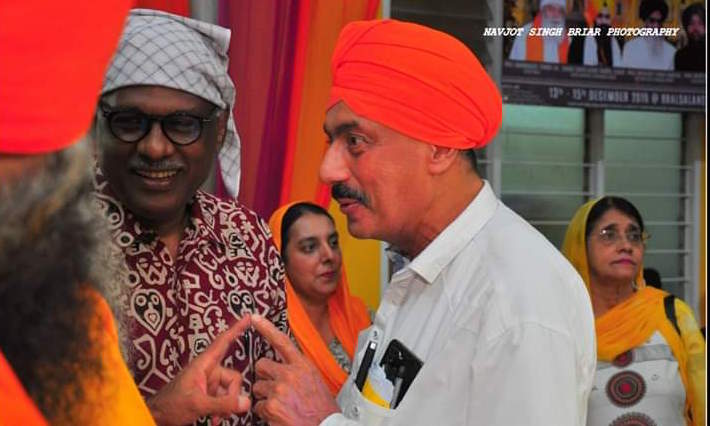
Klang MP Charles Santiago (middle) with GS Klang committee president Kulwant Singh during the gurdwara’s 550th celebration of Guru Nanak’s birthday – Photo: Navjot Singh Briar Photography
By Asia Samachar Team | KLANG,MALAYSIA | #GuruNanak550Malaysia |
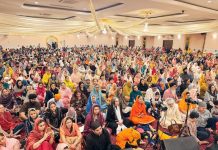
Klang MP Charles Santiago joined some 1,200 Sikhs who turned up for a nagar kirtan (Sikh religious procession) to celebrate Guru Nanak’s 550th birthday. Santiago is also the Water Commission chairman.
Klang local councillor Nalan Muniandy also joined the event on 16 Nov with the procession covering about 2km to the local Indian street.
“We had great participation of the Sanggat (congregation). We thank them all,” said Gurdwara Sahib Klang management committee president Kulwant Singh.
Photos: Navjot Singh Briar Photography (Uploaded to his Facebook on 23 Nov 2019, Gurudwara Sahib Klang’ s Nagar Kirtan in conjunction of 550 Saal Guru Nanak Dev Ji De Naal).
See select photos at Asia Samachar Facebook here.
————————— HOW TO SHARE STORIES WITH ASIA SAMACHAR? You are welcome to send reports/photos for our consideration. Send them via Facebook messenger, WhatsApp at +6017-3351399 or email to editor@asiasamachar.com
ASIA SAMACHAR is an online newspaper for Sikhs / Punjabis in Southeast Asia and beyond.Facebook | WhatsApp +6017-335-1399 | Email: editor@asiasamachar.com | Twitter | Instagram | Obituary announcements, click here |
I am not a poet and I don’t consider myself as one.
One such person whose poetry has always touched me is Bhai Nand Lal Ji who was born in Ghazni in Afghanistan in 1633. The 10th Sikh Guru, Guru Gobind Singh had 52 poets in his court. Bhai Nand Lal was one of them who wrote with the Goya pen name. Here is an excerpt of one of his works that has always touched and inspired me:
Deeno Duniya Dar Kamande Aa Pari Rukhsaar-e-maa|| Har do aalam keemat-e-yak taar-e-moo-e-yaar-maa||
Broadly translated, Bhai Nand Lal Ji described the physical beauty of Guru Gobind Singh Ji to that of fairies and that each strand of Guruji’s hair was more valuable than the two worlds put together.
Although he was an accomplished scholar and poet when he had already arrived at Guru Gobind Singh’s court, he worked quietly and anonymously in the kitchen with langgar duties for a considerable time before he assumed his role as a poet in the court. Such love and humility is today hard to find and only one that I can aspire to.
As a matter of fact, the minute I put my name on this book, I have lost a huge chunk of this humility. But that’s precisely why it’s important that I write. We all have good days and bad days and in the days that are challenging where we forget our purpose, mission and sometimes values, we need reminders to take us back, to remind us of how we should be. Some people use photographs. For me, poetry works. So for me the book will hopefully be a reminder of love, compassion, faith and gratitude and of the good days. I hope it will do the same for my kids as they grow up.
For my non- Sikh friends, I hope that the book will help you understand better and relate to spirituality from the Sikh perspective, our history, values and traditions and that you can relate to it from your own faith and experience, too. For my Sikh friends, I hope you will find the work does justice to all that we know and believe.
This is a book about the tensions that exist among all of us in our daily lives – of devotion yet insecurity, of faith yet fear.
Most of all this is an expression of gratitude to the Almighty, so it is terra – yours (God’s) – in Punjabi. In Latin, terra also means earth or ground, so this was intentional in naming the book as I guess without being “grounded” it is difficult being “Yours”. So, I urge you friends, if and when you read these poems, to keep Him in mind. Because this is after all not, and never should be, about me.
Malminderjit Singh’s speech at the launch of his book, Terra – An Eternal Journey. Mal, as he’s known among friends, was a former president of the Young Sikh Association Singapore (YSA) and the secretary of the Singapore Sikh Advisory Board. An editor at a Singapore-based media portal, Mal was an active member of the PAP Policy Forum and a volunteer at a number of PAP branches.
Mal’s writing style is unique, says Inderjit Singh Dhaliwal, an entrepreneur and former Singapore parliamentarian from 1996 to 2015, in a foreword to the book. He should know as Mal used to help him with his parliamentary speeches.
ASIA SAMACHAR is an online newspaper for Sikhs / Punjabis in Southeast Asia and beyond.Facebook | WhatsApp +6017-335-1399 | Email: editor@asiasamachar.com | Twitter | Instagram | Obituary announcements, click here |
SASKAAR / CREMATION: 28 Nov 2019 (Thursday) at Jalan Hospital Shamshaan Bhoomi. Cortege will leave from E-434, Taman Sejati Indah, Sungai Petani, Kedah, at 12 noon. PATH DA BHOG: 14 December 2019 (Saturday), 9.30am onwards, at Gudwara Sahib Sungai Petani, Kedah | Malaysia
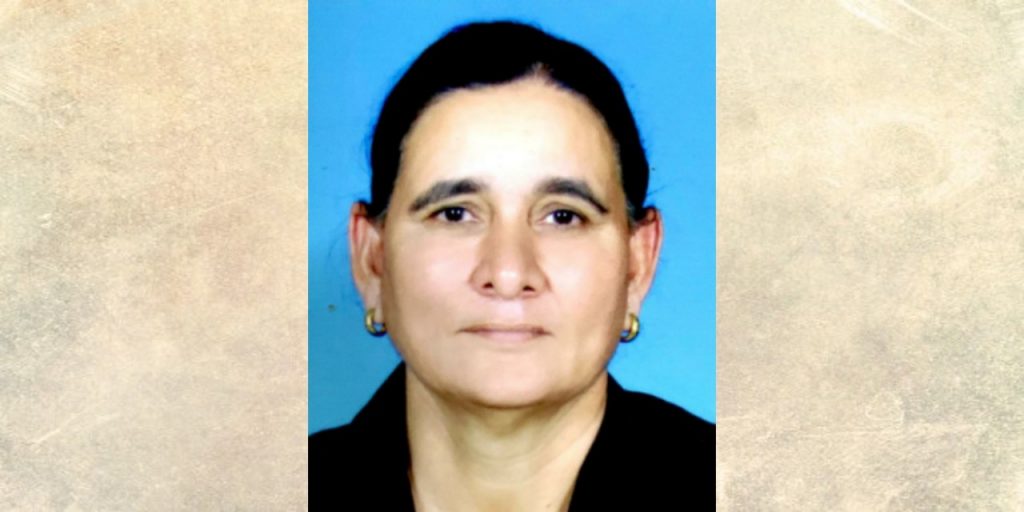
Mindar Kaur (1931-2019), Lim Gardens Ipoh / Sungai Petani
ਘਲੇ ਆਵਹਿ ਨਾਨਕਾ ਸਦੇ ੳੁਠੀ ਜਾਹਿ।।
Kaley aye nanake sedheh utteh jaye
MATA MINDAR KAUR D/O PHAGAR SINGH
Wife of Late Chiaran Singh of Lim Gardens Ipoh
Passed away peacefully on 27/11/2019. She leaves behind:
Children / Spouses:
Balbeer Kaur / Gurdeep Singh
Harbajan Singh
Baljit Singh / Harbans Kaur
Grandchildren / Spouses:
Dr. Sandev Singh / Dr. Harneet Kaur Sandhu
Dr. Arvind Dev Singh
Sunil Dev Singh
Great grandchild: Jiya Kaur Godrei
Brothers, sister, nieces and nephews to mourn her loss.
Special thanks to nurses Lily, Mala, Amy and Priya.
Saskaar / Cremation: 28 Nov 2019 (Thursday) at Jalan Hospital Shamshaan Bhoomi. Cortege will leave from E-434, Taman Sejati Indah, Sungai Petani, Kedah, at 12 noon
Path Da Bhog: 14 December 2019 (Saturday), 9.30am onwards, at Gudwara Sahib Sungai Petani, Kedah.
Contact:
Mr Baljit Singh 014 -754 3180 / 019-413 5821
Mdm Balbeer Kaur 010-280 8012
| Entry: 27 Nov 2019 | Source: Family
[ASIA SAMACHAR is an online newspaper for Sikhs / Punjabis in Asia. How to reach us: Facebook message or WhatsApp +6017-335-1399. Our email: editor@asiasamachar.com. For obituary announcements, click here]
Ekta Malaysia’s ‘Energise your life @ 50+’ workshop at Subang gurdwara – Photo: Ekta Malaysia
By Asia Samachar Team | MALAYSIA |
How do you ensure an active and happy living with high energy levels no matter what your age? A grand turnout of 54 enthusiastic participants turned up recently for a workshop at the Subang gurdwara to find out just how they can make it happen in their lives.
The ‘Energise your life @ 50+’ workshop took off with a fun and quirky quiz to discover the physiological age of the participants. Many were amused to find themselves being a few years older than their biological age.
Dr. Saran Kaur Gill, a former deputy vice chancellor of local public university who led the workshop, emphasized the importance of physical health and mental stimulation, nutritional needs, meditation and the need for adequate sleep.
“Eating well is often a form a self-respect. In everything we do, there must be discipline, fun and laughter and community integration,” she told the participants.
The one-day workshop was organised by Ekta Club of Kuala Lumpur & Selangor. Dr Saran heads the Ekta Youth Development and Life Long Learning (YDLL). She was assisted by her team comprising Kalwant, Indergeet, Pavittar, Harmeet, Sheena and Davinder.
Gurdwara Sahib Subang community development head Darshan Kaur said the growing number of aged members in the gurdwara warrants the setting up of a seniors’ club.
“Senior members must not be forgotten. Due attention must be given to help them cope and manage their physical, mental and social needs.
“The workshop empowered the members to suggest practical activities to help meet their growing needs. The burst of ideas, positivity and enthusiasm of the participants will boost the setting up of a seniors’ club,” she said.
The participants were treated to muscle stretching and strengthening exercises demonstrated by physiotherapists Jin Wei and assisted by Vincent.
They then worked in teams and proposed innovative ideas to empower each other and ways to foster friendships, relationships and community integration.
These ideas included taking group walks and exercises, sharing hobbies, learning a new craft, being proficient in smart phones and computers, internet banking, cooking classes and partaking in charity work were some inspiring ideas.
54 enthusiastic participants at Ekta Malaysia’s ‘Energise your life @ 50+’ workshop – Photo: Ekta Malaysia
The responses from the participants were encouraging.
“We all know exercise is essential to keep us going but the biggest hitch is we are not disciplined. We keep on telling ourselves we will do it tomorrow which sometimes never comes. It has to be part of our everyday routine,” said Manjit Kaur.
Fellow participant Bhajan Kaur, a 56-year-old who runs a furniture store, said she leads a hectic life but is now looking forward to a Seniors Club which will provide her an avenue to improve her mental and physical well being.
Charanjit Kaur, a 52-year-old teacher, found the workshop to be motivating as she is about to retire and was alerted on the need to look after her health.
EKTA YDLL looks forward to working with media partner Asia Samachar to share their knowledge and experience with other Gurdwaras and NGOs in Malaysia. Contact persons: Saran (012-2360019), Kalwant (017-8883061) or Indergeet (017-2823496).
ASIA SAMACHAR is an online newspaper for Sikhs / Punjabis in Southeast Asia and beyond.Facebook | WhatsApp +6017-335-1399 | Email: editor@asiasamachar.com | Twitter | Instagram | Obituary announcements, click here |
SASKAAR / CREMATION: Cortege leaves from residence (No. 18, Lorong 1, Taman Azizul Rahman, 34600 Kamunting, Taiping) to Prestavest Memorial Park Taiping at 4.30pm,28 Nov (Thursday). AKHAND PATH: 12pm, 29 Nov 2019 (Friday) to 1 Dec 2019 (Sunday) at residence. PATH DA BHOG & ANTEEM ARDAAS: 5pm, 1 Dec 2019 (Sunday), at Gurdwara Sahib Taiping | Malaysia
ਘਲੇ ਆਵਹਿ ਨਾਨਕਾ ਸਦੇ ੳੁਠੀ ਜਾਹਿ।।
Kaley aye nanake sedheh utteh jaye
MATA HAMIR KAUR D/O LATE KERNAIL SINGH
(13.4.1939-27.11.2019)
Village: Ratowal. District: Ludhiana, Punjab
Husband: Late Narangen Singh @ Rajan s/o Mahn Singh
2.30pm: Sukhmani Sahib at residence
4.00pm: Ardaas and paying of final respects
4.30pm: Cortege leaves from residence to Prestavest Memorial Park Taiping
5.00pm: Cremation preparation
5.30pm: Kirtan Sohila
6.00pm: Alahnia path at Gurdwara Sahib Taiping
Those wishing to pay last respects may do so at the family residence at No. 18, Lorong 1, Taman Azizul Rahman, 34600 Kamunting, Taiping
Akhand Path: 29 Nov 2019 (Friday) to 1 Dec 2019 (Sunday) at family residence at No. 18, Lorong 1, Taman Azizul Rahman, 34600 Kamunting, Taiping. Akhand path commences at 12.00 noon after Phool Chugna.
Path Da Bhog & Anteem Ardaas: 5pm, 1 Dec 2019 (Sunday), at Gurdwara Sahib Taiping
Contact:
Ranjeet Singh 019-416 8809
Ajit Singh 012-418 6072
Satnam Singh 016-567 2558
| Entry: 27 Nov 2019 | Source: Family
[ASIA SAMACHAR is an online newspaper for Sikhs / Punjabis in Asia. How to reach us: Facebook message or WhatsApp +6017-335-1399. Our email: editor@asiasamachar.com. For obituary announcements, click here]
L-R: Henry Yap (Anglican Church), Inspector Rakesh Naidoo (Chairman, Wellington Interfaith), John Good (WNS), Parmjeet Singh (IHC), Mustenser Qamar (Islamic Association), Brett Hudson (MP), Peter Leach (WNS), Wallace Huamaha (Deputy Commissioner of Police NZ) at the ceremony to hand over the donations to Wellington Night Shelter (WNS).
By Asia Samachar Team | NEW ZEALAND |
More than 200 people turned up for an interfaith food distribution at the Wellington Cenotaph, located next to New Zealand Parliament buildings, to commemorate 550th birth anniversary of Guru Nanak.
The multi faith event on 12 Nov 2019, led by charitable organisation Ekta New Zealand Inc, saw leaders of the various faiths speaking and saying prayers before joining in to distribute the vegetarian food to the lunch time crowd.
Several local MPs and the Deputy Commissioner of Police New Zealand participated and distributed the langar.
“Our purpose was to give meaning to Guru Ji’s teaching Awal Allah Noor Upaya Kudrat Kay Sub Banday,” Jasvinder Kaur of Ekta told Asia Samachar. “We wanted the idea of inclusiveness that Babaji to be seen by Wellingtonians and the best way to do so was to do it through a lunch time langar.”
The event was held in collaboration with the Indian High Commission in Wellington, Coexistence and Amma.
“Everyone who partook in the langar and passers-by were absolutely taken in by the idea. Everyone gave a thumbs up and said more of such activities should be undertaken,” said Jasvinder.
Ekta NZ also made a donation to the Wellington Night Shelter which provides accommodation to the homeless in the city.
The event included representatives of the Sikh, Muslim, Jewish, Ahmadiyya-Muslim and Hindu communities, as well as members from Hindu Council of New Zealand, Maori, Pakeha, Christian, Anglican and Chinese Anglican Churches, according to a local newspaper report.
The Indian High Commission was represented by its second secretary Paramjeet Singh.
ASIA SAMACHAR is an online newspaper for Sikhs / Punjabis in Southeast Asia and beyond.Facebook | WhatsApp +6017-335-1399 | Email: editor@asiasamachar.com | Twitter | Instagram | Obituary announcements, click here |
Sikh institutions must address sex education in a realistic way and take into account that abstinence-only education has no proof of being effective, recommends a US-based Sikh institute when releasing a report on Sikhi and abortion.
The outfit also reminded Sikh institutions that comprehensive sex education has been proven to delay the onset of sexual debut (i.e. when adolescents start having sex for the first time) and decreased risk taking.
“Sikh charities can diversify their seva to include pregnancy and abortion related counseling and support, including financial support,” Sikh Research Institute (SikhRI) recommended in the 42-page report entitled ‘Sikhi & Abortion’.
It added: “Sikh institutions must provide resources addressing sexuality and parenting, and offer support in the form of counseling for those who seek it while making a decision or after having made a decision and have undergone the procedure.”
In one rather bold recommendation, it suggested that Sikh institutions should provide access to contraceptive services so fewer people seek abortions, while recognising that ‘many consider that in itself to be an issue’.
With the laws on abortions changing quickly in the U.S. and other countries, SikhRi board member Dr Pritpal Singh said that the issue was more relevant than ever.
“We felt obligated to take a stand by looking for answers in the wisdom of Sikhi as well as surveying over a thousand self-identifying Sikhs worldwide for a better understanding of our collective view today,” he said.
The report included the results of a global survey of 1,277 self-identified Sikhs from 28 countries.
It said the responses demonstrated how closely defined sex-selection and abortion are in the Panjabi and South Asian contexts.
The majority of respondents also indicated they believe life begins sometime after conception, thus going against the position of Gurmat, the report added.
The report was prepared by SikhRi co-founder and senior fellow research and policy Harinder Singh and researcher Jasleen Kaur, and edited by Inni Kaur.
SOME SALIENT POINTS EXTRACTED FROM THE REPORT:
Gurbani: Moving from the symbolic into the practical, one of the first questions considered in the debate around abortion is the question of when life begins. While there is no consensus scientifically or philosophically, the Guru Granth Sahib states that the womb is where the self fully develops, and at birth becomes human (GGS, p77).
When the Guru Granth Sahib does explicitly refer to anything close to what is commonly considered to be an abortion in the Panjabi Sikh community, what is really being referred to is infanticide. The cultural-historical context of infanticide for sex-selective purposes during the Guru period was fueled by a belief in the inherent lack of value of a female child. This is the deliberate killing of a female child after birth, which does not fall under the definition of abortion (though, in the present, a similar act would be sex-selective abortion, which occurs before birth — the main reason for the procedure in both the Chinese and Indian contexts).
In the Sikh metaphysical scheme, both parents are equally important in the gift of life, and the whole person is created in the womb. Within Gurbani, there is a clear focus on the generative power of the one who has a womb.
History: There is not much historical or legal precedent regarding abortion in general from the Guru period, but there are many historical records about female infanticide, which was and remains a serious issue in the context of Sikhs in South Asia.
Because of the prevalence of infanticide in the Guru period, the Gurus explicitly addressed the issue and condemned female infanticide. Guru Gobind Singh Sahib even directly issued a Hukamnama (royal order) against the practice (kurimar). Kurimar (“killers of female infants”; “girl-killers” here onwards) are those guilty of killing their female babies.
Throughout various rahitname issued both during the Guru period and beyond, a clear moral line is drawn on the issue of female infanticide. Sikhs are told they would be fined if found guilty of female infanticide and, in some cases, are told not to even associate with those who commit such acts.
Lifestyle: When it comes to the issue of female infanticide or feticide, the choice is often between abuse and honor; ridicule and prestige; vulnerability and security — people will choose honor, prestige, and security — and thus, internalizing the patriarchal devaluation of women, Panjabi women themselves will place a higher value on sons.
The practice of female feticide is a symptom of a larger systemic issue, and of practices and realities that set women up for harder lives: dowry practices, lower literacy rates, domestic violence and sexual abuse, and financial burden. In order to lessen the prevalence of a symptom, a community must first address its underlying cause.
ASIA SAMACHAR is an online newspaper for Sikhs / Punjabis in Southeast Asia and beyond.Facebook | WhatsApp +6017-335-1399 | Email: editor@asiasamachar.com | Twitter | Instagram | Obituary announcements, click here |
Dr Jacob John (standing) and his team at the Petaling Jaya gurdwara free dental clinic – Photo: Asia Samachar
By Asia Samachar Team | MALAYSIA |
Know someone in Malaysia who has lost all their teeth? They can immediately get a full set of dentures and return to their routine diet for a healthy living.
“Many senior citizens have missing teeth. They then start changing their diet,” Dr Jacob John from University of Malaya’s dentistry faculty told Asia Samachar.
He led a team to provide dental screening at Gudwara Sahib Petaling Jaya on 3 Nov 2019. The one-day free dental and cervical health screenings were organised at the sidelines of the gurdwara’s 550th anniversary of Guru Nanak’s birth. #GuruNanak550Malaysia
Dr Jacob, an associate professor at the UM Department of Restorative Dentistry, said a full set of teeth will enable them to go back to their usual diet.
“If anyone is missing all of their teeth, they can register. We will call them and provide free dentures. They can get almost immediate treatment,” he said. The treatment will be done at the dental faculty, located within the UMSC in Petaling Jaya.
“If you are missing some teeth, you can still register, but you will fall under a wait list,” he said.
While the dental clinic was going on at one corner of the gurdwara, another set of volunteers from Rose Foundation were running a cervical cancer screening at the other end.
Cervical cancer is the fourth most frequent cancer in women with an estimated 570,000 new cases in 2018 representing 6.6% of all female cancers globally. Close to 90% of deaths from cervical cancer occurred in low- and middle-income countries, according to WHO information.
The high mortality rate from cervical cancer globally could be reduced through a comprehensive approach that includes prevention, early diagnosis, effective screening and treatment programmes. There are currently vaccines that protect against common cancer-causing types of human papilloma virus and can significantly reduce the risk of cervical cancer, it added.
In Malaysia, ROSE (Removing Obstacles to Cervical Screening), an innovation by Universiti Malaya (UM) and VCS Foundation (VCSF) of Australia, is a pioneering effort to battle cervical cancer.
All the medical and support staff at the clinics had volunteered their time and energy for the day.
Free cervical health screening at Petaling Jaya gurdwara for #GuruNanak550 – Photo: Asia Samachar
Free cervical health screening at Petaling Jaya gurdwara for #GuruNanak550 – Photo: Manisha / Asia Samachar
ASIA SAMACHAR is an online newspaper for Sikhs / Punjabis in Southeast Asia and beyond.Facebook | WhatsApp +6017-335-1399 | Email: editor@asiasamachar.com | Twitter | Instagram | Obituary announcements, click here |
AKHAND PATH: 6-8 Dec 2019 Gurdwara Sahib Serdang, Selangor, followed by PATH DA BHOG on 8 Dec 2019
Contact: 014-365 9181, Bally 012-385 1450
| Entry: 26 Nov 2019; Updated: 2 Dec 2019 | Source: Family
[ASIA SAMACHAR is an online newspaper for Sikhs / Punjabis in Asia. How to reach us: Facebook message or WhatsApp +6017-335-1399. Our email: editor@asiasamachar.com. For obituary announcements, click here]
Sikh Riot Survivors, Kalyanpuri Sector 13, Delhi, 1984 by Ram Rahman (Cover photo for Black November: Writings on the 1984 Sikh Massacres and the Aftermath)
By Asia Samachar Team | INDIA |
It has been 35 years since the assassination of Indian Prime Minister Indira Gandhi. And it has been a 35-year wait for justice for the 1984 massacres of the Sikhs. The dark and tormenting days of November 1984 are from healed. The victims may have aged, but their wounds are deep and still fresh in their minds.
“Justice, in this case, has already been delayed. Justice delayed is justice denied,” says an editor of a new book entitled ‘Black November: Writings on the 1984 Sikh Massacres and the Aftermath’.
“The generation of both the perpetrators and victims are at the end of their life; it is already 35 years to the incident. The judicial system has failed and perhaps we have not learnt our lessons well from the past,” Ishmeet Kaur Chaudhry tells Asia Samachar.
On 31 Oct 1984, Indira Gandhi was assassinated by her Sikh bodyguards, followed by killings, humiliation, rape and plunder over the next three days. The effects of such an organized violence were felt in several parts of the country including Kanpur, and Bokharo along with Delhi.
Indeed, thirty-five years down the line, the survivors of the massacres struggle on with their lives, waiting for justice, according to a media release accompanying the release of the book. The psychological trauma and the distressful conditions have led some of their children into drug addiction and petty crimes, still many of the widows of the colony continue fighting in the wait of justice, leaving behind their stories of strength and survival.
The 292-page book puts together interviews in the immediate aftermath of the massacres and more recent interviews of the victims in the Tilak Vihar Widows’ Colony. It aims to provide voice to these women and helps us to listen to the, persecuted and brutalized, and compels us to seek justice and healing for the survivors.
Ishmeet teaches at the Centre for English Studies at the Central University of Gujarat, Gandhinagar. She is the editor Patrick White: Critical Issues (2014), co-editor of Violence, Subversion and Recovery: Women Writers from the Sub-continent and Around (2019, with Rachel Bari) and the author of Texting the Scripture: Sri Guru Granth Sahib and the Visionary Poetics of Patrick White (2016).
Here’s a short interview with Ishmeet following the release of the book last month.
AS: What shocked you most in the course of putting this book?
I was touched most while interviewing the widows of Tilak Vihar widow’s colony. I was shocked at seeing their living conditions and dilapidated houses they lived in, endlessly fighting and struggling to get justice.
I had a feeling of shame that neither the government nor the Sikh community could do anything substantial for their upliftment. It is not a matter of giving compensation alone, it is a matter of empowering people by standing with them and their children; help them deal with the psychological trauma they went through and be able to give them a decent living.
The least that prosperous Sikh community members could have done was open a day school for these children and looked after them; support them and give them education and medical facilities so that they were not disarrayed and lost to drugs and petty crimes.
AS. You talk about being saved at the age of six. Can you elaborate on that incident?
My family was at Shimla then and my father a government employee. The experience is two-fold, both good and bad. Some of my father’s colleagues who were also his friends for years began turning their back to him owing to the anti-national discourses in the air pertaining the image of the Sikhs in the ’80. Particularly, in ’84, some of these people who visited us frequently passed derogatory remarks to him owing to his turban and long hair. While others helped him. One of his officers asked him to go home and stay safe as he smelled tension in the air. He assured him to take care of his official commitments which he did. Also, when the mob attacked the Gurdwara, our next door neighbour, eminent journalist Ravinder Randev, came running to our house and started stoning the mob and diverted it. People were scared of being identified and thus the mob scattered. Nothing happened to us. It gives me chills at the thought “what if Randev Uncle were not home that night?” People like my father’s officer and Randev enable us retain hope and faith in humanity. The aim of the book was to remember such stories of hope as well as lend voice to the survivors fighting for the day when they will be able to see justice.
3. Do you see any hope in bringing justice to the victims?
Justice, in this case, has already been delayed. Justice delayed is justice denied. At the same time, one is not entirely hopeless but the lessons that “justice in time” could have served are lost. In Bhuj, Gujarat, a park was made to rehabilitate and empower earthquake victims but in case of ’84, the widow’s colony has been turned into a ground for charity and a field to play politics.
The generation of both the perpetrators and victims are at the end of their life; it is already 35 years to the incident. The judicial system has failed and perhaps we have not learnt our lessons well from the past.
One wonders how many more carnages will awaken people from its sleep!
Nevertheless, the life sentence to Sajjan Kumar (though at the same time Kamal Nath was made Chief Minister of MP, that added to much distress amongst the Sikh people) and a handful of cases that were resolved does make us hopeful that maybe someday, some brave heart and a compassionate person may empathise with the victims and give them justice, lest we add another chapter of impunity to the history of India!
Black November: Writings on the 1984 Sikh Massacres and the Aftermath
ASIA SAMACHAR is an online newspaper for Sikhs / Punjabis in Southeast Asia and beyond.Facebook | WhatsApp +6017-335-1399 | Email: editor@asiasamachar.com | Twitter | Instagram | Obituary announcements, click here |