UA-56202873-1
Page 541

AirAsia Allstars celebrate Deepavali with underprivileged children

0
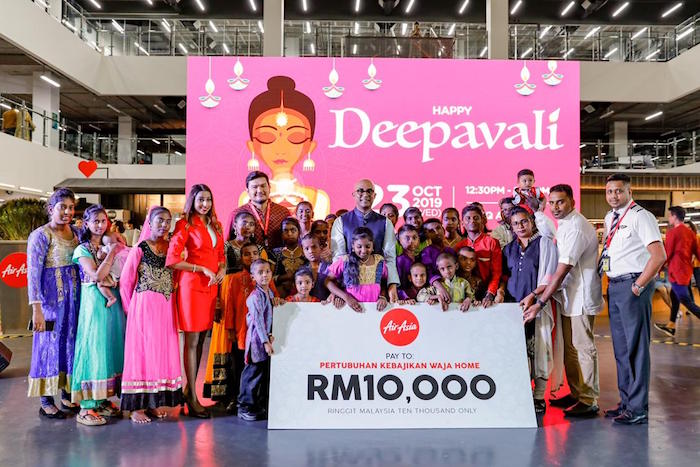
AirAsia X Malaysia CEO Benyamin Ismail presented the mock cheque to Pertubuhan Kebajikan Waja Home witnessed by AirAsia Group President (Airlines) Bo Lingam at the Allstars Deepavali celebrations – Photo: Supplied
By Jasbir Kaur | MALAYSIA |

Air Asia staff threw open their doors at their global headquarters for a pre-Deepavali celebration for underprivileged children from home in Klang, Selangor.

The children from Waja Home were personally welcomed by AirAsia Group President (Airlines) Bo Lingam, AirAsia X Malaysia CEO Benyamin Ismail and AirAsia Malaysia CEO Road Asmat.

They were given a tour of RedQ, as the office is called, followed by banana leaf lunch party which featured some Allstars in dance performance.

With an aim to inspire young minds, some inspirational Allstars shared their trials and tribulations at achieving their goals at AirAsia.

Here, AirAsia Senior First Officer Kugan Tangiisuran captivated the boys and girls with how he started in despatch before passing the cadet pilot exam and eventually achieving his childhood dream of becoming a pilot.

Benyamin Ismail said: “We hope that by visiting our office and listening to some of our inspiring staff stories, they too will be inspired to follow their dreams as our Allstars have done.”

At the event on Wednesday (23 Oct), AirAsia also pledged RM10,000 to the home to support their operations and charitable work.

Founded in January 2008, Waja Home is a charitable organisation and home to 30 underprivileged children from families at risk, who are orphaned or slow learners, aged 3-17 years.


RELATED STORY:

(Asia Samachar, 30 Oct 2018)


ASIA SAMACHAR is an online newspaper for Sikhs / Punjabis in Southeast Asia and beyond. Facebook | WhatsApp +6017-335-1399 | Email: editor@asiasamachar.com | Twitter | Instagram | Obituary announcements, click here |

You’re invited to MIC Diwali Open House on Sunday (Nov 3)

0

MIC DIWALI OPEN HOUSE 

| Date: 3 Nov 2019 (Sunday)

| Time: 12pm-3pm

| Place: Dewan Tun Razak 1, PWTC, KL

Malaysian Indian Congress (MIC) will be hosting the Diwali Open House on Sunday (3 Nov 2019) in Kuala Lumpur.

MIC president Senator Tan Sri S A Vigneswaran has extended an open invitation to everyone to the event at Dewan Tun Razak 1 at Putra World Trade Center (PWTC). The event is from 12 noon to 3pm.

“We look forward to seeing you at our Diwali Open House. Bring along your family and join us at this auspicious celebration of lights,” he said in a message relayed Asia Samachar.

MIC is looking forward to host Sikhs and Punjabis at the event. So, see you at the Diwali Open House on Sunday.


ASIA SAMACHAR is an online newspaper for Sikhs / Punjabis in Southeast Asia and beyond. Facebook | WhatsApp +6017-335-1399 | Email: editor@asiasamachar.com | Twitter | Instagram | Obituary announcements, click here |

Diwali: To celebrate or not to?

2
By Hb Singh | OPINION | MALAYSIA |

As far back as I can remember, my local Sikh community and my family had always celebrated Diwali.

Being surrounded by Tamils and other South Indians, it was generally known as Deepavali, the festival of light. We lived in a tin mining in Ayer Hitam in Puchong, Selangor.

At home, mum would cook exotic food. Dad would have brought back mutton, not a favourite of the kids, though. That’s for him and his friends. It goes well with liquor. For us, there is the customary chicken, cooked in curry or fried, or both.

Days before Diwali, the kitchen is a war zone. Mum and her sisters would be baking various types of biscuits. We had a roundish-shaped oven. We would snap the cookies hot from the oven. Closer to Diwali, one of the neighbours would come over to help mum with making the murukku, a crunchy snack that originated from southern India. Achi Ma (Aachi’s Mother), as we call her, was stout but strong. Again, we would snack on the murukku and achi-murukku fresh.

On Diwali day, we would put on our new clothes, usually bought from Petaling Street. In one year, our dad bought the boys – all four of us – black, pointy pair of shoes. We despised them, but dad insisted we wear them!

We lighted candles. Diwali signifies the triumph of good over evil, light over darkness and knowledge over ignorance. Not sure if we had that knowledge back then, but we delighted in keeping the candles lighted. It was fun!

Basically, we imitated our Hindu neighbours, minus the Hindu prayers and certain rituals that they may have.

We would then visit the homes of some neighbours. This is part of a unique Malaysian tradition of rumah terbuka (open houses). During festivals, people throw open their houses for visitors to come over and enjoy food and drinks. Anyone can walk in, enjoy the food, murukku and the cookies. Have a few cups of the sweetened drink. No liquor, of course. That’s under Dad’s command and it will appear later in the day.

So, on Deepavali, we would have neighbours of all races and religions coming over. A band of Malay boys would turn up. They would eat to their heart’s delight the murukku and other delicacies Mum would have prepared. Then our football kakis (team members) would come over. Again, the same ritual will take place. They would sit around the table, eyes on the covered glass wares containing all the cookies prepared.

During festivals like Hari Raya Aidilfitri, the Muslims would host the open houses. Our football team would go from one home to another to enjoy the day. The same with the Chinese New Year and Christmas.

Silakan makan,” the Hari Raya Aidilfitri host would say, inviting us to help ourselves to the food. Like piranhas, we would first go for the kuih baulu, a delicious sponge cake that is simply out of the world when it is a little dry. The baulu dish would be gone within seconds!

We were among the few Sikh families living in the barrack housing of the tin mine. The houses were linked to each other. We had Malay, Indian and Chinese neighbours. It was a mixed neighbourhood.

In this neighbourhood, we celebrated the major festivals. The community townhall would be decorated when the major festivals come around – Aidilfitri, Chinese New Year, Deepavali, Wesak and Christmas. Sikhs were largely counted as Indians. So our designated celebration was Deepavali.

Till the late 1970s, there were some mat sallehs. The British managers and their families lived in bungalows up on the hill. It was fenced up and I remember they had German Shepherd guard dogs. They played tennis and spoke English that we couldn’t really catch. Well, we hardly ever had the chance to interact with them in the first place.

So, we lived in our own little world in the tin mining neighbourhood, surrounded by miles and miles of rubber estates and a virgin jungle on the other side.

ELSEWHERE

But that is not the Diwali story of every other Malaysian Sikh. They were Sikhs who did not celebrate Diwali (or Deepavali), even back in the 1950s.

“We never celebrated Diwali,” recalled retired senior Malaysian lawyer and former teacher Joginder Singh. “My family was quite clear that it was a Hindu festival, and had nothing to do with Sikhi. For those who did, it was mostly a family-affair, not so much in the gurdwaras.”

The 88-year old lawyer, who was the nation’s most senior serving lawyer when he called it the day last year, said there was a sizeable number of Sikhs who did not celebrate Diwali.

In the 1980s, I recall lighting up candles in the Puchong gurdwara. Again, it was fun. We did it in the name of Diwali. Don’t recall anything about celebrating Bandee Chor Divas, as it has become fashionable over the last many years. That is in reference to the release of the sixth Guru, Guru Hargobind Sahib, along with 52 Hindu Rajas. Perhaps they spoke about in the Darbar Sahib during the kirtan programmes. Well, even when we were seated in the Darbar Sahib, I could hardly understand what the preachers were saying. So, I recall the event being Diwali, and Diwali alone.

1984

The attack on the Darbar Sahib, Amritsar, in 1984 was a watershed for Sikhs globally.

I was 17 then. I did not maintain my unshorn hair and turban as customary for practicing Sikhs. I had very basic knowledge of the faith. A Sikhi camp going kid today would put me to shame. But I was active in performing seva (service) at the gurdwara. Along with other youth, we would turn up for the early morning seva to prepare the Guru Ka Langgar. We would later help in serving the food and the clean up.

The 1984 Indian army invasion of the Golden Temple, as Harmandir Sahib is popularly known, had a tremendous impact on Sikhs. The so-called Operation Blue Star awoken many from their Sikhi slumber, myself included. Many began pondering about what it meant to be a Sikh.

“1984 led to waves of black turbans, refusal to celebrate Diwali in Malaysia, prominence of the Vaisakhi celebration, acceptance of Sikhi as a separate religious entity by the Malaysian government,” Hari Singh @ Paguman Singh, a retired Malaysian civil servant, told Asia Samachar in an interview in 2015. See here. He was the first secretary of the Malaysian Gurdwaras Council (MGC), itself an organisation that was established post-1984.

Many began disassociating from the Diwali celebration post-1984.  For me, as a family, we continued to celebrate Diwali, but on a more muted scale. In later years, it was merely the lunch or dinner that my mum would throw.

DIWALI TODAY

As the years went by, Vaisakhi began taking on a more prominent role. In the early 1990s, Sikh Naujawan Sabha Malaysia (SNSM) began producing Vaisakhi greeting cards. I was part of the team. We made one error: badging Vaisakhi as Sikh New Year, which it wasn’t. I take responsibility for that mistake. Today, I see a similar error in the making when we portray Diwali as Bandee Chor Divas. 

In Malaysian gurdwaras today, Vaisakhi has been firmly established as the primary Sikh festival. Some gurdwaras may still have Diwali events, but Vaisakhi supersedes in primacy.

At home, I now don’t celebrate Diwali, but I’m happy to join any Diwali gathering. My family gets together for the customary Diwali makan (lunch or dinner) with our mum. That is more of a family tradition that my mum still holds dear.

In fact, I had just returned after visiting my mum for Diwali. “How’s your Diwali,” I asked her as I give her the Diwali hug. Happy Diwali!

Hb Singh is a Kuala Lumpur-based journalist with some experience in dealing with Sikh organisations, both from within and outside. 

* This is the opinion of the writer, organisation or publication and does not necessarily represent the views of Asia Samachar.

RELATED STORIES:

Diwali and Sikhi (Asia Samachar, 26 Oct 2019)

Bandi Chhor Divas – Sikh Divali: The harbinger of Enlightenment and Freedom (Asia Samachar, 21 Oct 2019)

Why Divali (Deepavali) for Sikhs (Asia Samachar, 26 Oct 2019)

Lessons for today from 1984: Interview with Hari Singh (Asia Samachar, 13 Nov 2015)

ASIA SAMACHAR is an online newspaper for Sikhs / Punjabis in Southeast Asia and beyond. Facebook | WhatsApp +6017-335-1399 | Email: editor@asiasamachar.com | Twitter | Instagram | Obituary announcements, click here |

Best known Sikh geographer in Asia in 20th century

Prof Kernial Singh Sandhu: Director, Institute of South-East Asian Studies, Singapore
By Dr Manjit Singh Sidhu | PRIDE OF LIONS | MALAYSIA |

Prof. Kernial Singh Sandhu was born in mid-1929, the exact date remains unknown. His father, Sardar Jai Singh Sandhu was a farmer in the village of Guru-ka-Kotha, located in the district of Bathinda, Punjab. Kernial’s association with British Malaya started early in the 20th Century when his maternal uncle came to Malaya and settled in the south of Malaya, in Segamat.

As a geographer he wrote important articles on resettlement of rural non-Malay population (mainly the Chinese) into New Villages following the declaration of the Emergency to combat communist insurgency in British Malaya. He also studied the population of Malaya in some detail.

Indians in Malaya: Some Aspects of their Immigration and Settlement (1786–1957) By Kernial Singh Sandhu

Some of his major publications include ‘Indians in Malaya, Some Aspects of their Immigration and Settlement, 1786-1975‘ (Cambridge University Press, 1969) and ‘Early Malaysia‘ (University Education Press, 1973).

Apart from these publications Prof. Sandhu published many more papers and books. His single most important contribution to Sikh Studies was his article ‘Sikh Immigration to Malaya’.

To the best of my knowledge there have been only three British trained Sikh geographers in Malaysia and Singapore, Prof. Sandhu being the senior; the other two are Prof. Mahinder Santokh Singh, a well known administrator from University Science Malaysia, Penang and the present writer.

Indeed Kernial was the best known Sikh geographer in Asia in the 20th Century. His contributions as a scholar and administrator are even greater than those of Prof. Gurdev Singh Gosal from Panjab University, Chandigarh, the best known Sikh geographer from South Asia. I say this with conviction of a geographer, one familiar with the works of both men. Besides I had the good fortune of having both as my teachers.

Besides his academic achievements Kernial was a keen sportsman. He represented University of Malaya (Singapore) in hockey, cricket, rugby and football. He also played hockey and cricket for Johore state in the early 1950s.

HOW TO BUY A COPY? CLICK HERE.

Prof. Sandhu is certainly one of the three historical Sikh figures to have lived and died in Singapore; the other two being Bhai Maharaj Singh (this saint-soldier was exiled to Singapore in 1850 and died in 1856) and the late Justice Choor Singh. – Extracted from Pride of Lions: Eminent Sikhs in Malaysia. Read the full article in the book

Extracted from Pride of Lions: Eminent Sikhs in Malaysia,a 295-page book authored by Dr Manjit Singh Sidhu featuring 57 Malaysian Sikhs. Dr Manjit is also  author of Sikhs in Malaysia, which captured the results of interviews, conducted in 1978 and 1979, of 100 Malaysian Sikhs who were born in India and Pakistan. See here and hereThe retired Malaysian university lecturer is also author of ‘Sikhs and Sikh Institutions In Pakistan’. See here.

RELATED STORIES:

Pride of Lions (Asia Samachar, 28 Oct 2017)

Once Sikhs landed in Malaya, how many never revisited Punjab? (Asia Samachar, 24 Oct 2017)

Malaysian retired lecturer releases book on Sikhs in Pakistan (Asia Samachar, 24 Feb 2017)

ASIA SAMACHAR is an online newspaper for Sikhs / Punjabis in Southeast Asia and beyond. You can leave your comments at our website, FacebookTwitter, and Instagram. We will delete comments we deem offensive or potentially libelous. You can reach us via WhatsApp +6017-335-1399 or email: asia.samachar@gmail.com. For obituary announcements, click here

How excited Sikhs ‘made’ Jagmeet Singh Canada’s deputy prime minister

2
Jagmeet and his wife at the closing of Canada’s 2019 elections – Photo: Jagmeet Singh Facebook page
By Hb Singh | OPINION |

Sikhs have on their own ‘appointed’ their candidate as deputy prime minister (DPM) of Canada. Believe it not, they did!

Somewhere towards the end of the Canadian general elections, it became clear that Justin Trudeau and his Liberal Party could not muster the numbers to form an outright majority government. This opened up the possibility he may form a coalition government.

The New Democratic Party (NDP), a social-democratic federal political party led by Jagmeet Singh, seemed like an obvious choice. Before you know it, euphoric Sikhs had started sharing via the social media a poster congratulating Jagmeet for his appointment as DPM.

First, we look at the numbers. Liberals got 157 seats out of the total 338 seats up for grabs, with the Conservatives as closest rival with 121 seats. Then come Bloc Québécois (32), NDP (24), Green (3) and one independent candidate.

Before you know it, friends started forwarding the Jagmeet congratulatory poster. Is that so, I asked? A quick check of some reliable Canadian news portals showed no mention of it. I even went to Jagmeet’s Facebook page to double check. Zilch! Nothing there.

But this erroneous poster kept spreading, finding a life of its own. More and more people started sharing. By now, it breached the Sikh circle and had seeped into the non-Sikh communities.

I understand why Sikhs were excited. Jagmeet is an amazing politician. I followed his campaign. Remember the train ride where he unwrapped his turban and unravelled his hair to show a reporter what lies under the turban? Brave, indeed.

As a speaker, he could match outgoing PM Trudeau in style and presentation. At times, I think he performed so much better. He easily reaches out to the the people. When speaking with his fellow party candidates and supporters, you could see how comfortable he is with the people around him. Conservative’s Andrew Scheer comes across as stiff, in fact. And he and his team could suddenly break into bhangra or just dancing after a political gathering! The energy was captivating.

With all these pumped up moments, it is little wonder why many, Sikhs especially, were enamoured with Jagmeet. In that euphoria, many shared the poster proclaiming him DPM.

Were you one of them? Before sharing, did you ask yourself if the information were true? Did you take the trouble to first verify the information? Or did you just share blindly?

If you did, then you are part of the problem. You have just stuffed more junk into the digital space already brimming with tons of false and misleading information. There is so much out there that is not true. Worse, some of them are manufactured lies. Congratulations, you have just added to the growing digital junk.

We need to stop forwarding blind. This is definitely not a seva! It’s a disservice, actually.

And, if possible, we need to start adding value to the forwarding process. How? Simple. For a start, forward only stuff that you think will be beneficial. And that, too, forward only to those people who you think will benefit. Don’t simply send to everyone in your contact list.

Second, when forwarding, maybe tell your recipients why you are the material. At least I will know what motivated you to share that particular post. Now, that’s a wonderful value-add to the process.

So, we need to be less trigger happy, less we appoint another DPM.


Hb Singh is a Kuala Lumpur-based journalist with some experience in dealing with Sikh organisations, both from within and outside. 

* This is the opinion of the writer, organisation or publication and does not necessarily represent the views of Asia Samachar.


ASIA SAMACHAR is an online newspaper for Sikhs / Punjabis in Southeast Asia and beyond. Facebook | WhatsApp +6017-335-1399 | Email: editor@asiasamachar.com | Twitter | Instagram | Obituary announcements, click here |

Sweet news for narcotics officer ACP Dalbir Singh

0
Dalbir Singh (middle) with ACP Ravindar Singh (left) and ACP Baljeet Singh during the farewell for Commissioner Amar Singh in December 2018 – Photo: Asia Samachar
By Asia Samachar Team | MALAYSIA |

Long serving Malaysian federal narcotics police officer ACP Dalbir Singh Tanah Singh has landed a promotion that makes him the senior most serving Sikh police officer in Malaysia.

The wonderful news comes just as the Sikh community worldwide prepare to commemorate the 550th birth anniversary of the birth of Guru Nanak.

ACP Dalbir has been appointed as Bukit Aman Narcotics CID (Property Forfeiture) principal assistant director with the rank of acting Senior Assistant Commissioner (SAC), effective  25 Nov 2019, according to a federal police statement released on Thursday (24 Oct).

The previous most senior serving Sikh officer in Polis Diraja Malaysia (PDRM), as the Malaysian police force is officially known, was Commissioner Amar Singh.

Comm Amar, who retired in December 2018, was the highest ranking Sikh police officer in Asia, ex-India. He retired as the Federal Commercial Crime Investigations Department (CCID) director.


RELATED STORY:

Honouring top Sikh cop Amar Singh Ishar Singh (Asia Samachar, 8 Dec 2018)


ASIA SAMACHAR is an online newspaper for Sikhs / Punjabis in Southeast Asia and beyond. Facebook | WhatsApp +6017-335-1399 | Email: editor@asiasamachar.com | Twitter | Instagram | Obituary announcements, click here |

Sikh Politics, leadership and role of Akal Takht: Need for a new global approach

1
Akal Takht, Amritsar
By Gurmukh Singh | OPINION |

Guru Gobind Singh ji revealed the Khalsa in His own image and introduced the revolutionary concept of collective lead to progress Panthic organisation and achievement of societal objectives. This approach contrasts sharply with the cult of leadership worship of one person which derives from the ancient Indian tradition of guru and devoted chelas (disciples).

Sikhi is a learning tradition introduced by Guru Nanak Sahib. It is based on a questioning approach, albeit, in a learning mode in humility. A person who asks questions will seek the truth and follow the righteous path. Collective decisions are arrived at after due process of discussion guided by the teaching of the Guru. The success of the 18th century Khalsa was due to this process.

The need is for a paradigm shift away from personalities to issues and objectives through effective teamworking which brings diverse skills together. Today, Sikhs have high level professionals who have much to contribute given the right teamworking environment of equals. In such a system the skills needed to achieve specific objectives would determine the rotating team lead.. It is also a system which promotes skills and succession planning and produces good community team-workers – not self-styled leaders.

The second part of the Sikh Reht Maryada (SRM) gives the Sikhs their socio-political objectives. It is about Sikh Corporate Life or Panthic rehni. Every Sikh is enjoined to fulfil his or her Panthic obligation as a member of the Panth which is a theo-political organisation with social and political objectives centred around the sovereign Miri-Piri Institution of Sri Akal Takht Sahib.

Sikh political objectives derive from Sikh teachings, Gurbani, the Guru’s Word enshrined in Sikh Scriptures, Sri Guru Granth Sahib. Regardless of where the Sikhs live, these are the collective and individual objectives for the advancement of the Sikhs as a community as well of all humanity in a spirit of Sarbat da bhalaa i.e for universal good.

In the UK, the Sikh political experiment of having a Sikh Manifesto which sets down British Sikh socio-political objectives has worked very well since the 2015 General Election. Thus, Sikh political objectives for the recognition and advancement of the Sikh community become a sub-set of the national objectives in the manifestos of the political parties seeking Sikh votes. These are just aspirations and a law abiding, hardworking and self-sufficient community, also keen to promote national and global aims to achieve a just human society.

Political support is sought for these Sikh aspirations as a progressive community while the Sikhs themselves are free to join any party. Politicians who support the Sikh Manifesto are then supported by Sikh voters on the basis of their own party manifestos and personal qualities. There should be no conflict between Sikh interests and national interests and priorities as resolved by the democratic process.

A Global Sikh Manifesto agreed under the auspicious of Sri Akal Takht Sahib by top GurSikh professional in different fields can guide the global Sikh socio-political direction.

It is time that the hegemony of any one party claiming sole representation of  Sikh interests is challenged not only in Panjab but also in the diaspora.


Gurmukh Singh OBE, a retired UK senior civil servant, chairs the Advisory Board of The Sikh Missionary Society UK. Email: sewauk2005@yahoo.co.uk. 

* This is the opinion of the writer, organisation or publication and does not necessarily represent the views of Asia Samachar.


RELATED STORY:

Army of occupation in Jammu, Kashmir & Ladakh (Asia Samachar, 27 July 2019)

Annexation of Jammu & Kashmir and the unfolding Hindutva Imperial Project (Asia Samachar, 21 Aug 2019)


ASIA SAMACHAR is an online newspaper for Sikhs / Punjabis in Southeast Asia and beyond. Facebook | WhatsApp +6017-335-1399 | Email: editor@asiasamachar.com | Twitter | Instagram | Obituary announcements, click here |

Why Divali (Deepavali) for Sikhs

1
By Dya Singh | OPINION | 

Come Divali, our scholars and Sikh commentators pull out their kalams (metaphorically pens – to start writing) to present their research or just comment on whether we Sikhs should celebrate Divali or not. More often they write about why we should not – simply because all the historical facts point towards the fact that Divali has very little to do with us Sikhs except perhaps our proximity to Hinduism, Indian sub-continent traditions and close Hindu relationships. (We need to acknowledge that we Sikhs have sprouted mainly out of the traditions and ancient religions and practices, and people of the Indian subcontinent; that most intermarriages did and still do take place with others from Indian backgrounds and at least 75-80% of Sikhs are Indian born, live in India and have close proximity with India and all things Indian.)

There is no doubt that our long-term objective is, and should be, to untie ourselves from the apron strings of ‘Indian’ traditions and especially Hinduism simply because we need to grow up and stand on our own two feet. We are now a global phenomena.

In terms of major ‘religions’ of the world, we now stand at number five after Christianity, Islam, Hinduism and Buddhism. Even Judaism, which still gets mentioned amongst the top religions of the world and certainly is better known than ‘us’, has less numbers than Sikhism. It gets greater mention because it is one of the oldest religions. We are the youngest. We are still ‘the new kids on the block’ and as such need to start growing up and finding our own complete identity.

Divali or Deepavali plays its part. This is my Divali experience. Initially – perhaps up to about 50 years ago, there was no question. Every Sikh did so simply because everyone else did and in Malaysia, it took on a south Indian flavour and we called it Deepavali. We dressed up. We even had gurdwara services – modest, not the way Indian Sikhs celebrate with lighting of candles and divas. We helped to make and enjoyed home-made methiyan, sekerparay and pekaudian, mesoo and barfi mainly. (My mother, with help from our south Indian neighbours, made great sweet rice pinian (balls). They were delicious! I never experienced any huge gurdwara programmes and Sikhs flocking to gurdwaras with candles and divas to light them there until a Nishan Sahib almost burnt down in a gurdwara in the Midlands in UK when I was there! In fact, I was flabbergasted that Sikhs directly from India and probably in India, went to those extremes to celebrate Divali!

I remember a friend from India trying to convince me that Darbar Sahib is lit up on Divali because when Guru Hargobind was returning back from Gwalior the custodians of Darbar Sahib lit up Darbar Sahib to welcome Guru Ji back. He was not happy when I laughed and told him that he was confusing that story with the original fable of Ram, Sita and Laxman returning after 14 years of exile. Guru Hargobind Ji ‘may’ have been released as a goodwill gesture by the Moghul emperor for Divali, but with travel those days and the amount of sangats on the way he probably reached Darbar Sahib (if he went back to Darbar Sahib because his station was Kiratpur), he probably reached close to Christmas Day. (Greater reason for us, perhaps, to celebrate Christmas!!)

Then, about 50 years ago onwards, some eyebrows were raised and as questions were raised, our ‘spiritual leaders’ came up with Bandhi Shod Devas and Guru Hargobind’s release from Gwalior prison and the release of another 52 ‘rajas’. That became the popular story and excuse – even if no one questioned the fact as to why were we celebrating Guru Harkrishan Ji’s release from prison but not the release of Guru Nanak from Babur’s prison almost 150 years earlier.

I am not against our celebrating Divali but do it for the right reason. And that is:

The Sarbat Khalsa (Khalsa Council) mostly on the run from the Moghuls and other enemies after the jyoti-jyot (passing on) of Guru Gobind Singh Ji, used to meet twice a year to plan for the next six months, settle disputes and discuss other matters affecting them and the Panth. Those two occasions were Vesakhi and Divali.

So , perhaps we should call Divali the second Khalsa Day or Khalsa Day Divali, (after Khalsa Day Vesakhi), so that we know why we are celebrating the day and teach our younger generations the glory of the Khalsa, Akal Purakh Ki Fauj.

We do not need to light divas and candles but bring on the sekerparay, jalebian, ledu, methian, pekoray, pekorian, pinian, curry puffs and samosay and more such eats. Let us dress up well and go to gurdwara to celebrate our 2nd Khalsa Day! Or Happy Khalsa Day Divali.


Malaysian-born Dya Singh, who now resides in Australia, is an accomplished musician and a r
oving Sikh preacher. The Dya Singh World Music Group performs full scale concerts on ‘music for the soul’ based on North Indian classical and semi-classical styles of music with hymns from mainly the Sikh, Hindu and Sufi ‘faiths’. He is also the author of SIKH-ING: Success and Happiness. He can be contacted at dyasingh@khalsa.com

* This is the opinion of the writer and does not necessarily represent the views of Asia Samachar.


RELATED STORIES:

Diwali and Sikhi (Asia Samachar, 26 Oct 2019)

Bandi Chhor Divas – Sikh Divali: The harbinger of Enlightenment and Freedom (Asia Samachar, 21 Oct 2019)


ASIA SAMACHAR is an online newspaper for Sikhs / Punjabis in Southeast Asia and beyond. Facebook | WhatsApp +6017-335-1399 | Email: editor@asiasamachar.com | Twitter | Instagram | Obituary announcements, click here |

Make Diwali a happy occasion for all in Malaysia

1
LETTER TO EDITOR | MALAYSIA |


Dear Editor,

EVEN though there are various religious and cultural significance in Hinduism, Sikhism, Jainism and Buddhism, the essence of the festival of Diwali is still – to celebrate the victory, enlightenment, knowledge and wisdom.

Whether one celebrates

> Lord Ram’s homecoming after the victory over the demon Raavan or

> Lord Krishna’s victory over the demon Naraka or

> the wisdom of the sixth Sikh guru, Guru Hargobind Ji in releasing Emperor Jahangir’s prisoners or

> the attainment of moksha and nirvana of Lord Mahavira,

it is a grand pan-Indian, multi-faith and cultural festival to illuminate the positive over the negative.

However, for me, what I love so much of this festival is the beauty of enlightenment and happiness that follow.

Therefore, I appeal to all, to celebrate this festival by focusing on lighting up the life of others, instead of, blindly on firecrackers. The air and noise pollution in our humble housing areas at midnight is just not a right thing to have. Just think of the poor pets and those small sensitive animals.

We should celebrate this festival of lights by lighting up the diyas, and not getting into further darkness with a ‘smoke-full’ of ignorance.

With the special greetings of Diwali di lakh lakh vadhaiyan to Malaysia’s first ever Punjabi Sikh Minister- Mr Gobind Singh, I hope the Communications and Multimedia minister would make Malaysians enlightened with this knowledge and help make Diwali, a much happier occasion for all.

Also, this year it is interesting to note both the South Indian Hindus and North Indian Hindus, Sikhs, Jains and Buddhist communities are all observing the festival on the same day, on Oct 27.

DJ BOMBAY SINGH

George Town


RELATED STORY:

Diwali and Sikhi (Asia Samachar, 26 Oct 2019)

Bandi Chhor Divas – Sikh Divali: The harbinger of Enlightenment and Freedom (Asia Samachar, 21 Oct 2019)


ASIA SAMACHAR is an online newspaper for Sikhs / Punjabis in Southeast Asia and beyond. Facebook | WhatsApp +6017-335-1399 | Email: editor@asiasamachar.com | Twitter | Instagram | Obituary announcements, click here |
Sree Narayana Medical Mission doing ‘tremendous seva’, says Singapore Sikh women

0
Sree Narayana Medical Mission Hospital representatives at Central Sikh Temple (CST) – Photo: Supplied
By Asia Samachar Team | SINGAPORE |

The women’s wing of Central Sikh Temple (CST) donated provisions worth some S$1,400 to the Sree Narayana Medical Mission (SNMM) which runs a hospital.

At the same event on Wednesday (23 October), the CST Istri Satsang members also sat through a briefing on the activities of the mission.

“They are doing tremendous seva. In the briefing, we were informed on their services that may be required by our members,” CST Istri Satsang president Gurmail Kaur told Asia Samachar.

Th symbolic donation was part of the wing’s commemoration of Guru Nanak’s 550th birth anniversary as well as embracing the ethos of the Sikh faith.

Istri Sat Sang (CST) has been a social platform for Sikh women for over seven decades since its inception in the early days of Singapore’s modern history, helping to build the social support structure.

It organises numerous programmes focussing on the religious, social and humanitarian initiatives.


RELATED STORY:

Singapore senior minister attends Istri Sat Sang 70th anniversary (Asia Samachar, 8 April 2016)

Subang Sikhs host senior mums (Asia Samachar, 21 May 2019)


ASIA SAMACHAR is an online newspaper for Sikhs / Punjabis in Southeast Asia and beyond. Facebook | WhatsApp +6017-335-1399 | Email: editor@asiasamachar.com | Twitter | Instagram | Obituary announcements, click here |