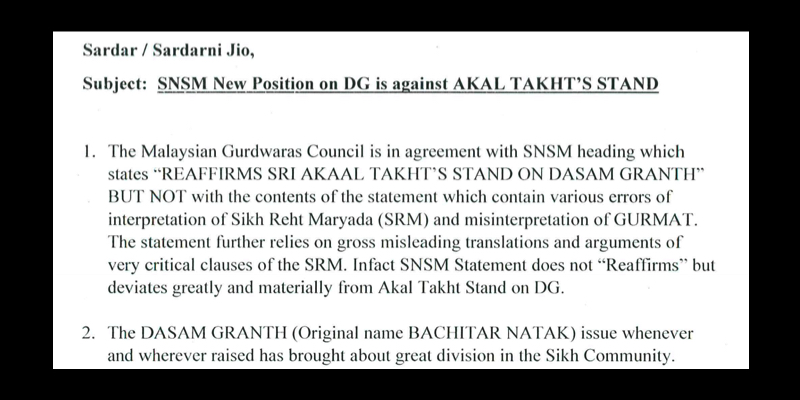
MGC letter rejecting SNSM position on Dasam Granth issue – Photo: Asia Samachar
A recent position statement on the Dasam Granth by the newly elected team at the Sikh Naujawan Sabha Malaysia (SNSM) ‘deviates greatly and materially’ from the stand held by the Akal Takht, according to a council of gurdwaras.
In a 10-page response to be sent out today (29 July 2018), Malaysian Gurdwaras Council (MGC) is calling on Malaysian gurdwaras and the Sanggat to reject the SNSM letter dated 18 July 2018.
The council is alleging that the SNSM letter contained ‘various errors of interpretations and misrepresentation of Gurmat’ and relied on ‘false translations of critical parts of SRM’ which had caused the Sikh youth-based organisation to deviate from its original historical stand.
“We are issuing this letter upon the requests of member gurdwaras,” MGC president Jagir Singh told Asia Samachar in a phone conversation.
SRM refers to the Sikh Reht Maryada or the Sikh code of conduct.
At its AGM on 8 July, Dr Jasbir Singh was reelected as the jathedar (akin to executive chairman) for another two-year term in what was seen as a compromise to allow the more pro-DG group to gain control of the organisation.
In their first executive committee (exco) meeting, the SNSM issued a four-page letter to articulate its position on DG, a granth originally known as Bachitar Natak which has been the centre of a raging debate within the community for years now.
The DG, an issue also discussed at the recent SNSM AGM and at past MGC meetings, has been a hot button on the social media for a segment of the Sikhs. The debate has broken up friendships and even severed family ties for some.
“The SNSM has made a stand on DG which is NOT SUPPORTED by SRM or GURMATTA-1. It was issued in haste that is just days after the Sabha AGM 2018 in July 2018, that it lends credence to fact that it was not well thought off. The PANTH until today has not been able to take a decision on it, showing the complexity of the issue. Thus, Sanggat must await decision of PANTH on it,” the MGC said in its statement dated 28 July 2018. A copy of the letter was emailed to Asia Samachar.
Excerpts from the MGC letter:
The Malaysian Gurdwaras Council is in agreement with SNSM heading which states “REAFFIRMS SRI AKAAL TAKHT’S STAND ON DASAM GRANTH” BUT NOT with the contents of the statement which contain various errors of interpretation of Sikh Reht Maryada (SRM) and misinterpretation of GURMAT. The statement further relies on gross misleading translations and arguments of very critical clauses of the SRM. Infact SNSM Statement does not “Reaffirms” but deviates greatly and materially from Akal Takht Stand on DG.
The DASAM GRANTH (Original name BACHITAR NATAK) issue whenever and wherever raised has brought about great division in the Sikh Community. Malaysian Gurdwaras from the very beginning have been following the teachings of Sri Guru Granth Sahib Ji in the Darbar Sahib guided by the Sikh Reht Maryada (Akal Takht) and this had brought about great unity and togetherness in the Sanggat.
The Statement of SNSM dated 18th July 2018 has now planted the seeds of discontent, division and discord amongst the Sanggat of Malaysia. Until SNSM statement, no Sikh Organisation in Malaysia had taken such a divisive stand openly and possibly in the rest of the world. Hitherto it was left to Scholars to put forward their views until PANTH could take a decision on the matter. Before PANTH could do so, SNSM has made its decision which is not supported by SRM or by Akal Takht.
[ASIA SAMACHAR is an online newspaper for Sikhs / Punjabis in Asia. How to reach us: Facebook message or WhatsApp +6017-335-1399. Our email: editor@asiasamachar.com. For obituary announcements, click here]
Path Da Bhog: 12 Aug 2018 (Sunday), 9.30am-12noon, at Gurdwara Sahib Bandar Sunway, followed by Guru Ka Langgar
Contact:
010-2198525 Son Lavin
019-3837123 Amar
| Entry: 27 July 2018; Updated: 10 Aug | Source: Family
[ASIA SAMACHAR is an online newspaper for Sikhs / Punjabis in Asia. How to reach us: Facebook message or WhatsApp +6017-335-1399. Our email: editor@asiasamachar.com. For obituary announcements, click here]
TABUNG HARAPAN DONATION: L-R: Tejvir Singh, minister special officer D Nallan, Keshvinder Singh, Satnaam Singh, Senator Raja Kamarul Bahrin Shah Raja Ahmad Baharuddin Shah, Kaveldeep Singh, Palwinder Singh, Amrinder Singh and Lim Choon Hock – Photo: Supplied
Members of the Malaysian Punjabi Licensed Moneylenders Association (MPLMA) are joining the thousands of individuals, companies and organisations in doing their little bit for the nation by donating to the Tabung Harapan Malaysia.
The 1952-established association marshalled its members to raise RM55,000 towards the fund which was set up not too long after the Pakatan Harapan government came to power.
Earlier this week, some of the key MPLMA leaders handed the cheque to Housing and Local Government deputy minister Senator Raja Kamarul Bahrin Shah Raja Ahmad in Putrajaya.
“We took the opportunity to congratulate him on his appointment as the deputy minister. We also extended our congratulations to Zuraida Kamaruddin for her appointment as the Minister of Housing and Local Government
“In a discussion, we briefed the Deputy Minister of some of the efforts by MPLMA to improve state of the moneylending business. Though our name carries the word Punjabi, our organisation is open to members from all races and religion,” MPLMA President Palwinder Singh told Asia Samachar.
He added: “As an outfit that serves all communities and faiths, we are delighted to be part of the Tabung Harapan project.”
The Tabung Harapan Malaysia was established by Prime Minister Dr Mahathir Mohamad on May 30 to enable Malaysians to donate towards reducing the RM1.087 trillion national debt. Finance Minister Lim Guan Eng had previously said donations to fund would only be used to settle government debts.
MPLMA, or Persatuan Pemberi Pinjam Wang Berlesen Punjabi Malaysia, was formerly known as Punjabi Sahukara Association which was was established in 1952.
Last year, the association brought together some 600 licensed money lenders representatives for a briefing on the impact of the Malaysian Personal Data Protection Act 2010 (PDPA) on the sector. Effective 16 Dec 2016, all registered money lenders are required to register themselves under the Act which regulates the processing of personal data in commercial transactions.
The half-day session also included officials from the Ministry of Urban Wellbeing, Housing and Local Government and Ministry of Communications and Multimedia.
For its next project, MPLMA is organising a gala dinner on 5 Oct 2018 at Sunway Putra. For more information on the dinner, contact Satnaam Singh (012-2957000) or Sukhamar (01902383838).
“The event is intended to foster the relationship among licensed money lenders and Government related agency,” said Palwinder.
[ASIA SAMACHAR is an online newspaper for Sikhs / Punjabis in Asia. How to reach us: Facebook message or WhatsApp +6017-335-1399. Our email: editor@asiasamachar.com. For obituary announcements, click here]
AKHAND PATH:3-5 August 2018 at Gurdwara Sahib Taiping. PATH DA BHOG: 5 August (Sunday) at Gurdwara Sahib Taiping| Malaysia
Naranjan Kaur (1926-2018), Taiping
NARANJAN KAUR W/O LATE CHANAN SINGH
Village: Baba Bekala (Punjab)
Born: 8 March 1926
Departed: 27 July 2018
Husband: Late Chanan Singh s/o Late Tara Singh (D.I.D. Sungai Petani)
Children / Spouse:
1. Bhajan Kaur / Jagindar Singh
2. Satnam Singh / Senander Kaur
Grandchildren / Spouse:
1. Dr. Jasvindar Singh / Dr. Karen Jeet Kaur
2. Maninder Kaur / Sukhder Singh
3. Harvinder Singh / Balvinder Kaur
4. Sukhvinder Kaur
5. Jasminder Kaur / Umabalan Kandiah
6. Dr. Taranjit Kaur / Malkeet Singh
7. Ranveer Singh
8. Inderjit Singh
Dearly missed by Great Grandchildren
Saskaar / Cremation: 2pm, 28 July 2018 (Saturday) at Pestavest Crematorium Ground, Taiping
Cortege Timing: Cortege leaves 760, Lorong 31, Aulong, Taiping, at 1.30pm, 28 July 2018 (Saturday)
Akhand Path: 3-5 August at Gurdwara Sahib Taiping
Path da Bhog: 5 August (Sunday) at Gurdwara Sahib Taiping
Contact:
Satnam Singh 016-567 2558
Dr. Jasvindar Singh 019-575 1099
| Entry: 27 July 2018 | Source: Family
[ASIA SAMACHAR is an online newspaper for Sikhs / Punjabis in Asia. How to reach us: Facebook message or WhatsApp +6017-335-1399. Our email: editor@asiasamachar.com. For obituary announcements, click here]
The Subang Jaya municipal council has two Sikhs as councilors again.
Keshminder Singh and Mohan Singh Surtar Singh were sworn in yesterday (26 July 2018) to serve as councillors of Majlis Perbandaran Subang Jaya (MPSJ) for a two-year term. Both have served the council earlier.
Keshminder, 58, returns after a spell of six years. He represents the Parti Keadilan Rakyat (PKR).
His lawyer-politician father, the late Karam Singh Veriah, was Malaya’s first youngest Member of Parliament when he elected under the Socialist Front ticket at 22 in 1959. In 1966, he was detained under the draconian Internal Security Act (ISA) laws.
Keshminder’s grandfather, Kaher Singh Veriah, was an MIC assemblyman in Negeri Sembilan.
Mohan, 45, who returns returns as a third term councilor, comes under the NGO quota.
He is also the special assistant to Puchong MP Gobind Singh Deo, who is also the Federal Minister of Communications and Multimedia.
in March, businessman Jasvir Singh, who is also Bentong gurdwara management committee president, was appointed as a council member of Bentong Municipal Council, believed to be the first Sikh in the municipality in the state of Pahang.
[ASIA SAMACHAR is an online newspaper for Sikhs / Punjabis in Asia. How to reach us: Facebook message or WhatsApp +6017-335-1399. Our email: editor@asiasamachar.com. For obituary announcements, click here]
It took just hours for a conservative radio station in New Jersey to suspend two of its most prominent talk-show hosts after the pair repeatedly referred to state Attorney General Gurbir Grewal, a practicing Sikh, as “Turban Man.”
“The guy with the turban,” New Jersey 101.5 host Dennis Malloy said on the airWednesday, referring to Grewal. He then declared he would never learn the name of the state’s top prosecutor, a key foe of President Donald Trump, reported Politico.
“Turban Man,” his co-host, Judi Franco, replied in a sing-song voice during a broader discussion about a recent action taken by the attorney general.
“Listen, and if that offends you, then don’t wear the turban and maybe I’ll remember your name,” Malloy said. “If you called me ‘Baseball Hat Man’ and I was in a culture where no one wore baseball hats … should I be offended?”
The comments mark another controversial episode in the history of New Jersey 101.5, where shock jock Craig Carton once ranted about the “damn Orientals and Indians” and mocked a former governor’s wife for suffering from postpartum depression.
But this latest incident, which gained widespread public attention after audio of the show was shared on Twitter Wednesday evening, was met with swift anger and, to the surprise of some, an apology and action by the station. The reaction seemed to highlight how quickly public outcry can can grow over insensitive comments in an age in which the level of political discourse has shifted dramatically since Trump became president.
The state’s top Democrats quickly weighed in to condemn the remarks and praise Grewal, who grew up in New Jersey and is the first Sikh American to serve as an attorney general in the United States.
Gov. Phil Murphy, who nominated Grewal to his position and has been a guest of the station numerous times, released a statement calling the comments “abhorrent and xenophobic” and urged New Jersey 101.5 to “hold the hosts accountable for these intolerant and racist comments.”
Hoboken Mayor Ravi Bhalla, also a Sikh American, tweeted, “Hey Racist Man,” at the Dennis and Judi show’s account.
As for Grewal, he started his day by tweeting at the station: “My name, for the record, is Gurbir Grewal. I’m the 61st Attorney General of NJ. I’m a Sikh American. I have 3 daughters. And yesterday, I told them to turn off the radio.”
He said it wasn’t the first “indignity” he had faced and it likely won’t be the last.
“Sometimes, I endure it alone. Yesterday, all of New Jersey heard it. It’s time to end small-minded intolerance,” he tweeted, thanking prominent Democrats who had come to his defense. “You’ve got my back – and the backs of all New Jerseyans. Others have faced far worse. We rise above this. Now let’s get back to business.”
Turbans are a religious article that “signifies equality and sovereignty” and can be worn by women or men who practice the Sikh faith, according to the Sikh Coalition.
Sim J. Singh, the senior manager of policy and advocacy for the Sikh Coalition, told ABA News that his organization has offered sensitivity training to New Jersey 101.5 employees following the comments.
“In addition to suspensions and any other responses affecting the individual hosts, we call on the radio station to issue strong public apologies on all of its communications platforms,” Singh told ABC News via email. “We have offered resources on media coverage of Sikhs and specifically requested that the station disseminate this information to all staff. Finally, we can offer cultural sensitivity training that addresses the negative impact of racism and xenophobia.”
“Words have consequences. Xenophobic remarks can fuel hate crimes, harassment, employment discrimination, and bullying against Sikh Americans and other communities. Whether it’s remarks by radio hosts with media-amplified voices or bigoted comments from elected officials about minority communities, we must speak up and hold one another accountable,” Singh added.
[ASIA SAMACHAR is an online newspaper for Sikhs / Punjabis in Asia. How to reach us: Facebook message or WhatsApp +6017-335-1399. Our email: editor@asiasamachar.com. For obituary announcements, click here]
By Surinder Kaur Sohan Singh |SIKHI STUDY | OPINION
Every human being’s main objective in life is to have PEACE, HAPPINESS, JOY and BLISS (PHJB).
All our efforts are directly or indirectly geared towards achieving this goal. But sadly PHJB eludes many of us. We do experience it momentarily now and then but it soon vanishes. Is there such a thing as eternal P H J B? If there is where do we find it?
Many of us have equated worldly success with P H J B. We postpone our Happiness in the pursuit of worldly goals mistakenly thinking that worldly success will guarantee us Happiness.
Here are some examples:
I will be happy when I pass my exams.
I will be happy when my child graduates.
I will be happy when I get married.
I will be happy when I have one million dollars in the bank.
Happiness for many of us is:
Something to be experienced in the future. No one is happy right HERE and NOW.
Something that is dependant on the outside world.
The result is that many of us die before we experience Happiness because the conditions for Happiness keeps on changing with time.
After passing my exam, now I say I will experience Happiness only when I get a job. When I get a job, then I will say I will only be happy when I get married. This goes on and on…
Gurbani tells us that to experience PHJB is our inherent right. We are born with this treasure inside us. We do not have to look for it outside of us. Any happiness we might find outside will be at best only TEMPORARY.
There is nothing in the world outside that can give us eternal Happiness. The treasure of PHJB inside us is not temporary. It is eternal.
How do we reach to this treasure inside us? The whole of Sri Guru Granth Sahib – all of the 1,429 pages – tells us how to access this treasure.
Surinder Kaur Sohan Singh is a Malaysia-based Gurbani enthusiast. This is an edited version of her regular articles shared within a circle of fellow Sikhi seekers
* This is the opinion of the writer, organisation or publication and does not necessarily represent the views of Asia Samachar.
[ASIA SAMACHAR is an online newspaper for Sikhs / Punjabis in Asia. How to reach us: Facebook message or WhatsApp +6017-335-1399. Our email: editor@asiasamachar.com. For obituary announcements, click here]
The light of the Sri Guru Granth Sahib (SGGS) is sought by over 300 million spiritual seekers worldwide. With this rapidly expanding urge and need, there is a concern that haunts us. It is about providing easy access to the Guru’s wisdom to a rapidly evolving global village.
Many linguists and educational researchers have established that the language of a culture, or mother tongue of an individual, is essential to impart any ideology or educational material.
EXPANDING NEEDS
In the past, the ideas of the SGGS have been communicated to 100 million Punjabi speaking people in the world. But if we continue to use only Punjabi, the Sikh ideology and the essential knowledge of the Guru’s Wisdom will not be communicated effectively to 500 million Urdu speaking people, a billion of each Hindi, Spanish, or Chinese speaking people, or twice as many English-speaking people in the West.
It does not matter, whether this audience is of Indian origin or others. It will not serve its purpose unless the knowledge is imparted in a local language – the language people learn from their surroundings, and not have to go to a Gurdwara school to learn it.
INFORMATION, KNOWLEDGE, AND LANGUAGE
There is a difference between information and knowledge. Information can be easily translated and transmitted in any language and is stored as well as propagated in any language. Knowledge, on the other hand, cannot be imparted effectively in a language other than the mother tongue.
Mother tongue is a language, which is acquired without requiring formal instructions in a school or from a tutor. It is learned from continued communication with the family members living at home, particularly the mother. We are losing Punjabi as the mother tongue day by day even in the areas where it has dominated for centuries. Further, Punjabi is not the mother tongue of the most of the world.
THE GURU GRANTH IN THE FUTURE WORLD
The children of the future world would not know the relevance of the SGGS in their life unless they learn it through language, which can effectively impart the required knowledge to them. And, that the knowledge is imparted in the newly acquired mother tongues of their parents and siblings.
At present, English is the most spoken language and the language of 75% printed material in the world.
If you do not believe me, then tell me how many of you can understand the advantage of Macintosh over Windows in any language other than in English. Why are all technologists even in Hindi speaking India, Urdu speaking Pakistan, or Hebrew speaking Israel making all software in English, why not in Hindi, Punjabi, or Hebrew? You know the answer.
We Sikhs take a lot of pride in the universality of the message of the Gurus meaning that our Guru revealed their message for the benefit of all peoples and all communities. Our clerics and our leaders miss no opportunity to emphasize this distinction of our Guru’s message. Similarly, we speak of our Gurdwaras and other congregational institutions open to everyone in the global village.
But we fail to realize that by trussing Sikh beliefs and practices far too tightly with Punjabi language, ethnicity, and lifestyle, we commit the sin of utterly refusing to share our religion with the rest of the world.
DISFRANCHISING CHILDREN AND FAILING TO SHARE
Failing to share our heritage with others is far too evident in our religious practices. Traditionally we limit our congregational services and prayers only to the language of our ancestors, and in doing so we virtually close doors to others. We even make it harder for our life partners to connect to our faith if they happened to be born outside Punjab.
Similarly, we disfranchise even our children and the young Sikhs growing up in the West from having full access to the Guru’s teachings.
It is not difficult to see a parallel with the days of racial discrimination in America. When the white population wanted to disfranchise a black people from their birthright to vote, they used the hurdle of literacy in a language that the black community had difficulty to be proficient in.
THE FOUNDERS DIFFERED
Strict adherence to any one language of a predominant religion was not the case at the time of our Gurus. Guru Nanak and his successors traveled to all reachable lands to spread the Word; they unreservedly used whatever language would get their message across. They defied tradition set by Brahmins and Mullahs, who insisted on Sanskrit and Arabic to teach theology; in contrast, the gurus used the spoken language of the people as a medium of their mission. I do not recall reading anywhere that when Guru Nanak visited many lands that he ever required his audience to learn Punjabi or he taught Punjabi to anyone.
Guru Amar Das rebuked a delegation of religious scholars who came to persuade him to use the language of the religious elite, Sanskrit, to impart his message.
According to Bhai Santokh Singh [4], Guru Amar Das told the visitors a metaphor to make his point. He said, “God’s theology is like water to a thirsty person. Divine knowledge in Sanskrit or Arabic is like water in a deep well; it takes the effort to draw it and then irrigate crops of only those who own the land and the means. Guru’s teachings must be in a language that serves like a cloudburst which turns the crops of everyone and in every field green; it reaches mountains and valleys alike, birds and mammals alike, animals and human alike, poor and rich alike.” (English translation from original Punjabi by the author.)
Guru Amar Das’s response was like a famous biblical parabola where Jesus said that when you light a lamp; place it on a higher pedestal so that the light can reach everyone. Requiring especially made colored glasses to see the light will contradict the essence of this parabola.
GURU GRANTH LANGUAGE
There are some Punjabi compositions in the SGGS, but mostly they are written in many other languages of India as well as Middle Eastern and South Eastern countries. There are over 22 languages used to compose the hymns in the Guru Granth [3].
Guru Gobind Singh mostly used Braj Bhasha (the language of Bihar), Persian and Arabic, but not any Punjabi in his compositions or in his daily teaching. The Sikh rulers similarly used Persian to conduct their day-to-day business. Maharaja Ranjit Singh, only two centuries ago, used Persian and so did Banda Bahadur, a contemporary of Guru Gobind Singh. He issued coins of the Sikh kingdom with Persian inscriptions.
The language of the SGGS, the Eternal Guru of the Sikhs, is so different from modern Punjabi that most Punjabi speaking people of today do not understand much of it. I have difficulty myself in understanding the Punjabi text that is currently being used by Sikh scholars in India to explain the doctrines in the SGGS.
No wonder that their Punjabi books find only negligible circulation in North America or Europe. Even in India, they are not read as is evident from a meager number of prints that are made of books on Sikhism published in Punjabi.
History is a witness, that if the Gurus were here in North America today, they would depart from the past and use English to communicate. They would use a language in which more than three fourth of all the printed material is produced.
TODAY MOST COMMUNICATION IS IN ENGLISH
Most of the progressive elements in every religion now use English to communicate. The cyberspace technology as the medium of future communication began to require that we speak the cyberspace language or be eclipsed from the wired communities.
Our youth outside India exclusively use only English language to conduct their daily lives both at home and at work. It will be wise not to resist the trend for the propagation of our religion among this generation.
EROSION OF SIKH IDENTITIES IS WARNING
I personally visited many places in North American where Sikh identities were entirely wiped out of existence by the third or fourth generation. It was primarily because their immigrant parents would not convey their religious inheritance to their children in the language of their adopted country. That left only the rituals or ceremonies of their faith for the children to relate to and those lost their meaningless appeal within a generation. You may not have to go far to see this trend continuing even today.
In many old communities of North America today, the only thing children recall to a visitor is the memory of their grandparents being Sikhs, the term that they can often not even pronounce correctly. These children usually preserve, besides photographs, one or two of their parents’ “prayer books” as the museum pieces in their homes.
It breaks my heart when I visit homes of this generation. But all I can do is to show some love towards them and promise to relate their message to our first-generation Sikh community here.
Many of them do ask me if I can send them some Sikh literature in English.
SOME HOPE
I am pleased to see that Sikh congregations in Pakistan use Shahmukhi script and Urdu language to publish the Sikh literature. In Sind and North West Pakistan, over 3 million Sikhs who are popularly known as Nanak Panahi use Sindhi. The newly converted Caucasian Sikhs in North America use English and Spanish as a medium in their Gurdwaras. Their outfits in China and Brazil similalry speak of the Guru Granth teachings in their own languages.
Only a very tiny but gradually growing population of Sikh children of Punjabi parents in North America is getting bold enough to break from the tradition and improvise the religious liturgy in English. The efforts of the youth groups promoted by Charhdi Kala in Northern California is one example. There are sprouting several cybergroups in the West to impact the Guru Granth knowledge in English.
CONCLUSION
For the conclusion, I would like to quote Dr. Indermohan Singh of the Charhdi-Kala Foundation. He recently wrote, “There are very good reasons for Sikhs of Punjabi origin to want to preserve their language and culture. There is also no question that for those who can understand it, Gurbani in its original languages is much more beautiful and meaningful. It is tough to capture the beauty and poetry of the original in a translation. But I believe we should be very clear about the differences between the religious versus cultural and linguistic issues. And we should make an effort to share the Guru’s Word using every language and medium that is effective and available.” [2].
Let us join the progressive civil societies of today and communicate the universal messages of the Guru Granth in the languages of the civil societies of today and tomorrow. And, that language today is English.
NOTE
See discussions, stats, and author profiles for an earlier version of this publication here
REFERENCES
SGGS = Sri Guru Granth Sahib. 1983 (reprint). Publishers: Shiromani Gurdwara Parbandhak Committee, Amritsar. (M = Mahla, i.e., succession number of the Sikh Gurus to the House of Guru Nanak).
Indermohan Singh. 2002. Chardi Kala Network Archives.
Padam, Piara Singh. 1990. Sri Guru Granth Da Bhasha Prabhat, In: Sri Guru Granth Parkash, Patiala, p. 307-322.
Santokh Singh. 1954. Sri Gur Partap Suraj Granth, Raas 1, Part 46, p. 1518. Reprinted Amritsar, Khalsa Samachar.
The article first appeared on 22 July 2018 at Harbas Lal’s blog, Seeking Wisdom. See here.
Harbans Lal, Ph.D.; D.Litt (Hons) is the Professor Emeritus & Chairman at the Dept of Pharmacology & Neurosciences, University of North Texas Health Science Center. He is also the Professor Emeritus at the Amritsar-based Guru Nanak Dev University as well as President of the Academy of Guru Granth Studies. He can be reached at Japji2050@gmail.com
* This is the opinion of the writer, organisation or publication and does not necessarily represent the views of Asia Samachar.
ASIA SAMACHAR is an online newspaper for Sikhs / Punjabis in Southeast Asia and beyond.Facebook | WhatsApp +6017-335-1399 | Email: editor@asiasamachar.com | Twitter | Instagram | Obituary announcements, click here |
AKHAND PATH: 27-29 July 2018 (Fri-Sun) at Gurdwara Sahib Ampang Ulu Kelang, Selangor. SEHAJ PATH DA BHOG / KIRTAN: 8.30am-12pm, 29 July (Sun) | Malaysia
Mata Parkash Kaur (1933-2018) & Kirpa Singh (1922-1982)
Waheguru Ji Ka Khalsa
Waheguru Ji Ki Fateh
Pyari Sanggat Ji
SRI AKHAND PAATH SAHIB will be held in the loving memory of Late Mata Parkash Kaur Ji and Late Sardar Kirpa Singh Ji from 27-29 July 2018 (Fri-Sun) at Gurdwara Sahib Ampang Ulu Kelang, Selangor.
Programme details:
27 July (Friday)
6.30am – 8.30am: Asa Di Waar, Kirtan & Ardaas; followed by commencement of Sri Akhand Paath
28 July (Saturday)
Sri Akhand Paath continues
29 July (Sunday)
8.30am – Sri Akhand Path da Bhog
9.30am – 12.00 noon: Kirtan followed by Sehaj Path Da Bhog
Please join the family in this prayers and assist in all kind of sewa.
Contact:
0178896711 (Dev)
0123685039 (Sarjit) @ DBKL
0192822100 (Sunder)
0163283677 (Balminder)
0172740094( Sunny)
Thank you Ji
KES NAL KIJE DOSTI
SAB JAG CHALANHAR..
| Entry: 24 July 2018 | Source: Family
[ASIA SAMACHAR is an online newspaper for Sikhs / Punjabis in Asia. How to reach us: Facebook message or WhatsApp +6017-335-1399. Our email: editor@asiasamachar.com. For obituary announcements, click here]
Ministry of Education is engaging widely in a process called Korero Mātauranga: let’s talk about Education. After 30 years, Ministry of Education is doing some changes in the Education System.
They consulted New Zealand Sikh womens Association, to engage with our Indian community to have our valuable contribution about building not just a better education system but the World’s best for Ethnic community.
On behalf of New Zealand Sikh Womens Association, you are cordially invited for this conversation on Saturday i.e. 28th of July, 2018 at 214, Great South Road, Otahuhu at 10.30 am to 12.30pm. Your input and contribution will be highly appreciated. Light refreshment will be served.
Please R.S.V.P. on our email : office@nzswa.org or can call on office phone no. 2700798 alternatively you can txt on 0212638471.
[Adapted from social media sharing by Jit Kaur]
[ASIA SAMACHAR is an online newspaper for Sikhs / Punjabis in Asia. How to reach us: Facebook message or WhatsApp +6017-335-1399. Our email: editor@asiasamachar.com. For obituary announcements, click here]


























 Harbans Lal, Ph.D.; D.Litt (Hons) is the Professor Emeritus & Chairman at the Dept of Pharmacology & Neurosciences, University of North Texas Health Science Center. He is also the Professor Emeritus at the Amritsar-based Guru Nanak Dev University as well as President of the Academy of Guru Granth Studies. He can be reached at Japji2050@gmail.com