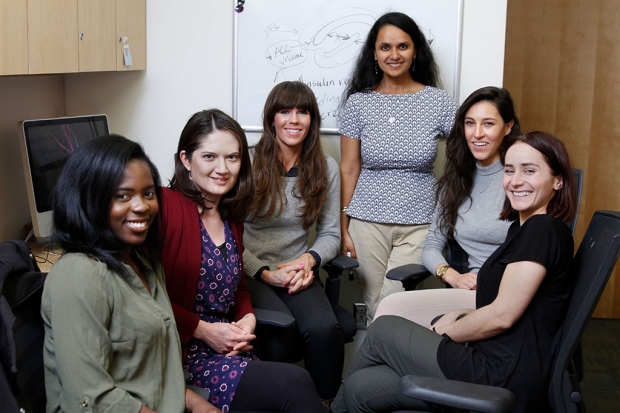
Manpreet Singh (standing) and her team are studying brain abnormalities that may link depression and early-life obesity. The other team members are (from left) Akua Nimarko, Sara Leslie, Melissa Packer, Danielle Wall and Yevgeniya Zaiko. – Photo: Standford Medical website / Paul Sakuma
Dr Manpreet Kaur Singh and a team of researchers at the Stanford University School of Medicine are studying brain abnormalities that may link depression and early-life obesity.
In a recently published findings, they found that early-life obesity and depression may be driven by shared abnormalities in brain regions that process rewards.
Their findings, published online April 23 in Hormones and Behavior, are based on brain MRI scans of children and teenagers ages 9-17 who struggled with depressive symptoms and maintaining a healthy weight. The study is the first to document how concurrent obesity and depression are reflected in the brain in this age group, according to a report at Stanford Medicine website.
Young people who had both conditions had low volumes in two of the brain’s reward-processing areas, the hippocampus and anterior cingulate cortex. The participants’ brain abnormalities also were linked to their level of insulin resistance, itself a precursor to diabetes, the report noted.
“We want to help children and families understand that these conditions are brain-based phenomena,” the report quoted Dr Manpreet who is the study’s lead author. “We want to destigmatize these issues. Understanding that there’s a brain basis may help both children and parents be solution-focused.”
Dr. Manpreet is an Assistant Professor of Psychiatry and Behavioral Sciences, and Director of the Pediatric Mood Disorders Program in the Division of Child and Adolescent Psychiatry at Stanford. Her time is divided among the clinical, research, and teaching missions of department.
She directs Stanford’s Pediatric Mood Disorders Clinic, which is an integrated multidisciplinary clinic that aims to treat youth with a spectrum of mood disorders along a developmental continuum.
She leads a team of child and adolescent psychiatrists, psychologists, child and adolescent psychiatry fellows, clinical and research postdoctoral fellows, residents, medical students, and research coordinators. Her research focuses on investigating the origins and pathways for developing mood disorders during childhood, as well as methods to protect and preserve function before and after the onset of early mood problems.
[ASIA SAMACHAR is an online newspaper for Sikhs in Southeast Asia and surrounding countries. We have a Facebook page, do give it a LIKE. Follow us on Twitter. Visit our website: www.asiasamachar.com]
[Fastest way to reach Asia Samachar: Facebook message or WhatsApp +6017-335-1399. Our email: editor@asiasamachar.com. For obituary announcements, click here]
Penang ladies at the Saddha Pindh Vasakhi night – Photo: Supplied
It was a colourful Vasakhi night which the Penang ladies will remember for a long time to come. True to the ‘Sadda Pindh’ (Our Village) dinner theme, the ladies came dressed in traditional attire resembling the typical dressing of the villages in Punjab.
Held at the Penang sports Club in conjunction with the Vasakhi, the event was organised by a Penang ladies team led by Manjit Kaur Jessy, Amarjit Kaur Penesar and Sarwant Kaur Sharon.
The atmosphere was electrifying, with the crowd hitting the dance floor. The event also included a Punjabi culture show.
[ASIA SAMACHAR is an online newspaper for Sikhs in Southeast Asia and surrounding countries. We have a Facebook page, do give it a LIKE. Follow us on Twitter. Visit our website: www.asiasamachar.com]
[Fastest way to reach Asia Samachar: Facebook message or WhatsApp +6017-335-1399. Our email: editor@asiasamachar.com. For obituary announcements, click here]
Ammetta Malhotra (left) and other winners at the WFF Kahma Classic in Melbourne – Photo: Ammetta Facebook page
If you think you are fit and fiery, meet your match.
Malaysian fitness enthusiast Ammetta Malhotra won two awards at an international fitness competition held in Australia recently.
The owner of a personal training studio and a mother of three came out first in the sports model category for over-30s and second in the glamour model category at the WFF Kahma Classic in Melbourne.
“I want to take the Malaysian fitness to the next level. I hope the international title will inspire more women, including our Punjabi ladies, and men, to get into the gym and start lifting weight for their wellbeing and strength and also to look good,” she told Asia Samachar.
The event on 25 March 2018 was organised by World Fitness Federation (WFF), an outfit established in 1968 that promotes bodybuilding, figure, bikini and sports modelling for men and women.
Her husband Brendan James Bergin was present to celebrate her success.
In June, she will represent Malaysia at the World Fitness Federation Universe event with contestants from all over the world converging in Singapore.
If that is not enough, Ammetta is now gunning for the Mrs Malaysia Universe title.
This is her Facebook entry today: “Is Malaysia ready for a Fitness queen with an English Literature degree to be the next Mrs Malaysia. Lets show them that beauty queens have beauty brains and fitness ..Lets take Malaysia to International heights.”
Looks like Ammetta is not about to stop anytime soon.
Her World Malaysia magazine featured Ammetta in its April 2018 issue
[ASIA SAMACHAR is an online newspaper for Sikhs in Southeast Asia and surrounding countries. We have a Facebook page, do give it a LIKE. Follow us on Twitter. Visit our website: www.asiasamachar.com] 18673
[Fastest way to reach Asia Samachar: Facebook message or WhatsApp +6017-335-1399. Our email: editor@asiasamachar.com. For obituary announcements, click here]
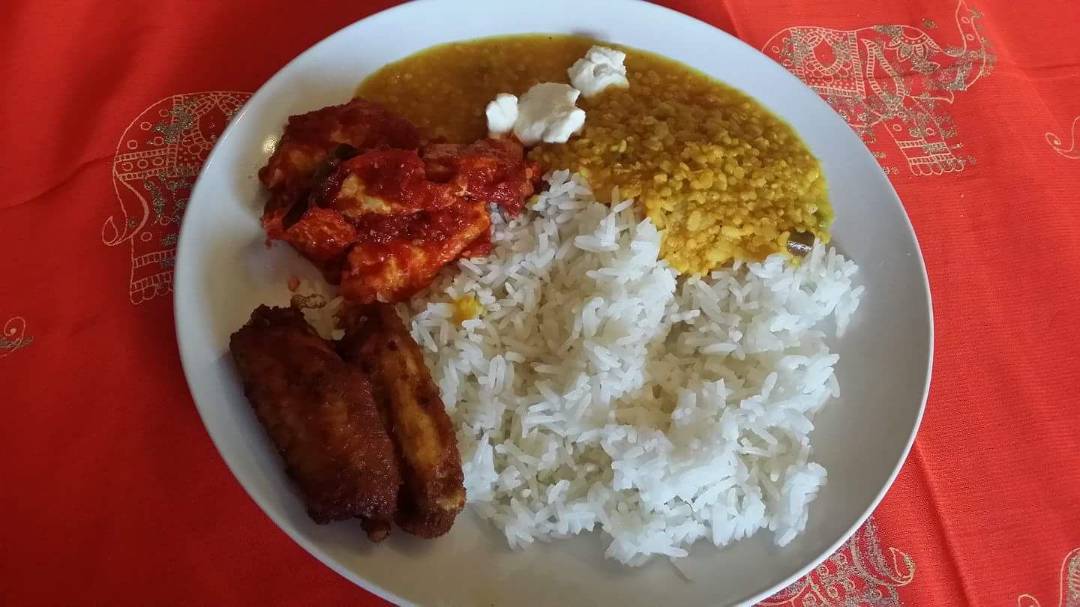
Ms Jit Dhaliwal’s homemade Punjabi speciality: Steamed rice, yellow daal tadka, deep fried mid-wings & sambal. – Photo: Jatinder Singh for Asia Samachar
By Jatinder Singh | SINGAPORE | OPINION
Mummy, whats for dinner? Rice, dhaal, chicken wings and ikan bilis sambal.
A few days ago a friend posted on Facebook a picture of a mouth-watering cuisine she had cooked for dinner. It was complimented with many ‘Likes’ and comments. I decided to read them.
– Fantastic Punjabi style makan
– Home Punjabi food is the best
– Well donelah, keeping our tradition alive!
And on the flipside…
– Sorry what kind of dinner is this?
– How does anyone eat lentils with chilli paste?
I investigated into the profile of the ‘dumbstruck’ to find that they were in fact of India origin; I have to exclude the term Indian but write India, because the former refers to all of our ethnic allegiance, while the latter inclines towards the country of socialisation.
My mind went back 18 years to my undergraduate days at the National University of Singapore (NUS). I met Rajveer Bains, a first year engineering student from New Delhi who was doing a cross faculty module with my majoring discipline of sociology.
My affinity for Punjabi material, social and cultural, accelerated my exchanges with Rajveer.
During Diwali in 2001, I invited him to my sister’s place for dinner, an experience that I would never forget.
While tea and samosas and insights to bargains while shopping at Karolbagh, New Delhi, formed enriching common ground (to my sister obviously), the transition to beers and assorted nuts with live Gurdaas Maan numbers formed the entertainment highlight of the evening.
It was then time for the “traditional” Punjabi dinner; no garlic naans or chicken tikka, not even butter chicken nor palak paneer, but….
Lemak curry with potatoes and carrots and cabbage and string beans, fried Tenggiri fish, tahu sambal, circular slices of cucumber garnished with light salt and lychee in tinned syrup for desert.
Rajveer stared at the food. He was a polite Delhi Boy. He said the beers had bloated him bad. He had overkilled the salted peanuts. He would very apologetically skip dinner.
My brother in law was quick to sympathise. He had years of experience in the F&B industry and could identify the actual root of the crisis. However, he added a disturbing statement, “Dont worry about it. Be comfortable. Food won’t be wasted. We will keep some in the fridge and it will taste better for lunch tomorrow!”
KITA PUNYA MAKAN
A grand narrative in Malay filled the room. My brother in law exclaimed, “Jet Sia (my nickname) lu tak cakap lu bawak orang dari sana datang rumah. Dia orang mana boleh makan kita punya makan (You didn’t tell us you were inviting a foreign guest. Our type of cuisine is not palatable for them)!”
So in 2010, Diwali dinner was prepared in a Punjabi household but deemed not palatable by a Punjabi from India. In 2018, what took seconds to stimulate my gastronomy, won consensus by many Singaporeans and Malaysians alike but did once again arouse “alienation” in a foreign few.
The conclusion: The study of social science informs the mental faculty that there exists peculiar or unique realities when communities react with localities.
EAT FIRST, PRAY LATER
A few months ago, I shared an article that was fairly well received by Punjabi folk in Singapore and Malaysia about the special Punjabi ‘Lingua Franca’ we enjoy and experience. I was pleased to garner feedback on many different paser vocabulary that I had not included or moreso grammatical expressions that I had not visited in my narratives.
We have now arrived at a congruent reality and that is Punjabi food or Punjabi homemade recipe. Unlike the topic of localised Punjabi language that was/is easy to connect with owing to commonalities across sects and families, the Punjabi food of Singapore / Malaysia has its special trademark, type and taste- or combinations.
We can mark a starting point of common prevalence in gurdwaras (Sikh temples) here, where tahu sambal and mee hoon are sought after entities so much that you would hear relished expressions such as “Hmmm, Gurdwara tahu sambal you cannot find anywhere at all.”
I grew up recognising gurdwara culinary experts with nicknames like “Tahu Sambal Majhi” – you see her and you know you need to adopt the summarised prayer version so you can attack the delicacy while stocks last (eat first, pray later…..!).
At the home front, R&R will form the staple base; roti and rice. The dhaal…Yes, the dhaal, all time “Happy Meal” condiment will have variations but typically with one genre the favourite… “If you go to Masi house and she cooked her yellow dhaal, you can eat it plain with rice!” And to be fair…. “Don’t eat Puah’s Dhaal.. the Rajma (kidney beans) is a real spoiler!”
And the main dishes to accompany the core foundation shall be the dynamic selection; so much so that as I pen these stanzas I am still not sure if I should even mention The List of possible combinations!
Well maybe for the sake of non Singaporean Punjabis, I should plot an idea of what’s cooking at home? I really don’t know if Thai Punjabis have Tomyam flavoured chicken with yellow dhaal, or if Japanese Punjabis savour Sushi with green dhaal, but we Singaporeans define Punjabi homemade food as:
– Egg sambal
– Kicap chicken
– Fried fish
– Chicken wings (KFC for some)
– Omelette
– Ikan bilis
– Potato masala fried
– Prawn sambal
– Tahu sambal with bird eggs
– Sausage sambal
– etc..
With dhaal of all sorts, curries, sauces, AND
The classic signature, unparalleled, as good as gold – Saag Suri: Boneless pork marinated with spices and pressure cooked with greens like spinach, mustard Seed Leaves, Chillies, etc.
The Saag Suri, now considered by some to be a dying, soon to be extinct, gastronomical gift to mankind in Singapore and Malaysia, has evolved to be experimented with alternatives to pork such as chicken, mutton, and even sardine. The signature standalone dhaal has also not been spared with some families infusing pork ribs in it, eggs and sardine.
MEAT EATER
As an ardent meat eater, I do apologise to adversaries of non-vegetarian culinaries if this assertion appears biased or wrongly represented.
I do envisage a gastronomical platform for vegetarians where “mock” meats shall find places in recipes such as Saag Suri and its likes.
I do also welcome criticisms to this rendition of mine since it is a secular account and I am sure I will be insighted with other “comfort” foods and recipes of the Punjabi home in Singapore and the region. One man’s meat is another man’s poison.
If I know there is dhaal in my fridge and plain rice is a quick fix but nothing else to go along with… so I stop by the Chinese chicken rice shop and takeaway just roasted chicken and barbecued pork.
I should share a picture of how I neatly arrange the dhaal, rice and “complimenting” local meat delights on my lunch plate!
Jatinder Singh possesses great interest in culture which he studied at National University of Singapore (NUS). He currently trains students and adults in schools and enrichment centres in a range of topics; including public speaking which forms his forte. Jatinder also extends his flair to host and emcee events.
* This is the opinion of the writer, organisation or publication and does not necessarily represent the views of Asia Samachar.
[ASIA SAMACHAR is an online newspaper for Sikhs in Southeast Asia and surrounding countries. We have a Facebook page, do give it a LIKE. Follow us on Twitter. Visit our website: www.asiasamachar.com] 18885
[Fastest way to reach Asia Samachar: Facebook message or WhatsApp +6017-335-1399. Our email: editor@asiasamachar.com. For obituary announcements, click here]
Ways to celebrate Sikh Environment Day – Chart: EcoSikh
By Taranjit Kaur | OPINION
The world today is far too dynamic, instantaneous and interrelated. Interestingly, we are all part of a wider ecosystem. Our actions largely impose some level of impact across the social value chain.
There is more. The many natural resources our lives revolve around are finite, that simply means it will either cease to exist or be available in limited quantities. A perfect example is water! The issue unfolding in Cape Town, South Africa is in itself an eye opener.
Okay! So what? We recently celebrated the World Earth Day, and we should be cherishing a life of abundance. True enough, part of which calls for contemplation and a sense of gratefulness. The looming question being – how are we going to sustain our Mother Earth, making it a beautiful place for generations to come?
Surely not an easy task ahead. The world’s population is growing, the need for natural resources is rising, individual footprint is increasing and natural resources are depleting. A colourful situation, indeed!
Closer to home, we witnessed a change in weather patterns and its associated consequences. The truth is, climate change is here, and it is real, and new experiences are likely to unfold. The choice is ours; to either benefit by making a positive change or worsen the situation further. Opting for the latter should be nowhere close!
Instead, let’s pledge this World Earth Day to start changing ourselves. We can make a difference in our own unique ways, as individuals and communities, alike. Decisions we make today will determine the quality of our shared tomorrow. We are all liable, like it or not!
Sustainability entails every person to embrace universally binding values to ensure our world remains a flourishing avenue. After all, sustainability means the ability to sustain and in essence, is about staying relevant and purposeful.
Here are some quick and easy solutions to be more respectful of Mother Earth:
1. Minimise the use of energy i.e. switch off electrical points and equipment when unused, invest in energy saving appliances
2. Do more with less i.e. be water savvy, recycle and reuse items, zero paper use (go digital!)
3. Reduce waste i.e. be conscious of domestic waste such as food, eliminate use of plastic (bring your own)
4. Cap off individual footprint i.e. get healthier – walk and take the stairs instead of taking lifts or driving over short distances, carpool if possible or if convenient, use public transport
5. Nurturing others i.e. inculcating awareness at home and in our circle of influence on the need to be more sustainability conscious i.e. propelling the teaching of Sikhi in a more humane manner; such as concepts of sharing and greed management.
There is a lot more we can do, if we put our minds to it – going beyond our individual selves to embedding the elements of sustainability in our households, societal practices (even in the way we operate our Gurdwaras!) and far beyond.
We owe utmost love and compassion for Mother Earth,. Every small deed matters! Time for action is now!
Taranjit Kaur is a Kuala Lumpur based executive who gets involved in Sikh activities.
* This is the opinion of the writer, organisation or publication and does not necessarily represent the views of Asia Samachar.
[ASIA SAMACHAR is an online newspaper for Sikhs in Southeast Asia and surrounding countries. We have a Facebook page, do give it a LIKE. Follow us on Twitter. Visit our website: www.asiasamachar.com] 18224
[Fastest way to reach Asia Samachar: Facebook message or WhatsApp +6017-335-1399. Our email: editor@asiasamachar.com. For obituary announcements, click here]
Meet math wizard Harneesha Kaur. The 18 year-old Malaysian student received the Top in the World Award for Mathematics for IGCSE examinations.
The former school captain, sprinter and student council member did exceedingly well in the subject for the November 2017 sitting of the UK-based examination. She scored 8As.
She is now pursuing A-Levels at the HELP Academy.
Her father Santokh Singh is the managing director of Multimedia Group in Ghana while her mother Sungeet Kaur is a teacher specialised in special education.
IGCSE, short for International General Certificate of Secondary Education, a popular international certification for end of secondary school (equivalent to O-Level, UK GCSE, fifth form or year 11 in respective countries and schools).
Harneesha Kaur receiving the award at a ceremony in Kuala Lumpur
ASIA SAMACHAR is an online newspaper for Sikhs / Punjabis in Southeast Asia and beyond.Facebook | WhatsApp +6017-335-1399 | Email: editor@asiasamachar.com | Twitter | Instagram | Obituary announcements, click here |
Melbourne will now hold the distinction of holding one of the larger Vasakhi events outside of India.
Some 10,000 are expected to converge for the one-day Vasakhi festival on Saturday (28 April 2018) at Melbourne’s iconic Federation Square, with the famed Malaysian Sikh pipe taking part as well.
The pole position goes to Surrey, Canada. On Sunday (22 April 2018), the British Columbia city hosted a record turnout of 500,000, making it the largest Vasakhi celebrations outside of India. The Surrey celebration typically attract some 300,000 people.
The Melbourne event is organised by the Victorian Sikh Gurduaras Council together with other Sikh and Australian organisations.
Various programs such as the Sikh pipe band, live music and Sikh cultural performances will be the part of the Vasakhi celebrations, the organising team said in a statement emailed to Asia Samachar.
The Sri Dasmesh Pipe Band from Malaysia will be performing first time in Melbourne at Federation Square.
Popular music groups Dya Singh and Gurmat Sangeet Academy will also perform at the event.
A crowd of over 10,000 people are expected to attend this year’s Vasakhi celebrations, the statement added.
Victorian Premier Daniel Andrews, Shadow Multicultural Minister Inga Peulich and other dignitaries are expected to take part in the event.
An exhibition to commemorate the Sikh ANZACs will also be exhibited at the event.
Australian organisations including Metropolitan Fire Brigade (MFB), Country Fire Authority (CFA) and Victoria Police will also participate at the event and educate the attendees about personal and fire safety.
Event coordinator Gurinder Kaur said: “Vasakhi is one of the most important Sikh Festival and it’s celebrated across the world as Khalsa Day. This day marks a turning point in Sikh History when the tenth Sikh Guru Gobind Singh ji formed the Khalsa Panth and initiated the Amrit ceremony. We have people eagerly looking forward to the festival, even non-Sikhs get very excited. That has been the biggest change and achievement.”
This is the second year of the event and there is lot of excitement amongst the community. Various business stalls will also be held during the event. There will be free food available during the event, the statement added.
[ASIA SAMACHAR is an online newspaper for Sikhs in Southeast Asia and surrounding countries. We have a Facebook page, do give it a LIKE. Follow us on Twitter. Visit our website: www.asiasamachar.com] 18880
[Fastest way to reach Asia Samachar: Facebook message or WhatsApp +6017-335-1399. Our email: editor@asiasamachar.com. For obituary announcements, click here]
I am reminded of an erstwhile Governor of New York, at one time a Presidential hopeful, Mario Cuomo. He famously advised politicians to “Campaign in poetry but govern in prose.”
For our newly minted current President, Donald Trump, it’s always campaign season. He makes policy, manages our myriad concerns, treaties and worldwide commitments by tweets and extreme eruptions – voluble, volatile, often self-contradictory but mercifully and tersely compact.
My mind longs for saner times, when policy gurus and canny politicians set us up for whatever the world dumped on our plates. Many of their utterances wrapped some truisms succinctly, briefly, even wisely. But President Trump’s soundbites are tons more colorful, even incendiary.
Certainly, hearts are easier nabbed by poetry than prose. Some prose captures the mind and dances rhythmically like the best poetry while some poetry turns to ashes as you read it – like clumsy maladroit prose. Keep in mind that poetry is more than awkward versification.
Sometimes I have advised young couples at their nuptials that a wedding is done in 15 or 20 minutes, no matter the religion or the mandated ceremony, but making a marriage out of a wedding takes a lifetime and more.
To me therein lies the difference between poetry and prose.
Falling in love, like a wedding, is poetry; prose would be making a life or even making a living, even if it reads like blank verse or doggerel. Prose demands a critical eye and constant tweaking. Poetry offers a plateful of hidden connections and meanings that enchants while it titillates our inner core.
A good life demands both prose and poetry. Poetry is the dream that makes you want to fly, prose is the effort to make the dream come true.
“We the people” (the Founding Documents of America) is poetry, as is all the writing in Guru Granth. In Meeri-Peeri, a defining doctrine of Sikhi, Peeri is poetry Meeri is the prose. Translating and interpreting the Guru into life-defining reality, like a societal contract, is prose. The ingredients would be social equality, racial, cultural, religious, gender and ethnic sensitivity, thus creating a greater, more inclusive society.
History attests that such a mix may deliver both good and evil, carrying as it does both the potential of a TNT explosive device, and also the wherewithal to unshackle the untold progressive human potential.
Ergo, the path is often messy. It echoes the time-worn advice to enjoy the sausage but never explore how it is made; that will repel all curiosity. For poetry or prose the devil is in the details and rests somewhere between the two.
Notwithstanding the awesome beauty of flying machines that can deliver us from one end of the Earth to the other is sheer poetry. (Does the shape of the earth allow for any ends or corners?)Prose is most of humanity’s achievements that stem from centuries of blood, sweat, tears – even failures. Now when we celebrate them, only the poetry of the phenomenon remains; its prose has become more effort than enjoyment, and is perhaps long-forgotten.
GURU GRANTH IS ALL POETRY
That brings me to the poetry and prose at the structural framework of Sikhi and an associated dilemma. The Guru Granth is all poetry; translating it and internalizing its message is the prose.
So, then, what exactly is our relationship to a gurduara service?
Music is seductive and keertan is all music, hence the heavy attendance at keertan, even if only a few seem to be in dedicated listening mode. Music has a self-hypnotic quality; it grabs the listeners even while they nod in joy or sleep (relaxing?) a bit.The heaviest attendance occurs at langar – the meal served gratis (without charge) at the end of every service in every gurduara worldwide. This states the desperate physical hunger. Socializing, invoking the community’s interactive need, is poetry; that, too, deserves and catches the crowd.
However, during katha — the exposition of history or a reading from Sikh sacred literature — the focus precipitously falls and often disintegrates. Why? Celebrating the message is poetry, living it is prose. Working and living the message demands examining its connection to life, even though the language is not always user-friendly, and many sermons seem unconnected to life. Interest plummets to rock bottom.
Normally,this is where moral lessons of poetry come to us in the dubious gray of prose, hence they elude us. Prose doesn’t quite hold us as poetry does. So, we hear the message without really listening and being clued to it.
We need to discover habits where Gurbani is both celebrated as life’s poetry and equally treasured as its essential prose. Only then will the human heart dance to the moral imperatives of a life steeped in Gurbani.
I.J. Singh is a New York based writer and speaker on Sikhism in the Diaspora, and a Professor of Anatomy. Email: ijsingh99@gmail.com.
* This is the opinion of the writer, organisation or publication and does not necessarily represent the views of Asia Samachar.
[ASIA SAMACHAR is an online newspaper for Sikhs in Southeast Asia and surrounding countries. We have a Facebook page, do give it a LIKE. Follow us on Twitter. Visit our website: www.asiasamachar.com] 18683
RBS Sikh Network guest panelists at the Birmingham launch event – Photo: Provided
The Sikhs at the Royal Bank of Scotland plc. (RBS) have launched RBS Sikh Network to celebrate diversity across the bank.
Some 300 guests attended the network’s official launch on 21 March 2018 with celebratory events in London and Birmingham attended.
“Both events had inspirational panel guests who shared their experiences, challenges and gave everyone so much to think about. Feedback has been phenomenal and of course the challenge now is to deliver on our objectives and continue to be totally inclusive in everything we do,” RBS Sikh Network chair Amrit Singh Bahia said in a statement emailed to Asia Samachar. Amrit is a customer experience director at RBS.
The network is the bank’s newest employee-led network, but with over 600 members already, it is set to become one of the most popular. Open to employees from all kinds of backgrounds, it has formally set out its remit as a support network designed to help colleagues achieve their true potential, through promoting diversity and inclusion within the bank, according to the statement.
The network’s objectives have been set around the three basic principles of Sikhism:
Honest Living (Kirat Karo) – Organising business networking events, profiling role models and mentoring activities.
Meditate on The Divine (Naam Japo) – Supporting colleagues with spirituality and wellbeing.
Share with Others (Vand ke Shako) – Participating in a number of community projects.
RBS Sikh Network London members with Amrit Singh Bahia (fourth from left) – Photo: Provided
The London event, held at RBS Bishopsgate, was preceded by a number of activities, which saw staff, including many of the bank’s executives, fully immerse themselves in learning more about the network. Some experienced wearing a turban, having creative henna tattoos applied and there were also a wide range of stalls to visit hosted by Sikh artists, charities and humanitarian organisations. Of the 300 guests attending launch celebrations, over half the attendees were external professionals.
The network’s executive sponsor James Holian said RBS was proud of the proactivity of all its employee led networks and believed that by harnessing diversity and celebrating cultural differences they could understand and serve customers even better.
On the event, he said: “The tone throughout was open, challenging and welcoming – exactly the culture we want to have everyday.”
ASIA SAMACHAR is an online newspaper for Sikhs / Punjabis in Southeast Asia and beyond.Facebook | WhatsApp +6017-335-1399 | Email: editor@asiasamachar.com | Twitter | Instagram | Obituary announcements, click here |
Sahej Path Da Bhog: 29 April 2018 (Sunday), 10am-11.30am, at Gurdwara Sahib Rawang, followed by Guru Ka Langgar.
Contact:
Linda 012-3183210
Harry 016-6658284
Melvin 016-6192342
Please treat this as a personal invitation from the family.
| Entry: 23 April 2018 | Source: Family
[ASIA SAMACHAR is an online newspaper for Sikhs in Southeast Asia and surrounding countries. We have a Facebook page, do give it a LIKE. Follow us on Twitter. Visit our website: www.asiasamachar.com] 18765
[The fastest way to reach Asia Samachar is by sending us a Facebook message or Whatsapp message to +6017-3351399. For obituary announcements, click here]

























 Jatinder Singh possesses great interest in culture which he studied at National University of Singapore (NUS). He currently trains students and adults in schools and enrichment centres in a range of topics; including public speaking which forms his forte. Jatinder also extends his flair to host and emcee events.