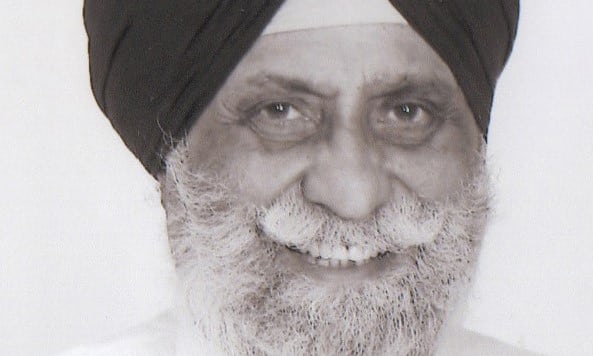
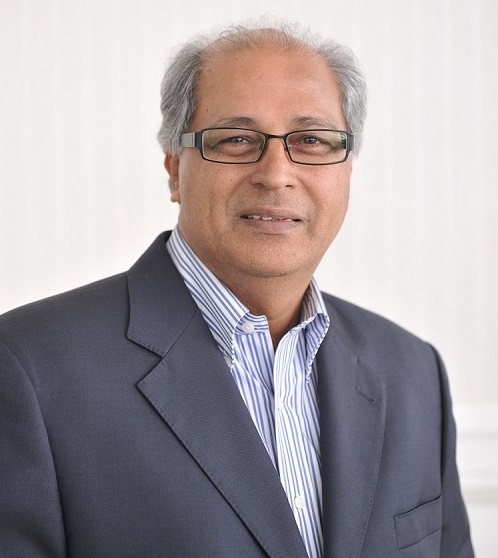
Malaysian information and communications technology (ICT) veteran Stan Singh will helm the Asia Pacific ICT Alliance (APICTA), marking the first time that Malaysia has been given the privelege to lead the 16 member-economies ICT alliance.
Stan, who represents National ICT Association of Malaysia (PIKOM) at the alliance, was elected as chairman at a recent APICTA executive committee meeting in Myanmar.
“It is a great privilege and honour to be appointed as the new chairman of APICTA, making Malaysia as the new head of the global alliance for the first time,” Said Stan in a statement released by PIKOM.
“I am thrilled at the opportunity of working with the new APICTA Executive Committee to strive together to tap and unearth the talents and skills of extraordinary companies and individuals in the dynamic ICT Community of Asia Pacific.”
Among others, APICTA organises the annual International APICTA awards dubbed as the “Oscars of the global ICT industry”. The next round will be held from Oct 9-13 in Guangzhou, China.
Stan, the previous APICTA deputy chairman, is no stranger to the ICT industry, serving almost three decades in IT management and business management roles in various industries ranging from hotel & properties, retail & supply chain management, manufacturing and finance and has led various IT & business projects in USA, UK, Australia, Hong Kong, Thailand, Indonesia, Singapore and Malaysia. He is also a business coach and an international speaker.
He was also the senior vice president of MUI dotcom Sdn Bhd, a member of the MUI Group of companies where he was responsible for the group’s IT services globally. He held the position of Managing Director of Wincor Nixdorf Retail for the Malaysia and Thailand markets.
He is the founder and principal consultant of IronHorse Asia Sdn Bhd, which provides IT solutions for the retail and financial industries.
He takes over Dr Dileepa De Silva from the Sri Lanka economy, who served as the APICTA chairman since 2014. Fulvio Inserra, the chief iAwards Judge of the Australia Information Industry Association is the new deputy chairman, the statement added.
PIKOM chairman Ganesh Kumar Bangah said Stan’s new position follows a string of Malaysian ICT leaders who have played pivotal roles on the global ICT platforms such as ASOCIO and WITSA.
The 16 economies in APICTA are Australia, Bangladesh, Brunei, China, Chinese Taipei, Hong Kong, Indonesia, Japan, Macau, Malaysia, Myanmar, Pakistan, Singapore, Sri Lanka, Thailand and Vietnam.
In Malaysia, PIKOM and MDEC are the representative ICT organisations in the alliance.
[ASIA SAMACHAR is an online newspaper for Sikhs in Southeast Asia and surrounding countries. We have a Facebook page, do give it a LIKE. Follow us on Twitter. Visit our website: www.asiasamachar.com] 18466
[Fastest way to reach Asia Samachar: Facebook message or WhatsApp +6017-335-1399. Our email: editor@asiasamachar.com. For obituary announcements, click here]
Businessman Jasvir Singh has been appointed as a council member of Bentong Municipal Council, believed to be the first Sikh in the municipality in the state of Pahang.
“I have been asked, among others, to look after the welfare o the Punjabi community in this district, he told Asia Samachar.
Jasvir, 45, who is also Bentong gurdwara management committee president, was officially appointed at a ceremony today (30 March 2018).
He received the title Datuk from the state of Pahang in 2016.
[ASIA SAMACHAR is an online newspaper for Sikhs / Punjabis in Asia. How to reach us: Facebook message or WhatsApp +6017-335-1399. Our email: editor@asiasamachar.com. For obituary announcements, click here]
Asia Samachar | Entry: 29 March 2018 | Source: Family
[ASIA SAMACHAR is an online newspaper for Sikhs in Southeast Asia and surrounding countries. We have a Facebook page, do give it a LIKE. Follow us on Twitter. Visit our website: www.asiasamachar.com] 18456
[The fastest way to reach Asia Samachar is by sending us a Facebook message or Whatsapp message to +6017-3351399. For obituary announcements, click here]
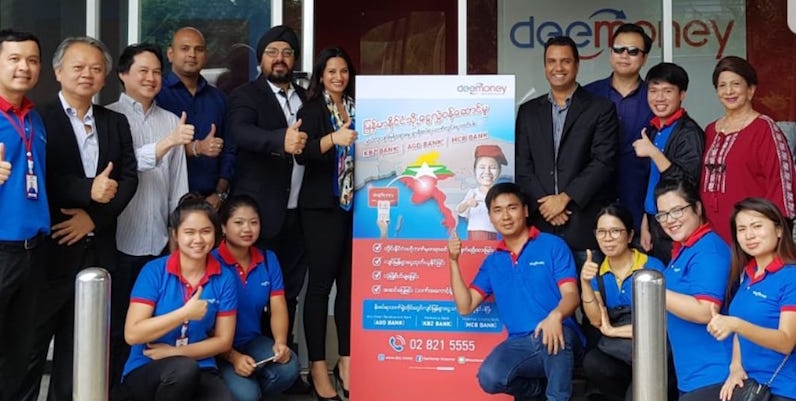
Deemoney launch branch at Tesco Mahachai – Photo: Deemoney
International money transfer firm DeeMoney today launched its third branch in home country Thailand, with the fourth branch expected to be unveiled in May.
Its latest branch was unveiled at Tesco Mahachai to facilitate money transfer activities to Myanmar, Cambodia, India and 15 more countries.
Deemoney is a subsidiary of Sawasdeeshop Co Ltd, a tier-two telecom solutions provider, helmed by a husband-wife team of Aswin Phlaphongphanic as SawasdeeShop CEO and Rasmegh Srisethi as its director.
Earlier this year, it emerged as as one of the first non-banks to receive the coveted international money transfer license from the Bank of Thailand, the nation’s central bank. See here.
Initial response has been ‘very positive and encouraging’, Aswin tells Asia Samachar.
DeeMoney has launched its first branch at Imperial Samrong, a popular destination for foreign migrant workers in Bangkok.
For its expansion into Cambodia, Deemoney has teamed up with Wing Money which has more than 3,000 branches in the neighbouring nation.
ASIA SAMACHAR is an online newspaper for Sikhs / Punjabis in Southeast Asia and beyond.Facebook | WhatsApp +6017-335-1399 | Email: editor@asiasamachar.com | Twitter | Instagram | Obituary announcements, click here
Some of the Sikh ladies gathered at Mogok, Myanmar – Photo: Rajeev Singh for Asia Samachar
Myanmar-born Tara Singh, who does Sikhi parchaar, with the Sikh team taking part in the procession to celebrate Mogok’s 800th anniversary – Photo: Rajeev Singh for Asia Samachar
Gurdwara Sahib Mogok, Myanmar – Photo: Rajeev Singh for Asia Samachar
REUNION: Sikhs getting together with their local friends during the 800th anniversary of the town known as the Land of the Rubies – Photo: Rajeev Singh for Asia Samachar
It was a day of rejoicing and reunion at Mogok, a Myanmar town once known as the “land of rubies” for its extraordinary treasure trove of jewels.
Some 200 Sikhs, many of them born at the town located about 800km north of Yangon, made their way to the town to celebrate its 800th anniversary.
A huge number of local friends and neighbours, estimated at around 700, joined them for a celebration at the Gurdwara Sahib Mogok today (28 March 2019) as the local Sikh community started a prayer programme. The local media was present, too.
“Many of them came for the Guru Ka Langgar we are having at the gurdwara. Today, the youth also rehearsed their bhangra performance for tomorrow’s big celebration,” Mogok-born Rajeev Singh told Asia Samachar. “Sikhs are shown great respect.”
Among those in the congregation is Tara Singh, a Myanmar born Sikh who Sikh-parchaar in the country.
Sikhs are taking an active part in the 800th anniversary celebration with prayer, Guru Ka Langgar and get-togethers.
On 24 March, Sikh youth wearing Punjabi dresses joined a procession, proudly holding the sign ‘Sikh Family’.
Sikhs have been present in Mogok for more than 150 years through the Indian army. Today, there are less than a dozen families in the town.
[ASIA SAMACHAR is an online newspaper for Sikhs in Southeast Asia and surrounding countries. We have a Facebook page, do give it a LIKE. Follow us on Twitter. Visit our website: www.asiasamachar.com] 18443
[Fastest way to reach Asia Samachar: Facebook message or WhatsApp +6017-335-1399. Our email: editor@asiasamachar.com. For obituary announcements, click here]
Airport journeys can be stressful for anyone. But walking through airport security as a bearded and turbaned Sikh can be an ordeal.
When you’re always selected for random security checks, they don’t seem so random after all – especially when you’re the only one pulled aside while travelling with others not wearing turbans.
These security checks usually only take an extra ten to fifteen minutes, but their psychological impact far outlasts this brief encounter, particularly when security staff leave you feeling belittled and disrespected.
When a security worker clearly waits for you to pick up your luggage so they can examine you, letting ten people walk past in the mean time, you start feeling you’re constantly under surveillance.
When it seems you’re targeted simply because of your dress, your faith, your ethnicity, you start to question whether you fit into society. It’s these kinds of small incidents, experienced repeatedly, that can drive young Sikhs to stop wearing their beards and turbans entirely.
Particularly for older Sikhs with limited English, being held up for longer than everyone else and bombarded with questions is intimidating and confusing. In fact, members of the Australian Sikh community often arrange for someone to accompany their parents on flights to guide them through the security process.
With Sikhism being Australia’s fastest growing religion, such incidents are bound to happen increasingly as more Sikhs migrate to Australia. When their relatives come to visit, their first impressions of Australia are shaped by the often-humiliating process of a security check – hardly reflecting a multicultural Australia that embraces all.
I fully support the important work airport security staff do to keep everyone safe. But by targeting those who are visibly different, they may be letting actual security threats slip through the cracks – who don’t necessarily fit the stereotypes of what a ‘terrorist’ looks like.
Ultimately, problems like this often arise from a lack of awareness. Security workers may be unfamiliar with the Sikh articles of faith and see turbans as mere fashion accessories, unaware tying a turban is an art that can take fifteen minutes each time. They may not know asking a Sikh to remove their turban – a religious crown, the most sacred object on their body – is highly disrespectful. And with the threat of terrorism always looming large, being visibly different makes you an easy target for suspicion.
Being disproportionately targeted by airport security is one of the many forms of indirect racism Sikhs face that makes us feel unwelcome. But if awareness of different faiths is included in security training – and awareness about Sikhs is spread more broadly – this unfair treatment could become a thing of the past.
[ASIA SAMACHAR is an online newspaper for Sikhs in Southeast Asia and surrounding countries. We have a Facebook page, do give it a LIKE. Follow us on Twitter. Visit our website: www.asiasamachar.com] 18433
[Fastest way to reach Asia Samachar: Facebook message or WhatsApp +6017-335-1399. Our email: editor@asiasamachar.com. For obituary announcements, click here]
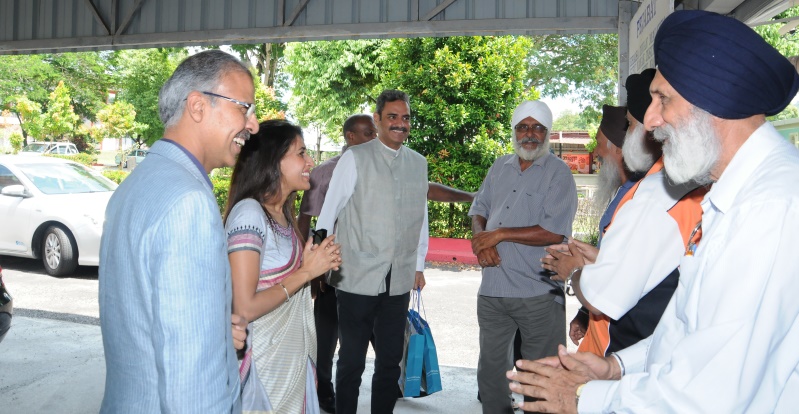
Newly appointed Indian High Commissioner to Malaysia Mridul Kumar (left most), accompanied by his wife, meet the Khalsa Diwan Malaysia leadership in Ipoh, Perak. Community Affairs and Labor counsellor Rajiv Ahir is in the middle, with Dr Bhajan Singh seen right most – Photo: KDM
By Jaginder Singh Rahpatti | Khlasa Diwan Malaysia
The newly appointed Indian High Commissioner to Malaysia, Mridul Kumar, recently visited Khalsa Diwan Malaysia (KDM), one of the oldest Sikh organisation that is still functioning.
In the visit to Ipoh on 4 March, he was accompanied by his wife and Indian Counsellor for Community Affairs and Labour Rajiv Ahir.
They were met on arrival at the KDM office by KDM president Santokh Singh, deputy president Gurnam Singh and other members from Ipoh.
In his welcome speech, Santokh gave a brief overview of the objectives of KDM and its effort in preserving Sikh religion, culture and identity, and the Punjabi Language.
He spoke about the good ties KDM has always had with the Indian high commission and its envoys. He also thanked the high commission for working hand-in-hand on numerous occasions to overcome problems afflicting the Sikh community.
In his address, Mridul acknowledged and thanked KDM for its effort in preserving the rich Sikh heritage, and the preservation of the Punjabi language.
He complimented the Sikh community for their past and continuous contribution globally. Among others, he saluted them for their bravery and the serving of Langgar in Gurdwaras.
THe newly appointed envoy also told how the previous envoy and the present embassy staff had spoken fondly about KDM, and he did not want to miss the opportunity to be in Ipoh in person.
He was full of praise for KDM for continuing to serve the needs of the Sikh community.
After a scrumptious North Indian lunch, a brief tour of the office, an exchange of souvenirs and a photography session, the entourage left with warm handshakes and greetings.
Mridul, who was the joint secretary in the Ministry of External Affairs, took over from T S Tirumurti.
[Jaginder Singh Rahpatti is the assistant secretary of Khalsa Diwan Malaysia]
[ASIA SAMACHAR is an online newspaper for Sikhs in Southeast Asia and surrounding countries. We have a Facebook page, do give it a LIKE. Follow us on Twitter. Visit our website: www.asiasamachar.com] 18365
[Fastest way to reach Asia Samachar: Facebook message or WhatsApp +6017-335-1399. Our email: editor@asiasamachar.com. For obituary announcements, click here]
THE rags-to-riches tale of Kuala Lumpur-born Ajit Singh Gill will render tears as he celebrates his 90th birthday as one of Asean’s most accomplished veteran sportsman and gentleman.
Today, he ranks as Singapore’s oldest Olympian, a double-international at hockey and cricket, and his proverbial blood, sweat and tears are nicely captured in a family-commemorative book, ‘The Heart of an Olympian’, written by his grandson Luc Gill, 27, a crypto-currency dealer and fitness guru.
Believe me, life was never a bed of roses as Ajit accomplished his personal and professional feats through sheer discipline and hard work, in his words, following the true principles of a Sikh, inherited from his late father.
He couldn’t afford a scout uniform but rose to be a scout master who later pioneered a patrol of scouts to Hong Kong for the Golden Jubilee in 1961.
He was cutting grass to feed the cows from childhood days in Selangor when he had a rare craze for the sport of the British Raj, he so admired. He went on to be a celebrated golfer at the prestigious Singapore Island Country Club (SICC) and a pioneer-leader at Senior Golfers’ Club. He played in the Singapore Inter-Club golf competitions, representing SICC, and at many Asean Senior Amateur championships, where he was a past winner for Best Net (Individual) in 1990.
Born in 1928 at the railway quarters in Sentul, Kula Lumpur, to railway workshop supervisor Milkha Singh, the eldest of 10 siblings, he was raised in the strictest way of Sikh-life. He says: “My father was a very good Sikh. His advice: Go, work hard, don’t drink, don’t smoke, speak the truth and don’t be afraid of anyone. That has been my mantra, I’ve been practicing it as much as possible.”
SICK WITH ASTHMA
Overcoming overwhelming challenges was just a way of life for Ajit. He was chronically sick with asthma as a child in Kuala Lumpur. Yet he assisted to set up an entire kampung named after his father, “Milkha Singh Kampung”. With the village organic food and health lifestyle, Ajit got over asthma to be a rousing international sportsman.
He recalls: “During the war, the Japanese Occupation era, I had to stop my schooling to work in order to help support my family. After it ended, I worked very hard to complete my secondary education and then began work as a teacher followed by becoming a junior draftsman in the survey department in Kuala Lumpur.”
At 17 years, he played for Selangor in arguably the strongest state hockey team for close to a decade and he was nicknamed “pint-sized” because of his scrawny stature. But he soon overcame the physical setbacks to be an Olympic Games fullback.
He had the urge to search for greener pastures and in 1951, he left for Singapore and enrolled at the Teacher’s Training College (TTC), where he started an uninterrupted career as an educationist, retiring as Vice Principal of Queenstown Secondary Technical School. The government conferred him with the Pingat Bakti Setia for “long and loyal education-service to the country”.
The highpoint of his sporting life was the 1956 Melbourne Olympic Games, the first and only time Singapore played at the world’s highest sporting stage. It brought back nostalgic memories as 28-year-old Ajit bought a wedding ring in the Australian city and, returning from the Games, he proposed to schoolteacher Surjit Kaur in January 1957.
He continued his devotion to sports despite the pressures of teaching and raising a family, much thanks to the support of his wife, who realised he was an awesome sportsmania!
“When I returned after the Olympics, my marriage and later my children became my priorities,” he says. “I was posted to the afternoon session, while my wife was in the morning session, so that we could spend more time with our children. I still found time to fit in my sports on the weekend and played a lot of cricket and later golf. I have never stopped to this day and still regularly beat my golf mates that are 30 years my junior!”
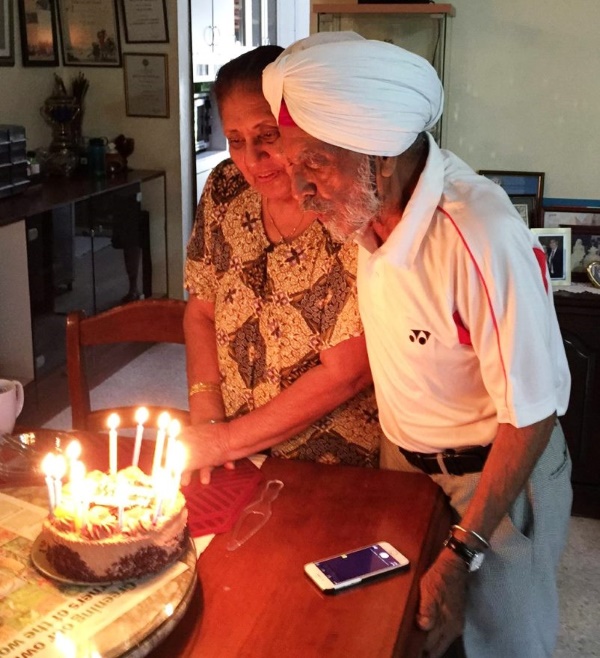
With a chuckle, as he celebrated his 90th birthday on March 21, he says: “My friends now joke that I used to run behind the ball (at international levels at hockey and cricket) and now I walk behind a ball at golf!”
Singapore hockey team at the Olympics 1956 in Melbourne, Australia – PHOTO / SIKHS IN HOCKEY
NATURAL TALENT FOR SPORTS
His natural talent for sports was obvious and he also excelled in another wood-wielding sport: Cricket. Swopping the hockey stick for the willow bat, he played for Singapore in internationals against Malaysia, Hong Kong, New Zealand and England. He was nicknamed the “big hitting Sikh”, once scoring a century in just 68 minutes in 1968 at an unusual blistering pace. He could hammer fours and sixes with ease with his powerful God-blessed swings from hockey, where he was a tough-blasting fullback.
Ajit is not embarrassed to say he sports a set of false teeth as he was seriously hit on the mouth in a 1954 inter-state match against Malacca. He was in excruciating pain but he simply spat out the broken teeth, wiped the blood and led Selangor to victory.
“I was a half-back and the Malacca forward was very rough and swung his stick madly into my mouth and broke five of my teeth,” he says.”The match was so intense that I spit out a mix of blood and shattered teeth and played on to win the game! I still have my false teeth because of that. It was this kind of determination and drive that allowed me to reach the 1956 Melbourne Olympics where I played for Singapore.”
His inspirational value as an awesome role-model, with a never-say-die spirit, was reflected when he was invited as the oldest torch-bearer to run with the torch at the Youth Olympic Games (YOG) 2010 as an 82-year-old. The first and only time Singapore hosted the YOG.
GRANDEST TRIUMPH
Perhaps the grandest triumph for Ajit, in his words, remains “the success of his five children in their chosen careers which speaks loudest for my wife and me”. He adds: “We had five over seven years. We were truly blessed to have a boy and girl in consecutive order!”
The fivesome Gill clan: Psychologist, motivational speaker and author Dr Mel Gill; Specialist English teacher in Hong Kong Inderbeer Kaur Gill; Recently-retired Chief Executive Officer of the Chicago Mercantile Exchange Phupinder Singh Gill; Family doctor at Holland Village, Shivcharan Kaur Gill and lawyer Paramjit Singh Gill, now in real estate.
“They’ve excelled in their career and it gives my wife and me the biggest personal satisfaction that we’ve achieved our family targets to the maximum,” he says.
Reflecting on his life, he adds: “The happiest moment of my life was on January 1, 1957 when I married my darling wife Surjit. The saddest moment was when I lost my mentor and my father. The book my grandson wrote is everything he taught me.”
Ajit, in my opinion, is truly blessed.
He’s healthier, more independent and wiser than ever before. And if you play your cards right, you can reach the age of 90 and be thriving at that age.
Like Queen Elizabeth, who turned 90 two years ago, Ajit has also shown none of us need to dwindle into senility. Simply because he is doing everything right. He’s very active, walks a lot, still passionately enjoys golf and has a very close Gill family.
Happy 90th birthday Ajit Singh Gill!
Let me reiterate that your secret formula is your very firm connectivity to family and friends. In ageing, adding life to years is what counts.
You’re just an awesome one-of-a-kind Sikh example.
Suresh Nair is a Singapore-based journalist, who ranks Olympian Ajit Singh Gill as the ultimate octogenarian role model. Instead of dreading old age, he is eagerly looking forward to it and hoping to hit 100 years very soon.
[ASIA SAMACHAR is an online newspaper for Sikhs in Southeast Asia and surrounding countries. We have a Facebook page, do give it a LIKE. Follow us on Twitter. Visit our website: www.asiasamachar.com] 18422
[Fastest way to reach Asia Samachar: Facebook message or WhatsApp +6017-335-1399. Our email: editor@asiasamachar.com. For obituary announcements, click here]
Gurdwara Sahib Kuantan, captured in 2015 – PHOTO / ASIA SAMACHAR
Kuantan gurdwara has taken a huge step forward on gender equality by accepting women as members.
At its annual general meeting (AGM) yesterday (25 March 2018), Gurdwara Sahib Kuantan (GSK) approved a resolution to allow women to become members.
“The resolution takes immediate effect,” GSK committee president Dr Dharshan Singh told Asia Samachar in a text message.
This leaves probably only a handful gurdwaras which still do not allow women to become direct members, though they do not restrict women from exerting their influence in the running of the gurdwaras.
At the AGM, the out going management team led by Dr Dharshan was reelected. This is the fifth consecutive team as the GSK committee president for the dental surgeon.
Also elected was Dr Ovinderjeet Singh as vice president, Sourjan Singh as the secretary and Darshan Singh as treasurer.
ASIA SAMACHAR is an online newspaper for Sikhs / Punjabis in Southeast Asia and beyond. When you leave a comment at the bottom of this article, it takes time to appear as it is moderated by human being. Unless it is offensive or libelous, it should appear. You can also comment at Facebook, Twitter, and Instagram. You can reach us via WhatsApp +6017-335-1399 or email: asia.samachar@gmail.com. For obituary announcements, click here.
My father, Jaginder Singh Brar, who has died aged 79, was a founder member of the Sri Guru Singh Sabha Gurdwara, the Sikh temple in Southall, London, and went on to use his experience to lead the establishment of a thriving Sikh community in Reading.
As one of six founding trustees, he rallied the few dozen Sikhs in Reading in the early 1970s to buy a spiritual home. They needed £26,000 to buy the property. Trustees used their homes as security to borrow £12,000. The rest came from a two-year fundraising mission led by my father.
At the time, Sikhs in the UK were campaigning against a ruling forcing Sikh men to wear a helmet while riding motorcycles. The fight led to the Motorcycle Crash Helmets (Religious Exemption) Act 1976. On his fundraising trips, Jaginder would recite poems in support of the campaign – including one that ran “This is the turban that fought the last two world wars without the helmet; no one cared back then, so why now?”
He was born in Ipoh, Malaysia, one of six children of Naranjan Kaur and Dalbara Singh, who was in the British military police. When Jaginder was nine his father retired and the family went to live in India. Between the ages of nine and 17 he studied, farmed the land and was a skilful kabaddi player. At 17, with a one-way ticket and his father’s blessing, he went back to Malaysia. There he learned to read and write English, and to drive cars and trucks, and had various jobs, including chauffeur at the Burmese embassy.
In 1962 Jaginder returned to India and married Surjit Kaur, a seamstress. It was an arranged marriage: their fathers had been in the military police in Malaysia together. Later that year, with opportunities few and far between in India for Sikhs, he moved to the UK, living in Southall. He was a lorry driver working on the M4, which was being built at the time.
After two years he moved to Reading, where a friend ran a bakery, and my mother came over to join him; she went on to work as a volunteer at the Gurdwara. They would often welcome families new to the country to stay in their home for days, weeks or even years.
From 1976 Jaginder worked as a driver and loader for British Airways; he took early retirement in 1992, but walked into another job at Cater-Air within weeks. He left there after five years and then worked on the rail-air buses between Reading and Heathrow, then finally bought a black cab and worked until 2003.
He particularly enjoyed travelling and cooking.
My mother died in 2006. Dad is survived by three daughters, Baljit, Rajwant and Sarbjit, by two sons, Randhir and me, by seven grandsons, and by a brother and a sister.
The article appeared at The Guardian on 23 March 2018. See here.
[ASIA SAMACHAR is an online newspaper for Sikhs in Southeast Asia and surrounding countries. We have a Facebook page, do give it a LIKE. Follow us on Twitter. Visit our website: www.asiasamachar.com] 18409
[Fastest way to reach Asia Samachar: Facebook message or WhatsApp +6017-335-1399. Our email: editor@asiasamachar.com. For obituary announcements, click here]






























 Suresh Nair is a Singapore-based journalist, who ranks Olympian Ajit Singh Gill as the ultimate octogenarian role model. Instead of dreading old age, he is eagerly looking forward to it and hoping to hit 100 years very soon.