AP Singh elected Lions Club International President in July 2025
By Asia Samachar | India |
AP Singh, a practicing chartered accountant based in Kolkatta, India, will helm the global team of Lions Club.
The volunteer organisation with 1.4 million members elected AP as the International President for 2025-26 at its international convention at Orlando in Florida, US, which ended on July 17.
AP, a Lion since 1984 and member of the Calcutta Vikas Lions Club, has family business interests in automobile dealerships, according to the club’s statement.
The Lions Club has more than 49,000 clubs in over 200 geographies. Among others, it runs programmes dedicated to health, youth outreach, scholarships, environment and disaster relief.
Lion Club’s official video on AP Singh can be viewed here.
ASIA SAMACHAR is an online newspaper for Sikhs / Punjabis in Southeast Asia and beyond. You can leave your comments at our website, Facebook, Twitter, and Instagram. We will delete comments we deem offensive or potentially libelous. You can reach us via WhatsApp +6017-335-1399 or email: asia.samachar@gmail.com. For obituary announcements, click here
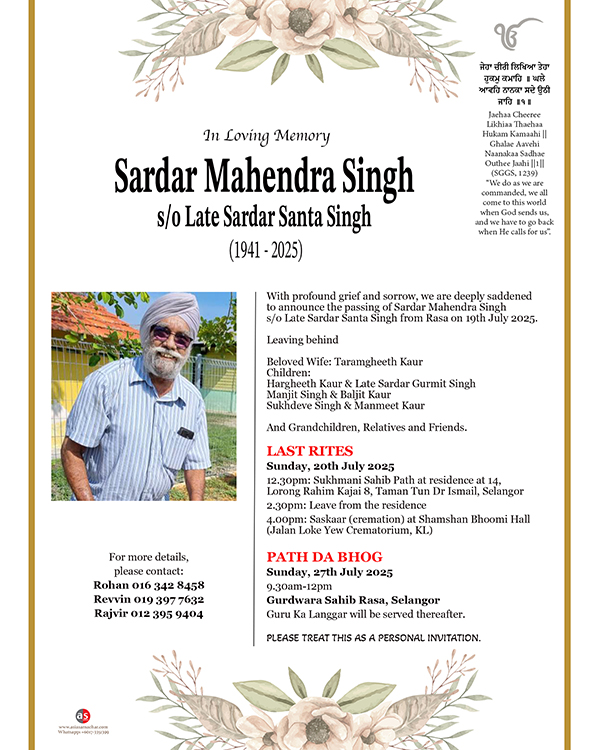
With profound grief and sorrow, we are deeply saddened to announce the passing of Sardar Mahendra Singh s/o Late Sardar Santa Singh from Rasa on 19th July 2025.
LAST RITES Sunday, 20th July 2025 12.30pm: Sukhmani Sahib Path at residence at 14, Lorong Rahim Kajai 8, Taman Tun Dr Ismail, Selangor 2.30pm: Leave from the residence 4.00pm: Saskaar (cremation) at Shamshan Bhoomi Hall (Jalan Loke Yew Crematorium, KL)
PATH DA BHOG Sunday, 27th July 2025 9.30am-12pm Gurdwara Sahib Rasa, Selangor Guru Ka Langgar will be served thereafter.
Please treat this as a personal invitation.
For more details, please contact: Rohan 016 342 8458 Revvin 019 397 7632 Rajvir 012 395 9404
ASIA SAMACHAR is an online newspaper for Sikhs / Punjabis in Southeast Asia and beyond. You can leave your comments at our website, Facebook, Twitter, and Instagram. We will delete comments we deem offensive or potentially libelous. You can reach us via WhatsApp +6017-335-1399 or email: asia.samachar@gmail.com. For obituary announcements, click here
KLSSRC players with former Malaysian international hockey player Maninderjit Singh for a pep-talk session as they prepare for the Malaysian Junior Hockey League (MJHL) 2025 league – Photo: Supplied
By Asia Samachar | Malaysia |
Kuala Lumpur Sikh Sports and Recreation Club (KLSSRC) is set to compete in the Malaysian Junior Hockey League (MJHL) 2025 , marking the team’s fourth consecutive year in the league.
The team consists of 10 dynamic young Sikh boys – Jaidev Singh Dio, Jaideep Ryan Singh, Deepraj Singh Sekhon, Tanveer Singh Sidhu, Raajdev Singh Khera, Jagjeevan Singh, Baljit Singh Randhawa, Jeevraj Singh Gill, Jaskirat Singh and Rajvinder Singh.
Their coaches Baljit Singh Charun and Kevinder Singh have urged the players to play theirs hearts out and at the same time remain focused and humble.
They play against Storm DBKL (July 24, 8pm, NHC2), MHS Junior (July 25, 9pm, NHC1), Negeri Sembilan (July 27, 8pm, NHC2) and TBSS-MSSMNS (July 29, 8pm, NHC1).
ASIA SAMACHAR is an online newspaper for Sikhs / Punjabis in Southeast Asia and beyond. You can leave your comments at our website, Facebook, Twitter, and Instagram. We will delete comments we deem offensive or potentially libelous. You can reach us via WhatsApp +6017-335-1399 or email: asia.samachar@gmail.com. For obituary announcements, click here
It begins, as such things often do, with shoes neatly arranged in the shoe racks. The tiles are shining, the microphones work, the atmosphere is air-conditioned. The daily protocol is carried out with clockwork precision. To the casual observer, there is little cause for concern. But listen longer, sit stiller, and something becomes apparent: the Gurdwara is no longer listening.
Across cities and rural corners alike, these institutions, which were once incubators of awareness and fellowship have slipped into a kind of autopilot. The sacred text is read, the kirtan performed, the steel thalis stacked high. Crowds come, especially around langar time, and the acoustics of presence are satisfied. But the transmission is faint. Gurbani is seldom discussed, let alone engaged with. There is no trace of the heritage of Siddh-gosht, the incisive discourse, the wrestling with meaning, the debate that once defined Sikh intellectual life. What remains is polite performance.
In this uninspiring atmosphere, where the keenness for reading, understanding, and learning from Gurbani has all but vanished, there is no shortage of enthusiasm for paid services. Families are quick to sponsor akhand paths, their names announced with solemnity, their donations logged and acknowledged. The path itself unfolds in the background, unheeded, while attention turns to the arrangement of langar, the preparation of sweets, and the presence of the right guests.
The ritual becomes a package, carefully curated. Even as the scripture is being recited continuously, the family paying for the service is more visible in the kitchen or behind the serving line, ensuring every detail of langar seva meets expectation. The performance is thorough, but the listening is absent. The words pass through the speakers like weather, noticed briefly, then forgotten.
And in this vacuum of inquiry, a kakistocracy has settled in, a governance by the least able and often the least inclined. A managerial class now dominates, wielding control with all the subtlety of functionaries on a tenure clock. They refer to themselves, not without irony, as sevadars (servants) and Guru Ghar day kooker. But in demeanor and conduct, they are anything but. These are not stewards of understanding, nor exemplars of living. They are control freaks, adept not in reflection but in committee arithmetic, visa sponsorship politics, and the art of intimidation masked as formality.
They are sarcastic about the old term pardhān (president) but eager to wrap themselves in the self-styled humility of seva. It is a curated humility, worn like an outfit. Not a lived truth, but a shield behind which decisions are made unilaterally and enforced rigidly. They do not function like caretakers; they function like landlords, men who manage property rather than meaning, protect territory rather than nurture trust.
ASIA SAMACHAR is an online newspaper for Sikhs / Punjabis in Southeast Asia and beyond. You can leave your comments at our website, Facebook, Twitter, and Instagram. We will delete comments we deem offensive or potentially libelous. You can reach us via WhatsApp +6017-335-1399 or email: asia.samachar@gmail.com. For obituary announcements, click here
PATH DA BHOG 27th July 2025, 10.00am – 12.00pm Gurdwara Sahib Klang
We humbly invite you & your family to join us for Kirtan Darbar followed by Sehaj path da Bhog at Gurdwara Sahib Klang on the 27th July, 2025 from 10.00am – 12.00pm.
ASIA SAMACHAR is an online newspaper for Sikhs / Punjabis in Southeast Asia and beyond. You can leave your comments at our website, Facebook, Twitter, and Instagram. We will delete comments we deem offensive or potentially libelous. You can reach us via WhatsApp +6017-335-1399 or email: asia.samachar@gmail.com. For obituary announcements, click here
On 27th June, 2025, the Shiromani Gurdwara Parbandhak Committee (SGPC) President Harjinder Singh Dhammi announced the setting up of a 34-member advisory committee that was constituted for the purposes of framing service rules for the Jathedar of Akal Takht Sahib (AT).
Dhami said the SGPC’s initiative was aimed at establishing a clear and transparent framework regarding the qualifications, responsibilities, appointment process and tenure for Jathedars.
Dhami proceeded to give an assurance that the principles of Sikh Rehat Maryada (SRM), Gurmat-based traditions and the concept of one person holding only one position would guide the process.
It is shocking that the SGPC, which is in charge of the tasks of identifying, hiring, paying and then firing the Jathedar of AT, has carried out these tasks for the past 100 years, without any “clear and transparent framework regarding the qualifications, responsibilities, appointment process and tenure” for the position. So lackadaisical is the level of professionalism within the SGPC that its charter does not even have the words “Jathedar” or “Akal Takhat” to denote the position and institution – which are denoted by the word “Granthi” and “Gurdwara” instead, respectively.
This state of affairs explains the myriad shenanigans that have plagued the AT and its Jathedars for the past century, the most serious of which is the weaponization of AT by the political powers of Punjab and the almost complete monopoly on the position of Jathedar by those with dera, taksali and sampardayi backgrounds.
All of which have led to a severe decline in the AT’s standing, credibility and trust in the eyes of the Sikh world.
It is equally shocking to note that these “Jathedars” who have sat on their positions without a “clear and transparent framework regarding the qualifications, responsibilities, appointment process, and tenure” for the position have issued all sorts of problematic and divisive “hukumnamas” such as the ban on having langar on benches; issuing forgiveness orders to political influencers even if they did not request any; operating from the premises of political leaders; not to mention ex-communicating a wide range of Sikh intellectuals, each other, and in one case at least – the president of SGPC itself. All of these without any “clear and transparent framework regarding the qualifications, responsibilities, appointment process and tenure” for the position.”
The Punjabi idiom ਸਵੇਰ ਦਾ ਭੁੱਲਿਆ ਸ਼ਾਮੀ ਘਰ ਆ ਜਾਵੇ, ਤਾਂ ਉਸਨੂੰ ਭੁੱਲਿਆ ਨਹੀਂ ਆਖਦੇ may offer some solace. It is never too late to do the right thing even after one century.
But what exposes the sham of the 34-member committee are two things. (1) the now proven fake assurance that the principles of Sikh Rehat Maryada (SRM) will guide the work of this committee and (2) the questionable composition of the committee.
Of the 34 members, 16 are known to have tossed out the SRM from their outfits, opposed it openly, acted against its tenets or otherwise undermined its tenets. The deras, taksals, sampardas, tthatts and cults that are members of this committee fall in this category. This anti SRM group is a solid 47 percent, and it represents the single biggest block in the committee.
10 of the members of the committee are such that their position on SRM is either unknown or unstated. Given the assurance by Dhami that the “Sikh Rehat Maryada (SRM) will guide the work of this committee” one would expect a selection of those who position of support of the SRM was known; publicly stated and supportive.
Those who have either shied away from ever disclosing their support of the SRM or lack the courage to do so have no business in a committee that will be “guided by the principles of the SRM” as stated by Dhami.
That leaves us with just 5 members who have indicated adherence to SRM in their public stands. This makes the SRM supporting block the smallest and hence most insignificant.
What adds to the sham of this 34-member committee pertains to the inclusion of individuals and outfits that have publicly displayed anti-Sikhi and anti-Gurmat behaviors. Why is an individual who attended the Maha Khumb Mela at Priyagraj UP and took part in the full ritual of dipping into the Tribeni and then attempted to spin the lie that our Gurus did similar things – appointed a member of this committee?
Why are members of the two cults that have their roots in anti-Guru and anti-Sikhi traditions included in the Committee? The Udasi group has its roots in the rebel and outcasted son of Guru Nanak, Sri Chand; who never accepted Bhai Lehnna’s ascension to Gurgaddi, and rejected Ghrist – the basic and foundational principle of Guru Nanak’s Sikhi. Why is the Nirmla group, which has its roots in all attempts in Benares based activities to fully Snatanize and Hinduize Sikhi since 1757 part of this committee?
Had the SGPC run out of credible Sikh organizations to be included in this committee? The SGPC runs 31 Sikh Missionary Colleges whose curriculum is entirely SRM based. Why is Gyani Baljit Singh of Sahibjada Jujhar Singh Sikh Missionary College the lone representative of these 31 colleges?
Also interesting is the exclusion of Bhai Ranjit Singh Dhadreanwalla who was recently “brought back into the fold” by newly appointed AT Jathedar Gargajj for his “large followership and ability to stem the tide of mass conversions of Sikhs out of Sikhi.” It is strange that Dhadreanwalla is considered qualified to stem the tide of apostasy in Punjab, but seemingly unfit to sit on this committee.
The almost complete silence within the Sikh world on this sham of a committee is deafening indeed. While organizations such as the Sri Guru Singh Sabha and the Delhi Sikh Gurdwara Management Committee did openly criticize Dhami, their opposition is self-serving at best; in that it was over the fact that they were excluded from the committee. One suspects that criticism of these two groups of the committee’s composition would turn into support if and when they would be invited to sit on it.
The Global Sikh Council (GSC) stands as the only Sikh organization thus far, to have voiced its criticism on the right grounds. The GSC wrote to Dhami, strongly objecting to the composition of the current committee – stating that many of its members are reportedly not adhering to the SRM and are promoting and associated with practices contrary to core Sikh beliefs. GSC President Lady Singh Dr Kanwaljit Kaur pointed out that appointing individuals who do not follow the SRM or promote un-Sikh practices at their Deras, Bungas and Thaaths, could raise serious questions about the sanctity and credibility of the entire exercise.
The GSC also expressed disappointment that distinguished scholars and representatives from the global Sikh diaspora have been completely excluded from this committee. The Council has emphasized that this exclusion not only alienates a significant section of the Panth but also undermines the spirit of collective Panthic consultation.
In its open letter, the GSC has demanded that the committee be reconstituted to exclude members who are not strictly abiding by the prescribed SRM. It has also suggested that all members of the committee should be asked to sign an undertaking affirming their full adherence to the teachings of Sri Guru Granth Sahib and their compliance with the SRM.
The possibility of SGPC rectifying the composition of the committee in a serious manner is remote. Dhammi may add a few more members to appease his critics, but it will most likely not alter the dynamics of the committee; its inherent anti-SRM biases; and its very obvious dera, taksal and cult slant. In fact, the very composition of the committee is a clear indicator as to which individuals and groups are the ones actually pulling the strings of it all.
The truth of the matter is that this whole episode started when a non-dera and non-taksali individual was appointed Jathedar of AT. One particular taksali leader openly criticized the appointment, followed up with an attempt to forcefully disrupt the installation of the new Jathedar who happened to have a missionary college background. A second attempt was made by that same taksal to forcefully cause disorder in the ceremony by the Jathedar to award siropas to families of martyrs of the June 1984 attack on Darbar Sahib. This same taksali leader then suggested that the new Jathedar be replaced by an individual who has been languishing in jail for some years.
No one should thus be faulted for surmising that this same very taksal and its leader is the prime mover of this 34-committee sham. Why and how so? All AT Jathedars, Jathedars of the remaining Takhats, all Granthis of Darbar Sahib and the 4 Takhats, have – with rare exceptions – come from this taksal and its supporter groups.
Now, they are upset that a non-Taksali has been appointed Jathedar of AT. This SGPC shenanigan of 34-member committee thus appears to be engineered by this taksal. Why should a kingmaker want to take a back seat now, especially after wielding such immense power and influence on the AT and related Sikh institutions? Having stacked up the committee in a way that Dhami has, one should not be surprised that “clear and transparent framework” will be one that is clearly in favor of the kingmaker’s agenda.
It is when this relationship between the puppeteers and puppets is put together that one gets a proper understanding of the assertion that the 34-member committee is a sham and its announcement is yet another shenanigan aimed at keeping the status quo with matters concerning the AT and its Jathedar, rather than striving to bring about real and meaningful reform.
The Sikh Bulletin is of the view that this 34-member committee – composed as it is – stands as a most questionable act that SGPC has ever done. The basis of this assertion is that byc constituting the committee in the way it has, the SGPC has accorded un-deserving recognition to anti-Sikh, anti SRM, pro Bachitar Natak groups, cults and other agenda-driven individuals on the platform of SGPC.
ASIA SAMACHAR is an online newspaper for Sikhs / Punjabis in Southeast Asia and beyond. You can leave your comments at our website, Facebook, Twitter, and Instagram. We will delete comments we deem offensive or potentially libelous. You can reach us via WhatsApp +6017-335-1399 or email: asia.samachar@gmail.com. For obituary announcements, click here
British marathon runner Fauja Singh died in Punjab, India, after being hit by a car while trying to cross a road.
Reports in India say he suffered fatal injuries in the accident in his birth village, Beas Pind, near Jalandhar in Punjab,
His London-based running club and charity, Sikhs In The City, confirmed his death and said their upcoming events in Ilford, east London, will be a celebration of his life and achievements, reports The Independent newspaper.
Singh – who lived in Ilford from 1992 – made his name by beating a number of records for marathon times in multiple age brackets.
The centenarian became an inspiration for countless athletes by running marathons past the age of 100.
A profile on the Olympics website said Singh was born in Punjab, then under British rule, on April 1 1911 and was the youngest of four children in a farming family.
He was said to have suffered from thin and weak legs, and was unable to walk until he was five years old. He moved to England and settled in east London with his son after the death of his wife Gian Kaur in Jalandhar.
It was not until 2000, aged 89, that he took up running, quickly rising to fame by completing his maiden marathon in London in six hours and 54 minutes, the report added.
ASIA SAMACHAR is an online newspaper for Sikhs / Punjabis in Southeast Asia and beyond. You can leave your comments at our website, Facebook, Twitter, and Instagram. We will delete comments we deem offensive or potentially libelous. You can reach us via WhatsApp +6017-335-1399 or email: asia.samachar@gmail.com. For obituary announcements, click here
In an age of political polarisation, institutional decay, and moral confusion at the apex institution of the Sikh Panth, namely the Shiromani Gurdwara Prabandhak Committee (SGPC), one question continues to haunt and divide the Sikh community: Who leads the Sikhs? This is not a new question, but the urgency with which it now presses upon us demands honest introspection, historical clarity and a collective vision grounded in Gurmat. In this brief article, I seek to offer some clarity on this question as well as offering a way forward for building Panthic unity and vision.
Fall-out following the recent removal of Jathedars
While the question of Sikh leadership remains an ongoing and contested debate within the Panth, recent developments have reignited urgent calls for institutional reform. In the past year alone, the SGPC, already under scrutiny for its political affiliations with the Badal clan, orchestrated a succession of controversial dismissals and appointments across multiple Takhts.
In February 2025, Giani Harpreet Singh was removed as Jathedar of Takht Damdama Sahib. This was swiftly followed in March by the sacking of Giani Raghbir Singh, Jathedar of Akal Takht, and Giani Sultan Singh, Jathedar of Takht Sri Kesgarh Sahib.
In a bizarre tit for tat move, in May 2025, the Panj Pyare (five initiated Sikhs) at Takht Sri Patna Sahib publicly declared the acting Akal Takht Jathedar Giani Kuldeep Singh Gargaj, along with the Jathedar of Damdamā Sahib (Baba Tek Singh), as “tankhaiya” essentially finding them guilty of religious misconduct. This was in response to their decision to reinstate excommunicated Patna Sahib Jathedar Ranjit Singh Gauhar and the summoning of Patna’s key priests to the Akaal Takht.
These abrupt actions, taken without widespread Panthic consultation, have stirred anxiety among Sikhs in Punjab and across the global diaspora, many of whom view these changes as politically motivated.
The installation of new appointees, such as Baba Tek Singh Dhanaula at Damdama Sahib and Giani Kuldeep Singh Gargaj at both Kesgarh Sahib and in an acting capacity at Akal Takht, has been met with deep scepticism by a range of Sikh institutions and diaspora organisations.who argue that these appointments lack transparency and violate the collective spirit of Guru Panth. There is also growing concern about the SGPC’s continued authority to unilaterally appoint and dismiss Jathedars, treating them as mere functionaries of the committee rather than independent guardians of Sikh temporal and spiritual authority. The World Sikh Organization of Canada, for instance, condemned the removals as “politically motivated”, and the Damdami Taksal headed by Harnam Singh Dhumma and some sections of the Sant Smajh (Society of Saints) has questioned the legitimacy of the process, further underscoring a crisis of confidence in Sikh leadership.
These developments have sparked renewed debate about the original blueprint of Sikh governance, rooted in the dual authority of Guru Granth and Guru Panth, and whether the SGPC, is fit to oversee the highest religious offices of the Panth. The crisis has exposed deep fault lines within Sikh institutions, revealing tensions between Panthic sovereignty and state-influenced bureaucracy. If the institutions meant to safeguard the Sikh tradition are themselves seen as compromised, the Panth must ask difficult yet necessary questions: Who truly has the authority to lead? By what process should such authority be conferred? And above all, how can the spiritual and temporal integrity of Sikh institutions be preserved for future generations?
The SGPC and the Crisis of Sikh Institutional Authority
The SGPC controls arguably the two most sacred and therefore most important institutions of the Sikh community, both located in the same complex in Amritsar. We are talking about the Darbar Sahib (Golden Temple), which symbolises the spiritual heart of the Panth, and the Akal Takht, which represents the temporal authority of the Sikhs. It is the SGPC that appoints both the head granthi (priest) of the Darbar Sahib and the Jathedar of the Akal Takht.
What is particularly noteworthy, and often overlooked, is that the SGPC itself is constitutionally regulated by the Indian state. Formally established a century ago through the Sikh Gurdwaras Act of 1925, the SGPC emerged during the colonial period as a statutory body with a narrowly defined remit: the management of a limited number of historic Sikh gurdwaras in designated regions of British India.
The Act not only codified the SGPC’s jurisdiction over religious sites but also ventured into defining Sikh identity, a deeply problematic move for many, and laid out mechanisms for electing committee members, managing gurdwara finances and overseeing religious affairs. Over the years, some have described the SGPC as a ‘mini-Sikh Parliament’, though this description belies the extent to which its autonomy is constrained by legal and political structures, both colonial and post-colonial.
Authority and role of Jathedar of Akaal Takht
Against the backdrop of the fallout concerning the recent removals and sackings discussed earlier, a debate has been ensuing about the distribution and location of Panthic authority and leadership.
One of the most pressing issues is the question of who has the authority to appoint the Jathedar of the Akal Takht and what powers, if any, that individual should possesses. Should the appointment, role and function of the Jathedar be independent of the SGPC or must they remain subordinate to it?
Under the current constitutional arrangement, the Jathedar of the Akal Takht is effectively an employee of the SGPC, a reality that raises serious concerns regarding the independence and integrity of this revered office. The SGPC retains full discretion to appoint and dismiss Jathedars at will!
Those who defend the SGPC’s authority to hire and fire argue that the mandate for Jathedar’s is strictly confined to religious affairs and that extending their power and remit into political matters could endanger democratic governance. From this perspective, maintaining a clear boundary between religion and politics is seen as essential to prevent the entrenchment of theocratic power in an individual, something that in Sikhi can only be given to the Guru. However, critics counter this view by invoking the original and distinctive vision of Sikh sovereignty articulated by Guru Hargobind Sahib through the concept of miri-piri, the seamless integration of temporal and spiritual authority. From this standpoint, they argue, the role of the Akal Takht is not to be apolitical, but rather to serve as a moral and political compass for the Sikh Panth, independent of state or party control.
This tension between bureaucratic control and spiritual sovereignty, which has been a feature of other faiths, most notably Christianity and the ruptures during the reformation from the 16th Century onwards, lies at the heart of the current debate within Sikhi. As Sikh institutions continue to grapple with questions of legitimacy, representation and autonomy, the status and authority of the Jathedar must be re-evaluated. This means not only considering the call for reforms to establish its independence from political patronage and corruption, but to consider if the model we are seeking to reform, which after all, was established in the early part of the 20th Century by the British, is in line with Gurmat principles.
Guru Panth and Guru Granth
The current fascination with the figure of the Jathedar of the Akal Takht and his supposed resemblance to the Pope in Catholicism reveals a dangerous drift from the egalitarian foundations of SikhI. The Akal Takht, established by Guru Hargobind Sahib Ji in 1606, was never meant to be a seat of clerical absolutism. The sovereignty lay not in the building or the throne but in the Guru himself.
At the heart of the matter lies a fundamental disjuncture between the original blueprint laid out by the Guru Granth Sahib and Guru Panth, and the current, state-defined framework of religious governance. The time has come for the global Sikh community to seriously reflect on whether institutions such as the SGPC, established in a colonial context and arguably co-opted in postcolonial India, are fit for purpose in the 21st century.
Indeed, following Guru Hargobind Sahib Ji, no subsequent Guru sat on the Akal Takht. Yet the Guru’s leadership of the Panth continued unbroken, culminating in the revolutionary act by Guru Gobind Singh Ji, who vested temporal and spiritual authority in Guru Granth Sahib Ji and Guru Panth.
This dual Guruship constituted of a scripture that speaks divine truth and a collective that deliberates in light of that truth, offers no space for papal-style infallibility. In fact, it radically decentralises authority and places sovereignty in the hands of the collective Sangat, as guided by Gurmat. It was no other than Guru Nanak, the founder of Sikhi who gave us a vision was of a community of conscious, sovereign individuals. As Bhai Gurdas assets:
ਮਾਰਿਆ ਸਿਕਾ ਜਗਤਿ ਵਿਚਿ ਨਾਨਕ ਨਿਰਮਲ ਪੰਥੁ ਚਲਾਇਆ॥ “In the world, Guru Nanak established his authority and set in motion a pure path (Nirmal Panth).”
It must be noted that this desire to spark a spiritual and ethical revolution and not an endorsement of charismatic individuals or inherited titles. It was a call for a society of centred on ethical living, critical reflection, equity and collective responsibility. Guru Nanaks vision of an egalitarian and spiritual utopia is perfectly captured in a Shabad by Bhagat Ravidas Ji that speaks of Begampura, the city without sorrow. (Guru Granth Sahib Ji, p345)
Begampura, the name of that city. There is no suffering or anxiety there. There are no taxes or cares, nor any wrongdoing. There is no fear, blemish or burning grief. (1) Now I have found a beautiful abode, in that city, all is well, O brother. ||Pause||It is an eternal, sovereign realm, there is no second or third; all are equal there. It is ever prosperous and renowned, The wealthy and the contented dwell there. (2) They do not suffer from loss or misfortune, there, one receives only what pleases the Divine. Some sit in the immovable state of self, Ravidas, immersed in the Love of the Divine, dwells there. ||3||5|| Crisis of Sikh Institutions
Despite the clear vision of ethical governance and living provided by Gurbani, today, many of our institutions have strayed far from that original vision. Whether it is the frequent appointment and removal of Jathedars in Amritsar or the political factionalism in diaspora gurdwaras, the signs of decay are plain to see.
We witness widespread mismanagement, nepotism and a failure to invest in people. Sacred spaces have become arenas for ego-driven conflicts, electioneering, and control over resources. Donations offered in seva are often used without transparency, long-term planning, or alignment with the Guru’s mission.
Too many of our gurdwaras prioritise marble over mental health services, gold domes over grassroots education, and carpets over capacity-building. In contrast, well-run institutions spend over 50% of their income on staff, training, operational systems and development because, without this, no institution, no matter how grand, can serve its community effectively.
Along with dysfunctionality, it has been exactly 100 years since the establishment of the SGPC, and we have seen little or no reform or evolution of the body. This is quite remarkable given the changes that have and are taking place, not least the spreading of Sikhs to the for corners of the globe and the partition of Panjab. If the SGPC was a truly functioning mini parliament, it would have managed to reform itself, but clearly, given the control of the Indian State, any reforms will be difficult to implement.
The Way Forward
The Sikh Gurdwaras Act, 1925, born in the context of British colonial rule, was a landmark achievement in its time. It designed to wrest control of Sikh gurdwaras from corrupt mahants and vest it in a democratically elected body, the SGPC. While it may have served the Panth well in the early 20th century, this Act is now widely regarded as anachronistic, restrictive and structurally unfit to address the complex political, spiritual and global realities of 21st-century Sikh life.
Today, the Sikh Panth stands at a historic crossroads. With over half of all Sikhs now living outside India, the continued dominance of India-centric institutions like the SGPC and the Takhts, whose functioning is increasingly compromised by partisan politics and state interference, has led to institutional dysfunction, confusion, and a deepening crisis of moral authority. These bodies, once envisioned as vehicles for unity and service, now risk becoming symbols of division and inertia.
In this moment of reckoning, the call for a Global Sikh Parliament (GSP) was never more prescient. Such a project should be underpinned by both political and spiritual imperatives. Not only are our institutions broken, but many have also fortaken the Guru for their own ego driven aims. The mission of a GSP must be provide the Sikh community with a collective voice rooted in the timeless principles of Guru Granth and Guru Panth. By embracing these principles, we not only honour the legacy of Guru Hargobind Sahib, but we also move closer to realising Guru Gobind Singh Ji’s dream of a Panth united in love, courage, wisdom and a collective vision.
Gurnam Singh is an academic activist dedicated to human rights, liberty, equality, social and environmental justice. He is an Associate Professor of Sociology at University of Warwick, UK. He can be contacted at Gurnam.singh.1@warwick.ac.uk
* This is the opinion of the writer and does not necessarily represent the views of Asia Samachar.
ASIA SAMACHAR is an online newspaper for Sikhs / Punjabis in Southeast Asia and beyond. You can leave your comments at our website, Facebook, Twitter, and Instagram. We will delete comments we deem offensive or potentially libelous. You can reach us via WhatsApp +6017-335-1399 or email: asia.samachar@gmail.com. For obituary announcements, click here
R Madhavan and Fatima Sana Shaikh (left) in romantic movie Aap Jaisa Koi
By Raag & Reel | Movie Reviews |
Quintessential romantic hero R Madhavan and actress Fatima Sana Shaikh star in romantic drama Aap Jaisa Koi featuring an unconventional love story between a reserved middle-aged Sanskrit professor and a spirited French instructor.
The professor, Shrirenu Tripathi (played by Madhavan) has crossed the 40-years-old mark. He wants to get married but is tossed around in the open seas while searching for a life partner.
He even tries to sign up for an app aimed at lonely hearts called ‘Aap Jaisa Koi’. This is where the fun begins. Lo behold, the app transforms him, cheers him up even. But he is nowhere closer to finding a partner.
Along the way emerges the French instructor Madhu Bose (played by Fatima). Their characters are almost opposites, but that stark difference attracts Madhu.
Fatima first gained widespread recognition for her role as Geeta Phogat’s younger sister, Babita Kumari , in the critically acclaimed film Dangal (2016). Her portrayal was praised for its sincerity and emotional depth.
In a review in The Mint, it said the movie — capturing the theme of late-blooming romance, masculine vulnerability, modern love and old-fashioned chauvinism — though polished was ‘superficial romance’.
It added that the narrative is burdened by a script that lacks depth and a story that never quite takes off. Interactions are built around overly familiar themes of sexual conservatism, ego and misunderstanding.
Still, worth a watch for those looking out for some light romantic comedy.
ASIA SAMACHAR is an online newspaper for Sikhs / Punjabis in Southeast Asia and beyond. You can leave your comments at our website, Facebook, Twitter, and Instagram. We will delete comments we deem offensive or potentially libelous. You can reach us via WhatsApp +6017-335-1399 or email: asia.samachar@gmail.com. For obituary announcements, click here
Parents: Late Atma Singh Bhullar & Late Basant Kaur of Mentakab
Wife: Raghbir Kaur (Debo) D/o Late Kartar Singh Sidhu-Brar & Late Dalip Kaur
“With profound sorrow, we bid farewell to a beloved husband, father, brother, son, and uncle, whose love, strength, and wisdom were blessings to all who knew him. Though he has departed from this world, his spirit lives on in the hearts he touched. May the Divine embrace his soul and grant him eternal peace in the light of the Almighty.”
LAST RITES – 14th July 2025, Monday 9.00 am: Sukhmani Sahib Path will take place at Gurudwara Sahib Petaling Jaya. 9.00 am – 11.00 am: Wake will be held at Gurudwara Sahib Petaling Jaya. 12.00 pm: Saskaar at Krematorium MBPJ (No. 60, Jalan 51A/229, Kg Tungku, 46300, Petaling Jaya, Selangor).
AKHAND PATH Akhand Path to start on the 14.07.25, Monday at 2pm Gurudwara Sahib Rawang and Path Da Bhog at 11.45 am on the 16.07.25, Wednesday followed by Antim Ardaas.
ASIA SAMACHAR is an online newspaper for Sikhs / Punjabis in Southeast Asia and beyond. You can leave your comments at our website, Facebook, Twitter, and Instagram. We will delete comments we deem offensive or potentially libelous. You can reach us via WhatsApp +6017-335-1399 or email: asia.samachar@gmail.com. For obituary announcements, click here