















UA-56202873-1
Page 78

Unveiling Indian spirituality: Time to confront this Opium of the Masses

0

By Gurnam Singh | Opinion |

India has long been painted, by both its cultural elite and Western admirers, as a land of saints, sages and seekers. The prevailing stereotype is that of a chaotic yet spiritually rich society, home to ancient wisdom and divine revelation passed down through generations of spiritual teacher’s or Gurus (a class of people who lead us from ‘darkness’ (gu) to ‘light’ (ru). In a society that, until relatively recent times, was predominantly illiterate, such spiritual mythmaking gained immense authority and traction over millennia. What emerges is not a celebration of critical spirituality, although that is there, but an architecture of seduction, control, exploitation and abuse. This becomes so pervasive that those enthralled and entrapped by the promises of these Godmen, become its defenders and advocates.

The image of a nation that had preserved ancient wisdoms that can set a person free through various religions rituals and practices, is more fantasy than fact; it is a carefully curated mirage that conceals darker, more troubling realities. What is often marketed as a spiritual sanctuary is, in many cases, a space for manipulation, exploitation, and abuse. Rather than offering liberation, Indian spirituality frequently functions as a form of social sedation, an opium of the masses, to borrow Karl Marx’s poignant phrase.

The West’s enchantment with India is deeply implicated in perpetuating this myth. Since colonial times, Westerners have projected their fantasies onto the ‘East’, romanticising it as the spiritual counterpoint to their own rational, industrialised, materialistic societies. The colonial orientalist imagination turned India into a metaphysical playground where temples, ashrams and yogic retreats promised self-realisation and transcendence. From the Beatles’ pilgrimage to Rishikesh in the 1970’s to the latest yoga influencer retreat in Goa, India has been consumed as a place to ‘find oneself’. As Edward Said noted in Orientalism, “The Orient was almost a European invention… a place of romance, exotic beings, haunting memories and landscapes, remarkable experiences.”

Yet, peel back the glossy brochures and Kiplingesque narratives, and one finds a deeply commodified and corrupted spiritual economy. According to a piece published in the Daily Pioneer, based on a National Sample Survey Office report, in 2022, the temple economy alone is worth over US$40 billion or 2.32% of GDP in that year. They go onto suggest, it may be larger if one were to include secondary industries, ‘everything from flowers, oil, lamps, perfumes, bangles, sindur, images and puja dresses’, industries that are sustained largely by informal unprotected labour, especially women form so called scheduled castes. In this regard, one can argue, those who head the religious orders and temples are not simply spiritual teachers but often buisness men and traders offering ‘enlightenment’ in exchange for blind faith, financial offerings, and, too often, sexual submission. The litany of exposed “Godmen”preaching renunciation while living in grotesque luxury should provoke outrage. And yet, silence prevails. Why?

A friend of mine from California, a state famously peppered with Indian spiritual enclaves, recently shared a chilling case concerning Swami Satchidananda, dubbed the “Woodstock Guru”, who from the 1970’s to his death in 2002 at the age of 87, was revered for his message of peace, spirituality and simplicity. His sprawling 750-acre Yogaville Ashram in the mountains of Virginian USA still attracts those seeking tranquillity. But in 2022, his former assistant, Shanti Norris, inspired through the #MeToo movement, revealed a decade-long exploitative sexual relationship and systemic abuse at the heart of the community. As she noted, he “mimicked the life of a celibate monk while living differently.”

SEE ALSO: Sexual abuse in Sikh Spaces: time to lift the lid!

Such revelations are not exceptions; India has produced a disturbingly long list of spiritual leaders accused and occasionally convicted of crimes ranging from rape to murder. These, I suggest, are not isolated acts of deviance, but symptoms of a broader malaise. Indian spiritual institutions function much like gambling casinos: dazzling spaces promising transcendence, yet trapping vulnerable individuals in cycles of dependency, guilt, and silence. While some escape, many remain ensnared, their pain compounded by societal shame and the ever-present threat of retribution.

SEXUAL ABUSE,MORE STORIES HERE

Though it is convenient for mainstream organisations to argue that such behaviour is confined to cults, who by definition are not part of the mainstream, in truth, as I have periodically argued in my column in Asia Samachar, the problem cuts across regions and religions. From Sants and Babas to Pirs and Brahamgianis, the abuse of spiritual authority for personal gain appears rampant. What unites these figures is not theology but strategy: the exploitation of the sacred to legitimise the profane.

TO QUESTION IS HERESY

To fully comprehend this phenomena, it is critical to consider the wider social context. India remains a deeply patriarchal and religiously saturated country. In such a climate, to question spiritual authority is tantamount to heresy and accusations of blasphemy, which is often one of the first defenced deployed by the alleged abusers. Victims, especially women (and children), who, because of patriarchy and misogyny are already silenced withing the home and community, face almost impossible barriers to speaking out. However, as Arundhati Roy in her book Public Power in the Age of Empire (2004) observed, “There’s really no such thing as the ‘voiceless’. There are only the deliberately silenced, or the preferably unheard.” This culture of enforced silence is reinforced by religious institutions, state actors, the media, and even families, all complicit in maintaining the illusion of a spiritually exalted nation.”

Yet, amidst this hegemony, victims and survivors do somehow manage to ‘speak out’ reminding us that whatever there is oppression, there are seeds of resistance. In this regard, Italian Marxist philosopher Antonio Gramsci’s concept of cultural hegemony offers a potent framework for understanding dominance and resistance. Gramsci argued that power is maintained not merely through coercion but through the consent of the governed via the domination of values, beliefs and norms. Religious institutions, media, and education become tools through which the worldview of the powerful is normalised.

In India, this logic manifests through the persistence of coloniality and patriarchy, reflecting the continued domination of colonial and pre-colonial ideas and hierarchies even after formal independence. The ‘Godman’ phenomenon is not an aberration cultivated by colonisers, but a relatively permanent hegemonic fixture. Co-opted and rewarded by both colonial rulers in the past, and now by the Hindutva-driven BJP regime, these figures legitimise themselves through a script of cultural nationalism, mysticism, patriarchal values and moral purity. Yet, as Gramsci reminds us, hegemony is never absolute. Resistance, through counter-hegemonic practices, is always possible. In the Indian context, the Sikh tradition offers a striking counter-narrative.

COUNTER NARRATIVE

Founded by Guru Nanak in 15th-century Punjab, Sikhi emerged as a radical critique of both Hindu and Islamic orthodoxy and patriarchy that in effect treated women as slaves to serve the needs and desires of men who they should revere as Gods.

As far back as 500 BCE, the dominant Brahmanical order emphasised ritual purity, lineage, and control over women’s sexuality, leading to their increasing confinement within the domestic sphere. The emerging varna (caste) system further reinforced gender roles, where women’s autonomy was curbed to protect caste purity and male honour. Texts like the Manusmriti (c. 200 BCE–200 CE) later codified this patriarchal worldview, explicitly stating that women must always be under the guardianship of men, father, husband, or son. Over centuries, these ideas became embedded in cultural norms and religious practices. The concept of pativrata dharma (the duty of a devoted wife) and the glorification of female obedience, chastity and sacrifice helped sustain male dominance, turning women into symbols of family and community honour rather than autonomous individuals.

During the medieval period and Islamic rule (8th–18th century), the purdah system of veiling and seclusion became more widespread across the Indian-subcontinent, further restricting women’s mobility and intensifying patriarchal control over marriage, dowry and inheritance, partly driven by fears of inter-caste and inter-religious mixing. While some attribute these changes to Turkic-Mongol Islamic customs, as pointed out above, many restrictive practices had already been entrenched in Brahmanical traditions.

Under British colonial rule (18th–20th century), Indian women were often portrayed as helpless victims of barbaric customs through an orientalist lens, ands in post-independence India, despite constitutional guarantees of equality, patriarchal norms persist strongly within family structures, customary practices such as dowry and honour killings, popular culture, and religious institutions. Although laws now criminalise dowry, domestic violence, and triple talaq, patriarchal control continues to be socially enforced under the guise of tradition or morality.

No doubt there have been attempts to disrupt the logics and oppression and exploitation in India over the centuries, but sadly, because, as the African proverb implies, ‘until the oppressed narrate their own history, history will always glorify the oppressor’. One such example of outright defiance against what was deemed to be a ‘natural order of things’, is the emergence of Nanak (also referred in reverence as Baba and Guru Nanak) who from around the age of 30 in the late 15th Century, began to denounced patriarchy, misogyny, caste, ritualism, identity politics and the spiritual exploitation of the masses. His declaration “Sachu oṛai sabh ko, upar sach āchār” (Truth is high, but higher still is truthful living, SGGS, 62) was a direct challenge to performative religiosity of the time. And as the Sikh tradition began to assert itself, the Gurus and the various Bhagats rejected Brahminical control, the idea of priestly intermediaries, and any claims to spiritual powers for personal gain.

ETHICAL LIVING

The institutionalisation of the Guru Granth Sahib as the eternal Guru, thereby transferring authority from charismatic individuals to the collective wisdom of scripture and community, was a phenomenal counter-hegemonic act. Today, Sikh and non-Sikhs activists and scholars draw on the Guru Granth Sahib to continue to challenge fraudulent deras and spiritual charlatans who exploit the faith for personal gain, as well as public authorities that sanction such behaviour.

This tradition exemplifies how religion, not merely a belief system, but the practice and manifestation of ethical living, can serve not as sedative but as a tool for liberation when rooted in egalitarianism and rationality. Sikhi’s emphasis on seva (selfless service), naam simran (meditative remembrance), and community accountability in some senses reflects Gramsci’s idea of “organic intellectuals”, that is ‘ordinary’ people who through their actions become appreciated as leaders emerging from within the community who embody ethical and liberatory practice.

Let me make it be clear, in critiquing Indian spirituality, I am neither dismissing faith itself nor am I suggesting that India is a special case; the challenge of patriarchy, violence, corruption and the complicity of religion and priestly classes, is universal. Rather, my argument is of the absolute necessity for those who claim allegiance to any faith, to it is to reclaim the moral and ethical heart of spirituality. As Guru Nanak teaches us, spiritual depth is measured not by ritual or spectacle, but by how one lives, how one treats others, especially the vulnerable, and one’s willingness to stand up for the truth, even if this means betraying one’s own circle of friends and ultimately tradition, as Guru Nanak did.

In conclusion, I say, it is high time we stopped romanticising Indian spirituality, both in India and abroad, and began interrogating it. We must ask: Who benefits from this myth? Who is silenced by it? And what would it mean to build a spiritual culture grounded in justice, transparency, rationality and ethical responsibility?

Until we confront these uncomfortable truths, India’s spiritual landscape will remain, for many, not a path to liberation, but a theatre of illusion.

References

  1. Marx, Karl. Introduction to a Contribution to the Critique of Hegel’s Philosophy of Right. 1844.
  2. Said, Edward. Orientalism. New York: Vintage Books, 1979.
  3. Roy, Arundhati. Public Power in the Age of Empire. New York: Seven Stories Press, 2004.
  4. Guru Nanak. Sri Guru Granth Sahib Ji, Ang 62.
  5. Gramsci, Antonio. Selections from the Prison Notebooks. Edited and translated by Quintin Hoare and Geoffrey Nowell Smith. London: Lawrence and Wishart, 1971.
  6. Norris, Shanti. “Open Letter to Integral Yoga Leadership”, 2022. https://gurusexabuse.com/womens-testimony/

Gurnam Singh is an academic activist dedicated to human rights, liberty, equality, social and environmental justice. He is an Associate Professor of Sociology at University of Warwick, UK. He can be contacted at Gurnam.singh.1@warwick.ac.uk

* This is the opinion of the writer and does not necessarily represent the views of Asia Samachar.

RELATED STORY:

Sikh preachers, social media and the cult of fame (Asia Samachar, 22 June 2025)


ASIA SAMACHAR is an online newspaper for Sikhs / Punjabis in Southeast Asia and beyond. You can leave your comments at our website, FacebookTwitter, and Instagram. We will delete comments we deem offensive or potentially libelous. You can reach us via WhatsApp +6017-335-1399 or email: asia.samachar@gmail.com. For obituary announcements, click here

Manjit Kaur Amar Singh (1966 – 2025), Johor Bahru

Manjit Kaur d/o Amar Singh

11.10.1966 – 27.6.2025

(Terang, Manjit, Azmi & Hardip Singh Advocates and Solicitors)

Johor Bahru | Village: Sandhra

She is a devoted and loving wife, daughter, sister, mother. She is also a very wise and compassionate lawyer who was trusted and sought by many. She has always believed in the concept of sewa and was willing to go to great lengths to help others

Husband: Hardip Singh Akhara

Children: Phavinjit Kaur, Dr. Jasjeet Kaur Akhara, Raaj Preett Kaur, Goviindeep Singh Akhara

PATH DA BHOG

Sunday, 6 July 2025, 10am to 12 noon

Gurdwara Sahib Johor Bahru

Goviindeep Singh Akhara +60 12-799 2191
Jasjeet Kaur Akhara +60 12-770 3161
Daljit Singh +60 16-791 4039
Malkit Singh +60 13 366 3538

Link to posting at Facebook and Instagram; Updated Facebook and Instagram

| Entry: 27 June 2025; Updated: 29 June 2025 | Source: Family

ASIA SAMACHAR is an online newspaper for Sikhs / Punjabis in Southeast Asia and beyond. You can leave your comments at our website, FacebookTwitter, and Instagram. We will delete comments we deem offensive or potentially libelous. You can reach us via WhatsApp +6017-335-1399 or email: asia.samachar@gmail.com. For obituary announcements, click here
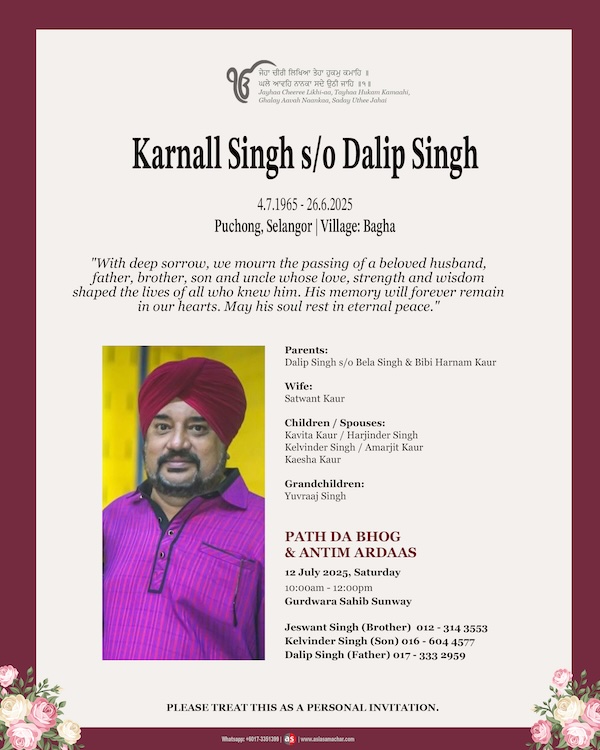
Karnall Singh Dalip Singh (1965 – 2025), Puchong

Karnall Singh s/o Dalip Singh

4.7.1965 – 26.6.2025

Puchong, Selangor | Village: Bagha

“With deep sorrow, we mourn the passing of a beloved husband, father, brother, son and uncle whose love, strength and wisdom shaped the lives of all who knew him. His memory will forever remain in our hearts. May his soul rest in eternal peace.”

Parents: Dalip Singh s/o Bela Singh & Bibi Harnam Kaur

Wife: Satwant Kaur

Children / Spouses:
Kavita Kaur / Harjinder Singh
Kelvinder Singh / Amarjit Kaur
Kaesha Kaur

Grandchildren: Yuvraaj Singh

PATH DA BHOG
12 July 2025, Saturday
10:00am – 12:00pm
Gurdwara Sahib Sunway

Contact:
Jeswant Singh (Brother) 012 – 314 3553
Kelvinder Singh (Son) 016 – 604 4577
Dalip Singh (Father) 017 – 333 2959

Link to posting at Facebook and Instagram; Updated Facebook and Instagram

| Entry: 27 June 2025; Updated: 28 June 2025 | Source: Family

ASIA SAMACHAR is an online newspaper for Sikhs / Punjabis in Southeast Asia and beyond. You can leave your comments at our website, FacebookTwitter, and Instagram. We will delete comments we deem offensive or potentially libelous. You can reach us via WhatsApp +6017-335-1399 or email: asia.samachar@gmail.com. For obituary announcements, click here

Is Malaysia Safe? A Nation in Mourning and Reflection After the Tragic Death of Manishapriet Kaur Akhara

0
A Nation in Mourning and Reflection After the Tragic Death of Manishapriet Kaur Akhara

By Dr. B. S. Bains | Opinion |

Malaysia, known for its diverse culture, warm hospitality, and modern ambitions, is today grappling with a question that has shaken the very conscience of the nation: Is Malaysia safe?

This pressing concern has been brought into heartbreaking focus by the recent murder of 20-year-old Manishapriet Kaur Akhara, an aspiring physiotherapy student who had just stepped into the threshold of her dreams. She had chosen a noble path — to heal, to care, and to contribute to Malaysia’s healthcare system. But her journey was cut short in the very place that was meant to protect and nurture her — her university dormitory in Cyberjaya.

A Place Meant for Safety, Not Horror

University campuses are sanctuaries — spaces that should represent opportunity, growth, and security. When a student entrusts her life to such an institution, when parents hand over their children to academic institutions, they do so with an unspoken trust. That trust has now been shattered. Manishapriet was violated and brutally killed in her own dorm — a space that should have been off-limits to danger.

This wasn’t just a crime. It was a breach of societal duty, institutional responsibility, and national safety.

Not Just One Girl — A Symbol of Many

Manishapriet’s story is not isolated. Her death is a harrowing reminder that gender-based violence continues to haunt our society. That women — even in the most seemingly secure spaces — are vulnerable to the worst horrors imaginable.

She wasn’t just a victim. She was a daughter, a dreamer, a healer in the making. Her life mattered. Her voice is now forever silenced, but her story must not be.

Is Malaysia Safe?

This is the question echoing across every parent’s heart, every student’s mind, and every concerned citizen’s conscience. Safety is not simply about reducing crime statistics — it’s about creating a culture where crimes like this are unthinkable.

Malaysia has achieved much in infrastructure, education, and global partnerships — but have we lost our moral fabric in the process? Are our surveillance systems effective? Are background checks stringent enough? Are mental health red flags being ignored? Are female students safe when lights go out and doors lock?

These are not questions to be postponed. These are questions to which answers must be demanded, and actions must follow.

Accountability Must Follow Tragedy

Manishapriet’s murder should not dissolve into another media headline. The institution must take responsibility for every security failure. Authorities must ensure justice is swift, transparent, and uncompromising. The Ministry of Higher Education and the Ministry of Women, Family and Community Development must conduct urgent audits of all student accommodations across the country.

The suspect or suspects must be prosecuted to the fullest extent of the law, and systemic negligence must be penalized.

A National Wake-Up Call

This is no longer just about one university or one young woman. This is a national wake-up call.

  • Parents deserve transparency.
  • Students deserve protection.
  • Women deserve respect and safety — always and everywhere.

If Malaysia is to move forward as a modern, just society, it must begin by protecting its most vulnerable. We must all — as citizens, lawmakers, educators, and professionals — ask ourselves: What kind of country are we building?

A Candle That Must Not Burn Alone

Let us not allow Manishapriet’s dreams to die with her. Let this tragedy ignite reforms. Let her name echo in policy rooms and reform committees. Let her memory shape a safer, more compassionate Malaysia.

Because only then can we begin to answer — with honesty and resolve — the question that now haunts us all: Is Malaysia safe?

May Manishapriet Kaur Akhara rest in peace. And may her story awaken a nation.

THE ARTICLE WAS ALSO SHARED AT ASIA SAMAACHAR FACEBOOK AND INSTAGRAM

Dr Balwant Singh Bains is a Malaysia-based kirtan enthusiast and a practicing physiotherapist with a chain of physiotherapy clinics.

RELATED STORY:

Significance of Chaur Sahib (Asia Samachar, 22 Feb 2025)

ASIA SAMACHAR is an online newspaper for Sikhs / Punjabis in Southeast Asia and beyond. You can leave your comments at our website, FacebookTwitter, and Instagram. We will delete comments we deem offensive or potentially libelous. You can reach us via WhatsApp +6017-335-1399 or email: asia.samachar@gmail.com. For obituary announcements, click here

Daya Singh Singara Singh (1950 – 2025), Ex-MAS

Daya Singh s/o Singara Singh

8.11.1950 – 25.6.2025

(ex-MAS)

It is with heavy hearts that we announce the passing of Sardar Daya Singh.
A man of great warmth, generosity and gentle humour.
A dedicated and loving husband of the late Sardani Suvinder Kaur.
His love, kindness and laughter will be remembered always and deeply missed by family, friends, and all whose lives he touched.

Fondly remembered by family:

Children & Spouses:
Kiran & Raj, Harjeet & Ramindar,
Sharen & Jaspal, Kawal & Vish

Grandchildren: Hameeshya, Aadeesh, Jaidev, Gulveer, Arjan

We would like to extend our heartfelt thanks to all his siblings, relatives and friends for their love, care, and unwavering support during this difficult time.

Please join us in offering prayers for the departed soul, and in cherishing the memories that will forever remain in our hearts.

WAKE AND CREMATION SERVICE
28 June, 2025, Saturday
10 am – 12 noon
Shamshaan Bhoomi, Jalan Loke Yew Crematorium, Kuala Lumpur

PATH DA BHOG
5 July, 2025, Saturday
10 am – 12 noon
Gurdwara Sahib Ampang (Ulu Kelang)

Prem S. 019 – 227 8747
Jaspal S. 016 – 668 5077

Link to posting at Facebook and Instagram

| Entry: 26 June 2025 | Source: Family

ASIA SAMACHAR is an online newspaper for Sikhs / Punjabis in Southeast Asia and beyond. You can leave your comments at our website, FacebookTwitter, and Instagram. We will delete comments we deem offensive or potentially libelous. You can reach us via WhatsApp +6017-335-1399 or email: asia.samachar@gmail.com. For obituary announcements, click here

Uncontrolled immigration threatens social harmony in UK

UK immigration – Photo: Centre for Policy Studies

By Gurmukh Singh | Opinion |

Successive governments have tried to control immigration but that has not worked. There are daily reports of boats crossing the English Channel with hundreds of migrants arriving with greater frequency. Right wing politicians argue that these migrants threaten to destroy your quality of life.

A report by the Centre for Policy Studies, argues that the scale and composition of recent migration have failed to deliver the significant economic and fiscal benefits its advocates promised, while putting enormous pressure on housing, public services and infrastructure. According to Home Office figures, the annual asylum cost reached £3.96 billion in the year up to 2023 double that of the previous year and six times higher than 2018.

One, rather selective, analysis showed that 17 councils are accommodating up to 10 times more asylum seekers than ‘local’ homeless people. About seven million people from very diverse backgrounds arrived in the UK in the last two decades. Directly or indirectly, this is the result of uncontrolled mass immigration. Such reports and rumours, depending on the sources, do not inspire much public confidence in the border control system and encourage extreme right-wing politics. International asylum laws are being questioned.

It cannot be denied that there is now visible negative impact of mass migration on smooth integration, community cohesion, education, health, housing and other services. Right wing Reform Party is gaining political ground while public opposition to mass immigration is growing.

Yet, UK is a country of immigrants. It is not so much the statistics but visible evidence around us which tells us that uncontrolled immigration is beginning to cause serious environmental and socio-political problems. For example, within an area of about 500 yards square next to the Southall Railway station and Sri Guru Singh Sabha, Park Avenue Gurdwara, there are about 10 high-rise flats being built. Each block is about 25 to 30 floors high. With average families of four, that gives us at least four to five thousand men women and children in an over-congested area.

Most of those who have been allocated these flats so far, are people from very different cultures, creeds and countries. It is unlikely that many can speak fluent English. They need interpreters at hospitals and when using public services. So, issues about employment, education, health and smooth integration into the British way of life and values are raised with justification. Mass immigration has made gradual integration impossible. That has prevented successful integration.

When earlier immigrants arrived in the UK, they made special effort to adjust to the British way of life. They looked around and learnt. They worked hard and were known to be law-abiding. Those who were better educated, moved on from menial jobs to work with potential for progress. They did not preach extreme ideologies. They brought up well educated children. They did not throw litter in the streets!

Today, earlier generations are seeing a very different environment and social behaviour in areas affected by mass immigration which has not allowed for smooth integration.

We are looking for security and social harmony in our daily lives. Social harmony has been described as a state of peaceful and cooperative coexistence within a society, characterized by mutual respect, understanding, and a sense of unity among its members. It is essential for a sense of belonging and good and stable inter-community relations in a plural society in which diversity is celebrated.
Only regulated migration will ensure social harmony.

Gurmukh Singh OBE, a retired UK senior civil servant, chairs the Advisory Board of The Sikh Missionary Society UK. Email: sewauk2005@yahoo.co.uk. Click here for more details on the author. The article first appeared at Panjab Times, UK

* This is the opinion of the writer, organisation or publication and does not necessarily represent the views of Asia Samachar.

RELATED STORY:

1984: When Darbar Sahib became enemy territory (Asia Samachar, 5 June 2025)

ASIA SAMACHAR is an online newspaper for Sikhs / Punjabis in Southeast Asia and beyond. You can leave your comments at our website, FacebookTwitter, and Instagram. We will delete comments we deem offensive or potentially libelous. You can reach us via WhatsApp +6017-335-1399 or email: asia.samachar@gmail.com. For obituary announcements, click here

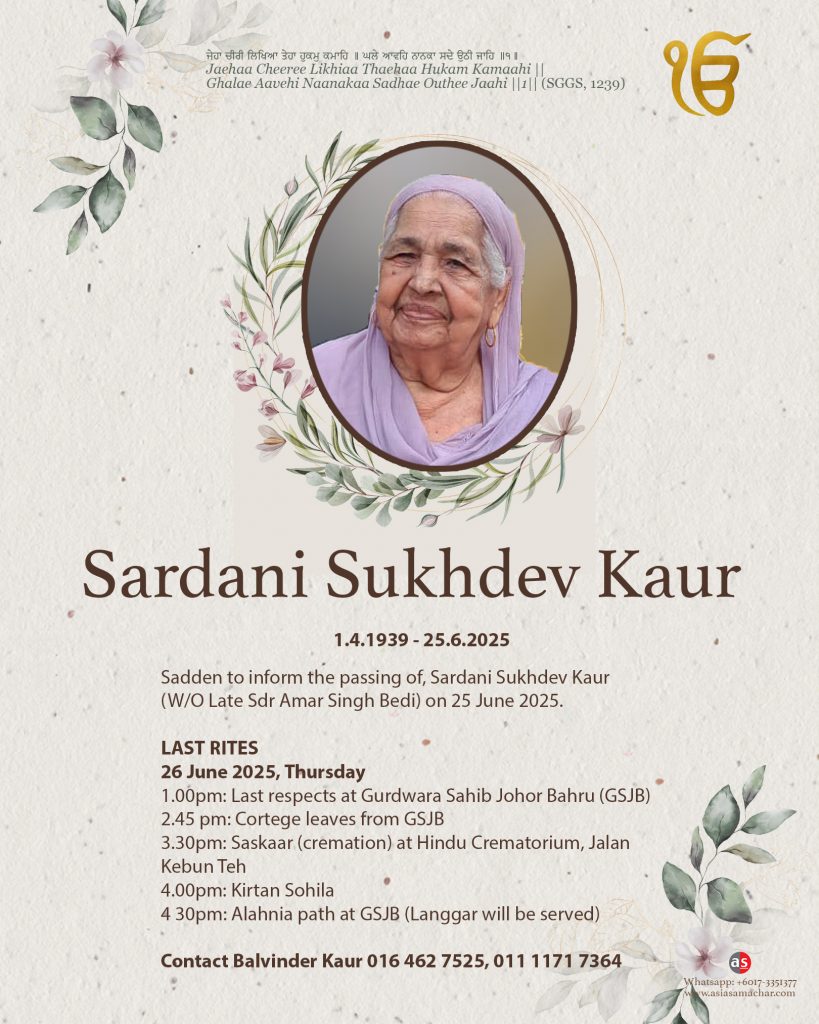
Sardani Sukhdev Kaur (1939 – 2025), Johor Bahru

Sardani Sukhdev Kaur

1.4.1939 – 25.6.2025

Sadden to inform the passing of, Sardani Sukhdev Kaur (W/O Late Sdr Amar Singh Bedi) on 25 June 2025.

LAST RITES
26 June 2025, Thursday
1.00pm onwards: Last respects at Gurdwara Sahib Johor Bahru (GSJB)
2.45 pm: Cortege leaves from GSJB
3.30pm: Saskaar (cremation) at Hindu Crematorium, Jalan Kebun Teh
4.00pm: Kirtan Sohila
4 30pm: Alahnia path at GSJB
Langgar will be served at GSJB

Contact: Balvinder Kaur 016 462 7525, 011 1171 7364

Link to posting at Facebook and Instagram

| Entry: 26 June 2025 | Source: Family

ASIA SAMACHAR is an online newspaper for Sikhs / Punjabis in Southeast Asia and beyond. You can leave your comments at our website, FacebookTwitter, and Instagram. We will delete comments we deem offensive or potentially libelous. You can reach us via WhatsApp +6017-335-1399 or email: asia.samachar@gmail.com. For obituary announcements, click here

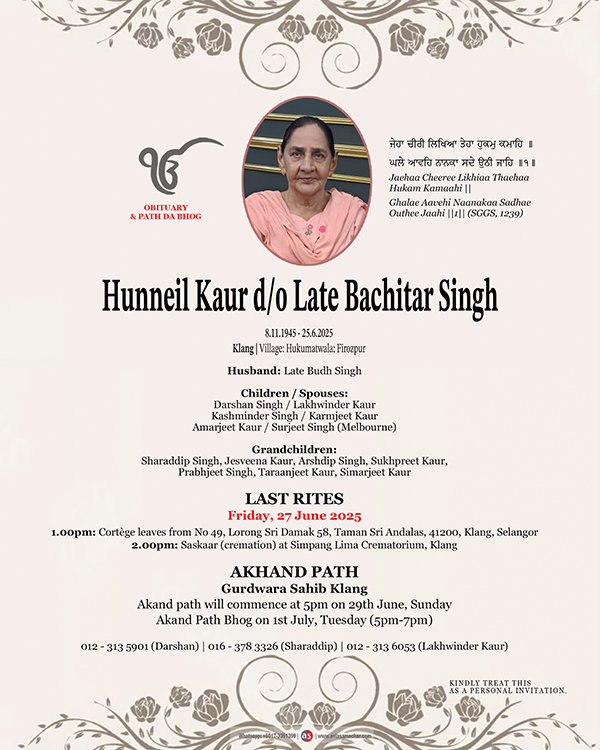
Sardarni Hunneil Kaur (1945 – 2025), Klang

HUNNEIL KAUR D/O LATE BACHITAR SINGH

8.11.1945 – 25.6.2025

Klang | Village: Hukumatwala; Firozpur

Husband: Late Budh Singh

Children / Spouses:
Darshan Singh / Lakhwinder Kaur
Kashminder Singh / Karmjeet Kaur
Amarjeet Kaur / Surjeet Singh (Melbourne)

Grandchildren:
Sharaddip Singh
Jesveena Kaur
Arshdip Singh
Sukhpreet Kaur
Prabhjeet Singh
Taraanjeet Kaur
Simarjeet Kaur

LAST RITES
Friday, 27 June 2025
1.00pm: Cortège leaves from No 49, Lorong Sri Damak 58, Taman Sri Andalas, 41200, Klang, Selangor
2.00pm: Saskaar (cremation) at Simpang Lima Crematorium, Klang

AKHAND PATH
Gurdwara Sahib Klang
29 June (Sunday) to 1 July (Tuesday)
Akand path will commence at 5pm on 29th June, Sunday
Akand Path Bhog on 1st July, Tuesday (5pm-7pm)

Contact:
012 – 313 5901 (Darshan)
016 – 378 3326 (Sharaddip)
012 – 313 6053 (Lakhwinder Kaur)

Link to posting at Facebook and Instagram

| Entry: 25 June 2025 | Source: Family

ASIA SAMACHAR is an online newspaper for Sikhs / Punjabis in Southeast Asia and beyond. You can leave your comments at our website, FacebookTwitter, and Instagram. We will delete comments we deem offensive or potentially libelous. You can reach us via WhatsApp +6017-335-1399 or email: asia.samachar@gmail.com. For obituary announcements, click here
Maniishapriet Kaur Akhara (2005-2025) Kuching, Sarawak

Maniishapriet Kaur Akhara

17.10.2005 – 24.6.2025

Kuching, Sarawak | Village: Akhara

A devoted daughter, a caring sister and much loved and cherished granddaughter, niece and cousin. Very much loved by everyone who knows her and shall forever be remembered and her memory etched in our hearts.

Parents: Terjinder Singh Akhara & Hervinder Kaur

Grandparents:
Late Jail Singh Akhara & Madam Jaswant Kor (Paternal)
Late Hajura Singh Brar & Late Tejinder Kaur (Maternal)

Brother: Jasdeep Singh Akhara
Sister: Bhavinjit Kaur Akhara

Tayaji & Tayiji, Mamaji & Mamiji, Masijis & Maserjis, Phuajis & Phuperjis and cousins

PATH DA BHOG
Gurdwara Sahib Kuching
Saturday, 5 July 2025
(Note: The date has been changed)
9.30am to 12noon

Jasdeep 019 818 8342 | Hardip 012 799 3161
Malkit 013 366 4538

Link to posting at Facebook and Instagram; Updated at Facebook and Instagram

| Entry: 25 June 2025; Updated 29 June 2025 | Source: Family

ASIA SAMACHAR is an online newspaper for Sikhs / Punjabis in Southeast Asia and beyond. You can leave your comments at our website, FacebookTwitter, and Instagram. We will delete comments we deem offensive or potentially libelous. You can reach us via WhatsApp +6017-335-1399 or email: asia.samachar@gmail.com. For obituary announcements, click here
Sardar Hari Singh Chehal (1935 – 2025) EX-LLN / TNB

SARDAR HARI SINGH CHEHAL

(1935 – 2025) EX-LLN / TNB
Village: Alisher, Mansa, India

With profound grief & sorrow, we inform the passing of our beloved father
HARI SINGH CHEHAL. He passed away peacefully at home. He leaves behind
a legacy of love, warmth & loads of wisdom.

Deeply and fondly remembered by family;

Wife: HARJINDER KAUR

Children / Spouses
Amarjit Singh & Suria Kumari
Jagjit Singh & Kulwant Kaur
Malkit Singh & Harbhajan Kaur
Kuldeep Singh & Amardeep Kaur
Charanjit Singh & Jit Kaur

Grandchildren/Spouses
Gurjit Singh & Baljinder Kaur
Baljit Singh & Pari Kaur
Manmohanjit Singh
Sohanjit Singh
Raveena Kaur & Baaljinder Singh
Manisha Jit Kaur
Dheshraj Singh
Dheshwin Kaur
Ajay Harveen Singh
Previnjit Kaur
Dheshpreet Kaur

Great Grand Child
Anaiyrareet Kaur

SASKAR / CREMATION
DATE: 27th June 2025 (Friday)
TIME: 1pm
LOCATION: NIRVANA Memorial Park Shah Alam (Jalan Pusaka 21/1, Off Persiaran Jubli Perak, Seksyen 21, 40300 Shah Alam)

Cortege leaves from residence at 12 noon:
(17, Jln Anggerik Eria 31/111, Kota Kemuning 40460 Shah Alam)

Path Da Bhog: To-Be-Confirmed

CONTACT
Jagjit : 019 270 2489
Malkit : 012 233 6372
Charanjit : 012 217 7049

We request everyone to join us in offering prayers of peace for the departed soul.
With love from the Chehal family

Link to posting at Facebook and Instagram

| Entry: 25 June 2025 | Source: Family

ASIA SAMACHAR is an online newspaper for Sikhs / Punjabis in Southeast Asia and beyond. You can leave your comments at our website, FacebookTwitter, and Instagram. We will delete comments we deem offensive or potentially libelous. You can reach us via WhatsApp +6017-335-1399 or email: asia.samachar@gmail.com. For obituary announcements, click here