





















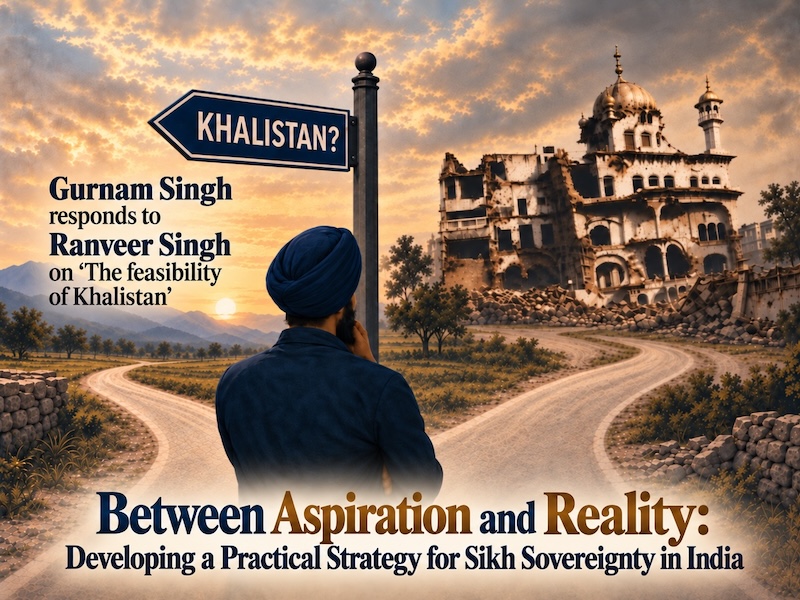
By Gurnam Singh | Opinion |
I am grateful to Ranveer Singh for engaging so thoughtfully with my article, The Feasibility of Khalistan: A Critical Assessment, published in Asia Samachar (Aug 26, 2026). His response, Realism According to Whom? A Response to “The Feasibility of Khalistan”, first appeared on his Substack before being republished in Asia Samachar (Sept 7, 2026).
As a respected author and publisher, I would have expected nothing less than a serious and challenging engagement with the arguments I presented. Given the significance of the issues at stake, and recognising that no individual possesses either the authority or the wisdom to pass final judgement on the question of Sikh sovereignty, such scrutiny is both welcome and necessary. Indeed, it is my hope that our exchange encourages others to examine these issues critically and contributes to a broader discussion about the future of Sikh aspirations for sovereignty and self-determination.
Problematising the Framing of the Khalistan Narrative
With few exceptions, much of the literature critiquing the Khalistan movement has been produced by scholars, commentators, journalists and policymakers who, for ideological, political or personal reasons, have been sceptical of, or openly hostile towards, the idea of an independent sovereign Sikh state. As a consequence, the movement has often been analysed through a predominantly security-oriented lens rather than as a political project rooted in questions of self-determination, minority rights, federalism, state violence and historical grievance.
Opposition to Khalistan has frequently been framed through narratives of “extremism”, “terrorism”, “religious fanaticism”, “gangsterism” and foreign conspiracy, portraying Sikh demands for sovereignty as irrational, dangerous or externally manipulated rather than as a legitimate, if contested, expression of political aspiration.
This framing is evident in both academic and public discourse. Studies of the Sikh insurgency in Punjab during the 1980s and 1990s, for example, have often focused overwhelmingly on militant violence while devoting comparatively less attention to the political circumstances that contributed to the conflict, including human rights abuses and, many would argue, acts amounting to state-sponsored violence against Sikhs. Similarly, contemporary discussions of pro-Khalistan activism in the diaspora frequently emphasise concerns about radicalisation, criminal networks or foreign interference, while paying less attention to why demands for Sikh self-determination continue to resonate among many Sikhs in Punjab and across the diaspora decades after the insurgency formally ended.
This asymmetry between Indian state narratives and those of Sikh activists becomes particularly visible when comparisons are made with other nationalist and self-determination movements. Political aspirations for Kurdish statehood, Palestinian sovereignty, Scottish independence, and Catalan, Irish or Québécois nationalism are generally studied as political phenomena worthy of critical examination, regardless of whether scholars support their objectives. By contrast, Khalistan has often been approached as a security problem to be managed rather than a legitimate political claim to be interrogated. This tendency has narrowed the scope of inquiry, leading researchers to focus on the consequences of the movement rather than the social, historical and political conditions that gave rise to it.
Against the backdrop of such a sustained assault on the legitimacy of the Khalistan case, it is understandable why advocates of Khalistan may be reluctant to discuss the efficacy or limitations of the project itself. However, all political movements require critical self-analysis if they are to develop and mature. Simply refusing to confront difficult questions is not a viable option.
Ideally, a more comprehensive scholarship would examine both the movement’s critics and its proponents, situating the movement within broader debates on nationalism, sovereignty, decolonisation, diaspora politics and the rights of minorities to political self-determination. Such an approach would neither romanticise nor demonise the movement; it would be to seek to understand it as a complex historical and political phenomenon.
It was precisely the desire to challenge the polarisation surrounding this debate and to encourage a more balanced evaluation of the movement that motivated my original article and, indeed, this response to Ranveer Singh’s critique. It is my sincere hope that together we can create a space for this kind of engagement within Sikh intellectual and political circles. As someone who values reason and critical thinking, I remain convinced that open, rigorous and respectful dialogue offers the best route towards advancing both the interests of the Panth and the broader aspiration for sovereignty.
The Essence of the Argument
In his critique, Ranveer Singh begins by commending me for “starting the conversation”. Given that discussions concerning Khalistan, or more broadly Sikh sovereignty, can be traced back at least to the establishment of the Khalsa in 1699, I assume he meant initiating a conversation about the movement in its contemporary form.
Indeed, he qualifies his own position by noting that the present-day case for Khalistan “has its own historical form” and that Sikh resistance to external domination did not begin in 1984. I entirely agree that contemporary political questions must be understood through their deeper historical antecedents. Nevertheless, the purpose of my original article was not to offer a comprehensive historical exegesis, but rather to provide an assessment of the movement’s present circumstances and possible options to advance the struggle for Sikh sovereignty.
A significant difficulty I have with Ranveer Singh’s critique is his tendency to move the discussion away from material realities facing the struggle and into the realm of ideas and, at times, the metaphysical. This is perhaps most evident in his invocation of Indic cosmology through the concept of Kaljug as a counterpoint to what he regards as the limitations of the modern nation-state.
Certainly, questions of ontology, epistemology, power and morality are relevant to any discussion of sovereignty. However, my analysis proceeded from the assumption that the contemporary Khalistan movement, as articulated by many of its advocates, broadly seeks a form of sovereignty recognisable within the existing international system. I recall during the early 1980’s advocates of Khalistan, most notably Dr Jagjit Singh Chauhan, Ganga Singh Dhillon, Balbir Singh Sandhu, Kirpal Singh Sihra and Sewa Singh Lali, producing symbols of a nation state, such as passports, currency, flags, possible constitutions, maps embassies and a government in exile. My frame of reference was therefore the modern democratic nation-state, understood through these aspirations and a widely accepted UN based criteria, including those codified in the 1933 Montevideo Convention on the Rights and Duties of States.
According to these criteria, a state requires a permanent population, a defined territory, an effective government and the capacity to enter into relations with other states. Ranveer Singh’s observation that my argument operates largely within this framework is therefore entirely correct.
Unlike Ranvir Singh’s approach, which draws heavily upon concepts such as Guru Khalsa Panth, Halemi Raj and Patshahi, my concern was with the practical realities of state formation and international recognition. As a Sikh, I fully acknowledge the importance of Sikh scripture, history and political philosophy in shaping the values and institutions of any future Sikh polity. However, I would argue that the establishment of a viable state cannot ignore the international structures within which all contemporary states operate.
Straw-Man Arguments and Divergent Meanings
It is this divergence between a focus on contemporary political realities and a focus on theological ideals that renders much of our disagreement less substantive than it initially appears.
In this regard, I feel elements of Ranveer Singh’s critique exhibit characteristics of a straw-man argument. A straw man occurs when a person’s position is reframed into something they did not argue, and that substituted position is then criticised. For example:”I oppose creating an independent Sikh state because I believe a more practical route to protecting Sikh rights is to work within existing constitutional frameworks.” A straw-man response might be: “So you are saying Sikhs do not deserve sovereignty.” The latter does not engage with the original claim about political strategy. Instead, it substitutes an argument about the legitimacy of Sikh sovereignty itself.
Having read Ranveer Singh’s critique carefully, I have concluded that our disagreement is not principally about evidence. Rather, it concerns the meaning or if you like conceptualisation of Khalistan itself. My article examined the feasibility of establishing an independent, territorially defined and internationally recognised Sikh state. It asked a relatively straightforward political question: given current demographic, geopolitical, economic and diplomatic realities, how likely is the emergence of such a state?
My conclusion was that, under present conditions, the prospects of such an outcome are extremely remote. Consequently, I suggested consideration of alternative and potentially more achievable avenues toward greater Sikh autonomy or khudh mukhtiari.
Ranveer Singh, by contrast, appears to understand Khalistan largely through concepts such as Halemi Raj, Begampura and Sikh political theology. Within this framework, Khalistan functions less as a conventional nation-state and more as a moral, spiritual and civilisational horizon.
That is an entirely legitimate and intellectually rich project. It is simply not the project that my article sought to evaluate. The distinction matters because moral aspiration and political feasibility are not the same thing. History contains many examples of noble political visions that either failed to materialise, collapsed under internal contradictions or evolved into forms vastly different from what their original advocates intended.
The challenge for any political project is not simply to articulate an ideal, but to demonstrate how that ideal can be realised within the constraints of historical, political and human realities.
Critical Realism and Political Idealism
Ranveer Singh accepts my emphasis on the importance of strong Sikh institutions. However, our methodological differences remain substantial.
My own position is grounded in political realism and critical realism. These approaches recognise the significance of values, beliefs and aspirations while insisting that they operate within objective social, political and economic structures. They seek to understand how power actually functions and how political outcomes emerge from identifiable causal mechanisms.
Ranveer Singh’s position is closer to political idealism. It begins with a vision of what Sikh sovereignty ought to be and evaluates existing realities against that benchmark. This approach undoubtedly offers inspiration and moral direction. Yet it also risks conflating desirability with feasibility.
When Ranveer Singh argues that sovereignty emerges through the Panth’s collective orientation towards Gurmat, expressed through institutions that place the Panth in opposition to the Indian state, he effectively links Khalistan and Gurmat as inseparable concepts.
While appealing, this raises important questions. Who determines what constitutes Gurmat in practice? How are competing interpretations adjudicated? What distinguishes such claims from similar appeals by adherents of other religions who seek to organise political life around their own theological commitments? A cursory scan of the conflict we have within Sikh religious institutions that are in theory directly run according to Gurmat should serve as a reminder of the challenge one faces in bridging theology with reality.
To identify structural obstacles to Sikh sovereignty is not to reject Sikh aspirations, nor is it to legitimise the Indian state. Rather, it is to ask what political, institutional and material conditions would actually be necessary for sovereign statehood to emerge. A political project does not become feasible simply because it is morally compelling. Equally, acknowledging present realities does not imply accepting them as just.
Legitimacy and Feasibility Are Not the Same Thing
A recurring theme in Ranveer Singh’s response is the suggestion that by acknowledging India’s territorial control, military strength and international recognition, I am somehow accepting the legitimacy of Indian sovereignty over Punjab. This does not follow!
Legitimacy and feasibility are analytically distinct concepts. One may believe that a political order is morally illegitimate while simultaneously recognising the formidable obstacles involved in overturning it. Colonial regimes, apartheid systems and military occupations have all generated such tensions throughout history.
Sikh history itself provides useful examples. Although Sikhs were frequently in conflict with the Mughal Empire, this did not prevent Guru Arjan from maintaining cordial relations with Emperor Akbar, nor Guru Gobind Singh from supporting Bahadur Shah during a succession struggle. Such examples suggest that the Gurus understood political strategy in highly pragmatic terms.
My article therefore examined factors such as demographics, geopolitics, international recognition and political support not to determine moral legitimacy, but to understand the conditions under which sovereignty movements succeed or fail.
Many movements have enjoyed substantial moral legitimacy without achieving political success. Conversely, many states have exercised effective political power without enjoying widespread moral legitimacy. These are historic realities that one cannot escape.
The Problem of Halemi Raj as a Political Blueprint
Perhaps our most significant disagreement concerns the concept of Halemi Raj. I fully accept that Halemi Raj, Begampura and related concepts constitute rich ethical resources within Sikh political thought. They offer profound reflections on justice, equality, power, human flourishing and ethical living.
However, they do not in themselves provide a concrete programme of state formation. These concepts remain open to interpretation. Different Sikh scholars, institutions and movements have understood them in different ways. They do not yield a singular, uncontested model of governance.
More importantly, they do not answer practical questions concerning constitutional arrangements, territorial boundaries, citizenship, personal liberty, minority rights, economic governance, resource allocation, , foreign policy or international law.
A critical realist approach therefore requires a distinction between normative ideals and political programmes. To treat Halemi Raj as though it already constitutes a fully elaborated model of sovereignty risks confusing an ethical aspiration with a practical blueprint.
Indeed, if Halemi Raj, rather than statehood, is the primary objective, then the debate shifts away from the feasibility of Khalistan as an independent state and towards the desirability of a moral and spiritual order.
The broader point is that political projects grounded in universal moral ideals frequently encounter tensions between their universal aspirations and their territorial expression. That tension deserves serious consideration in any discussion of Khalistan.
Interpreting Patshahi Dava
Similar issues arise in relation to Patshahi Dava, the assertion of sovereign authority derived from the principle of Miri-Piri.
This principle was given institutional form by Guru Gobind Singh Ji in 1699 through the creation of the Khalsa. Sovereignty was vested not in a monarch but in the collective body of the Sikhs. Legitimate authority derived from the Divine rather than from temporal rulers.
This understanding acquired a more explicit political character during the eighteenth century. The Khalsa’s refusal to submit to Mughal and Afghan domination provided an ideological foundation for the state-building efforts of Banda Singh Bahadur, the Sikh Misls and eventually Maharaja Ranjit Singh’s empire.
Yet contemporary invocations of Patshahi often assume a degree of historical clarity that simply does not exist. The Guru Granth Sahib , for example, does not provide a detailed constitutional theory of governance. Much of what is understood today as Sikh political sovereignty has emerged through historical interpretation, institutional development and collective memory.
Texts such as Rattan Singh Bhangu’s Prachin Panth Parkash have played a significant role in shaping contemporary understandings of sovereignty, but historians have long debated the relationship between historical fact, memory, political advocacy and mythic reconstruction within such works.
This is not to diminish their importance. It is simply to recognise that appeals to Patshahi are themselves acts of interpretation. There is no single, uncontested Sikh theory of sovereignty waiting to be recovered from the past. There are multiple interpretations, shaped by distinct historical, theological and political assumptions.
Indeed, Sikh history cautions against romanticising political sovereignty. Disputes surrounding Banda Singh Bahadur and resistance from certain Cis-Sutlej states to Maharaja Ranjit Singh’s expansion remind us that Sikhs themselves have often disagreed over the meaning of legitimate Sikh rule.
If that was true historically, it is reasonable to ask why a future Khalistan would be immune from similar tensions and contradictions.
The Anandpur Sahib Resolution Revisited
Ranveer Singh is particularly sceptical of my suggestion that aspects of the Anandpur Sahib Resolution may offer a more realistic pathway than outright statehood.
It is certainly true that many of its demands have been pursued before and that the Indian state’s response to Sikh political aspirations has frequently been disappointing and, at times, deeply repressive. However, the failure of constitutional reform in one historical period does not logically demonstrate its impossibility in another.
History is replete with examples of reforms once dismissed as unrealistic that later became politically achievable as circumstances changed. My argument is therefore not that federalism is guaranteed to succeed. Rather, it is that greater autonomy, enhanced fiscal powers and stronger Sikh institutions currently appear more attainable than outright secession.
One may disagree with that assessment, but it remains an empirical question rather than a theological one.
Conclusion
The debate between Ranveer Singh and myself is therefore not fundamentally about whether Sikh sovereignty is desirable, nor about the enduring relevance of Sikh political thought. Rather, it concerns how the question of Khalistan should be framed and assessed in the present moment.
My article sought to examine Khalistan as a concrete political project: an independent, territorially defined and internationally recognised Sikh state. Viewed through that lens, questions of demographics, geopolitics, economics, institutional capacity and international recognition become unavoidable.
Ranveer Singh’s response approaches the issue from a different direction, emphasising Khalistan as an expression of Sikh political theology rooted in concepts such as Halemi Raj, Begampura and Patshahi. These are profound and important traditions of thought, but they address a somewhat different set of questions.
Both perspectives have value. Political movements require moral vision, but they also require an honest assessment of the conditions within which they operate. Aspirations without strategy risk becoming utopian; strategy without ideals risks becoming directionless. The challenge for the Panth is not to choose between these perspectives but to bring them into productive dialogue.
Ultimately, if Sikh sovereignty is to remain a meaningful political aspiration rather than merely a symbolic ideal, it must be able to withstand rigorous scrutiny, critical reflection and open debate. Such debate should not be feared. On the contrary, it is through intellectual honesty, collective self-examination and respectful disagreement that political movements develop the clarity, resilience and strategic imagination necessary to advance their goals.
Join the conversation on this story on Asia Samachar’s Facebook and Instagram pages.

Gurnam Singh is an academic activist dedicated to human rights, liberty, equality, social and environmental justice. He is a Professor of Sociology at University of Warwick, UK. He can be contacted at Gurnam.singh.1@warwick.ac.uk
* This is the opinion of the writer and does not necessarily represent the views of Asia Samachar.
RELATED STORY:
Forty-two years after Blue Star: How 1984 transformed the Sikh struggle (Asia Samachar, 7 June 2026)
ASIA SAMACHAR is an online newspaper for Sikhs / Punjabis in Southeast Asia and beyond. You can leave your comments at our website, Facebook, Twitter, and Instagram. We will delete comments we deem offensive or potentially libelous. You can reach us via WhatsApp +6017-335-1399 or email: asia.samachar@gmail.com. For obituary announcements, click here