














By Daljit Singh Khalsa | Experience |
There are places on this earth that we visit, and there are places that seem to have been waiting for us long before we arrived.
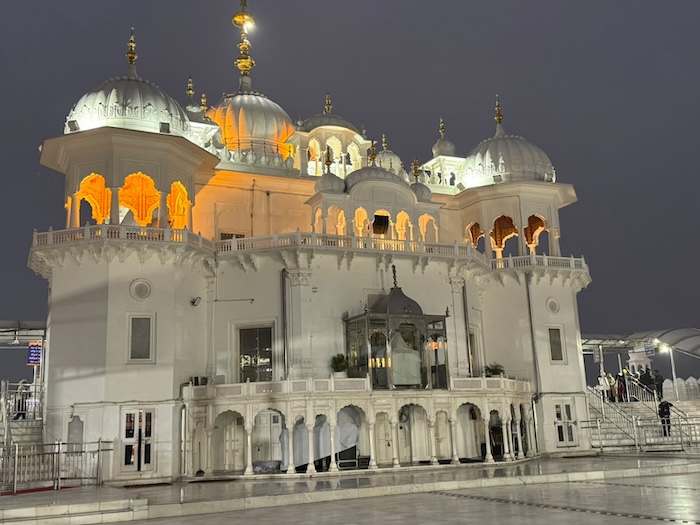
Takhat Sri Keshgarh Sahib is such a place.
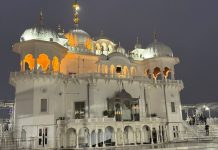
On a radiant morning in Anandpur Sahib, beneath a sky washed in sunlight, I walked towards the sacred Takhat with a feeling difficult to put into words. The morning was alive, yet beneath its movement lay a stillness — a quietness that seemed to belong not merely to the present moment, but to the centuries that had passed through this sacred land.
Yet its grandeur was not merely architectural. Its true magnificence lay in what had unfolded here. For this is not simply a place associated with history. This is where history was transformed into destiny. This is where the Khalsa was awakened. This is where Guru Gobind Singh Ji gave visible form to an ideal that had been gathering spiritual force through the centuries — an ideal of fearless faith, equality, dignity, discipline, compassion and unwavering devotion to truth.
It was here, on Vaisakhi in 1699, that Guru Gobind Singh Ji summoned the Panj Pyaare (the Five Beloved Ones) and administered Khanda-di-Pahul, the Amrit initiation through the double-edged Khanda, inaugurating the Khalsa Panth.
The moment was revolutionary.
The Guru did not ask whether a person was born into privilege or poverty. He did not ask about caste, occupation, region or social standing. He called upon the human being beyond all such boundaries. And those who answered became immortal within the spiritual imagination of humanity:
Bhai Daya Singh Ji.
Bhai Dharam Singh Ji.
Bhai Himmat Singh Ji.
Bhai Mohkam Singh Ji.
Bhai Sahib Singh Ji.
Five men. Five journeys. Five backgrounds. One surrender.
Before the Guru, the distinctions imposed by society dissolved, and a new order emerged — one in which dignity was not conferred by birth, wealth or status, but revealed through character, courage and devotion.
The Panj Pyaare became a living declaration that every human being holds within them the capacity for spiritual greatness.
Their story resonates across centuries because it speaks to something eternal within us.
It asks: What are we willing to surrender when Truth calls? And, perhaps more profoundly: What remains of us once everything superficial has been stripped away?
Standing there, amid the living presence of the Sangat, I felt those questions stir quietly within me. I had not come merely as a traveller. I had come as a seeker. And there is a great difference between the two. A traveller looks at a sacred place. A seeker allows the sacred place to look within him.
The Silence of the Shastars
I was also blessed with darshan (sacred sight) of the revered Shastars (sacred arms) associated with Guru Gobind Singh Ji, preserved here with extraordinary reverence.
They speak of responsibility, courage, protection, sovereignty (the right and duty to govern oneself by righteous principle), and the defence of those who cannot defend themselves.
Each carries its own history, yet together they express a profound principle within the Sikh tradition:
The strength bestowed upon us is not for domination, but for protection.
Courage without compassion can become brutality.
Compassion without courage can become helplessness.
The Sikh ideal demands something more exacting — the union of the two.
What Does It Mean to Be Khalsa?
Perhaps the most profound question that arose within me concerned not the history of the Khalsa, but its meaning for the present.
What does it mean to carry the spirit of the Khalsa today?
It means to possess courage without arrogance. To practise humility without weakness. To serve without seeking applause. To speak truth without hatred. To defend the vulnerable without expecting reward. To remain disciplined when nobody is watching. To recognise the Divine within every human being. To stand for justice without allowing anger to consume the heart.
And to remember that the greatest victory is not victory over another person. It is victory over one’s own ego.
The Khalsa ideal therefore demands an inner revolution as much as an outer one.
And the greatest triumph comes when humility defeats ego, compassion defeats hatred, courage defeats fear, and remembrance defeats forgetfulness.
Where the Soul Surrenders
Takhat Sri Keshgarh Sahib remains, for me, far more than a place of pilgrimage.
For in the presence of the Guru, the heart discovers a truth the world so often makes us forget:
We do not own this life. We are entrusted with it.
And the noblest way to honour that trust is to live with courage, walk with humility, serve with love, remember the Divine, and leave behind a trail of goodness wherever our footsteps fall.
Takhat Sri Keshgarh Sahib — where the soul surrenders, and the Khalsa awakens.
(This is an abridged version of the author’s article)
FOR MORE COMMENTS ON THIS ARTICLE, GO TO ASIA SAMACHAR FACEBOOK AND INSTAGRAM

Daljit Singh Khalsa, a UK-based practitioner with over 50 years of experience in both medical and mental health field, is a devout Sikh and an avid traveller. Physical fitness, spiritual discipline and sewa (selfless service) form the core of my daily practice.
RELATED STORY:
When the soul bowed before the Guru at Hazur Sahib (Asia Samachar, 1 March 2026)
ASIA SAMACHAR is an online newspaper for Sikhs / Punjabis in Southeast Asia and beyond. You can leave your comments at our website, Facebook, Twitter, and Instagram. We will delete comments we deem offensive or potentially libelous. You can reach us via WhatsApp +6017-335-1399 or email: asia.samachar@gmail.com. For obituary announcements, click here