

















LETTER TO THE EDITOR
By A Bold, Dignified and Free-Thinking Woman
(ਇੱਕ ਬੇਬਾਕ, ਸਵੈਮਾਣੀ ਅਤੇ ਆਜ਼ਾਦ ਖ਼ਿਆਲਾਂ ਵਾਲੀ ਨਾਰੀ।)
When I was growing up, I used to hear my aunts in the UK talk about how much gold jewellery they had to give to the mundey wallay (the boy’s side or the groom’s family) during their daughters’ weddings.
It was quite daunting to learn that the dowry system was still being practised in the UK, of all places. Then I realised that the UK had continued receiving fresh waves of migrants, bringing with them traditional beliefs and cultural practices from India.
In Malaysia, I considered Panjabi Sikhs fortunate. After Malaysia gained independence in 1957, there were no longer significant waves of fresh Indian migrants. Although some families continued to arrange marriages for their sons with girls from India, these too dwindled over the years. Hence, I assumed there was little importation of Indian beliefs and customs. Or so I thought.
Sadly, what I failed to realise was that the practice of giving gold jewellery to the groom’s parents and relatives remains very much alive in Malaysia today.
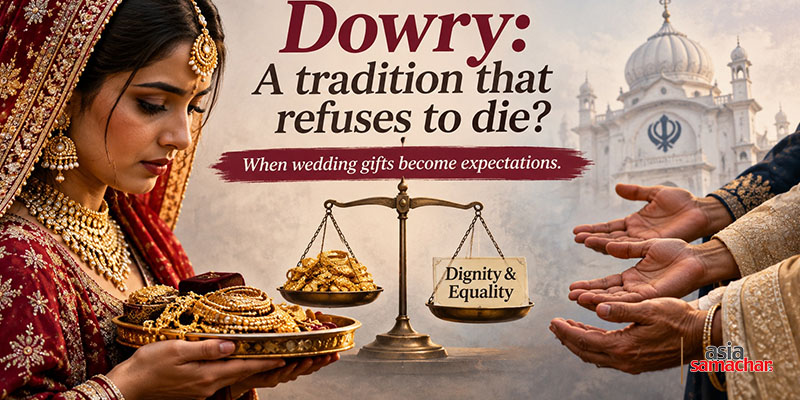
This is done openly during the Milni, the first event on the wedding day at the gurdwara. Male members of the bride’s family meet their counterparts from the groom’s side and exchange greetings, with the bride’s side presenting gifts ranging from inconsequential items like ties to gold jewellery.
The type of gifts may depend on how deep the bride’s father’s pockets are, whether he feels like splurging on this happy occasion, or whether the groom’s family has made specific demands. The number of Milnis would depend on what was negotiated before the wedding.
SEE ALSO: Anand Karaj: A marriage ceremony with a difference
Whenever a close relative got married, I used to wonder why everyone would surge forward during the Milni to secure front-row positions. I usually hung back, my mind already drifting towards breakfast, which would follow soon after. Once the Milni was over, there would be discussions about who received what, which was of little consequence to me.
Besides this open display of gift-giving, there is also a more discreet way of doing things.
I happened to be the chaperone at a niece’s wedding. Just as we were about to leave the bride’s home, her mother handed me a small package containing jewellery for her daughter’s in-laws. I was instructed to pass it to my niece when we arrived at her new home. She would then hand it to her mother-in-law.
FOR MORE ARTICLES ON SIKH MARRIAGES, CLICK HERE
Again, I had no idea whether the mundey wallay had demanded the gold, whether such gifts were simply expected, or whether the bride’s mother wanted to present them out of sheer happiness.
Based on these experiences, I can think of three reasons why families give such gifts:
- The bride’s family is overjoyed that their daughter is getting married, and they have the financial means to be generous.
- It is considered the norm or an accepted practice.
- The groom’s family has made specific demands.
Of these, I would condone the first, but certainly not the second or third. In fact, the third would definitely be a deal breaker for me.
Now, let me share another experience.
A friend’s daughter got married a few years ago. My friend, being rather clueless about these expectations, did not initially realise what was expected of her.
Before the wedding, her daughter’s future mother-in-law requested clothes for her close relatives. That got my friend pretty rattled, but she complied anyway.
Her daughter was well-educated, had a good job and promising career prospects. So I couldn’t understand why my friend had to keep grovelling before the mundey wallay.
The family was already planning to give their daughter a jewellery set, her wedding trousseau and whatever else she wanted.
As is customary, the bride’s family paid for the gurdwara function. Lunch for the janj (the groom’s wedding party) was hosted at a lovely venue, and every effort was made to ensure everyone had a good time.
On the wedding day, there was only one Milni, between the two fathers. My friend’s husband presented the groom’s father with a gift that all of us thought was appropriate, although it was not made of gold.
However, after the dust had settled from the wedding festivities, my friend called me one day with some disturbing news. Her daughter’s in-laws were unhappy that they had not received any gold during the Milni or afterwards.
Until today, I cannot fathom why two pieces of gold jewellery, probably costing RM5,000 to RM6,000 at the time, were of such paramount importance.
What made it even more baffling was that these expectations came from an upper-middle-class family who already enjoyed a luxurious lifestyle.
Against the teachings of our Gurus
All that I have described goes against the philosophy of Guru Nanak.
When Guru Nanak refused to participate in the janeu (sacred thread) ceremony, he challenged the significance of a ritual that was tied to caste and social distinctions. His teachings also upheld the dignity and equality of women. Surely, there is no place in this philosophy for the idea that the mundey wallay are somehow superior, or for the sense of entitlement that some families on the groom’s side seem to enjoy.
Our Gurus also spoke against practices that placed women at a disadvantage.
Guru Amar Das, the third Sikh Guru, challenged oppressive practices such as sati (widow burning) and purdah (the seclusion or veiling of women). He advocated women’s dignity and equality, and the origins of the Sikh marriage tradition, Anand Karaj, are traced to his time.
Guru Ram Das, the fourth Guru, composed the four Laavan (marriage hymns) recited during the Anand Karaj. In Sri Guru Granth Sahib (SGGS, 79), he also rejected the ostentatious display of material dowry as falsehood and ego, declaring Naam to be the true dowry.
There is also a traditional account of Guru Hargobind, the sixth Guru, refusing material dowry when arranging the marriage of his son, the future Guru Tegh Bahadur, to Mata Gujri. The account conveys a simple message: a daughter should not be treated as a financial transaction between families.
The Sikh Rehat Maryada (Sikh code of conduct) is equally clear in rejecting the demand for dowry in marriage. (For SRM English translation, click here).
Yet, despite these teachings, the dowry culture continues in various forms among Sikhs.
Unfortunately, far too many Sikhs in Malaysia and elsewhere seem unaware of, or choose to ignore, the teachings of our Gurus. Instead, they have happily continued practices that place the mundey wallay on a pedestal.
Join the conversation on this story on Asia Samachar’s Facebook and Instagram pages.
RELATED STORY:
The hidden stress behind the smiles at Sikh weddings (Asia Samachar, 25 Oct 2026)
ASIA SAMACHAR is an online newspaper for Sikhs / Panjabis in Southeast Asia and beyond. You can leave your comments at our website, Facebook, Twitter, and Instagram. We will delete comments we deem offensive or potentially libelous. You can reach us via WhatsApp +6017-335-1399 or email: asia.samachar@gmail.com. For obituary announcements, click here